

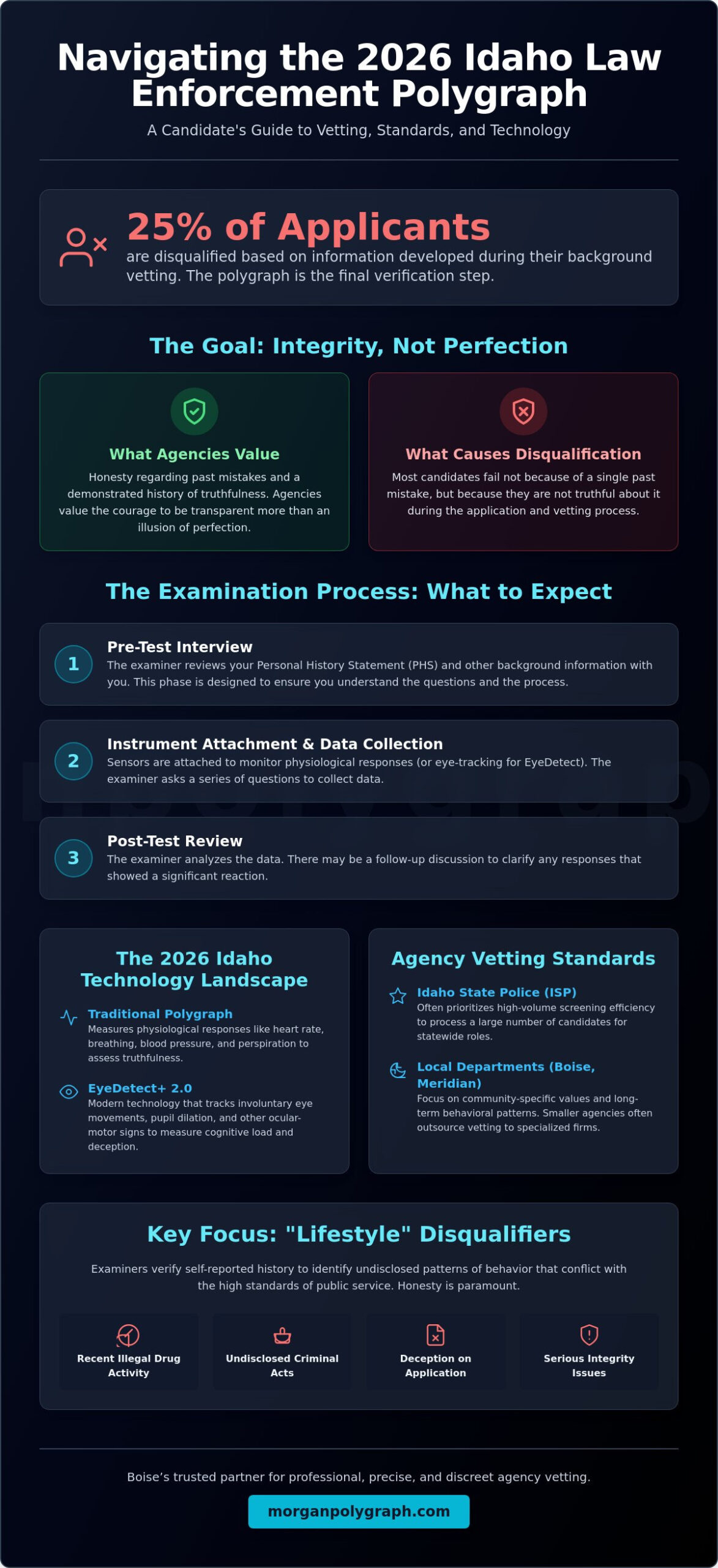
Did you know that approximately 25% of applicants are disqualified from police employment based on information developed during their background vetting? It’s natural to feel a surge of anxiety when you face the integrity portion of your application. You’ve worked hard to reach this stage, and the fear of a minor past indiscretion or a misunderstood physiological response can be overwhelming. Navigating the pre-employment polygraph for law enforcement Idaho doesn’t have to be a source of dread if you understand the science and the standards behind the process.
We’ll help you master the 2026 Idaho law enforcement polygraph process, from POST requirements to agency-specific standards. This guide provides expert insights into the multi-disciplinary forensic approach used by Boise’s leading examiners. We will preview the examination phases, explain the tiered approach involving EyeDetect+ 2.0 technology, and clarify the July 2024 Idaho State Police procedure updates. Whether you’re applying for the Boise Police Department’s June 2026 recruitment cycle or another local agency, you’ll gain the knowledge needed to approach your vetting with calm, collected confidence.
Key Takeaways
- Understand why Idaho law enforcement agencies mandate specialized forensic evaluations to maintain the highest standards of public safety and integrity.
- Navigate the 2026 standards for a pre-employment polygraph for law enforcement Idaho, from POST requirements to specific agency protocols in Boise and Meridian.
- Familiarize yourself with the examination phases, including the pre-test interview and instrument attachment, to approach the process with calm, collected confidence.
- Explore the technical distinctions between traditional physiological monitoring and modern eye-tracking technology within the current Idaho vetting landscape.
- Learn how Boise’s leading examiners provide the precision and discretion required for sensitive agency vetting and internal integrity checks.
The Role of Pre-Employment Polygraphs in Idaho Law Enforcement
Idaho’s public safety agencies carry a heavy burden of trust. To maintain the highest levels of community confidence, they utilize the pre-employment polygraph for law enforcement Idaho as a specialized forensic tool. This instrument isn’t merely a hurdle in the hiring process. It’s a data-driven verification method designed to ensure that every individual wearing a badge possesses the baseline of radical transparency required for the job. While most private employers in the state are prohibited from using such tests, Idaho Code Section 44-904 provides a specific exclusion for law enforcement agencies. This legal framework allows departments to vet both sworn officers and non-sworn personnel, such as dispatchers and evidence technicians, through rigorous integrity testing.
The examination serves as the final, critical verification of an applicant’s Personal History Statement (PHS). Background investigators spend weeks tracking down references and checking records, but the polygraph addresses the “unknown” factors that paper trails can’t reveal. By providing a comprehensive Polygraph overview, examiners help candidates understand that the process is about verifying the truthfulness of their self-reported history. It bridges the gap between what is documented and what is lived, ensuring that the agency has a complete and honest picture of the person they’re about to entrust with public authority.
Statutory Requirements and Idaho POST Standards
The Idaho Peace Officer Standards and Training (POST) Council establishes the administrative rules that govern law enforcement certification. Under these standards, “truthfulness” is a non-negotiable trait. Candidates must demonstrate a history of honesty to meet the requirements for basic certification. A professional polygraph examination supports this background investigation phase by providing a standardized method to assess that honesty. These rules ensure that every agency in the state, from the Panhandle to the Treasure Valley, adheres to a consistent level of vetting. This consistency prevents “agency hopping” by individuals who may have been disqualified elsewhere for integrity issues.
The Goal: Integrity, Not Perfection
A common misconception among applicants is that they must have a “perfect” past to pass the vetting process. In reality, Idaho agencies are looking for honesty regarding past mistakes rather than a flawless history. Examiners focus on identifying “lifestyle” disqualifiers, such as recent illegal drug activity or undisclosed criminal acts, before the agency invests thousands of dollars in expensive academy training. Most candidates who fail the pre-employment polygraph for law enforcement Idaho don’t fail because of a single past mistake; they fail because they weren’t truthful about it during the application process. The Idaho law enforcement polygraph is a forensic instrument used to validate the moral character and behavioral history required for a career in public service. Agencies value the courage it takes to be honest about one’s history more than the illusion of perfection.
Agency Standards: ISP vs. Local Idaho Departments
While the Idaho POST Council sets the minimum certification requirements, individual agencies often establish more stringent vetting protocols. The pre-employment polygraph for law enforcement Idaho is not a one-size-fits-all procedure. Standards can shift depending on whether you are applying for a state-level position, a county sheriff’s office, or a municipal police department. State agencies often prioritize high-volume screening efficiency, while local departments may focus more heavily on specific community-oriented policing values and long-term behavioral patterns. Understanding these nuances is essential for any candidate moving through the multi-stage hiring process.
Smaller agencies across the Treasure Valley often lack the budget or personnel to maintain a full-time forensic division. Departments in areas like Garden City or Star frequently outsource their vetting to independent experts. These agencies rely on the specialized skill of Boise based firms to ensure their recruits meet the same rigorous standards as larger departments. If you are an agency administrator looking to streamline your vetting process, you can partner with a local professional to handle overflow or specialized internal vetting.
The Idaho State Police (ISP) Model
The Idaho State Police utilizes a tiered approach to truth verification. Since 2016, the ISP has integrated EyeDetect technology as a primary screening tool for both commissioned and non-commissioned personnel. This automated system analyzes involuntary eye behavior to detect deception in under an hour. According to the ISP Polygraph Examination Procedures, applicants who successfully pass the EyeDetect phase move directly to the background check. However, if the results are inconclusive or if the agency requires a deeper dive into a candidate’s history, a traditional polygraph is mandated. This model aims to reduce the time required for vetting while maintaining the high standards of the American Association of Police Polygraphists (AAPP).
Municipal and County Variations
Municipal departments like the Boise Police Department have recently moved toward tougher hiring standards. In mid-2023, Boise PD reinstated the polygraph examination as a mandatory requirement for public safety positions. This change reflects a broader trend among local agencies to ensure that entry-level recruits meet the same “Internal Affairs” standards as seasoned officers. County sheriffs, such as those in Ada or Canyon County, also maintain independent criteria that often emphasize stability and moral character. Because these local exams are often scheduled on tight timelines, many candidates and agencies begin by conducting a polygraph near me search to locate examiners who are familiar with Idaho’s specific regional requirements. Local departments value the nuanced, face-to-face interaction of a traditional exam, which allows for a more detailed exploration of a candidate’s background than automated systems might provide.
The Examination Process: What Idaho Candidates Should Expect
The pre-employment polygraph for law enforcement Idaho is a highly structured, multi-phase forensic procedure. It isn’t a rapid-fire interrogation; rather, it’s a methodical sequence designed to ensure clarity and fairness for every applicant. The process typically begins with the Pre-Test Interview. During this phase, the examiner reviews your background packet and Personal History Statement in detail. This is the most critical portion of the day because it provides you the opportunity to clarify potentially confusing answers before any sensors are attached. You’ll review every question that will be asked during the exam. There are no surprise questions in a professional law enforcement screening.
Candidates can gain significant insight into these topics by reviewing the official Pre-Employment Polygraph Screening Booklet provided by state authorities. Once the questions are settled, the examiner moves to the Instrument Attachment phase. This involves placing physiological sensors on the candidate: pneumographs to monitor breathing, galvanometers to track skin conductivity, and a cardio-cuff to measure blood pressure and heart rate. During the Data Collection phase, the examiner asks the pre-reviewed questions while the instrument records your autonomic responses. Finally, the Post-Test Review allows you to explain any physiological reactions that were recorded, ensuring the final report transmitted to your background investigator is as accurate as possible.
Common Question Categories in Idaho Vetting
Idaho agencies focus on specific behavioral patterns that indicate a candidate’s suitability for public service. You’ll face questions regarding:
- Drug History: This includes the frequency and recency of illegal drug usage, as well as any involvement in the sales or manufacturing of controlled substances.
- Criminal Conduct: Examiners look for undetected crimes or felony involvement that may not appear on a standard criminal record check.
- Professional Integrity: This category covers past employment disciplinary actions and “theft of time,” such as falsifying hours or engaging in personal activities while on duty.
Physiology and the Autonomic Nervous System
The polygraph does not “read minds.” It monitors the autonomic nervous system’s involuntary responses to the stress of deception. When a person provides a deceptive answer to a significant question, their body typically undergoes subtle physiological changes that they cannot consciously control. It’s a common myth that simply “being nervous” will cause you to fail. Professional examiners are trained to distinguish between general situational anxiety and the specific physiological signatures associated with deception. When you ask, are polygraphs accurate, the answer lies in the expertise of the forensic professional and the standardized protocols they follow. By maintaining a baseline of calm, collected confidence, you allow the sensors to record an accurate reflection of your truthfulness throughout the pre-employment polygraph for law enforcement Idaho.
Polygraph vs. EyeDetect: The 2026 Idaho Landscape
The integration of automated eye-tracking technology has sparked a frequent question among candidates: is the traditional polygraph becoming obsolete? In the current Idaho vetting landscape, the answer is a definitive no. While systems like EyeDetect+ 2.0 offer impressive 89-91% accuracy rates by analyzing pupil dilation and cognitive load, they serve a different purpose than a full diagnostic exam. These technologies are often used as rapid screening tools because they take under an hour to complete. However, they lack the multi-channel physiological depth of a polygraph, which monitors respiration, sweat gland activity, and cardiovascular changes simultaneously. The pre-employment polygraph for law enforcement Idaho remains the primary method for deep-dive investigations where nuance and human interpretation are required.
Many Idaho agencies now utilize a “tiered” approach to truth verification. An applicant might first undergo an automated eye-tracking screen. If the results are inconclusive or if the candidate has a complex background that requires clarification, the agency moves to a traditional polygraph. This synergy allows departments to process high volumes of recruits quickly while maintaining the ability to conduct rigorous follow-up vetting. AI can identify a reaction, but it cannot engage in the critical post-test dialogue necessary to understand the “why” behind a physiological response. If your agency requires this level of precision for high-stakes hiring, you should schedule a professional screening with a court-recognized forensic expert.
Why the Polygraph Remains the “Gold Standard”
The polygraph is uniquely capable of utilizing “directed lie” and “comparison question” formats to isolate specific issues in a candidate’s past. This level of customization is essential for internal affairs investigations and high-security clearances where a general screen is insufficient. Automated systems are excellent at identifying broad patterns of deception, but they cannot adapt to the specific, often messy realities of a human life history. Modern technology serves as a sophisticated supplement to, not a total replacement for, expert forensic observation.
Managing Applicant Stress and Anxiety
When preparing for a pre-employment polygraph for law enforcement Idaho, your physical state is just as important as your mental preparation. At Morgan Polygraph, we provide a professional, non-interrogatory environment designed to minimize situational anxiety and ensure valid data collection. We recommend that candidates prioritize the following before their appointment:
- Rest: Ensure you get at least 7-8 hours of sleep the night before the exam.
- Hydration and Nutrition: Eat a normal meal and stay hydrated to maintain stable physiological baselines.
- Radical Honesty: The easiest way to manage stress is to have nothing to hide; the exam is a test of your integrity, not your past mistakes.
Candidates often search for ways to “beat the test” using online myths or physical maneuvers. These tactics are easily detected by modern sensors and result in an immediate “countermeasures” finding. Attempting to manipulate your physiology is a guaranteed path to permanent disqualification from Idaho law enforcement. The most effective strategy is to remain calm, follow the examiner’s instructions, and provide truthful answers.
Morgan Polygraph: Boise’s Trusted Partner for Agency Vetting
Morgan Polygraph serves as the premier forensic resource for agencies across the Treasure Valley. We specialize in the pre-employment polygraph for law enforcement Idaho, providing a level of precision that automated systems alone cannot achieve. Our firm is built on a foundation of discretion and trust, ensuring that both agencies and applicants feel they are in capable hands. We maintain a professional suite on State Street in Boise, specifically designed to offer a neutral, calm environment for high-stakes testing. This deliberate setting helps minimize the human stress involved in the process, allowing for the most accurate physiological data collection possible.
Agencies choose our firm because we prioritize the integrity of the results above all else. We adhere strictly to Idaho POST-recognized methodologies and maintain membership in leading professional associations. This commitment ensures that our findings are reliable, ethical, and defensible. Whether we are conducting a standard background screen or a complex administrative investigation, our focus remains on providing background investigators with the clear, actionable information they need to make informed hiring decisions. We understand the weight of the “integrity” portion of hiring and treat every examination with the seriousness it deserves.
Expert Credentials and Court Recognition
The credibility of a background investigation often rests on the expertise of the forensic professional involved. Our lead examiner is a highly decorated practitioner with decades of industry experience and extensive national certifications. This depth of knowledge allows us to handle specialized testing, including internal affairs and post-conviction sex offender testing (PCSOT), with total confidence. Our reports don’t just provide simple metrics; they offer detailed analysis and behavioral observation that add a layer of academic gravitas to the vetting process. By maintaining these high standards, we play a vital role in protecting the reputation and effectiveness of Idaho’s law enforcement community.
Scheduling and Agency Support
We understand that law enforcement agencies often operate under strict recruitment deadlines. Morgan Polygraph is committed to streamlining the hiring timeline by offering prompt scheduling and rapid report turnaround. Our methodical and organized approach ensures that your agency’s vetting process remains on track without sacrificing the quality of the investigation. When an applicant enters our office for their pre-employment polygraph for law enforcement Idaho, they are met with a persona of seasoned expertise and respect. This approach softens the clinical nature of the service and reassures candidates that their sensitive information will be handled with the utmost confidentiality.
Contact Morgan Polygraph today to schedule your law enforcement screening.
Advancing Your Law Enforcement Career with Integrity
Mastering the background vetting process requires a clear understanding of the 2026 Idaho POST standards and the specific protocols of your hiring agency. Whether you’re navigating the tiered technology approach of the Idaho State Police or the rigorous standards of the Boise Police Department, transparency remains your greatest asset. The integration of modern eye-tracking technology and traditional physiological monitoring ensures that Idaho’s public safety remains in the hands of those with verified moral character. Expert human interpretation is the final bridge between raw data and the complex realities of your personal history.
Preparing for a pre-employment polygraph for law enforcement Idaho is a significant milestone in your professional journey. At Morgan Polygraph, we provide the methodical precision and professional environment necessary for valid forensic results. Our firm is led by nationally certified examiners utilizing state-of-the-art forensic technology, and we’re trusted by Idaho legal and law enforcement professionals to maintain the highest ethical standards. We are here to guide you through this sensitive phase with calm, collected confidence.
Secure Your Professional Vetting-Book a Certified Polygraph in Boise
We’re here to help you move forward with your career goals. Your commitment to honesty today builds the foundation for the community’s trust tomorrow.
Frequently Asked Questions
Is a polygraph test required for all police jobs in Idaho?
Most sworn and many non-sworn positions within Idaho law enforcement require a truthfulness assessment. While Idaho Code Title 44 prohibits most private employers from requiring these tests, Section 44-904 provides a specific exclusion for law enforcement agencies. This allows departments to verify the moral character of applicants through forensic vetting before they’re entrusted with public authority.
What happens if I fail my pre-employment polygraph?
A finding of deception usually results in disqualification from the current hiring process. Nationally, about 25% of applicants are disqualified based on information developed during the pre-employment polygraph for law enforcement Idaho. This is often because the test reveals inconsistencies with the candidate’s Personal History Statement that weren’t previously disclosed to the background investigator.
Can I take a polygraph test if I am naturally an anxious person?
You can certainly take the exam even if you experience situational anxiety. Professional examiners are trained to establish a physiological baseline that accounts for your natural stress levels. The process focuses on specific physiological shifts that occur during deception, which are distinct from general nervousness or the “stress of the test.”
How long does a law enforcement pre-employment polygraph take?
A traditional polygraph examination typically requires approximately three hours to complete. This timeframe includes the detailed pre-test interview, the attachment of physiological sensors, and the actual data collection phases. This is more comprehensive than automated eye-tracking methods, which usually take between 15 and 30 minutes at agencies that use them for initial screening.
Does Idaho use EyeDetect instead of polygraph tests?
Idaho utilizes a tiered approach that incorporates both technologies. The Idaho State Police has used EyeDetect since 2016 to streamline the initial screening of commissioned and non-commissioned personnel. If a candidate passes this phase, they may move forward without a traditional pre-employment polygraph for law enforcement Idaho, though the polygraph remains the primary tool for complex follow-up vetting.
What are the most common disqualifiers found during an Idaho police polygraph?
The most frequent disqualifiers involve undisclosed drug history, undetected criminal activity, and past professional disciplinary actions. Most candidates who face disqualification don’t fail because of their past actions themselves, but because they weren’t entirely truthful about those actions during the application or the pre-test interview. Honesty is valued more than a perfect history.
How should I prepare for my law enforcement polygraph exam?
The best preparation is to arrive well-rested and hydrated. You should get at least 7-8 hours of sleep and eat a normal meal before your appointment to ensure stable physiological readings. Most importantly, commit to radical honesty. Attempting to use physical maneuvers or tricks found online is easily detected by modern sensors and will lead to immediate disqualification.
Are the results of my pre-employment polygraph confidential?
Yes, your examination results are handled with the highest level of discretion. The examiner provides a professional report only to the background investigator or the hiring board of the specific agency you applied to. These records are stored securely and aren’t shared with outside parties without proper legal authorization or your specific consent.