
When you need definitive answers to sensitive questions, the search for a credible polygraph service can feel overwhelming. The critical question, “where can I take a polygraph test?” often leads to more uncertainty: How can you verify an examiner’s credentials? Who can you trust to handle your situation with the professionalism and confidentiality it deserves? Navigating this landscape requires a methodical approach to ensure you are placing your trust in a court-recognized expert, not an uncertified operator. This is a decision that carries significant weight, whether for a personal matter, a legal proceeding, or a professional inquiry.
This guide is designed to eliminate that uncertainty and empower you to move forward with confidence. We will provide you with the essential criteria for selecting a qualified, certified examiner, explain how to vet their professional background, and outline the steps to finding a respected local service. By the end of this article, you will have a clear, actionable path to securing a professional, compassionate, and accurate truth verification test, helping you achieve the clarity you seek.
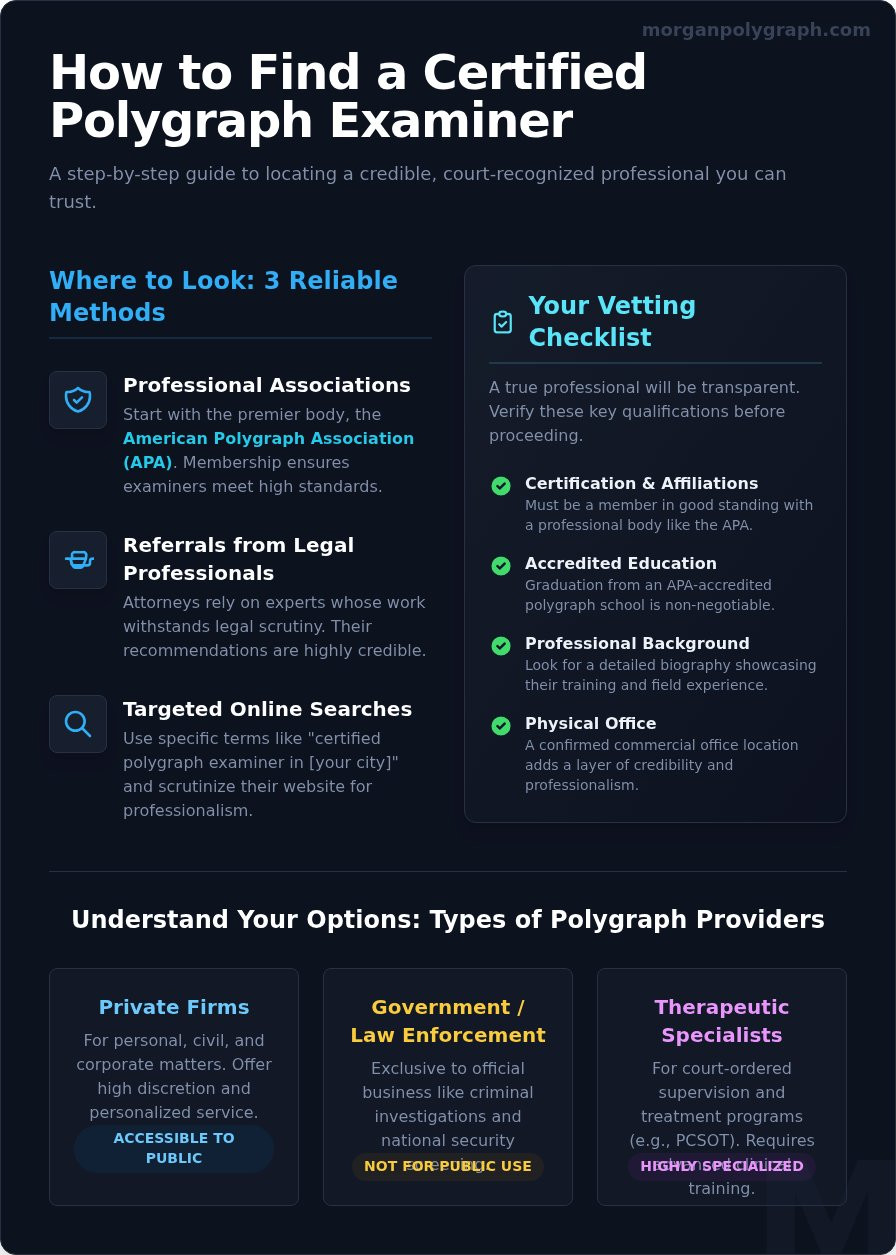
Understanding Your Options: Types of Polygraph Providers
When you ask, “where can I take a polygraph test?”, the answer depends entirely on your specific circumstances. Polygraph examiners are highly trained professionals who often specialize in distinct areas-from private family matters to federal criminal investigations. Not all polygraph services are the same, and choosing a provider with relevant experience is the most critical step toward ensuring the process is handled with the appropriate care, confidentiality, and professional accuracy.
The right examiner for a corporate theft investigation is likely not the same one who specializes in therapeutic monitoring. Understanding these distinctions will help you find a certified professional best suited to your needs. Below, we outline the primary settings where polygraph tests are conducted.
Private Polygraph Firms
Private polygraph firms are independent, expert-led businesses that serve the general public, attorneys, and corporations. These are the most common and accessible providers for sensitive personal and civil matters. Their services are ideal for a wide range of situations, including:
- Relationship, infidelity, and family disputes
- False accusations or allegations of theft
- Verifying statements for private legal matters
- Pre-employment screening for certain private sector jobs
These firms offer the highest level of discretion and personalized service, understanding the emotional stress often involved. Many are founded and operated by highly respected former law enforcement or federal examiners, bringing decades of field-tested expertise to the private sector.
Government & Law Enforcement Examiners
These certified examiners work exclusively for local, state, and federal government agencies. Their focus is strictly on official business, such as criminal investigations, counterintelligence cases, and pre-employment screening for sensitive positions in law enforcement and national security. These services are governed by strict, government-mandated protocols like the Employee Polygraph Protection Act (EPPA) and are not available to the public for personal or civil matters. Their mission is to support the justice system and protect national interests within a rigid, structured framework.
Therapeutic & Post-Conviction Testing Specialists
This is a highly specialized field of polygraphy dedicated to clinical and therapeutic applications. These examiners work in close collaboration with therapists, probation officers, and parole agents as part of court-ordered supervision and treatment programs. Their primary function is to monitor treatment compliance and verify the conduct of individuals on probation or parole, most notably in Post-Conviction Sex Offender Testing (PCSOT) programs. This work requires advanced training in clinical and forensic techniques, as it goes beyond the fundamentals of what a polygraph test measures and demands a deep understanding of rehabilitation protocols to support treatment goals and community safety.
How to Find a Reputable Polygraph Examiner Near You
When you are asking, “where can I take a polygraph test?”, the most critical factor is not just finding a location but securing a certified, ethical, and experienced examiner. The accuracy and validity of the examination depend entirely on the professional conducting it. While a quick internet search may yield dozens of results, true diligence is required to distinguish a qualified expert from an uncertified practitioner. The following methods provide a structured approach to locating a credible service you can trust.
Professional Polygraph Associations
Your search should begin with national and state-level professional organizations. The premier body in the field is the American Polygraph Association (APA). These associations maintain publicly accessible directories of their members who are in good standing. Membership is a strong indicator of quality, as it requires examiners to have graduated from an accredited school, adhere to a stringent code of ethics, and complete regular continuing education to stay current with best practices and technology.
Referrals from Legal Professionals
One of the most reliable methods for finding a court-recognized examiner is through a referral from a legal professional. Criminal defense attorneys, in particular, frequently rely on polygraph experts whose work is credible and can withstand intense scrutiny in a legal setting. These professionals are deeply familiar with the legal standards governing lie detector tests, including regulations like the federal Employee Polygraph Protection Act, and will only recommend examiners who operate with the highest degree of legal and ethical integrity.
Targeted Online Searches
If you choose to search online, use specific, targeted search terms to narrow your results. Instead of a generic query, try “certified polygraph examiner in [your city]” or “APA member polygraph services near me.” Once you find a potential examiner, scrutinize their website for key indicators of professionalism:
- Detailed Credentials: Look for specific certifications, graduation from an APA-accredited school, and professional affiliations.
- Examiner Biography: A reputable professional will provide information about their background, training, and experience.
- Physical Office Address: A confirmed commercial office location lends more credibility than a P.O. box or non-specific service area.
- Professional Website: The website should be professional and informative, not just a simple landing page or directory listing.
This method requires more personal vetting, but it can be highly effective for finding where you can take a polygraph test with a qualified local expert.
Key Criteria for Choosing a Polygraph Service
Once you have a list of potential examiners, the next critical step is to vet them carefully. The answer to “where can I take a polygraph test” should always lead you to a competent, ethical, and certified professional. Do not compromise on these core qualifications, as the accuracy and validity of your results depend entirely on the examiner’s expertise. A true professional will be transparent about their credentials and welcome your questions.
Certification and Licensing
The foundation of any credible polygraph examiner is their education and professional standing. Before committing to a service, verify the following non-negotiable credentials:
- Accredited Education: The examiner must provide proof of graduation from a polygraph school accredited by the American Polygraph Association (APA). This is the gold standard for comprehensive and ethical training.
- State Licensing: Many states require examiners to be licensed to practice. Verify if your state has this requirement and ask for the examiner’s current license number.
- Professional Memberships: Active membership in professional organizations like the APA or the American Association of Police Polygraphists (AAPP) demonstrates a commitment to ongoing education and adherence to strict ethical codes.
Relevant Experience and Specialization
Not all polygraph examinations are the same. An examiner with extensive experience in pre-employment screening may not be the best choice for a sensitive infidelity or family matter. When you inquire, ask about their background and ensure their expertise aligns with your specific needs. An examiner specializing in criminal defense cases will have a different skill set than one who primarily handles corporate theft investigations. Ask directly about their years of practice and experience with cases similar to yours.
Technology and Methodology
Modern polygraphy relies on advanced, validated techniques. Confirm that the examiner uses modern, computerized polygraph equipment, as outdated analog instruments are less precise. Furthermore, they should be able to name the validated testing techniques they employ and explain the process to you in clear, understandable terms. An unwillingness to discuss methodology is a significant red flag.
Confidentiality and Professionalism
When you are seeking the answer to a difficult question, the environment matters. The entire process, from the initial phone call to the final report, must be handled with strict confidentiality. Look for an examiner who operates from a professional office setting, not a temporary or home-based location. The examiner should conduct themselves with impartiality and respect, creating a calm and controlled atmosphere. A compassionate and professional demeanor is essential for a valid examination. Our examiners meet the highest professional standards. Learn more.
The Process: What to Expect When Scheduling Your Test
Understanding the polygraph process is a crucial step that can significantly reduce anxiety and help you prepare for the examination day. A professional, certified examiner will always follow a clear, structured, and transparent procedure. This methodical approach ensures fairness, accuracy, and confidentiality. If a service seems vague or unwilling to explain its process, you should consider it a major red flag in your search for where can I take a polygraph test. This section outlines the typical steps you can expect from a reputable service.
The Initial Consultation
Nearly every professional engagement begins with a confidential phone consultation. This is not a sales call; it is an essential first step for both you and the examiner. It provides you with a discreet opportunity to explain your situation, understand the capabilities and limitations of a polygraph, and ask any questions you may have. During this call, the examiner will assess the details you provide to determine if the core issue is suitable for a polygraph examination, ensuring the test is appropriate for your specific circumstances.
Providing Information and Formulating Questions
Once you decide to proceed, you will need to provide detailed background information relevant to the case. This is a collaborative and critical phase where the examiner works directly with you to formulate the precise, non-leading questions that will be used during the test. An expert examiner’s skill in question construction is paramount to the accuracy of the results. This careful process ensures the exam directly addresses the issue at hand, leaving no room for ambiguity.
Scheduling the Exam and Pre-Test Instructions
After the questions are finalized, you will schedule a date, time, and location for the in-person examination. A professional service like Morgan Polygraph will then provide you with a clear set of pre-test instructions designed to ensure you are in an optimal state for an accurate reading. These instructions typically include:
- Getting a full night of restful sleep before the exam.
- Avoiding alcohol and non-prescribed drugs for at least 24 hours prior.
- Arriving on time and not being rushed on the day of the test.
Importantly, a certified examiner will never provide information on how to “beat” the test. Their professional and ethical duty is to seek the truth through a standardized and validated process, and any suggestion otherwise undermines the integrity of the examination.
A Warning: The Truth About Online Lie Detector Tests and Apps
In today’s digital age, a quick search often reveals dozens of websites and mobile apps claiming to offer “lie detector” services. These tools, which may use a phone’s microphone for voice stress analysis or a camera to track eye movement, are marketed as a fun way to settle a friendly dispute. It is critical, however, to understand that these applications are designed for entertainment purposes only and have no scientific validity.
Relying on these apps for any serious matter can lead to devastating consequences. A false result can shatter trust within a family, lead to wrongful accusations in a personal relationship, or create irreparable damage in a business setting. They are not, and can never be, a substitute for a professional polygraph examination conducted by a certified expert.
Why Online Tests Are Not Reliable
These digital novelties lack the fundamental components required for credible truth verification. A professional polygraph is a sophisticated scientific instrument, not a simple piece of software. The reasons for their unreliability are clear:
- Lack of Scientific Instrumentation: Real polygraph exams use medical-grade sensors to accurately and simultaneously record multiple involuntary physiological responses, including heart rate, blood pressure, respiration, and electrodermal activity. A smartphone cannot replicate this process.
- Absence of a Controlled Process: A valid test is a multi-stage procedure involving a structured pre-test interview, careful and neutral question formulation, the examination itself, and a post-test review. An app offers none of this crucial structure.
- No Certified Examiner: The expertise of a certified examiner is the most critical component. This professional is trained to interpret complex data, observe subtle behavioral cues, and ensure the entire process is conducted ethically and accurately.
The Importance of a Professional, In–Person Examination
The search for where can I take a polygraph test for a serious legal, personal, or business issue should lead you exclusively to a certified examiner in a professional setting. A valid examination is a complex human and scientific process that cannot be automated. The in-person approach is non-negotiable for achieving accurate results, as the examiner must create a controlled, distraction-free environment and personally calibrate the sensitive equipment to your unique physiological baseline. This expert oversight is essential for distinguishing deceptive responses from anxiety, ensuring the final report is as reliable as possible.
For matters involving legal disputes, family trust, or pre-employment screening, the stakes are far too high to place your faith in an unscientific app. True accuracy, confidentiality, and professional respect can only be achieved through a properly administered polygraph test. For truth verification you can trust, schedule a professional exam with a court-recognized expert who understands the gravity of your situation.
Find Clarity with a Certified Polygraph Examiner
Navigating the world of truth verification requires careful consideration. The key to a reliable result lies not in the technology alone, but in the expertise and credentials of the examiner. Choosing a certified professional over unregulated online tests and understanding the formal testing process are the most critical steps you can take. When the question is where can I take a polygraph test, the answer should always point toward a trusted expert who can provide a confidential and professional experience.
For those in Boise, Idaho, and the surrounding region, Morgan Polygraph provides this essential expertise. Our team is comprised of Nationally Certified Examiners who are also Court-Recognized Experts in their field. We are committed to a professional and compassionate process, ensuring your sensitive matter is handled with the utmost discretion and respect.
If you are ready to find answers, we invite you to Schedule a Confidential Consultation with Our Certified Examiners.
Taking this step can be daunting, but with the right guidance, you can move forward with the confidence and clarity you deserve.
Frequently Asked Questions About Polygraph Testing
Can anyone request a private polygraph test?
Yes, any adult can request a confidential polygraph test for a wide range of private matters. Common reasons include resolving family disputes, addressing accusations of infidelity, verifying statements for civil litigation, or clearing one’s name in a personal conflict. Professional examiners conduct these tests with the same level of integrity and precision used in official contexts, ensuring a discreet and respectful process for every client. The key is having a specific issue that can be addressed with clear questions.
How can I verify if a polygraph examiner is actually certified?
To verify an examiner’s certification, ask them directly for their credentials, including a diploma from a polygraph school accredited by the American Polygraph Association (APA). You can then cross-reference their membership status on the websites of major professional organizations, such as the APA or the National Polygraph Association (NPA). A reputable, certified expert will readily provide this information, as it substantiates their qualifications and adherence to the highest professional standards of practice.
Are professional polygraph services available in every state?
Yes, professional polygraph services are available in all 50 states, but state regulations can vary. Some states have specific licensing boards and requirements that examiners must meet to practice legally. If you are searching for ‘where can I take a polygraph test,’ the most reliable method is to consult the online directories of national organizations like the American Polygraph Association. These resources list qualified members by state, ensuring you find a certified professional operating in your area.
What is the difference between a private examiner and one used by the police?
The primary difference lies in their employer and typical client. A police examiner is a law enforcement officer who conducts tests as part of official criminal investigations. A private examiner is a civilian expert who provides confidential services to the general public, attorneys, and businesses for civil, clinical, or personal matters. While both use standardized, evidence-based techniques, their case types and the context of the examination are fundamentally different and serve distinct purposes.
Is it better to find a polygraph examiner through a lawyer?
Engaging an examiner through a lawyer is highly advantageous for legal matters, as the process and results may be protected by attorney-client privilege. Attorneys often have established relationships with court-recognized experts. However, for personal issues not involving litigation, you can confidently contract directly with a certified private examiner. The most critical factor is ensuring the examiner you choose is properly credentialed, experienced, and respected in the polygraph community.
How long does a typical polygraph examination take?
A complete, professional polygraph examination is a thorough process that typically lasts between 90 minutes and three hours. This duration includes three essential phases: a detailed pre-test interview to review the issue and formulate questions, the in-test phase where physiological data is collected using the polygraph instrument, and a post-test phase to discuss the results. This comprehensive approach ensures that all professional standards are met for maximum accuracy and a valid outcome.