
From high-stakes courtroom dramas to sensational talk shows, the polygraph is a fixture in popular culture. But when you are faced with a real-life situation that demands truth verification, the conflicting narratives can be overwhelming. Is it a scientifically sound tool or an unreliable instrument of intimidation? The fear of a false positive derailing your life, or the concern that a deceptive person could pass, are valid and serious. These questions all lead to one critical point of inquiry: how accurate are lie detector tests?
In a field often clouded by misinformation, getting a straight, factual answer is essential for your peace of mind. As certified and court-recognized polygraph experts, we are here to provide that clarity. This article moves beyond the myths to deliver an evidence-based review of polygraph validity. We will break down the accepted accuracy rates from credible studies, explain the science behind the examination, and detail the critical factors-from the examiner’s skill to the testing format-that significantly influence the results. You will leave with a confident, professional understanding of the entire process.
Understanding Polygraph Accuracy: The Numbers and the Science
When clients ask, “how accurate are lie detector tests?” they are seeking a simple number, but the answer is rooted in extensive scientific research and professional standards. There is no single, universal accuracy percentage because the outcome depends heavily on the examiner’s expertise, the testing format, and the specific issue being investigated. However, decades of data provide a clear and reliable picture of the polygraph’s effectiveness as a truth verification tool. It’s also important to differentiate between accuracy (the degree of correctness), reliability (the consistency of results), and validity (whether the test measures what it claims to measure).
The modern polygraph is the result of over a century of development in psychophysiology. This technology is designed to record the body’s involuntary “fight or flight” responses when a person is confronted with questions that pose a significant threat. For a comprehensive overview of polygraphs, including their history and validated techniques, it is clear that this is a highly specialized field, not a simple machine that flashes “truth” or “lie.”
What the Research Says: Citing Key Studies
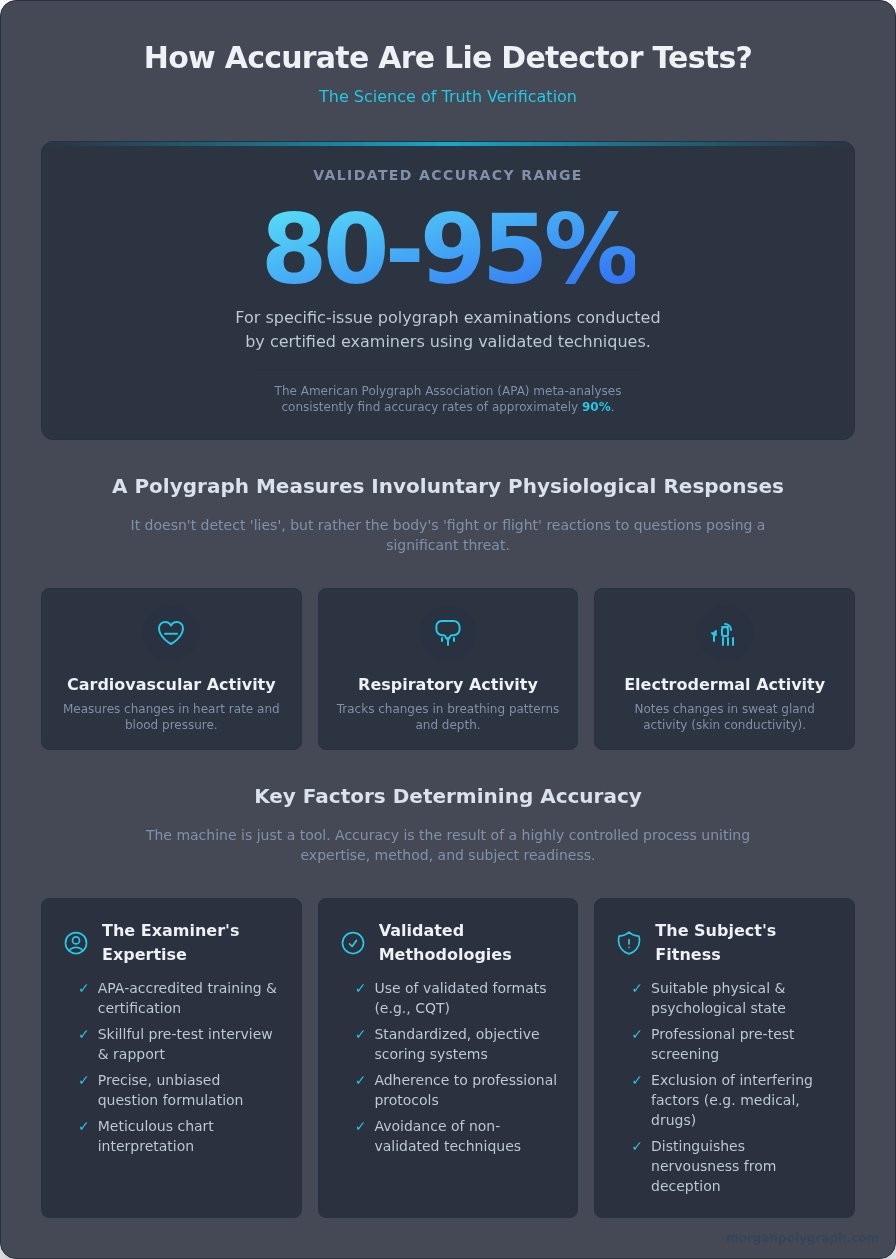
The most credible figures on polygraph accuracy come from professional organizations that aggregate decades of research. The American Polygraph Association (APA) has conducted numerous meta-analyses of validated testing techniques, consistently finding accuracy rates to be approximately 90%. Research often distinguishes between laboratory studies, which can have lower validity, and real-world field studies, which often show higher accuracy rates because the stakes and emotional responses are genuine. The consensus in the scientific community places the accuracy of specific-issue polygraph examinations between 80% and 95% when conducted by a certified and experienced examiner following established protocols.
How Polygraphs Measure Deception
A professional polygraph examination does not detect lies; it measures and records significant physiological changes in the body. These reactions are controlled by the autonomic nervous system, which operates outside of our conscious control. A certified examiner uses a suite of sensitive instruments to track these changes, including:
- Cardiovascular Activity: A blood pressure cuff measures changes in heart rate and blood pressure.
- Respiratory Activity: Pneumograph tubes placed around the chest and abdomen track breathing patterns and depth.
- Electrodermal Activity: Sensors on the fingertips measure changes in skin conductivity, or sweat gland activity.
When a person is deceptive about a serious issue, the fear of getting caught often triggers these involuntary responses. The raw data from the polygraph instrument is then carefully analyzed by the examiner, whose expert interpretation is the final and most critical component in determining the truth.
Key Factors That Determine Lie Detector Test Accuracy
The accuracy of a polygraph test is not determined by the machine alone. Instead, it is the result of a highly controlled process where several critical factors converge. Understanding these elements is essential to answering the question of how accurate are lie detector tests. From the examiner’s expertise to the subject’s physical state, each component plays a vital role in producing a reliable outcome. A properly conducted exam is a careful synthesis of human skill, validated science, and procedural integrity.
The Examiner’s Crucial Role in Accuracy
A polygraph instrument is merely a data collection tool; the examiner is the expert who turns that data into a meaningful result. A certified, professional examiner with training from an accredited institution like the American Polygraph Association (APA) is fundamental to accuracy. Their expertise is evident in several key areas:
- The Pre-Test Interview: Skillfully building rapport and establishing a psychological baseline.
- Question Formulation: Crafting clear, precise, and unbiased questions tailored to the specific issue.
- Chart Interpretation: Meticulously analyzing the physiological data recorded on the charts.
- Objectivity: Maintaining complete neutrality to ensure the process is fair and the conclusion is based solely on the recorded responses.
Validated Testing Formats and Methodologies
The structure of the examination itself is a cornerstone of its reliability. The most widely used and validated technique is the Control Question Test (CQT), which compares physiological responses to relevant questions with responses to control questions. While other formats like the Relevant/Irrelevant Test (RIT) exist, professional standards demand the use of scientifically validated, non-proprietary techniques. The debate around the scientific validity of polygraph tests often centers on the methodology used. Employing standardized scoring systems further removes subjectivity, allowing for a more objective and replicable analysis of the results.
The Subject’s Fitness for Examination
The person being tested must be in a suitable physical and psychological state for the exam to be valid. Extreme emotional distress, certain medical conditions, medications, or even severe lack of sleep can produce physiological responses that interfere with the test. A key part of a professional polygraph examination is the pre-test screening, where the examiner assesses the subject’s fitness. They are trained to differentiate the natural nervousness anyone would feel from the distinct reactions associated with deception, ensuring that anxiety alone does not lead to an inaccurate result.
The Great Debate: Polygraph Validity, Criticisms, and Limitations
While polygraph examinations are a trusted truth verification tool for law enforcement, government agencies, and private matters, they are not without critics in the scientific and academic communities. The core of the debate over how accurate are lie detector tests centers on whether the physiological responses measured-such as heart rate, respiration, and electrodermal activity-are unique and reliable indicators of deception. Some scientific bodies, as detailed in the comprehensive National Academies of Sciences report on polygraph validity, argue that no specific physiological pattern is exclusive to lying, leading to potential errors.
However, it is crucial to understand that a modern polygraph test is not just about the instrument. It is a highly structured process that includes a detailed pre-test interview, careful question formulation, and post-test analysis conducted by a certified expert. This professional methodology is designed to isolate relevant responses and significantly increase the examination’s reliability.
The Problem of False Positives and False Negatives
In any diagnostic test, the potential for error exists. In polygraphy, these errors are categorized as:
- False Positive: A truthful person is incorrectly identified as deceptive. This can occur due to extreme anxiety or other emotional responses unrelated to deception.
- False Negative: A deceptive person is incorrectly identified as truthful. This is a less common error but can happen if an individual has an unusual lack of physiological response.
Certified examiners mitigate these risks by using validated scoring algorithms and adhering to strict procedural standards established by organizations like the American Polygraph Association. The goal is always to protect the innocent while correctly identifying deception.
Can You ‘Beat’ a Polygraph Test?
Myths about “beating” a polygraph are widespread, from placing a tack in your shoe to biting your tongue. These are known as countermeasures-deliberate actions to alter physiological responses. However, a trained and experienced examiner can often detect such attempts. Unnatural spikes in data that do not correlate with specific questions are significant red flags. Attempting to manipulate the test can result in an “inconclusive” finding or be reported as a deliberate effort to deceive, which is often as damaging as a “deception indicated” result. For a truthful individual, the best strategy is always honesty and full cooperation.
Polygraphs and Their Status in the Legal System
The admissibility of polygraph results in court is complex and varies by jurisdiction. Under the Daubert standard, which governs how courts handle scientific evidence, polygraph results are often challenged and typically not admitted as standalone evidence. However, they play a vital and accepted role in the investigative process, helping law enforcement narrow down suspects and verify statements. In some civil and criminal cases, results may be admitted if all parties agree to the examination and its admissibility beforehand (a process known as stipulation). Need a court-recognized expert for a legal matter? Contact us for a confidential consultation.
Maximizing Accuracy: The Professional Polygraph Standard
The conversation about how accurate are lie detector tests fundamentally shifts when professional standards are rigorously applied. A polygraph examination is not merely a machine reading; it is a complex, methodical process where the examiner’s expertise, the quality of the technology, and strict ethical protocols are paramount. Professional firms do not leave accuracy to chance-they build it into every step of their procedure through established best practices that separate a valid test from an unreliable one.
The Importance of APA-Accredited Examiners
The American Polygraph Association (APA) provides the global gold standard for examiner training, ethics, and practice. Examiners who achieve and maintain APA accreditation must complete extensive continuing education, ensuring they are proficient in the latest validated techniques. Choosing a certified professional who utilizes non-proprietary, scientifically accepted methods is the foundational step toward securing a reliable and fair examination result.
State-of-the-Art Technology and Procedures
Modern, computerized polygraph systems offer significant advantages over older analog models by providing more precise data collection and sophisticated analysis tools. These instruments are often equipped with advanced activity sensors designed to detect subtle physical countermeasures an examinee might attempt. This cutting-edge technology, combined with a controlled, distraction-free testing environment and validated digital scoring algorithms, provides the examiner with the highest quality data for an expert interpretation.
Beyond the individual examiner and their equipment, top-tier firms implement strict quality control measures to ensure objectivity and validity. This includes a mandatory peer-review process where examination charts, data, and reports are independently reviewed by another certified examiner to confirm the conclusion. These ethical and procedural safeguards are non-negotiable for any professional practice. The highest degree of accuracy is achieved when the following standards are met:
- The examination is administered by an experienced, APA-accredited examiner.
- Modern, calibrated, and computerized polygraph instrumentation is used.
- Validated testing formats and proper question construction techniques are followed.
- A mandatory quality control review of all examination results is conducted.
Ultimately, understanding how accurate are lie detector tests is inseparable from understanding the professional standards behind them. To ensure a confidential, compassionate, and respectful process that adheres to the industry’s highest benchmarks, it is essential to partner with a court-recognized expert. You can learn more about our certified and ethical practices at morganpolygraph.com.
The Final Verdict: Maximizing Polygraph Accuracy
As we’ve explored, the debate around polygraph validity is complex. While no test is infallible, modern examinations conducted under strict protocols can achieve a high degree of accuracy. The answer to how accurate are lie detector tests ultimately hinges less on the machine itself and more on the integrity of the entire process. The examiner’s expertise, the specific testing format, and the use of validated techniques are the critical factors that separate a reliable assessment from an uncertain one.
When you need clear, dependable answers, the standard of the examination is paramount. At Morgan Polygraph, our nationally certified and court-recognized examiners leverage over 40 years of combined professional experience and state-of-the-art polygraph technology to ensure the highest level of precision. We provide a professional, compassionate, and discreet environment for every client seeking truth verification.
Don’t leave such a critical matter to chance. If you require professional polygraph services you can trust, we are here to provide the clarity you seek. Schedule a confidential consultation with a certified examiner today and take the first step toward finding resolution.
Frequently Asked Questions
What does an ‘inconclusive’ polygraph result mean for accuracy?
An inconclusive result is not a failure or an indication of deception. It signifies that the physiological data recorded was not sufficiently clear for the examiner to render a definitive opinion. This can occur due to factors like intentional non-cooperation, certain medical issues, or attempts to manipulate the test. A professional examiner may recommend a re-examination under more controlled conditions to ensure a conclusive and accurate outcome for the truth verification process is achieved.
Do nerves make you fail a lie detector test?
It is a common concern, but general nervousness does not cause a truthful person to fail a polygraph. Certified examiners are trained to expect and account for anxiety. The pre-test interview helps establish an individual’s unique baseline physiological responses. The test measures significant deviations from this baseline in response to specific questions, not the overall level of nervousness. A professional process differentiates between natural anxiety and the distinct reactions associated with deception.
Are polygraphs more accurate for certain types of questions or situations?
Yes, polygraph examinations are most accurate when used for specific-incident, single-issue testing. For example, questions about a distinct event (e.g., “Did you take the missing file from the office?”) yield more reliable results than broad or vague questions about character or lifestyle (“Have you ever told a lie?”). This focused approach is a critical component of modern polygraph technique and is essential for achieving the highest levels of accuracy and reliability.
Can a medical condition or medication affect my polygraph results?
Absolutely. Certain medical conditions, particularly those affecting the cardiovascular or respiratory systems, and some medications can impact physiological responses. It is crucial to disclose all such conditions and current prescriptions to your examiner confidentially before the test. A qualified examiner will assess this information to determine if a valid test can be conducted and will make procedural adjustments as needed to ensure the integrity and accuracy of the examination results.
How accurate are the newer ‘AI lie detectors’ or voice analysis tests compared to polygraphs?
While innovative, emerging technologies like AI-driven voice analysis and microexpression recognition are not yet as scientifically validated as the polygraph. Their accuracy is still the subject of ongoing research, and they are not widely accepted as a standalone method for truth verification in professional settings. The polygraph, when administered by a certified expert following established protocols, remains the industry standard with a far more extensive history of research and validated field use.
Why is there such a wide range of accuracy statistics reported for polygraphs?
The debate over how accurate are lie detector tests often highlights a range of statistics because accuracy is influenced by several key variables. These include the examiner’s training and expertise, the specific testing format used, the complexity of the case, and whether the study was conducted in a controlled lab or in a real-world setting. The skill of the examiner and adherence to validated techniques are the most critical factors in producing consistently reliable and defensible results.