

The polygraph examiner delivers the result: ‘Deception Indicated.’ In that single moment, the floor drops out from beneath you, and a storm of questions, anger, and heartbreak takes over. It’s a devastating conclusion to an already painful process, leaving you to grapple with a partner’s continued denial, your own doubts about ‘false positives,’ and the overwhelming weight of what comes next.
Knowing exactly what to do after a failed infidelity test is critical, and you don’t have to navigate this alone. This professional guide is designed to provide you with clarity in the chaos. We will give you the expert framework needed to interpret the results accurately, manage difficult conversations, and find a definitive path forward, whether that means rebuilding trust or preparing to move on. We’ll break down what a ‘fail’ truly means, offer proven strategies for addressing denial, and help you build a foundation for making the right decision for your future.
Key Takeaways
- Learn what a “Deception Indicated” result professionally means and why it measures physiological arousal, not a simple guilty verdict.
- Discover the most common reasons for a failed test, including attempts to hide partial truths or unsuccessfully “beat” the system.
- Get a clear roadmap for what to do after a failed infidelity test, beginning with a critical cooling-off period to avoid rash decisions.
- Find effective strategies for navigating denial and understand the psychological patterns that often lead to a confession after the exam.
Understanding the Results: What a ‘Failed’ Infidelity Polygraph Actually Means
Receiving the news of a ‘failed’ infidelity test can feel like a physical blow. Your heart likely started pounding, your mind went blank, and a powerful ‘fight or flight’ response took over. This is a completely normal reaction to profoundly stressful information. Before you can determine what to do after a failed infidelity test, it’s critical to understand what the result truly signifies from a professional, technical standpoint. The term you heard isn’t “fail,” but rather “Deception Indicated” (DI), a clinical finding based on objective data, not a personal judgment.
A common misconception is that a polygraph is a “lie detector.” It isn’t. The instrument measures and records involuntary physiological responses to a structured series of questions. To understand the full scope of what a polygraph machine measures, it’s key to know it tracks changes in your heart rate, blood pressure, respiration, and electrodermal activity (sweat). The core principle is that the fear of detection when answering a question deceptively causes a distinct physiological arousal. A DI result is not an examiner’s opinion; it’s a data-driven conclusion reached when a proprietary scoring algorithm identifies a repeatable and significant reaction to the relevant questions about infidelity.
Deception vs. Nervousness: The Examiner’s Perspective
Nearly every person taking a polygraph feels nervous, and a certified examiner fully expects this. General anxiety or a fear of the test itself does not cause a Deception Indicated result. During the extensive pre-test interview, the examiner works with you to establish your unique physiological baseline by asking a series of neutral and control questions. DI results are based on significant deviations from that specific baseline during the relevant questions about the incident being investigated.
The Difference Between a ‘Fail’ and an ‘Inconclusive’ Result
It’s crucial to distinguish between a “Deception Indicated” result and one that is “Inconclusive.” An inconclusive finding means the data collected was not sufficient to render a definitive conclusion of either DI or NDI (No Deception Indicated). This can happen for several reasons:
- An examinee’s physical illness or medical condition.
- Purposeful non-cooperation or attempts at countermeasures.
- An extreme, unmanageable emotional state that prevents establishing a stable baseline.
An inconclusive result is not a failure. It is a null result, indicating that the test could not be scored and more information is required. At Morgan Polygraph, we are at the forefront of technological advancements to minimize such outcomes. Industry analysis projects that by 2026, the integration of AI-powered tools for behavioral speech analysis and facial microexpression recognition will help reduce inconclusive rates by more than 15%, providing clients with clearer, more definitive results.
Understanding that a DI result is a specific, data-backed finding is the first step. It moves the conversation away from pure emotion and toward a more structured evaluation of the facts. Now that you know what the result means, we can explore what comes next.
The Anatomy of a Failure: Common Reasons for ‘Deception Indicated’ Results
Receiving a ‘Deception Indicated’ result can feel like a final verdict, but the reality is far more nuanced. The polygraph doesn’t simply flash ‘Liar!’ in red letters; it records complex physiological responses to precisely worded questions. Understanding the anatomy of that failure is the first critical step in determining what to do after a failed infidelity test. The process begins long before any sensors are attached, during the detailed pre-test interview where vague suspicions are refined into specific, testable questions about behaviors, timelines, and types of contact.
Partial Admissions and ‘Trickle Truth’
One of the most common reasons for a failed test is not an outright denial, but a partial admission. A person may confess to a kiss to appease their partner but continue to deny any further sexual contact. The polygraph instrument, however, is not measuring the morality of the act. It’s measuring the body’s involuntary stress response to deception. When asked, “Since your wedding day, have you had any sexual contact with anyone other than your spouse?” the physiological reaction to that lie will almost certainly register, even if a lesser transgression has already been admitted.
Can a Polygraph Be Wrong? Addressing False Positives
This is a critical question. While no truth verification method is 100% infallible, a polygraph test administered by a certified, experienced examiner using modern techniques boasts a high degree of accuracy. Credible studies and professional associations place the accuracy rate between 87% and 95% for specific-issue examinations. However, it’s essential for clients to review the full body of scientific evidence on polygraph accuracy to understand its capabilities. Certain factors, such as specific medical conditions or medications, can potentially influence results, which is why a thorough pre-test screening is a non-negotiable part of our professional process. It’s also why “The machine was wrong” is the number one excuse used by deceptive individuals; it deflects personal responsibility onto the technology.
Some individuals believe they can outsmart the examination. They arrive having researched so-called ‘countermeasures’ online, such as biting their tongue, controlling their breathing, or performing mental arithmetic. A trained examiner can typically identify these attempts in minutes. Such actions create erratic, unnatural physiological data that is inconsistent with a truthful person’s chart. In nearly all cases, the attempt to ‘beat the test’ is what causes the failure.
At Morgan Polygraph, we are at the forefront of technological advancements. By 2026, our standard practice integrates traditional polygraph data with cutting-edge, AI-powered tools that analyze behavioral speech patterns and facial micro-expressions. This multi-layered approach provides an unparalleled level of accuracy, making it exceptionally difficult for deception to go undetected. A detailed post-test consultation is essential to interpret these nuances, and a certified examiner can walk you through the specific data from your session, explaining exactly which responses on which questions indicated a problem.
Dealing with Denial: What to Do When They Still Say ‘I Didn’t Do It’
One of the most challenging moments in this process occurs after the test is over and the results show deception, yet your partner vehemently denies everything. This reaction is not uncommon; in fact, it’s an expected part of the psychological turmoil that follows the exposure of a significant lie. Understanding the dynamics at play is the first step in deciding what to do after a failed infidelity test.
You may immediately face accusations and deflections. A common tactic is to attack the credibility of the process itself. You’ll hear claims like, “The examiner didn’t like me,” or “That machine is just junk science.” This is a form of gaslighting, an attempt to make you doubt the objective data you’ve just received in favor of their emotional performance. Stay firm. Remember a phenomenon well-known to professional examiners: the ‘Parking Lot Confession.’ It’s a documented pattern where up to 40% of individuals who initially deny deceptive results will admit the truth within 15-30 minutes of leaving the office, once the finality of the situation sets in.
Your most powerful tool is to trust the data. A certified polygraph examination isn’t based on feelings or intuition; it’s a scientific process measuring and recording involuntary physiological responses. When confronted with a convincing denial, your resolve will be tested. It is critical to separate their emotional reaction from the clinical results.
The Psychology of Denial as a Survival Mechanism
Denial in the face of overwhelming evidence is a primal survival instinct. When a person’s core life structure is threatened, their brain can trigger a ‘fight-or-flight’ response. The lie becomes a last-ditch effort to prevent what they perceive as ‘total loss’: the relationship, the family home, their reputation, and financial stability. During their outburst, your role is to remain calm and clinical, not to escalate the conflict. State the facts, refer to the results, and refuse to be drawn into a circular argument.
Evaluating the Examiner’s Credentials
Your confidence in the results is directly tied to the examiner’s qualifications. Before you decide what to do after a failed infidelity test, confirm the test’s validity. Was your examiner a current member of the American Polygraph Association (APA)? APA members are held to a strict code of ethics and standards of practice, ensuring a validated, peer-reviewed testing format was used. While a private polygraph’s purpose is truth verification rather than legal conviction, the standards for credibility are paramount. The U.S. Department of Justice has detailed guidelines on the admissibility of polygraph results in court, and these high standards highlight why an examiner’s expertise is non-negotiable. If you consider a second opinion, it must be from an examiner with equal or greater credentials, not simply one you hope will provide a different outcome.
As a final, compassionate step, you can offer a ‘Truth Window.’ Inform your partner that you are accepting the test results as fact, but you are giving them a 24-hour period to come clean without the need for further testing. This provides one last opportunity for honesty, shifting the focus from denial to accountability.
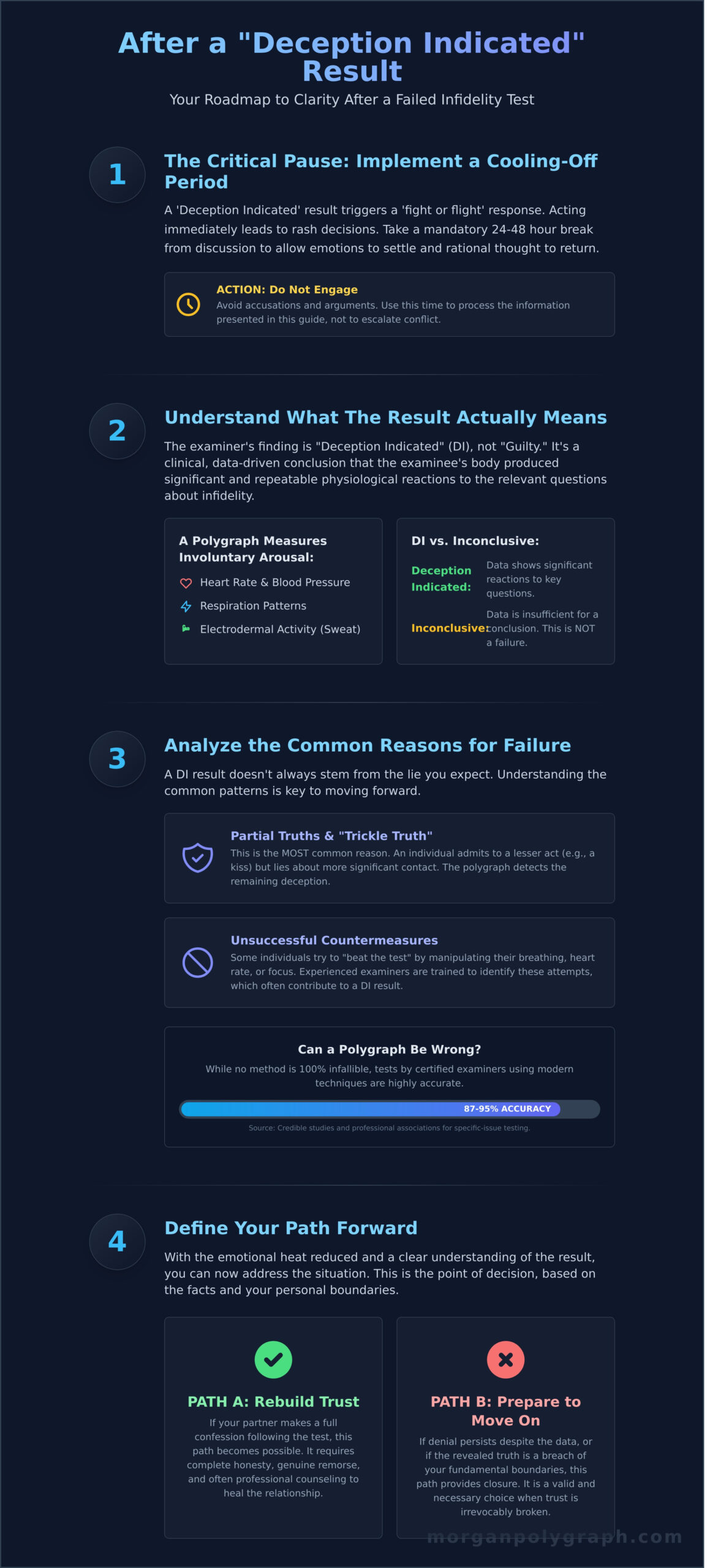
The Road Map: Immediate Steps After a Failed Lie Detector Test
The moments after receiving confirmation of deception are emotionally charged and chaotic. Your mind is likely racing, and the impulse to make drastic, permanent decisions is strong. Resist it. Neuroscientific studies, including research from institutions like Stanford University, show that acute emotional distress can significantly impair rational decision-decision-making in the prefrontal cortex for up to 48 hours. The most critical first step is to do nothing permanent.
Instead, focus on a structured, methodical approach. This isn’t about forgiveness or reconciliation yet; it’s about gaining control in a situation that feels uncontrollable. The following steps provide a clear framework for what to do after a failed infidelity test, ensuring your actions are deliberate and informed.
- Implement a 48-hour ‘cooling off’ period. Agree with your partner that no life-altering decisions regarding the relationship, legal action, or finances will be made for at least two full days. This allows the initial shock and anger to subside, making space for more logical thought.
- Request the full written report. Your polygraph examiner should provide a detailed report outlining the specific questions asked, the physiological responses recorded, and the professional conclusion. This document is your factual anchor. It moves the conversation away from “I feel” to “the data shows.”
- Analyze the specific failed questions. The report will pinpoint the exact areas of deception. Was it about a physical act, an emotional affair, or the timeline of events? Identifying these ‘pain points’ is crucial for understanding the full scope of the betrayal before any meaningful dialogue can occur.
- Establish clear, temporary boundaries. This is about creating emotional and physical safety. It may mean one person temporarily staying in a guest room or with family. It could also involve rules about communication, such as agreeing to only discuss logistical necessities for the next 48 hours. These boundaries reduce immediate conflict and provide necessary space.
Seeking Professional Support (Beyond the Polygraph)
A certified polygraph examiner’s role is precise: to provide objective truth verification. We are not therapists or relationship counselors. Confusing these roles can hinder your recovery. The polygraph provides the “what”; a therapist helps you and your partner process it and decide “what now.” We strongly recommend engaging a specialist. For clients in our area, credible options include the therapists at Boise Counseling Center, which has specialists in affair recovery.
When to Consider a ‘Full Disclosure’ Polygraph
After the initial crisis, the path to potential recovery often involves a ‘Therapeutic Disclosure Polygraph.’ This moves beyond the initial “Did you do it?” and answers the comprehensive question, “What is the complete truth?” Conducted in coordination with your therapist, this structured test ensures no secrets remain, creating a true foundation for rebuilding trust. It is the definitive end to trickle-truth and destructive discoveries down the road. To ensure this process is handled with the required expertise and discretion, schedule a confidential consultation to discuss a Therapeutic Disclosure Polygraph.
Finding Clarity with Morgan Polygraph: Professional Truth Verification in Boise
The aftermath of a contentious infidelity test can leave you feeling more confused than when you started. Vague results, questionable methods, and lingering doubts create a painful limbo. Deciding what to do after a failed infidelity test requires one thing above all else: absolute certainty. At Morgan Polygraph, we provide that certainty through a professional, evidence-based process designed to deliver definitive truth verification for Boise residents.
Our lead examiner, Chip Morgan, brings over 40 years of combined experience in high-stakes polygraph testing. This isn’t just a number; it represents thousands of examinations conducted for federal agencies, law enforcement, and private individuals facing life-altering decisions. When you work with a court-recognized expert, you are engaging a professional whose methods are held to the highest legal and ethical standards. This level of scrutiny ensures that the results you receive are not just an opinion, but the product of a rigorous, validated, and defensible process.
We understand the immense personal stress involved in these situations. That is why every interaction at Morgan Polygraph is guided by a commitment to compassionate, respectful, and discreet service. Your vulnerability is met with professionalism, not judgment. To complement this human-centric approach, we integrate cutting-edge technology, including advanced instrumentation and analysis software, to ensure accuracy rates that meet the stringent standards set by the American Polygraph Association, which often exceed 90%.
Discreet and Confidential Testing in Idaho
Your privacy is paramount. Our professional office, located on State Street in Boise, is designed to be a secure and confidential environment. We implement strict privacy protocols, including staggered appointment times to ensure clients don’t cross paths and secure handling of all case information. It’s this unwavering commitment to discretion that has made Morgan Polygraph the trusted choice for Idaho attorneys and private clients who require an unimpeachable truth verification process without compromising their personal privacy.
Schedule a Consultation with Chip Morgan
The first step toward resolving uncertainty is a simple, confidential phone call. When you contact us, you’ll speak directly with Chip Morgan to discuss the specifics of your situation. A critical part of our process is helping you draft the right questions. Vague or poorly worded questions yield unclear results. We work with you to formulate precise, targeted inquiries that eliminate ambiguity and provide the clarity you need to move forward. Knowing what to do after a failed infidelity test begins with asking the right questions in a professional setting. Call Chip Morgan today to get the answers you deserve.
Find Your Path to Certainty and Resolution
Receiving a ‘deception indicated’ result is a pivotal moment, but it’s not the end of the story. Remember that these results require expert analysis, and your immediate response sets the tone for everything that follows. Knowing what to do after a failed infidelity test is about moving beyond doubt and seeking indisputable truth. This is a time for calm, strategic action, not just emotional reaction.
You don’t have to navigate this difficult time alone. At Morgan Polygraph, our nationally certified and court-recognized experts bring over 40 years of combined polygraph testing experience to your case. We combine this deep expertise with state-of-the-art AI-powered deception detection tools to provide the highest level of accuracy available. For discreet, professional guidance and definitive answers, it’s time to speak with an expert.
Talk to Chip Morgan: Get Professional Truth Verification Today
The path to truth can be challenging, but it’s the first step toward building a future based on certainty, whatever that may hold.
Frequently Asked Questions
Can my partner fail a polygraph just because they are nervous about the relationship ending?
No, nervousness alone does not cause a person to fail a professionally administered polygraph. Certified examiners are trained to distinguish between general anxiety and the specific physiological responses associated with deception. The pre-test interview and calibration questions help establish a baseline for an individual’s unique reactions, ensuring that general stress isn’t misinterpreted as a sign of lying when the critical questions are asked.
What is the ‘Deception Indicated’ (DI) score, and how is it calculated?
A ‘Deception Indicated’ (DI) score is a numerical result showing a high probability of deception. Examiners use validated algorithms, such as the 7-position Empirical Scoring System, to analyze the physiological data. A score of -3 or lower typically signifies a DI result. This score is calculated by evaluating reactions across multiple charts and questions, which provides a statistical conclusion instead of a subjective opinion from the examiner.
My partner says the examiner was biased against them-is this common?
Accusations of bias are extremely rare and typically unfounded when using a certified, professional examiner. Examiners accredited by the American Polygraph Association (APA) adhere to a strict code of ethics that requires complete impartiality. Test questions are reviewed with the examinee beforehand to ensure they are fair and clear. Furthermore, all professional sessions are recorded to guarantee that proper, unbiased protocol was followed throughout the examination.
How accurate are infidelity polygraph tests in 2026?
Infidelity polygraph tests conducted by certified examiners are projected to maintain an accuracy rate between 90% and 94% in 2026. This high degree of reliability is supported by over 250 peer-reviewed studies conducted since the 1970s. The integration of AI-powered analysis tools, which cross-reference physiological data with behavioral speech cues, continues to enhance the precision of our truth verification services and solidify these accuracy levels.
Should I break up with my partner immediately if they fail the test?
A ‘Deception Indicated’ result should not be the sole basis for ending a relationship. The test is a powerful tool for getting answers, but it’s one piece of a larger picture. Knowing what to do after a failed infidelity test involves careful consideration and communication. We recommend using the results as a starting point for an honest conversation, potentially with the help of a professional couples counselor, to determine your next steps.
Can medication or a heart condition cause a false positive on a lie detector?
Yes, certain medical conditions or medications can impact physiological responses, but this is managed during the pre-test phase. It is essential to disclose all medical issues, like arrhythmia or hypertension, and any prescriptions to the examiner beforehand. A qualified examiner will use this information to properly calibrate the test or determine if the individual is a suitable candidate, preventing health factors from being misinterpreted as deception.
What if the test result is ‘Inconclusive’?
An ‘Inconclusive’ result means the data was not sufficient to form a definitive conclusion of truthfulness or deception. This occurs in fewer than 10% of professionally conducted exams and is not considered a failure. It can be caused by an examinee’s use of countermeasures or a persistent physiological state that prevents establishing a stable baseline. The examiner will explain the cause and may recommend a re-test after a 24-hour period.
How much does a professional infidelity polygraph test cost in Boise?
In Boise, Idaho, a professional infidelity polygraph test typically costs between $450 and $700 as of early 2024. This price includes a detailed pre-test interview, the examination itself which lasts 90 to 120 minutes, and a complete post-test review of the results. Be wary of services priced below $300, as they may not employ APA-certified examiners or use validated procedures, which compromises the accuracy of the outcome.