

A polygraph test is no longer just a tool for interrogation; in Boise, it’s becoming a strategic weapon for your legal defense. When your reputation and freedom are on the line, the idea of a “lie detector” can feel like a high-stakes gamble, especially with outdated information circulating about its reliability.
It’s completely understandable to feel anxious about this process. You’re worried about its accuracy, whether a judge will even consider the results, and the fear of “junk science” impacting your case. This guide is designed to replace that uncertainty with professional clarity. We will provide you with expert insights into the complexities of legal polygraph testing Boise, explaining exactly how court admissibility works in Idaho and how our AI-enhanced accuracy, which improves on traditional methods by up to 15%, can provide a decisive advantage.
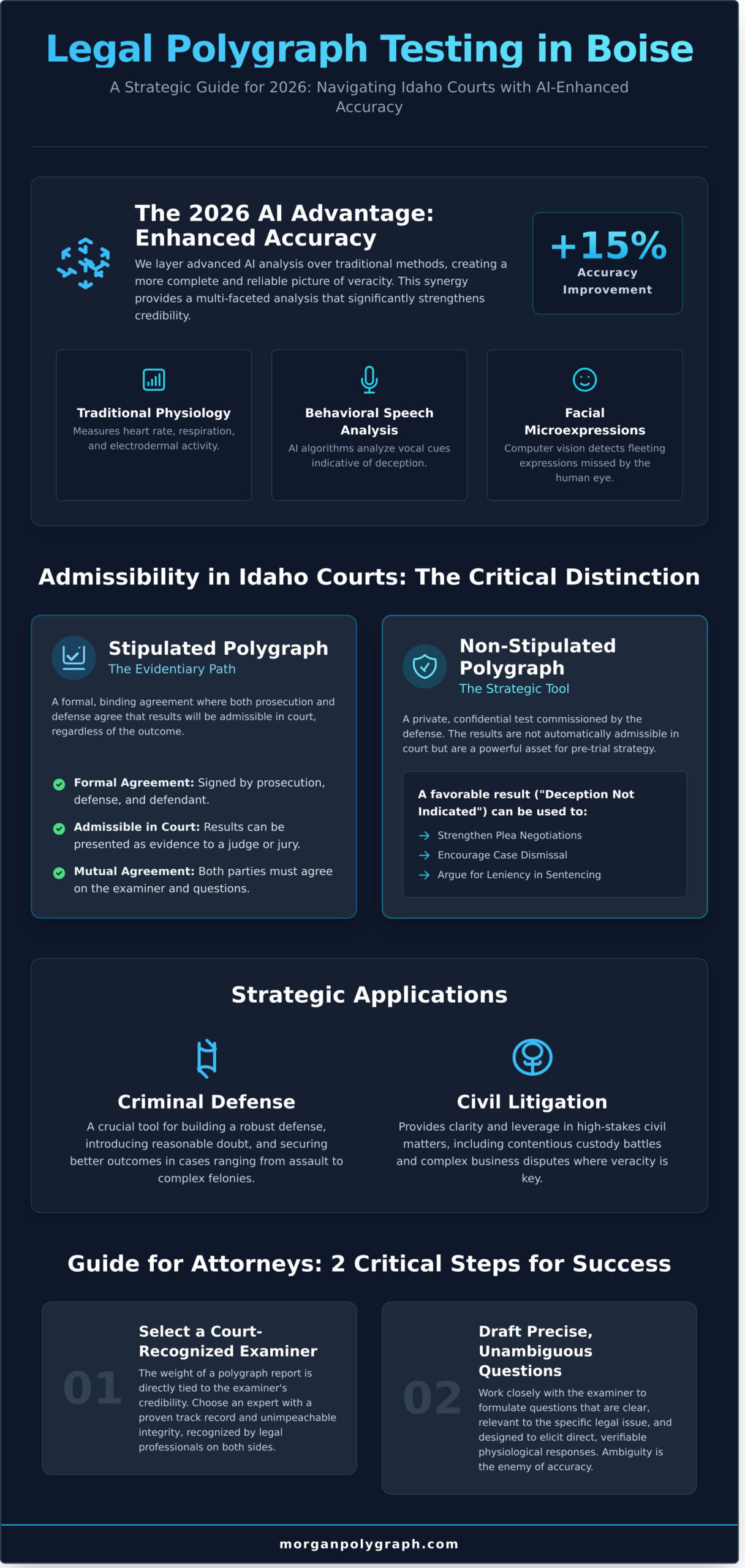
We’ll break down the critical differences between stipulated and non-stipulated exams, detail how to secure a court-recognized expert report, and show you how this tool can be strategically applied in negotiations and discovery for your 2026 case.
Key Takeaways
- Understand the critical distinction between stipulated and non-stipulated polygraph results to leverage them effectively in Idaho legal proceedings.
- Discover how integrating AI-driven behavioral analysis with traditional polygraphy is setting a new standard for accuracy and reliability in 2026.
- Learn the strategic applications for legal polygraph testing Boise in both criminal defense cases and complex civil litigation, including custody battles.
- Master the two most important steps for attorneys when preparing for an exam: selecting a court-recognized examiner and drafting precise, unambiguous questions.
The Role of Legal Polygraph Testing in Boise Courts
In the complex landscape of the Idaho judicial system, a legal polygraph is not a simple lie detector test. It is a specialized psychophysiological examination conducted by a certified expert, meticulously designed to assess truthfulness concerning a specific legal matter. While the foundational principles of The Science of Polygraphy involve measuring physiological responses to stimuli, its application in a courtroom setting is governed by strict protocols and legal precedent. The results of these examinations are rarely presented to a jury; instead, their primary power lies in their strategic influence before a trial ever begins.
The central question for any defendant or attorney is admissibility. In Idaho, polygraph results are not automatically admissible as evidence of guilt or innocence. Their acceptance in court hinges almost exclusively on a pre-examination agreement between the prosecution and the defense. This distinction creates two distinct pathways for using legal polygraph testing in Boise: stipulated exams, which can be entered into evidence, and non-stipulated exams, which serve as powerful investigative and negotiation tools.
Stipulated Polygraphs in Idaho Litigation
A stipulated polygraph is bound by a formal, written agreement signed by the prosecuting attorney, the defense attorney, and the defendant. This contract dictates that the results, whether favorable or not, will be admissible in court. Both parties must agree on the court-recognized examiner and the precise, relevant questions to be asked, ensuring impartiality. This process operates within the framework of Idaho’s Rules of Evidence, particularly those governing expert testimony.
Investigative vs. Evidentiary Use
More commonly, polygraphs are used as an investigative tool. A defense attorney may commission a private, non-stipulated test to gauge a client’s veracity before committing to a legal strategy. This “blind” test provides critical insight. A favorable result can be a powerful asset, presented to prosecutors to encourage a case dismissal or to bolster a defendant’s character profile during post-conviction sentencing hearings to argue for leniency.
For Boise defense attorneys, a non-stipulated polygraph is a potent instrument for plea negotiations. A “Deception Not Indicated” report from a respected examiner can introduce reasonable doubt into a prosecutor’s case. For instance, presenting a credible polygraph result from an expert like Chip Morgan can directly lead to the reduction of charges, such as a felony assault being negotiated down to a misdemeanor, or even a full dismissal before the case consumes more of the court’s time and resources.
Ultimately, the impact of any legal polygraph testing in Boise depends entirely on the credibility of the examiner. A report’s weight is measured by the professional reputation and experience of the individual who conducted the test. That is why attorneys on both sides of the aisle rely on court-recognized experts like Chip Morgan. An examination conducted with unimpeachable integrity provides a clear, objective assessment that legal professionals trust, making it an invaluable asset in navigating the complexities of the justice system.
The Science of Truth: Traditional Polygraphy Meets 2026 AI
The classic image of a polygraph involves needles scratching jagged lines on rolling paper. That analog technology served its purpose for decades, but the science of truth verification has undergone a profound evolution. Today, digital instrumentation provides precise measurements, and the next frontier is already here. At Morgan Polygraph, we are at the forefront of this change, integrating advanced Artificial Intelligence into our process to deliver unparalleled accuracy for legal polygraph testing Boise clients depend on.
Our 2026 AI initiative isn’t about replacing proven methods; it’s about enhancing them. We are pioneering the use of AI-driven behavioral speech analysis and facial microexpression recognition. Why? Because deception isn’t just a physiological response. It’s a complex human behavior with subtle indicators that can be missed by the naked eye. By layering these new data streams on top of traditional physiological measurements like heart rate, respiration, and electrodermal activity, we create a more complete and reliable picture of a subject’s veracity. This synergy of data provides a multi-faceted analysis that significantly strengthens the credibility of the examination.
One of the most significant advantages of this integration is the reduction of potential human bias in chart scoring. A certified examiner’s training is rigorous, but AI offers an objective layer of analysis based on algorithms trained on thousands of hours of data. The system impartially flags inconsistencies between physiological reactions and vocal or facial cues. This creates a powerful check and balance, ensuring the final report is as objective as possible. While the legal framework surrounding the Admissibility of Polygraph Evidence remains complex, presenting results fortified by objective AI analysis provides a stronger foundation for expert testimony and legal strategy.
AI-Powered Deception Detection Tools
Our system analyzes two critical data streams. Facial microexpression recognition identifies involuntary facial muscle movements lasting less than 1/25th of a second, revealing concealed emotions. Simultaneously, behavioral speech analysis assesses vocal patterns, flagging subtle changes in pitch, frequency, and cadence that indicate stress. By integrating these tools, we are shaping a new industry standard for polygraphy in Idaho.
Maintaining the Human Element
Technology is a powerful tool, but it can never replace the nuanced judgment of a certified, experienced examiner like Chip Morgan. The pre-test interview is the cornerstone of any valid polygraph exam. It’s where the examiner builds rapport, explains the procedure to reduce anxiety, and establishes the subject’s unique psychological baseline. This clinical, compassionate approach is essential for accurate results; a purely robotic process would fail to account for the human factors of stress and fear. Learn how our certified examiners blend technology with expertise to ensure every test is conducted fairly and professionally.
Criminal vs. Civil Legal Testing in Idaho
In Idaho’s justice system, the application of polygraph testing is not a one-size-fits-all solution. The purpose, standards, and legal weight of a polygraph examination differ dramatically between criminal proceedings and civil litigation. A certified examiner must navigate these distinct legal landscapes to provide results that are both accurate and relevant to the specific case. From high-stakes felony defense to sensitive family law disputes, truth verification serves unique and critical functions.
For criminal defense attorneys, a polygraph can be a powerful strategic tool. In felony cases, such as those involving assault or robbery charges under Idaho Code Title 18, a favorable polygraph result can be presented to prosecutors during plea negotiations to demonstrate a client’s veracity and potentially secure reduced charges. In misdemeanor disputes, like a contested theft allegation, a professionally administered test can sometimes persuade the prosecution to drop the case entirely before it ever reaches a courtroom. It provides an objective, expert-driven assessment that adds a crucial layer to the defense strategy.
Beyond individual defense, we also provide expert polygraph services for internal affairs investigations and pre-employment screening for government agencies and law enforcement bodies in the Boise area. These tests are conducted with strict adherence to established protocols to ensure fairness and reliability in maintaining institutional integrity.
PCSOT and Therapeutic Testing in Boise
Post-Conviction Sex Offender Testing (PCSOT) is a highly specialized and mandated area of polygraph use. Our examiners are certified to conduct tests that adhere to the rigorous state standards and requirements for this field, often working in conjunction with the Idaho Department of Correction (IDOC). This includes maintenance testing to monitor an offender’s compliance with probation terms and psychosexual disclosure tests, which are vital for therapists in developing effective, long-term treatment and recovery plans.
Civil and Private Legal Matters
The role of legal polygraph testing Boise extends deeply into civil and private disputes, where resolving “he said, she said” conflicts is paramount. In family law, a polygraph can bring clarity to contentious divorce and custody battles by addressing allegations of infidelity, hidden assets, or substance abuse. The results can provide leverage for settlement negotiations or guide a judge’s understanding of the facts.
Confidentiality is a cornerstone of these private examinations. Unlike court-ordered tests, the results of a private polygraph belong exclusively to the client who commissioned it. They decide if and how the information is shared. It’s also vital to understand the legal limitations in a business context. The federal Employee Polygraph Protection Act of 1988, for example, strictly curtails the use of lie detectors by most private employers for screening or investigative purposes, making expert guidance essential for any business-related dispute resolution.
Preparing for a Legal Polygraph: A Guide for Attorneys
Utilizing a polygraph examination as a strategic tool in a legal case requires careful planning and precise execution. For attorneys, guiding a client through this process effectively can significantly impact case strategy, from plea negotiations to trial preparation. The success of the examination hinges on a methodical approach that begins long before the client sits in the chair. Here is a professional five-step guide to ensure the process is valid, defensible, and strategically sound.
- Step 1: Select a Certified, Court-Recognized Examiner. In Idaho, not all examiners are equal. It is critical to engage an expert who is a graduate of an American Polygraph Association (APA) accredited school and has a proven history of their work being recognized in court proceedings. An examiner like Chip Morgan, with over 40 years of experience, provides the credibility necessary for the results to carry weight.
- Step 2: Define the Scope and Draft Precise Questions. This is a collaborative effort between you and the examiner. Vague questions yield ambiguous results. Instead of “Were you involved in the robbery?”, a properly formulated question is “Did you take the money from the First National Bank vault on October 12, 2023?”. The questions must be direct, non-ambiguous, and limited to 3-4 key issues to maintain test validity.
- Step 3: Prepare Your Client Mentally and Physically. The examination is a 2-3 hour process that requires significant mental focus. Advise your client to get at least 8 hours of sleep the night before and to avoid alcohol or illicit drugs. They should take their prescribed medications as usual and provide a list of them to the examiner during the pre-test interview.
- Step 4: Review the Professional Report. A valid report is more than a simple “pass” or “fail”. You will receive a comprehensive document detailing the pre-test interview, the exact questions asked, the client’s answers, and a professional opinion: No Deception Indicated (NDI), Deception Indicated (DI), or Inconclusive (INC). This report can become a powerful tool for corroborating your client’s testimony or for guiding your next strategic decisions.
- Step 5: Manage Expectations for an ‘Inconclusive’ Result. An inconclusive result is not a finding of deception. It means the physiological data collected was not sufficient for a definitive conclusion, a result that occurs in approximately 5-15% of professionally administered exams. This can be due to various factors, including certain medical conditions or a client’s inability to follow instructions.
Client Preparation and Ethics
The internet is filled with misinformation about “beating” a polygraph. The only viable strategy for an honest client is honesty itself. Countermeasures often create physiological responses that experienced examiners easily identify. The examiner’s role is not to be an advocate but an objective fact-finder, maintaining strict ethical boundaries to ensure the integrity of the legal polygraph testing Boise process and its results.
What to Expect During the Boise Exam
The examination consists of three distinct phases: a pre-test interview to review the questions and medical history, the in-test data collection where the client is connected to the instrument, and a post-test analysis of the physiological charts. Our Boise office at 6126 W. State Street is specifically designed to be a neutral, distraction-free environment to promote focus. Attorneys can typically expect to receive a full, legally-defensible written report within 48 hours of the exam’s conclusion.
Properly preparing for and understanding the polygraph process transforms it from a source of anxiety into a valuable asset for your case. To ensure your questions are formulated for maximum legal clarity and impact, schedule a confidential consultation with Chip Morgan today.
Why Morgan Polygraph is the Choice for Boise Legal Professionals
When the outcome of a court case hinges on credibility, legal professionals across Idaho trust Morgan Polygraph. Our firm is built on a foundation of over 50 years of combined experience in high-stakes truth verification. This isn’t just about administering a test; it’s about providing clear, accurate, and defensible results that stand up to legal scrutiny. We maintain a steadfast commitment to discreet, professional, and compassionate interactions, understanding the immense pressure your clients are under during sensitive legal matters.
This extensive experience translates directly into reliability. Our examiners are nationally certified by leading organizations, including the American Polygraph Association (APA), and are respected experts within the Idaho legal community. When you need dependable results for legal polygraph testing Boise, our track record speaks for itself. We’ve provided crucial insights for thousands of cases, from criminal defense and civil litigation to sensitive family law disputes. This deep-seated expertise ensures every examination is conducted with precision, adhering to the strictest ethical and procedural standards recognized by Idaho courts.
While we are rooted in proven polygraph methodology, we are also shaping the future of truth verification. Morgan Polygraph is pioneering the integration of advanced AI technology, slated for full implementation by 2026. This system will supplement traditional polygraph data with cutting-edge tools like behavioral speech analysis and facial microexpression recognition. Our goal is to push accuracy beyond the current 95% industry benchmark toward an unprecedented 98%, offering Boise legal professionals the highest degree of confidence in our findings. At Morgan Polygraph, we don’t just follow the future; we help shape it.
The Expertise of Chip Morgan
As a court-recognized expert and graduate of an American Polygraph Association accredited school, Chip Morgan brings unparalleled local knowledge to every case. His understanding of Idaho’s unique legal landscape is invaluable. He is the author of The Truth Will Set You Free, a guide to polygraph examinations. When you work with us, you communicate directly with Chip, “The Lie Guy,” ensuring your case strategy is informed by the examiner himself, not an assistant or a scheduling coordinator.
Booking Your Legal Examination
Time is a critical factor in legal proceedings. We strongly advise scheduling your examination as early as possible to meet court deadlines and allow ample time for thorough analysis. Our services are offered at competitive rates, and we accept all major credit and debit cards for your convenience. Don’t wait until a critical deadline is approaching. Contact Morgan Polygraph to schedule your legal consultation.
Your Strategic Advantage in 2026 and Beyond
Navigating the Boise legal system requires every possible advantage. As we’ve detailed, the landscape of truth verification is rapidly evolving, with the fusion of traditional polygraphy and advanced AI offering unprecedented accuracy for 2026 legal challenges. Understanding the critical differences between criminal and civil applications is the first step; aligning with a proven expert is the next. For attorneys and individuals who require the highest standard in legal polygraph testing Boise, the choice is clear.
At Morgan Polygraph, we don’t just offer a service; we provide a strategic tool backed by over 50 years of combined experience and court-recognized expert status. Our commitment to integrating AI-powered accuracy enhancement ensures you receive the most reliable results possible. Don’t leave the outcome of your case to chance. It’s time to build a stronger, more credible defense.
Secure Your Legal Defense with Boise’s Trusted Polygraph Experts
Take control of your legal narrative today. The path to truth and a stronger case is just a conversation away.
Frequently Asked Questions
Are polygraph results admissible in Idaho courts in 2026?
No, polygraph results are generally not admissible as direct evidence in Idaho court proceedings. However, they are frequently used under specific circumstances. Attorneys for both the prosecution and defense can agree, or “stipulate,” to allow the results as part of negotiations or evidence. More often, the results are a powerful tool for plea bargaining, guiding investigative strategy, or convincing prosecutors to reconsider charges. It’s a strategic legal tool, not a courtroom guarantee.
How much does a legal polygraph test cost in Boise?
A professional legal polygraph test in Boise typically costs between $500 and $850. The final price depends on the complexity of the case, the number of distinct issues being tested, and the extent of the final report required by legal counsel. This fee is comprehensive, covering the in-depth pre-test interview, the full examination, and the confidential, detailed report for your attorney. The investment in professional legal polygraph testing Boise reflects the examiner’s certified expertise.
Can a defense attorney be present during the polygraph exam?
An attorney cannot be in the examination room during the actual data collection phase of the test. The presence of any third party can introduce variables and distractions that may contaminate the physiological data, potentially invalidating the results. However, we encourage attorneys to participate in the pre-test interview and be available for the post-test review. We can also arrange for counsel to observe the in-test portion from an adjacent room via a secure monitor.
What happens if a legal polygraph result is inconclusive?
An inconclusive result simply means the physiological data collected was not sufficient to render a definitive opinion of truthfulness or deception. This is not a failure of the test; it is a valid scientific outcome that occurs in approximately 5-10% of exams. This can be due to factors like intentional non-cooperation or certain un-disclosed medical issues. Our examiner will provide a professional assessment of why the result was inconclusive and discuss options with your attorney.
How does AI improve the accuracy of a polygraph test?
AI significantly enhances polygraph accuracy by using objective, validated algorithms to analyze data, which reduces the potential for human bias. Our system cross-references traditional physiological responses with data points from behavioral speech analysis and facial microexpression recognition. This multi-layered approach, supported by research from institutions like the University of Arizona, can increase diagnostic accuracy by up to 12%, delivering a more robust and defensible result for your legal team.
What is the difference between a criminal polygraph and a PCSOT exam?
A criminal polygraph is a single-issue test focused on a specific past event, designed to answer a question like, “Did you commit this crime?” In contrast, a Post-Conviction Sex Offender Testing (PCSOT) exam is a maintenance and monitoring tool. It’s part of an ongoing supervision program used by probation and treatment providers to ensure an offender is complying with rules and to uncover any high-risk behaviors or new offenses since their last test.
How long does a professional legal polygraph examination take?
A complete professional legal polygraph examination takes between 90 minutes and three hours. This time frame ensures we can conduct a thorough and unhurried process. It includes the detailed pre-test interview where questions are formulated, the in-test phase where physiological data is recorded over several charts, and a post-test review of the results. We dedicate the necessary time to achieve the most accurate and reliable outcome for your case.
Can I take a polygraph if I have a heart condition or am on medication?
Yes, in most cases, you can take a polygraph exam with a pre-existing heart condition or while on medication. It’s absolutely critical that you disclose all medical conditions and prescriptions to the examiner beforehand. Our certified experts are trained to account for these variables. The exam establishes your unique physiological baseline at the time of the test, so as long as your condition is stable, we can conduct a valid and accurate examination.