

What if the most challenging part of your polygraph exam isn’t the machine, but the uncertainty leading up to it? It’s a common and understandable feeling. Facing a Containment Model team of professionals, including your Probation Officer, therapist, and a certified polygraph examiner, can be incredibly intimidating. The fear of a technical “fail,” confusion over different maintenance exams, and the simple anxiety of the process can feel overwhelming.
This guide is designed to replace that uncertainty with professional clarity and confidence. We will provide a step-by-step walkthrough of the entire process for the probation compliance polygraph Idaho mandates, demystifying the requirements so you know exactly what to expect. By understanding the structure and purpose of the examination, you can maintain compliance with Idaho Department of Correction (IDOC) mandates and navigate your requirements successfully. You’ll learn the specific expectations of the Idaho Sex Offender Management Board (SOMB) and discover strategies to remain calm and honest, ensuring the process is fair and accurate.
Key Takeaways
- Understand that a probation compliance polygraph Idaho uses is a clinical tool to verify progress, not a traditional law enforcement interrogation.
- Learn how the “Triangle of Supervision” works and how your Probation Officer, therapist, and polygraph examiner communicate to manage your case.
- Identify the three specific types of compliance exams you will face during supervision so you know exactly what to expect from each test.
- Discover proven strategies to manage test anxiety and learn why the pre-test interview is the most critical part of the entire process.
What is a Probation Compliance Polygraph in Idaho?
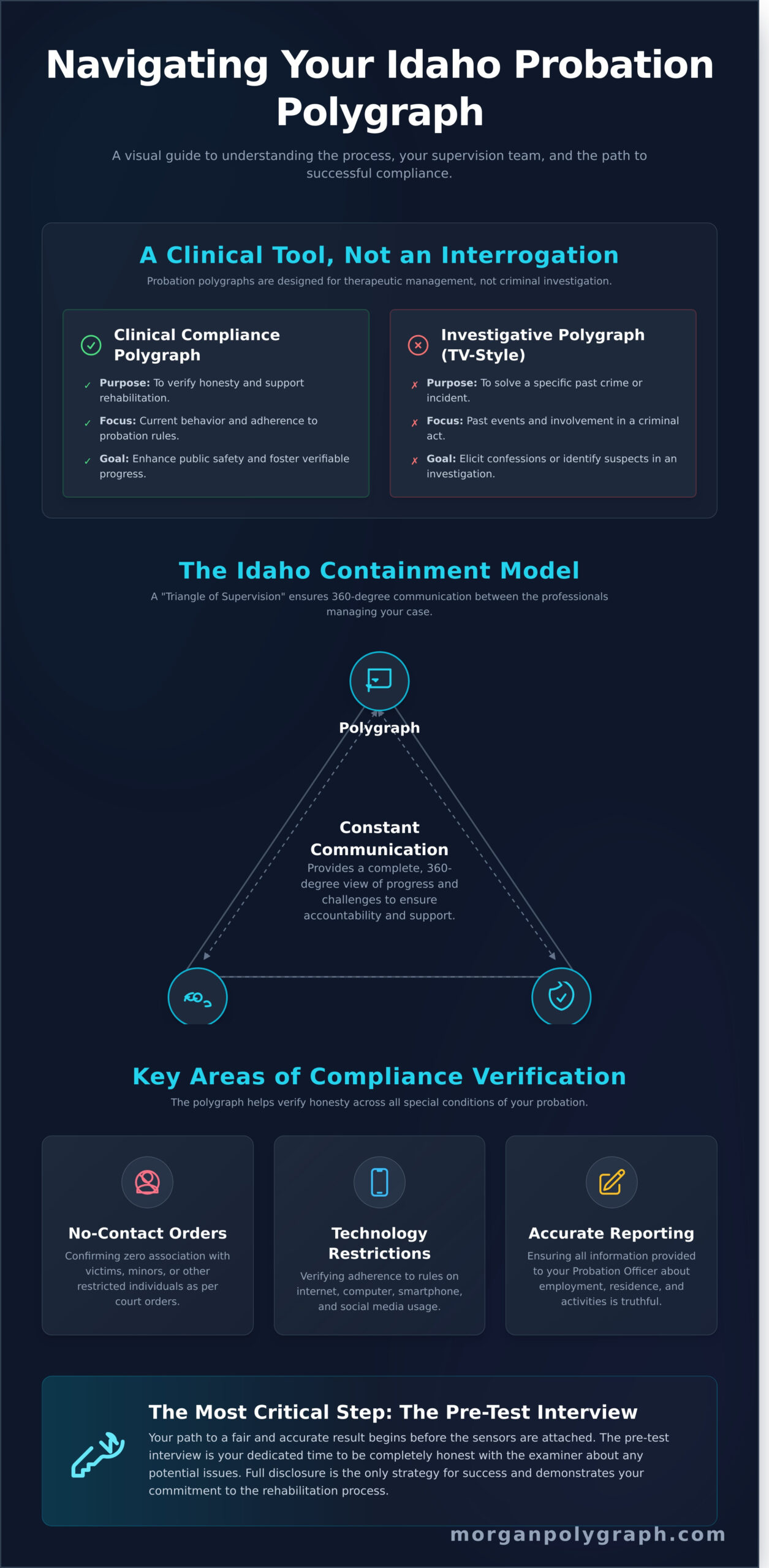
A probation compliance polygraph is a specialized tool used by the Idaho Department of Correction (IDOC) and the Sexual Offender Management Board (SOMB) to monitor and verify an individual’s adherence to the terms of their supervision. This isn’t the type of test you see in movies, which is typically an ‘investigative’ polygraph used to solve a specific crime. Instead, post-conviction polygraphs are clinical in nature, designed as a long-term therapeutic and management tool.
The fundamental instrument, a Polygraph, measures physiological responses to a structured series of questions. In the context of probation, these questions are not about a past crime but about your current behavior and honesty. Idaho law mandates these tests for certain offense categories under the Post-Conviction Sex Offender Testing (PCSOT) standards. The core purpose is twofold: to enhance public safety by ensuring rules are followed and to support an offender’s rehabilitation by providing a structured framework for verifiable honesty. A professionally administered probation compliance polygraph Idaho test serves as a crucial bridge of accountability between the probationer, their treatment provider, and their supervising officer.
The Legal Framework: IDOC and SOMB Standards
In Idaho, the process is not arbitrary. The Idaho Sexual Offender Management Board (SOMB) establishes the strict standards and protocols for all post-conviction polygraph examinations. Under these guidelines, individuals on probation for specific offenses can expect to undergo testing at least twice during their first year of supervision and a minimum of once annually thereafter. Crucially, Idaho law mandates that only SOMB-certified examiners are qualified to conduct these tests, a certification that requires extensive training and adherence to the highest ethical standards. This ensures every test is consistent, fair, and legally sound.
Why ‘Compliance’ is More Than Just Not Breaking the Law
Probation often includes a detailed list of ‘Special Conditions’ tailored to an individual’s case. Compliance means adhering to every single one. A polygraph helps verify honesty about these specific, and often complex, rules. This can include:
- No-Contact Orders: Confirming you have not associated with victims or minors.
- Technology Use: Verifying you are following restrictions on internet, computer, or smartphone usage.
- Monthly Reports: Ensuring the information you provide your Probation Officer about your activities, employment, and relationships is accurate.
Beyond enforcement, there is a significant psychological benefit. The process of ‘verifiable honesty’ can be empowering for a probationer committed to rehabilitation. It provides a concrete way to demonstrate progress and rebuild trust with supervising authorities and treatment providers, forming a critical foundation for successful reentry into the community.
The Idaho Containment Model: Your Supervision Team
When you’re required to undergo a probation compliance polygraph Idaho, you aren’t just taking a test; you’re engaging with a comprehensive support system known as the Containment Model. This model is the established standard for post-conviction supervision across the state, from Boise to Coeur d’Alene. Its goal is to create a transparent and accountable environment that fosters genuine rehabilitation and protects the community. The system is built on a “Triangle of Supervision,” a professional team dedicated to your successful reintegration.
This team consists of three essential, collaborating experts:
- The Probation or Parole Officer (PO): The legal authority responsible for enforcing the court’s orders and managing the conditions of your supervision.
- The Treatment Provider: The certified therapist focused on addressing the underlying behaviors and thought patterns that led to the offense.
- The Polygraph Examiner: The certified and objective professional who provides truth verification, acting as a clinical tool to support both supervision and therapy.
Effective and constant communication between these three parties is the bedrock of the model. The polygrapher doesn’t operate in a vacuum. They are a clinical part of your treatment team, providing objective data that informs the strategies of both the PO and the therapist. This creates a 360-degree view of your progress, ensuring that support and accountability are applied precisely where they’re needed most.
The Role of the Probation or Parole Officer (PO)
Your PO uses polygraph results as a critical data point to manage your case effectively. A report showing No Deception Indicated (NDI) can build trust and may lead to adjusted supervision, such as less frequent check-ins. Conversely, a report indicating Deception (DI) or one that is Inconclusive prompts specific action. The PO will investigate the issues raised, but it doesn’t automatically result in a new charge. It’s vital to understand the difference: a technical violation (e.g., unauthorized internet use) discovered via polygraph is a breach of your supervision rules, while a new criminal charge involves a separate illegal act. The polygraph results guide the PO’s response to both.
The Role of the Treatment Provider
In therapy, progress often stalls against a wall of denial. The polygraph is a powerful tool for dismantling that wall. When a client’s verbal account in a session is contradicted by polygraph results, it shifts the therapeutic focus from arguing about facts to exploring the reasons behind the behavior. This dynamic is central to the containment approach validated by the Office of Justice Programs. Furthermore, specific exams like the Sexual History Disclosure Polygraph provide your therapist with a comprehensive and accurate history, allowing them to design a treatment plan that addresses your specific risks and needs, not a generic template. This information is then shared and discussed in collaborative team meetings to ensure your supervision and treatment are perfectly aligned. Understanding this collaborative framework is the first step, and for a confidential overview of the exam process, our certified examiners are available to answer your questions.
Maintenance, Monitoring, and Disclosure: The 3 Types of Exams
Understanding the polygraph process during probation in Idaho begins with recognizing that not all exams are the same. Your supervising officer and treatment provider use specific, distinct types of tests to evaluate different aspects of your compliance and history. These examinations are not interchangeable; each serves a unique and critical function in your supervision plan. The three primary categories you will encounter are Maintenance exams, Monitoring exams, and the Sexual History Disclosure (SHD) exam. Knowing the purpose and scope of each is essential for navigating your supervision successfully.
At Morgan Polygraph, our certified examiners are experts in administering all court-approved tests required for probation. We conduct every examination with professional discretion, ensuring the process is clear, fair, and respectful. Our goal is to provide accurate, unbiased results that serve the objectives of the court, the supervising agency, and the client’s treatment plan.
Maintenance vs. Monitoring: What’s the Difference?
A Maintenance Exam is the most common type of probation compliance polygraph Idaho requires. Think of it as a routine check-up. This test is designed to verify your compliance with all general and specific rules of your supervision since your last polygraph. Maintenance tests usually cover the last 6 to 12 months of behavior. Questions are direct and focus on key rules, such as:
- Adherence to no-contact orders
- Abstinence from drugs and alcohol
- Compliance with internet and computer restrictions
- Truthfulness in reporting to your probation officer
- Avoidance of prohibited areas or associations
A Monitoring Exam, in contrast, is not routine. It is a targeted test ordered to address a specific concern or “red flag” identified by your probation officer or therapist. These exams are triggered by new information or behaviors that suggest a potential violation or an increase in risk. For example, a Monitoring exam might be ordered if a home search reveals suspicious items, if you miss a therapy session, or if your GPS data shows you in a prohibited location. The questions are narrowly focused on the specific incident or behavior under investigation, providing a precise tool for risk management.
The Sexual History Disclosure (SHD) Exam
For many individuals on probation for a sex offense, the Sexual History Disclosure (SHD) exam is the most intensive and stressful part of the process. It is typically conducted once, near the beginning of your treatment program. The purpose of the SHD is not to uncover new crimes for prosecution; its function is clinical. It ensures your treatment provider has a complete and accurate understanding of your entire history of sexual behaviors, not just the offense for which you were convicted.
This comprehensive disclosure is a foundational element of effective treatment. It allows therapists to address the full scope of problematic thoughts and behaviors, rather than just a single data point. This approach is fundamental to the Containment Model of supervision, a framework detailed by national programs like the U.S. Department of Justice’s Sex Offender Management Assessment and Planning Initiative, which emphasizes a multi-disciplinary team approach to reduce recidivism.
While daunting, completing a truthful and thorough SHD can significantly benefit you in the long run. Passing the SHD polygraph demonstrates a genuine commitment to transparency and rehabilitation. It builds critical trust with your supervision team. This verified honesty often leads to a re-evaluation of your risk level and, over a period of 18 to 24 months, can result in less intensive supervision requirements, ultimately helping you move forward more effectively.
Preparing for Your Compliance Exam: Managing Anxiety and Honesty
Facing a polygraph exam understandably creates anxiety. It’s a serious process with significant implications. However, the key to a successful and accurate examination isn’t about suppressing nerves; it’s about preparation and radical honesty. A properly administered test is designed to distinguish the physiological response of deception from general nervousness. Your role is to arrive prepared, both physically and mentally, to engage transparently with the process.
Your physical state directly impacts the quality of the data collected. For optimal results, we advise clients to get a full 7 to 8 hours of sleep the night before their appointment. Continue to take any medically prescribed medications as directed by your doctor. It’s crucial, however, to avoid non-prescribed sedatives, alcohol, or illicit substances for at least 24 hours prior to your exam. Eat a normal meal, but refrain from consuming caffeine or energy drinks for a minimum of 4 hours before you arrive at our Boise office. These simple steps ensure your body’s baseline responses are stable and clear.
The most critical part of the entire examination happens before any sensors are attached. The pre-test interview, which typically lasts around 60 minutes, is a structured conversation designed to build rapport and eliminate any ambiguity. This is your dedicated opportunity for ‘Full Disclosure.’ If there is a minor, unrelated issue causing you internal conflict, disclosing it to the examiner beforehand prevents it from contaminating the results of your probation compliance polygraph Idaho exam. Honesty during this phase is your greatest asset; a skilled examiner can work with the truth but cannot work around a lie discovered during the test.
The 5 Steps of a Successful Compliance Exam
Our process is methodical and transparent, designed to produce the most accurate results possible. There are no surprises.
- 1. Reviewing the Questions Verbatim: You will review every single test question with the examiner until you understand them perfectly. You will know exactly what will be asked before the data collection begins.
- 2. Discussing ‘Gray Areas’: This is the time to clarify any potential misunderstandings or complex situations with the examiner to ensure your answers are direct and truthful.
- 3. Understanding the Physiological Sensors: Chip will explain what each component measures, including cardiovascular activity, respiratory patterns, and electrodermal response (sweat gland activity). We believe an informed client is a better participant.
- 4. The Data Collection Phase: During this short phase, you will be asked to sit still and provide simple “yes” or “no” answers while breathing naturally.
- 5. The Post-Test Discussion: Immediately following the test, Chip will review the preliminary data with you and explain the initial findings in a clear, professional manner.
Dealing with ‘Inconclusive’ Results
An ‘Inconclusive’ result is not a failure. It simply means the physiological data collected was not clear enough to render a definitive opinion of ‘Deception Indicated’ or ‘No Deception Indicated.’ Common causes include extreme fatigue, acute physical pain (like a severe headache or injury), or a fundamental misunderstanding of a question’s scope. At Morgan Polygraph, our commitment is to accuracy. If a test is inconclusive due to transient physiological factors, we will work with you and the referring agency to schedule a re-test, often at no additional cost, to ensure a valid outcome.
Your success in a probation polygraph depends on this partnership of transparency. To ensure you are fully prepared and understand every step of the process, schedule a confidential consultation with Chip Morgan today.
Why Morgan Polygraph is Idaho’s Trusted Compliance Expert
When your freedom and future are on the line, choosing the right polygraph examiner is not just a detail; it’s a critical decision. For over 40 years, Chip Morgan has been a fixture in Idaho’s legal and correctional communities, building a reputation for uncompromising accuracy and professionalism. This isn’t just experience; it’s four decades of understanding the specific requirements of Idaho’s judges, attorneys, probation officers, and treatment providers. We don’t just administer tests. We provide credible, court-recognized truth verification that stands up to scrutiny.
Our expertise is formally recognized and certified. As a Sex Offender Management Board (SOMB) certified examiner, Chip Morgan meets the rigorous standards required for post-conviction sex offender testing (PCSOT), one of the most demanding specializations in the polygraph field. This certification ensures we adhere to the strictest ethical guidelines and validated testing techniques. This level of qualification is why legal professionals across Boise and throughout Idaho trust our findings. Our deep understanding of the system makes us the leading choice for any court-ordered probation compliance polygraph Idaho requires.
We believe that advanced technology is essential for a fair and just outcome. Morgan Polygraph utilizes state-of-the-art computerized polygraph systems that measure physiological responses with exceptional precision. This technology helps to eliminate ambiguity and reduce the chance of inconclusive results, ensuring that your truthfulness is accurately represented. Our commitment is to provide the most reliable data possible, giving you, your attorney, and the court the confidence you need to move forward.
Beyond the technology and credentials lies our core commitment to you. We understand that undergoing a polygraph is an inherently stressful experience. That’s why every interaction at Morgan Polygraph is handled with compassion, discretion, and profound respect for the individual. We provide a calm, controlled environment where you can focus on the process without added anxiety, knowing you are in the hands of a seasoned professional dedicated to a fair process.
Discreet and Professional Testing in Boise
Our office on State Street in Boise is designed to be a neutral and professional setting, intentionally created to reduce stress and promote a calm atmosphere. We frequently work directly with your attorney to ensure the entire testing process is transparent and that your legal rights are protected from start to finish. This combination of expert accuracy and genuine human respect is the signature of the Morgan Polygraph experience.
Ready to Schedule Your Compliance Exam?
Coordinating your test is a straightforward process. We will work with you, your probation officer, or your therapist to schedule your next mandated exam at a time that meets your compliance deadlines. If you have any questions about what to expect or how the process works, you are encouraged to contact Chip Morgan directly. He can personally walk you through the steps and address your concerns. Schedule your professional compliance polygraph with Morgan Polygraph today.
Navigate Your Probation with Confidence and Expertise
Understanding the Idaho Containment Model is the first step toward successfully navigating your supervision. This process isn’t just about truth verification; it’s a structured tool for accountability, supported by your entire team. Honesty and calm preparation are your greatest assets when facing the exam. When it’s time to schedule your probation compliance polygraph Idaho exam, the expertise of your examiner is critical.
At Morgan Polygraph, you’re not just a case file. Chip Morgan is a SOMB Certified Examiner with over 40 years of combined experience, providing court-recognized expert testimony. He approaches every confidential session with the professional, compassionate, and respectful interaction you deserve. You can trust that the process will be handled with precision and integrity.
Take the next confident step in your journey. Talk to Chip Morgan about your Idaho probation compliance needs and ensure you have a trusted expert on your side. Your commitment to this process is a powerful move forward.
Frequently Asked Questions About Probation Polygraphs
Can I fail a probation polygraph just because I am nervous?
No, you cannot fail a polygraph examination based on nervousness alone. Our certified examiners are extensively trained to differentiate the physiological signs of general anxiety from reactions linked to deception. The pre-test interview and a series of calibration questions establish your unique baseline. With over 40 years of combined experience, we ensure a professional, calm setting to produce a valid and accurate test result, fully accounting for the natural stress of the situation.
What happens if my Idaho probation polygraph shows deception?
If your polygraph results indicate deception, the examiner is required to send a formal report of these findings directly to your probation officer or the requesting agency. Your supervising officer then determines the appropriate course of action based on the terms of your probation and Idaho Department of Correction policy. Consequences can vary from a simple warning and increased supervision to a formal probation violation hearing before a judge.
How often am I required to take a compliance polygraph in Idaho?
The frequency of required polygraph testing is dictated by the specific conditions of your probation or parole agreement. This schedule is set by the court or the Idaho Department of Correction, not the examiner. While many individuals are tested quarterly or semi-annually, your probation officer reserves the right to order a test at any time if a potential violation is suspected. Always consult your official documents for your specific schedule.
Do I have to pay for my own probation polygraph in Boise?
Yes, in over 95% of probation cases in Idaho, the financial responsibility for a court-ordered polygraph rests with the individual under supervision. This cost is considered a standard condition of probation. At Morgan Polygraph, we offer competitive and transparent pricing for all court-approved examinations and accept multiple forms of payment. We advise planning for this expense as a necessary part of your compliance requirements.
Can my attorney be present during my compliance polygraph exam?
No, your attorney is not permitted inside the examination room during the in-test phase of the polygraph. To ensure the scientific validity of the test, American Polygraph Association standards require a controlled environment free from outside influence or distraction. However, your attorney is absolutely welcome to consult with you on-site both before the examination begins and immediately after its conclusion. This procedure protects the integrity of the results.
What kind of questions are asked during a Maintenance polygraph?
Maintenance polygraph questions are strictly focused on your adherence to the specific rules of your probation. They don’t explore unrelated personal matters. Typical questions will cover your compliance with no-contact orders, abstinence from drugs and alcohol, approved living arrangements, and internet usage restrictions. Every relevant question is reviewed with you in detail before the test begins, so there are no surprises during the examination.
Is the result of a probation polygraph admissible in an Idaho court?
Polygraph results are typically not admissible as primary evidence in a new criminal trial in Idaho to establish guilt. However, they are widely accepted and utilized in post-conviction administrative and judicial settings, such as probation violation hearings. A judge can consider the results of a required probation compliance polygraph Idaho provides when deciding if you have violated the terms of your release. The results serve as valuable supplemental information.
What should I do if I realize I made a mistake during the test?
If you believe you’ve misunderstood a question or answered something inaccurately, it’s vital to tell the examiner right away. Do not wait for the test to end. A professional examiner can pause the examination, clarify the issue, and make necessary adjustments to ensure an accurate outcome. Honesty and immediate communication are essential to maintaining the integrity of your probation compliance polygraph Idaho examination and providing the most precise results possible.