

Could a common prescription or a minor cardiovascular condition stop a truth verification exam before it even begins? Understanding what disqualifies you from a polygraph test is essential for anyone facing an upcoming appointment, as certain physical and psychological states can fundamentally compromise the accuracy of the physiological data. It’s natural to feel a sense of unease when you’re unsure if a pre-existing condition might skew the results or force an examiner to halt the process entirely.
This guide clarifies the medical, psychological, and legal barriers that professional examiners must respect to maintain the highest standards of integrity. You’ll find a detailed breakdown of 12 specific medical contraindications, such as acute respiratory distress or late-stage pregnancy, alongside an overview of your rights under the Employee Polygraph Protection Act of 1988. We’ll provide the professional reassurance you need to navigate this process with calm, collected confidence and a clear understanding of the protocols that protect both the test’s validity and your personal well-being.
Key Takeaways
- Learn how physiological stability and specific medical conditions are screened during the pre-test interview to ensure a reliable and readable chart.
- Understand the legal protections of the Employee Polygraph Protection Act (EPPA) and exactly what disqualifies you from a polygraph test in the private sector.
- Identify the difference between common testing anxiety and clinical psychological disqualifiers that could impact your cognitive understanding of the exam.
- Discover why intentional countermeasures or non-cooperation lead to immediate disqualification and how to maintain the integrity of your truth verification session.
- Get expert advice on physical and mental preparation, including nutrition and rest, to ensure you are ready for your appointment with Morgan Polygraph.
Medical Conditions and Physical Contraindications for Polygraphy
Physiological stability is the foundation of any accurate truth verification exam. A polygraph doesn’t directly detect lies; it detects changes in the autonomic nervous system. If a subject’s body is in a state of constant flux due to illness, sensors cannot establish a reliable baseline. This instability is a primary factor in what disqualifies you from a polygraph test. During the pre-test interview, a professional examiner must conduct a medical screening to ensure the data is readable. This Polygraph overview explains how sensors track heart rate and respiration, which requires a calm, stable physical state.
Examiners distinguish between temporary and permanent disqualifiers. A common cold or a migraine might delay a test by 48 hours. However, chronic conditions require a more detailed assessment. The examiner’s ethical obligation is clear. They must refuse to test if the subject’s health makes the environment unsafe or the data uninterpretable. With over 40 years of combined experience at Morgan Polygraph, we prioritize the subject’s wellbeing to ensure the highest accuracy and maintain professional standards.
Cardiovascular and Respiratory Issues
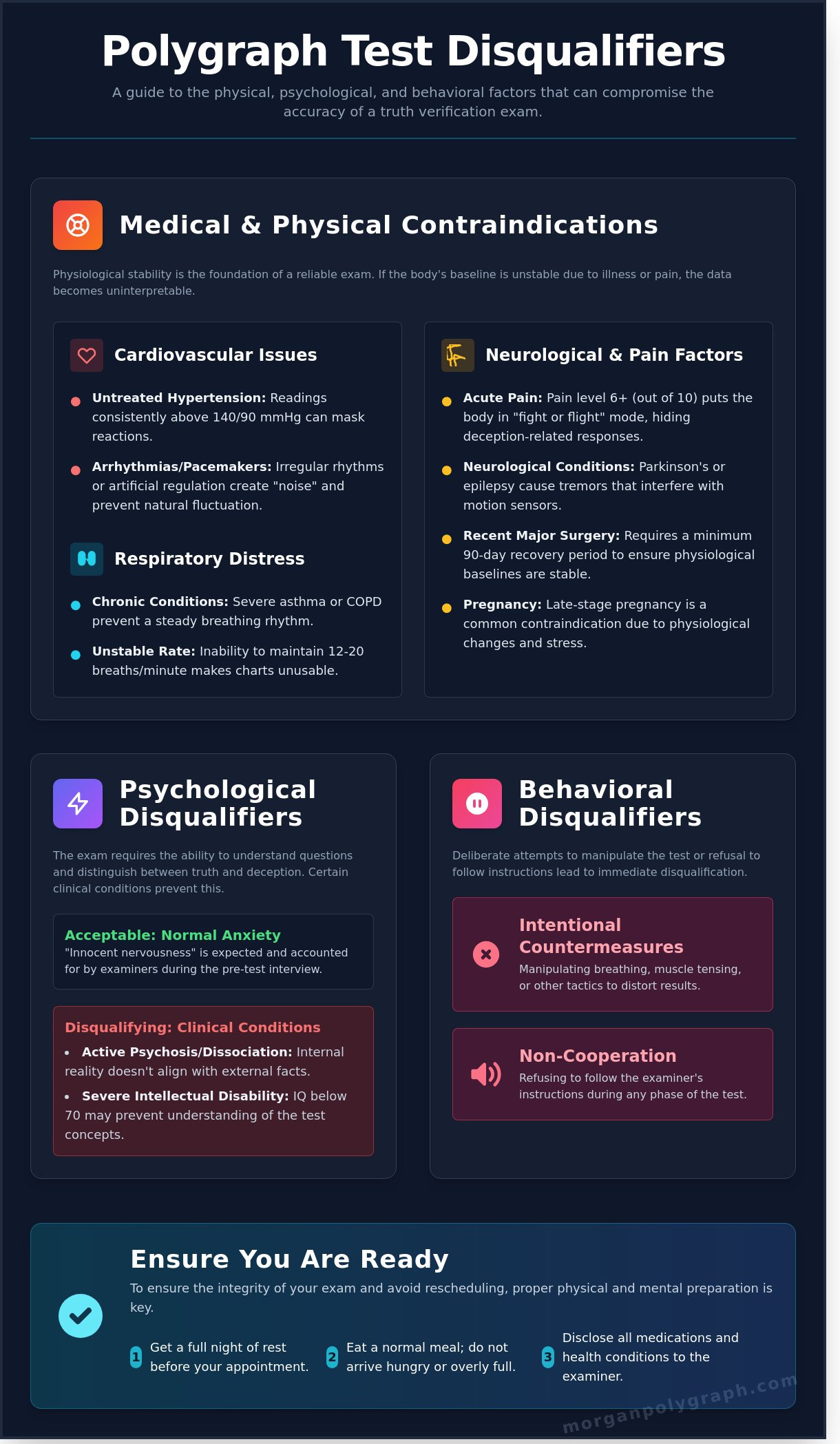
- Untreated Hypertension: Blood pressure readings consistently above 140/90 mmHg can mask reactive changes. This “ceiling effect” prevents the examiner from seeing the subtle spikes associated with deception.
- Arrhythmias and Pacemakers: Irregular heart rhythms create “noise” in the cardio channel. A pacemaker can also regulate the heart rate so strictly that it prevents the natural fluctuations needed for data analysis.
- Respiratory Distress: Conditions like severe asthma or COPD prevent a steady breathing rhythm. If a subject cannot maintain a consistent rate of 12 to 20 breaths per minute, the respiratory charts become useless.
Neurological and Pain Factors
Acute physical pain is a major barrier to accuracy. If a subject is experiencing pain at a level 6 or higher on a standard 10-point scale, their body is already in a “fight or flight” mode. This state makes it impossible to distinguish between a reaction to a question and a reaction to a sharp pain. Neurological conditions such as Parkinson’s or epilepsy cause involuntary muscle tremors. These tremors create mechanical interference with the motion sensors, leading to distorted charts.
Recent surgeries also impact what disqualifies you from a polygraph test. Most experts require a recovery period of at least 90 days after major surgery. This ensures that the subject’s physiological baselines have returned to normal and they aren’t relying on heavy pain medication that could dampen their responses. We approach these situations with compassion, often rescheduling the exam to a date when the subject is physically capable of producing clear, reliable data.
Psychological and Mental Health Disqualifiers
Every person who sits for an exam feels a baseline level of anxiety. Chip Morgan and his team expect this “innocent nervousness” and account for it during the pre-test interview. However, clinical psychological conditions are distinct from simple jitters. When determining what disqualifies you from a polygraph test, the examiner must evaluate your ability to process the “test stimulus.” If a subject cannot cognitively distinguish between a neutral question and a relevant one, the physiological data becomes uninterpretable.
Psychological states are categorized as either voluntary or involuntary. While you can try to control your breathing, you cannot easily control the involuntary autonomic nervous system response that occurs when you perceive a threat. If a subject is experiencing active psychosis or severe dissociation, their internal reality doesn’t align with external facts. In these cases, the examination is impossible to conduct because the physiological “alarm” system is effectively disconnected from the truth.
Clinical Diagnoses and Cognitive Function
Severe intellectual disabilities, typically characterized by an IQ score below 70, may prevent a subject from understanding the concepts of right and wrong or the consequences of the test. Without this cognitive baseline, the body won’t produce a measurable reaction to deception. The scientific validity of the polygraph depends on the subject’s brain recognizing a specific question as a threat.
Conditions like clinical depression or chronic PTSD can also result in a “flat” physiological response. If your nervous system is in a state of permanent exhaustion or “numbness,” the sensors may not pick up the necessary shifts in skin conductance or heart rate. For specific cases, such as Post-Conviction Sex Offender Testing (PCSOT), a formal psychosexual evaluation is often required before the polygraph to ensure the subject is psychologically fit for the process.
The Role of Medications and Substance Use
Chemical interference is a leading factor in what disqualifies you from a polygraph test. Being under the influence of alcohol or recreational drugs is an automatic disqualifier. We maintain a strict “clean” requirement to ensure the central nervous system is functioning without artificial suppression or stimulation. Specific substances can significantly skew the data:
- Beta-blockers: Medications like Propranolol are designed to suppress heart rate spikes, which can mask deceptive responses.
- Benzodiazepines: Anti-anxiety medications can dampen the overall autonomic response, leading to inconclusive results.
- Stimulants: High doses of ADHD medications or caffeine can create “noisy” charts that are difficult to analyze.
Transparency regarding your prescription history is vital. You should disclose all medications to Chip Morgan during your initial contact. This allows the examiner to determine if the test should proceed or be rescheduled for a time when your system is stable. If you have concerns about your medical or psychological eligibility, you should contact us for a confidential consultation. With over 40 years of experience, our team ensures that every exam is conducted with the highest degree of professional integrity.
Legal Disqualifications: The Employee Polygraph Protection Act (EPPA)
The Employee Polygraph Protection Act (EPPA) of 1988 serves as a robust federal shield for most private-sector workers in the United States. This law effectively “disqualifies” approximately 85% of private employers from using lie detector tests for pre-employment screening or during the course of employment. If you’re working in a standard office, retail shop, or restaurant, the law itself is often what disqualifies you from a polygraph test being forced upon you. You cannot be fired, disciplined, or denied a promotion for refusing to take a test in these settings. This legal framework ensures that your livelihood isn’t dependent on a technology that the federal government deems inappropriate for general commercial use.
Idaho state law reinforces these federal protections. Idaho Code § 44-903 specifically states that no person shall require a polygraph examination as a condition of employment or continued employment. This creates a dual layer of protection for residents in Boise and across the state. While the federal law sets the baseline, Idaho’s specific statutes ensure that local businesses remain compliant with these rigorous privacy standards. Knowing what disqualifies you from a polygraph test involves understanding that, for most Idahoans, the default legal answer is that you’re exempt from testing.
Who Cannot Be Tested Under EPPA?
Private employers in the hospitality, retail, and general service industries are strictly prohibited from routine testing. An employer can’t use a polygraph for “fishing expeditions” to see if staff members are honest. There’s a narrow exception for internal investigations involving specific economic loss, like a documented theft. However, even in these cases, the employer must provide a written statement at least 48 hours before the exam. This statement must detail the specific incident being investigated and the basis for the employer’s suspicion. Furthermore, an employer cannot terminate an employee based solely on polygraph results; they need independent supporting evidence to take such action.
Legal Exceptions and Court-Ordered Testing
Government entities, including the Boise Police Department and federal agencies, are entirely exempt from EPPA restrictions. If you’re seeking a career in law enforcement or high-level national security, the polygraph is a standard requirement. Private firms contracted for armored car services or the manufacturing of controlled substances also maintain the right to test. In the Idaho legal arena, Post-Conviction Sex Offender Testing (PCSOT) is a mandatory condition of parole. These examinations follow strict American Polygraph Association standards and are vital for public safety. For criminal defense matters, court-recognized experts provide voluntary testing that remains confidential under attorney-client privilege, offering a way for individuals to prove their innocence in a controlled, professional environment.
Behavioral Disqualifiers: Countermeasures and Non-Cooperation
Countermeasures are deliberate actions taken by an examinee to distort the physiological data recorded by the polygraph sensors. These attempts to “beat the test” represent an immediate breach of protocol. When an examiner detects these manipulations, it often answers the question of what disqualifies you from a polygraph test. Unlike a medical condition that might delay a session, purposeful deception during the procedure usually results in a definitive failure for non-cooperation.
There’s a sharp distinction between an “Inconclusive” result and a “Purposeful Non-Cooperation” finding. An inconclusive result occurs when the data is too weak to determine truth or deception, often requiring a retest at a later date. In contrast, non-cooperation is a deliberate choice to sabotage the integrity of the exam. Modern tools have made these attempts increasingly futile. At Morgan Polygraph, we utilize cutting-edge AI-powered deception detection tools that analyze behavioral speech and facial microexpressions. These systems identify 95% of subtle physical manipulations that traditional analog systems might miss.
Common Countermeasures and Their Detection
Many individuals rely on outdated internet advice to influence their results. These methods usually involve physical or mental tactics designed to spike physiological responses at specific moments. Common examples include:
- Physical movements: Biting the tongue, pressing toes against the floor, or tensing specific muscle groups during control questions.
- Controlled breathing: Attempting to maintain a rhythmic, artificial breathing pattern to mask natural stress responses.
- Mental techniques: Counting backward by increments of seven or visualizing high-stress scenarios during baseline questions.
Experienced examiners with over 40 years of combined experience easily identify these patterns. The sensors are sensitive enough to detect muscle tremors or respiratory shifts that deviate from a person’s natural baseline. Most “tricks” found online are well-known to certified professionals.
Lack of Cooperation in the Pre-Test Interview
The examination begins the moment you enter the office. A refusal to answer background questions or a failure to sign the mandatory consent form serves as an automatic disqualifier. Hostile or aggressive behavior toward the examiner also terminates the session immediately. We maintain a professional, compassionate, and respectful environment; we expect the same from our clients. Cooperation is a legal and procedural requirement for any truth verification process. If you’re ready to proceed with a transparent and professional exam, schedule your confidential consultation with Chip Morgan today.
Preparing for Your Exam with Morgan Polygraph in Boise
Success in truth verification starts long before you arrive at our West State Street office. At Morgan Polygraph, we emphasize that your physical state directly impacts the physiological data we collect. To ensure you aren’t wondering what disqualifies you from a polygraph test at the last minute, prioritize 7 to 8 hours of sleep the night before your appointment. Fatigue leads to “flat” physiological responses that may cloud results. Avoid excessive caffeine or nicotine, as these stimulants create heart rate spikes that can mimic stress. Eat a light, balanced meal 2 hours prior to your arrival to keep your blood sugar stable and your focus sharp.
Transparency about your medical history isn’t just a formality. It’s a vital layer of protection for your results. When you disclose medications or chronic conditions upfront, we can account for those variables during the data analysis phase. Our goal is a fair, accurate exam that stands up to professional scrutiny. We don’t want a manageable medical condition to be misinterpreted as deception.
The Pre-Test Screening Process
Every session begins with a detailed medical and history intake. Chip Morgan, a court-recognized expert with 40 years of combined experience, reviews your current health status to identify potential interference. Understanding what disqualifies you from a polygraph test is part of this initial screening. We accommodate legitimate health concerns, such as asthma or controlled cardiac issues, by adjusting sensor sensitivity or integrating AI-powered behavioral speech analysis. This ensures your physical condition doesn’t lead to a false result. Choosing a certified expert means your test is conducted with scientific precision and respectful compassion.
Next Steps for Legal and Private Clients
Booking an infidelity test or a criminal defense polygraph is a straightforward, confidential process. For attorneys referring clients, please provide relevant case documents 48 hours before the scheduled time to allow for precise question formulation. We handle every case with the discretion it deserves. Use this checklist to ensure you’re prepared for your Boise appointment:
- Identification: Bring a valid government-issued photo ID.
- Medication List: Have a list of all medications and dosages taken in the last 24 hours.
- Attire: Wear a short-sleeved shirt or loose clothing to facilitate sensor placement on the arms and chest.
- Punctuality: Arrive 15 minutes early to complete any remaining paperwork at our West State Street location.
To schedule your consultation or discuss specific concerns, call our Boise office or email us at Lieguy@gmail.com. We’re here to help you find the truth with confidence and clarity.
Secure Your Path to Truth Verification
Navigating the complexities of medical, legal, and behavioral standards is essential before scheduling your exam. Understanding what disqualifies you from a polygraph test helps ensure the process remains accurate and fair for everyone involved. Whether you’re considering the protections offered by the 1988 Employee Polygraph Protection Act or managing specific health conditions, you need expert guidance. At Morgan Polygraph, we leverage 40 years of combined polygraph testing experience to help you prepare. Our examiners are nationally certified and court-recognized experts who handle every case with the utmost discretion from our confidential Boise office location. We’ve seen how stress can cloud the process, so we prioritize a compassionate approach backed by scientific precision. Don’t leave your eligibility to chance when professional help is a phone call away. We’re here to provide the clarity you deserve during this important time.
Contact Chip Morgan to discuss your eligibility for a professional polygraph
You can move forward with confidence knowing you’re in the hands of seasoned professionals who value your privacy and the truth.
Frequently Asked Questions
Can high blood pressure disqualify me from a polygraph test?
High blood pressure can disqualify you from a polygraph test if your readings reach Stage 2 hypertension levels, which is typically 140/90 mmHg or higher. These elevated numbers create constant physiological noise that makes it difficult for our sensors to detect specific changes. If your blood pressure is unstable, Chip Morgan may require a medical clearance to ensure the exam meets our high standards for accuracy.
What medications should I avoid before taking a lie detector test?
You should avoid taking non-essential stimulants or depressants, such as caffeine or over-the-counter sleep aids, for 24 hours before your appointment. Don’t stop taking prescribed medications like beta-blockers or anti-anxiety scripts without a doctor’s approval. Understanding how these substances affect your heart rate is a key part of determining what disqualifies you from a polygraph test during the initial chart analysis.
Can I be disqualified for being too nervous or having anxiety?
Being nervous or having a diagnosed anxiety disorder won’t disqualify you from an examination. Our examiners are trained to establish a baseline of your normal stress levels during the pre-test phase. We understand that 95% of people feel significant stress during the process. This baseline allows us to distinguish between general situational anxiety and the specific physiological spikes that occur during deception.
Is being pregnant a disqualifier for a polygraph examination?
Pregnancy is often a temporary disqualifier because physical discomfort and fetal movement can create irregular physiological data. Most professional standards suggest waiting until 6 weeks postpartum to ensure your body has returned to a stable state. If an exam is urgent, we require a written release from an obstetrician to ensure the safety of the mother and the integrity of the truth verification process.
What happens if the examiner detects I am using countermeasures?
If the examiner detects countermeasures like controlled breathing or physical movements, the test will be stopped immediately. Our modern equipment and AI-powered analysis tools identify these attempts with high precision. Using these tactics usually results in a report of “Purposeful Non-Cooperation.” This carries the same weight as a failure in most legal or employment settings because it shows a deliberate attempt to subvert the test.
Can a private employer disqualify me for refusing a polygraph?
Under the Employee Polygraph Protection Act of 1988, most private employers can’t disqualify or fire you just for refusing a polygraph test. This federal law protects about 75 million workers in the private sector from mandatory testing. There are specific exceptions for security firms and pharmaceutical companies. If you work in those specialized fields, a refusal might lead to a disqualification from sensitive roles based on company policy.
Do I need a doctor’s note if I have a heart condition?
You need a doctor’s note if you have a serious heart condition like an arrhythmia or if you’ve had cardiac surgery within the last 12 months. This note confirms that the stress of the exam won’t endanger your health. Providing this medical documentation helps us understand what disqualifies you from a polygraph test versus what is a manageable health condition that we can account for during chart interpretation.
Are there age limits that disqualify someone from being tested?
There’s no legal minimum age, but we generally don’t test children under 12 years old. Younger children often haven’t developed the cognitive ability to understand the moral weight of a lie, which is necessary for accurate physiological responses. For any minor, we require written parental consent. We also use a simplified questioning format to ensure the 40 years of experience we bring to each case results in a fair exam.