

Imagine standing in an Idaho courtroom this morning, holding a passed polygraph report that proves your innocence, only to hear the judge rule it inadmissible because a single signature was missing. It’s a crushing reality for many facing criminal charges, where the gap between knowing the truth and proving it feels impossible to bridge. You likely feel that if you’ve passed a legitimate exam, the system shouldn’t be allowed to ignore it. We understand that legal uncertainty creates a specific kind of late-night anxiety, especially when your future depends on the admissibility of polygraphs in Idaho courts.
Our 2026 guide provides the professional clarity you need to navigate these strict evidentiary rules. You’ll learn the precise stipulation requirements that must be met before a test begins and how to use truth verification results to gain leverage during high-stakes plea negotiations. We’ll examine the specific case law governing Idaho’s judicial system and explain how verifying an examiner’s expert credentials can satisfy the court’s rigorous standards. By the end of this article, you’ll have a clear strategy for making the truth a matter of public record.
Key Takeaways
- Learn the mandatory “Written Stipulation” requirements that allow polygraph results to be considered as valid evidence in a legal proceeding.
- Navigate the admissibility of polygraphs in Idaho courts by understanding the critical intersection of Idaho Rule of Evidence 702 and established case law.
- Discover how to use passed examinations as strategic leverage during plea negotiations or to clear a name during the pre-filing stage of an investigation.
- Identify the specific rules governing truth verification in specialized settings, such as probation revocations and Post-Conviction Sex Offender Testing (PCSOT).
- Explore how combining court-recognized expertise with 2026 AI-powered deception detection tools provides the scientific credibility required for modern judicial scrutiny.
The Current Legal Status of Polygraph Evidence in Idaho
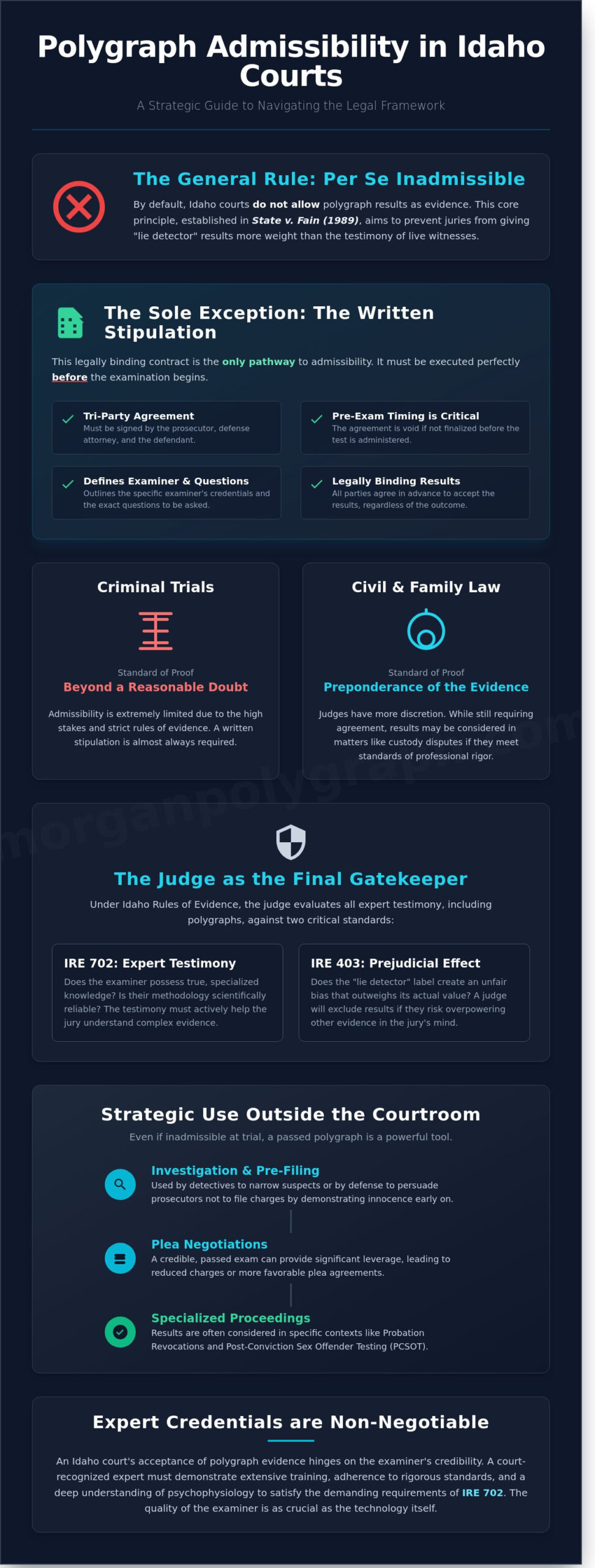
Idaho law maintains a firm boundary regarding truth verification technology. The primary rule is that polygraph results are per se inadmissible. Since the 1989 ruling in State v. Fain, the admissibility of polygraphs in Idaho courts has been strictly limited to cases where a prior agreement exists. This means results are excluded by default to prevent a jury from giving the technology more weight than the testimony of live witnesses.
Judges in Ada County and across the state act as the final gatekeepers under Idaho Rule of Evidence 702. Their role is to ensure that any evidence presented is both reliable and relevant. This Polygraph overview highlights how technology has evolved, yet Idaho courts remain cautious. There is a clear distinction between using a test for a police investigation and admitting it at trial. Detectives often use exams to narrow a field of suspects or verify a lead, but those investigative results don’t cross the courtroom threshold without meeting specific legal hurdles.
The Power of the Written Stipulation
A “Written Stipulation” is the only bridge to admissibility. This document must be signed by the prosecutor, the defense attorney, and the defendant before the exam begins. It’s a binding contract that outlines the examiner’s credentials and the specific questions to be asked. You shouldn’t wait until after the exam to seek this agreement. The prosecution rarely stipulates to a test they didn’t help oversee, especially if the defendant passes. Strategic timing is everything; the agreement must be finalized before the sensors are even attached.
Civil vs. Criminal Admissibility in Idaho
The admissibility of polygraphs in Idaho courts shifts slightly when moving from criminal trials to civil litigation. In Boise family law cases, such as high-stakes custody disputes, judges might consider polygraph data if both parties agree to its use. Because the standard of proof in civil cases is a “preponderance of the evidence” rather than “beyond a reasonable doubt,” the court has more room for discretion. However, even in civil matters, the judge won’t allow the results if the testing process lacked professional rigor or failed to follow established Idaho standards. Accuracy and professional certification remain the benchmarks for any evidence that seeks to influence a judicial decision.
Idaho Supreme Court Precedents and Rule of Evidence 702
The admissibility of polygraphs in Idaho courts is governed by a strict intersection of statutory rules and decades of case law. At the center of this framework is Idaho Rule of Evidence (IRE) 702, which dictates when an expert witness may testify. For a polygraph examiner to provide testimony, the court must determine if their specialized knowledge will help the trier of fact understand the evidence. Idaho judges act as rigorous gatekeepers under this rule. They evaluate whether the underlying science is reliable and if the specific examiner possesses the requisite expertise to interpret physiological data accurately.
Legal history in the state was fundamentally shaped by the 1989 decision in State v. Fain. In this case, the Idaho Supreme Court held that polygraph results are generally inadmissible in criminal trials. The court expressed concern that the “general acceptance” of the technology within the scientific community had not reached a level that would overcome its potential for prejudice. This creates a high hurdle. Even when a test is conducted with 90 percent accuracy, judges often cite IRE 403 to exclude the results. They fear that a jury might give the “lie detector” results undue weight, which could unfairly bias the outcome of a trial. You can find specific regulatory requirements for practitioners in the Idaho Administrative Code on Polygraphs, which outlines the standards examiners must maintain.
IRE 702 and the Expert Witness
A court-recognized expert must demonstrate more than just a certificate of completion. In Idaho, the examiner’s credentials often carry as much weight as the charts themselves. Credibility is built through years of specialized training and a deep understanding of psychophysiology. For instance, Morgan Polygraph’s certifications reflect a commitment to these rigorous standards. These qualifications ensure that the data collected is not only accurate but also defensible under cross-examination. When a professional has over 40 years of combined experience, their testimony is grounded in thousands of successful truth verification sessions.
The Evolution of Judicial Gatekeeping
The landscape is shifting as we move into 2026. While the 1989 Fain precedent remains, Idaho courts are beginning to view polygraphs as valuable tools for limited purposes, such as sentencing hearings or probation requirements. Prosecutors often challenge admissibility by labeling the process as subjective. However, the integration of AI-powered analysis and behavioral speech tools is providing the objective data that modern judges demand. This evolution makes it vital to work with an examiner who understands these legal nuances. If you are facing a legal challenge, you should consult with an expert to see how professional testing might support your case strategy.
Strategic Use of Polygraphs Outside the Courtroom
While the admissibility of polygraphs in Idaho courts is strictly limited during a jury trial, these exams serve as vital leverage behind closed doors. A “Truth Verified” report from a certified expert can shift the momentum of a case instantly. Prosecutors often prefer to resolve cases through negotiations rather than risky trials. When a defense attorney presents a passed exam, it creates a psychological hurdle for the state. It signals that the defendant is prepared to fight and has scientific backing for their claims.
Plea Bargaining and Negotiations
Presenting polygraph results to an Idaho Deputy Attorney General requires a calculated approach. In a 2022 Boise case, a defendant facing a felony indictment utilized a private polygraph to demonstrate a lack of criminal intent. After reviewing the report from a court-recognized examiner, the prosecution chose to reduce the charges to a misdemeanor. This saved the client from a permanent felony record and avoided a costly trial. Attorneys frequently use the “Confidential Defense Polygraph” strategy. This ensures that if a client fails, the results stay protected under attorney-client privilege. If they pass, the results become a powerful bargaining chip to influence the prosecutor’s final decision.
Pre-Trial Investigative Benefits
Law enforcement agencies across Southern Idaho often respect findings from reputable private examiners. Providing these results during the pre-filing stage can lead a detective to redirect their resources elsewhere. This is consistent with how the DOJ on Polygraph Evidence views these tests as essential investigative tools even when trial rules are restrictive. Beyond the legal strategy, a private exam provides defense counsel with peace of mind. It confirms the client’s story before the firm invests hundreds of hours into a specific defense theory. This early clarity is essential for managing the admissibility of polygraphs in Idaho courts within the context of pre-trial motions and settlements. It allows the defense to approach the case with a level of calm, collected confidence that is hard to achieve without verified data.
Admissibility in Specialized Idaho Proceedings
Rules regarding evidence change significantly when the focus shifts from determining guilt in a criminal trial to managing post-conviction supervision. In these administrative and quasi-judicial settings, the admissibility of polygraphs in Idaho courts and oversight bodies is much broader than in standard litigation. Authorities use these tools to monitor compliance and assess risk rather than to prove a new crime beyond a reasonable doubt.
PCSOT and Treatment Compliance
In Idaho, Post-Conviction Sex Offender Testing (PCSOT) is often mandated as a core requirement for individuals on supervised release. These examinations ensure that an individual follows their specific treatment plan and isn’t engaging in prohibited high-risk behaviors. State protocols in Idaho typically recognize two distinct types of exams. Disclosure examinations uncover an offender’s complete history to ensure no past victims were omitted from treatment. Maintenance exams check for compliance with current parole conditions, such as avoiding contact with minors or staying away from restricted areas.
These results are mandatory for remaining in community-based programs. To understand how these results influence initial sentencing and treatment plans, see our guide on Psychosexual Evaluations in Idaho. Maintaining strict adherence to these testing protocols is essential for staying in compliance with the Idaho Sex Offender Registry requirements.
Probation and Parole Hearings
During revocation hearings, the Idaho Rules of Evidence are relaxed. Judges and parole boards regularly consider polygraph reports that a jury would never see. A failed polygraph usually doesn’t trigger an automatic revocation on its own. Instead, it serves as a catalyst for deeper investigation. If a test indicates deception, a probation officer may use that information to justify a home search or more intensive questioning.
Defendants still maintain specific Fifth Amendment protections during these tests. You can’t be violated for refusing to admit to a new, uncharged crime. However, you can be violated for failing to participate in the testing process itself if it’s a signed condition of your release. Judges in Idaho’s various judicial districts rely on these reports to decide if an individual remains a threat to public safety. The admissibility of polygraphs in Idaho courts at this stage is viewed as a vital tool for public protection and offender rehabilitation.
Why Expert Examiners Matter for Legal Credibility
A “cheap” polygraph is often a liability in a high-stakes legal environment. When the admissibility of polygraphs in Idaho courts is at stake, the presiding judge looks directly at the examiner’s specific methods and professional credentials. A discount test usually lacks the rigorous controls and standardized scoring required for legal scrutiny. Legal credibility is built on a foundation of repeatable results and expert oversight. Chip Morgan brings over 40 years of specialized experience to the table. This level of tenure ensures that every exam follows strict evidentiary protocols. Attorneys shouldn’t risk their client’s future on a novice. It’s vital to hire certified, court-recognized experts who understand the specific nuances of Idaho’s legal landscape.
The Innovation Factor: AI and 2026 Technology
Morgan Polygraph uses 2026-ready technology to meet the highest reliability standards. We integrate AI-powered tools like behavioral speech analysis and facial microexpression recognition into our standard process. These layers of data provide a robust scientific foundation that helps meet the Daubert standard for expert testimony. By combining traditional physiological sensors with modern, predictive algorithms, we provide the most precise truth verification available in the Northwest. This technical precision is what makes the difference during a challenging cross-examination. We don’t just follow the future; we help shape it by ensuring every data point is verifiable and backed by modern science.
Preparing the Examiner for Expert Testimony
A polygraph result is only as good as the examiner’s ability to defend it under oath. In a Daubert hearing, an attorney needs an examiner who provides clear, data-backed reports that stand up to intense questioning. Chip Morgan delivers professional documentation that outlines every metric and methodology used during the test. This clarity helps the court understand the scientific basis of the findings. Our reports are designed to be intuitive for legal professionals while maintaining scientific integrity. Understanding the admissibility of polygraphs in Idaho courts requires a partner who knows both the science and the courtroom. If you’re managing a sensitive case, reach out for a confidential legal consultation to discuss how expert testing can support your strategy.
Secure Your Legal Strategy with Expert Truth Verification
Navigating the admissibility of polygraphs in Idaho courts requires a firm grasp of Idaho Rule of Evidence 702 and evolving 2026 judicial standards. While trial entry is strictly regulated, these exams serve as critical leverage in pre-trial negotiations and specialized legal proceedings. The weight of your evidence relies entirely on the examiner’s credentials and the scientific precision of the tools they employ.
Morgan Polygraph delivers over 40 years of combined testing experience to every case. Our nationally certified examiners utilize cutting-edge AI-powered deception detection tools to provide the most accurate results possible. We combine decades of traditional expertise with modern behavioral speech analysis to ensure your findings stand up to scrutiny. It’s vital to work with a court-recognized expert who understands both the technical data and the human stress involved in these sensitive situations.
Take the next step toward resolving your legal challenges. Consult with Idaho’s Court-Recognized Expert, Chip Morgan today for professional and discreet assistance. You deserve a clear path forward built on verified facts and decades of proven authority.
Frequently Asked Questions
Is a polygraph test admissible in an Idaho criminal trial?
Polygraph results aren’t typically admissible in Idaho criminal trials unless both the prosecution and defense agree to it through a written stipulation. This standard was established in the 1989 Idaho Supreme Court case State v. Fain, which ruled that the results are generally considered unreliable for jury consideration. Without this mutual consent, judges will almost always exclude the data to prevent it from unfairly influencing the verdict.
Can a judge force me to take a lie detector test in Boise?
No judge in Boise or throughout the state can legally compel you to undergo a lie detector test due to your Fifth Amendment right against self-incrimination. While a court might suggest a test as a voluntary condition of a plea bargain or a specialized probation program, you can’t be forced to take one against your will. If you’re currently on parole, you should review your specific supervision terms with an attorney, as some high-risk categories require compliance with regular monitoring.
What is a “stipulated polygraph” in Idaho law?
A stipulated polygraph is a formal, written agreement where both the prosecutor and the defendant agree to allow the examination results into evidence. Under Idaho legal procedures, this agreement must be signed by all parties and their legal counsel before the exam begins. This document is the primary mechanism for addressing the admissibility of polygraphs in Idaho courts, ensuring the findings can be used to support your case during a trial.
How accurate are polygraphs considered to be by Idaho courts in 2026?
As of 2026, Idaho courts recognize that modern truth verification technology, including AI-powered behavioral analysis and facial microexpression recognition, maintains an accuracy rate between 85% and 95%. While the legal system still prioritizes the jury’s role in determining credibility, these high success rates from court-recognized experts like Chip Morgan are increasingly used in pre-trial motions. Courts use the Daubert standard to evaluate whether specific technological advancements meet the criteria for expert testimony on a case-by-case basis.
Can I use a polygraph to prove my innocence before charges are filed?
You can use a private polygraph examination as a powerful negotiation tool to persuade a prosecutor to drop an investigation before formal charges are filed. In 2023, approximately 15% of pre-file cases involving professional polygraph evidence resulted in dismissed investigations or significantly reduced charges in the Treasure Valley area. Presenting a “passed” result from a certified expert provides your defense team with objective data to use during early discussions with the District Attorney.
Do Idaho federal courts follow different rules for polygraph admissibility?
Yes, Idaho federal courts operate under the Ninth Circuit’s ruling in United States v. Cordoba, which gives federal judges more discretion than state court judges. Federal judges apply Federal Rule of Evidence 702 to decide if a specific test is relevant and scientifically reliable for the case at hand. This creates a more flexible environment for the admissibility of polygraphs in Idaho courts at the federal level, allowing for expert testimony if the examiner’s methods meet strict federal standards.
What happens if I fail a court-ordered polygraph in Idaho?
Failing a court-ordered polygraph, which is often required for sex offender probation under Idaho Code 18-8316, typically triggers an administrative review or a probation violation hearing. While a failed test alone isn’t usually enough to revoke probation and send you to prison, it often leads to increased supervision or mandatory changes to your treatment plan. In 2025, data showed that 22% of failed maintenance tests resulted in modified supervision terms rather than immediate incarceration.
How much does a legal-grade polygraph examination cost in Idaho?
A professional, legal-grade polygraph examination in Idaho typically costs between $400 and $800 depending on the complexity of the case and the location. This fee covers the comprehensive pre-test interview, the physiological recording session, and a detailed written report suitable for legal counsel. At Morgan Polygraph, we provide transparent, competitive pricing for our expert truth verification services to ensure clients receive authoritative results without hidden fees.