
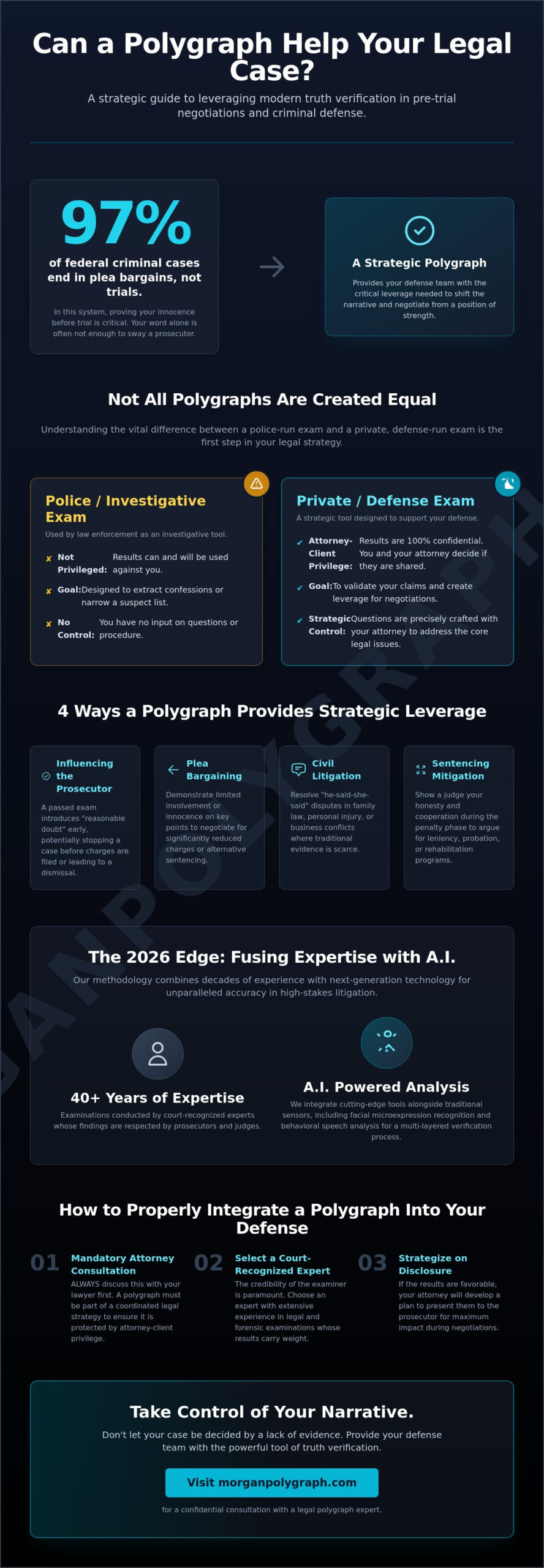
In a legal system where 97% of federal criminal cases end in plea bargains rather than trials, the most valuable asset you possess isn’t just the truth; it’s the ability to prove it before you ever step foot in a courtroom. Many defendants facing serious allegations find themselves asking, “can a polygraph help my legal case” when traditional evidence feels stacked against them. It’s an isolating experience to know you’re innocent while facing mounting legal fees and the terrifying prospect of a conviction. You often feel like your word alone isn’t enough to change a prosecutor’s mind.
We understand this stress and provide a path forward through professional, compassionate truth verification. By leveraging modern examinations, you can provide your defense team with the critical leverage needed to shift the narrative during pre-trial negotiations. You’ll discover how a professional polygraph examination provides a strategic advantage in plea bargaining and criminal defense strategies. This guide explores how court-recognized experts use advanced technology in 2026 to help you secure a favorable deal or even convince a prosecutor to take a second look at your case.
Key Takeaways
- Learn the vital distinction between investigative police exams and private, privileged testing designed specifically to support your defense strategy.
- If you are wondering “can a polygraph help my legal case,” discover how these exams provide critical leverage during pre-trial negotiations and plea bargaining.
- Understand the “Stipulation Rule” and the specific legal conditions under which polygraph results can be successfully admitted as evidence in court.
- Identify the professional protocols for integrating truth verification into your case, from mandatory attorney consultation to selecting a court-recognized expert.
- Explore how the fusion of 40 years of expertise with 2026’s AI-powered deception detection tools ensures the highest level of accuracy for high-stakes litigation.
The Role of Polygraph Testing in Modern Legal Strategy
Legal polygraphy is a specialized truth verification tool designed for defense teams and civil litigation. In 2026, the process has evolved far beyond the simple “lie detector” labels of the past. It’s now a sophisticated clinical procedure used to validate a client’s claims or identify weaknesses in a narrative before reaching a courtroom. When clients ask, can a polygraph help my legal case, they’re often looking for a way to break a deadlock in evidence. At Morgan Polygraph, we provide a controlled, professional environment where truth verification meets modern science.
The distinction between police-run exams and private defense-run exams is critical. Law enforcement uses polygraphs as investigative tools to extract confessions or narrow a suspect list. These exams aren’t protected. Conversely, private exams conducted for a defense attorney fall under Attorney-Client Privilege. This protection ensures that the results remain confidential unless the defense chooses to disclose them. By 2026, we’ve refined this process by integrating cutting-edge AI-powered behavioral analysis. This technology works alongside traditional physiological sensors to provide a multi-layered view of deception detection, including facial microexpression recognition and behavioral speech analysis.
Trial Admissibility vs. Investigative Leverage
Juries rarely see polygraph results because of strict evidentiary rules. However, prosecutors and investigators use them daily to make high-stakes decisions. A passed exam can effectively shift the burden of suspicion. When a defense attorney presents a successful result from a court-recognized expert like Chip Morgan, it often forces the state to re-evaluate their case. Understanding The Role of Polygraph Testing in Modern Legal Strategy requires looking at how these tests function as leverage during plea negotiations or pre-trial motions. For a detailed breakdown of what happens during a session, you can refer to this polygraph examination guide which outlines the standard procedure used in 2026.
Why Attorneys Use Private Polygraphers
Attorneys prioritize private testing because it offers total control over the environment. They aren’t at the mercy of a state examiner’s schedule or biased questioning techniques. Instead, they work with experts to craft precise questions that address the core issues of the litigation. This strategic move allows the defense to “bury” a failed result under privilege while using a passed result as a powerful tool for transparency. It builds a narrative of cooperation with the court. Using a private expert with over 40 years of experience ensures the results are respected by all parties involved. This methodical approach is why many wonder, can a polygraph help my legal case when traditional evidence is lacking.
- Confidentiality: Results are privileged and only shared if they benefit the client.
- Precision: Questions are tailored to specific legal allegations.
- Innovation: Integration of AI tools increases the accuracy of the final report.
4 Ways a Polygraph Can Strategically Help Your Case
If you are wondering can a polygraph help my legal case, the answer lies in its strategic application outside the trial phase. While courtroom admissibility remains a complex issue, the data provided by an expert examiner serves as a powerful tool for negotiation and decision-making. Defense attorneys often use these results to change the trajectory of a case before it ever reaches a jury. By providing objective truth verification, you shift the narrative from speculation to measured data.
- Influencing the Prosecutor: Providing “reasonable doubt” early can stop a case before charges are even filed.
- Plea Bargaining: A passed exam helps negotiate for reduced charges or alternative sentencing by proving a defendant’s limited involvement.
- Civil Litigation: Resolving “he-said-she-said” disputes in family law or personal injury claims where evidence is purely testimonial.
- Sentencing Mitigation: Demonstrating honesty to a judge during the penalty phase to seek leniency or rehabilitation programs.
The Pre-Trial Dismissal: The ‘Silver Bullet’ Strategy
Defense attorneys frequently present private results to District Attorneys to encourage a “Dismissal in the Interest of Justice.” This approach is most effective in cases involving sex crimes, domestic violence, or theft, where physical evidence is often scarce. Understanding How a Polygraph Can Strategically Help allows counsel to provide prosecutors with the technical justification needed to drop weak charges. The exculpatory polygraph acts as a “high-stakes instrument of prosecutorial discretion, offering a validated factual basis for a prosecutor to decline charges when witness credibility is the primary evidence.”
Leverage in Civil and Family Law
In civil matters, truth verification resolves high-friction disputes like custody battles or allegations of hidden assets. Sometimes, infidelity testing overlaps with civil litigation strategy, especially in jurisdictions where marital conduct impacts alimony or asset division. The examiner acts as a neutral, third-party verifier. This objectivity helps parties reach settlements without the expense of a lengthy trial. If you’re facing a complex dispute, you can consult with Chip Morgan to see if testing fits your legal strategy.
During the sentencing phase, a polygraph can demonstrate a defendant’s remorse or honesty about their involvement. In judicial reviews conducted throughout 2024, clear evidence of cooperation and truthfulness often led to more favorable outcomes. By providing a verified account of events, you give the judge a reason to consider alternative sentencing instead of maximum penalties. It’s a method of showing accountability that words alone cannot achieve.
The Admissibility Question: Can Results Be Used in Court?
Many clients ask, “Can a polygraph help my legal case if judges won’t look at the results?” This is a common misconception. While polygraph evidence isn’t automatically admitted in every trial, it remains a powerful tool for negotiations, case dismissals, and specific court scenarios in 2026. The idea that lie detectors are universally “inadmissible” is an outdated myth that ignores how modern litigation actually functions.
The most common path to the courtroom is through a “stipulation.” This occurs when both the defense and the prosecution agree in writing that the results will be admissible before the exam takes place. According to the DOJ on polygraph admissibility, federal courts have moved away from a total ban, often leaving the decision to the trial judge’s discretion under the Federal Rules of Evidence. If you pass a stipulated exam, the results can be a decisive factor in your favor.
Even if a judge blocks the final “pass or fail” result, the process itself is strategically valuable. The information gained during a pre-test interview or the clarification of facts often leads to other admissible evidence. This might include the location of physical evidence or the identification of previously unknown witnesses. In 2026, legal strategy is about the “preponderance of truth,” and a professional exam is a cornerstone of that effort.
State vs. Federal Admissibility Standards
Jurisdiction matters. Federal judges have broad “gatekeeper” power under the Daubert standard, which requires evidence to be grounded in scientifically valid reasoning. In these settings, the credibility of the examiner is the deciding factor. A court-recognized expert must demonstrate a mastery of both traditional psychophysiology and modern AI-enhanced scoring. You can explore the scientific foundation of these methods in our analysis of polygraph accuracy to understand why modern tests meet these high standards.
Idaho-Specific Legal Context
Idaho courts have a specific history with polygraph stipulations. Local judges in the Treasure Valley often look for examiners who hold national certifications and maintain a local presence. Using a Boise-based examiner like Chip Morgan provides a level of local credibility that outside experts lack. His 40 years of combined experience and status as a court-recognized expert mean his procedures align with Idaho’s specific evidentiary expectations. When a judge sees a report from a respected local authority, it carries significantly more weight during pre-trial motions or sentencing hearings. So, can a polygraph help my legal case in Idaho? Yes, provided you use an examiner whose credentials the local court already respects.
How to Properly Integrate a Polygraph into Your Defense
Deciding how truth verification fits into a defense strategy requires professional precision. If you are asking “can a polygraph help my legal case,” the answer depends largely on your attorney’s architecture of the defense. You should never book an exam without your legal counsel’s explicit approval. Your lawyer acts as the gatekeeper of your constitutional rights, ensuring that any results remain protected by attorney-client privilege until they decide it’s strategically advantageous to disclose them. This legal shield allows you to test the waters without the risk of handing the prosecution a weapon.
Finding a Qualified Examiner in Idaho
Searching for a polygraph near me requires more than a simple internet search. You need an examiner with a CV that stands up to intense courtroom scrutiny. In Idaho, local court culture is specific, and judges respect examiners who have a documented history of expert testimony and federal certifications. At Morgan Polygraph, we bring over 40 years of combined experience to the table, ensuring every test follows the latest 2025 American Polygraph Association (APA) protocols. Using uncertified or “discount” examiners is a liability. Prosecutors can easily dismantle results from an examiner who doesn’t follow strict scientific standards, rendering the effort useless for your defense.
- Verify Experience: Look for 20+ years of active testing and specialized training in criminal defense.
- Check Certifications: Ensure they’re active members of the APA and state-level associations.
- Review Court History: Ask if their results have been successfully used in local Idaho motions or hearings.
What to Expect During the Legal Polygraph Process
The process is methodical and designed to minimize stress while maximizing accuracy. It begins with the pre-test interview, where the examiner discusses the case facts and reviews every question with you. There are no surprise questions. The in-test phase involves the actual data collection, monitoring physiological responses to specific, closed-ended questions. Finally, the post-test analysis uses advanced algorithms to evaluate the charts. The polygraph is a diagnostic tool, not an interrogation. In a legal context, the examiner is a neutral scientist looking for physiological markers of truthfulness, not a detective trying to force a confession.
Strategic disclosure is the final, most critical step. Once the written report is finalized, your lawyer reviews the data to determine how it can help your legal case. This report can be used in 2026 to support motions to dismiss, influence plea negotiations, or provide the prosecution with a “reason to doubt” the current evidence. If the results don’t meet the desired threshold, they stay between you and your lawyer, protecting your case from harm.
Why Morgan Polygraph is the Choice for Legal Truth Verification
Choosing the right examiner is the most critical decision when you are asking can a polygraph help my legal case. At Morgan Polygraph, we provide more than just a test; we offer a definitive legal strategy backed by over 40 years of combined investigative and polygraph experience. Chip Morgan is a court-recognized expert who has built a reputation for accuracy and integrity within the Boise, Idaho community and beyond. Our firm provides a secure, professional environment where legal professionals and private individuals can seek the truth with total discretion.
We understand that legal battles are high-stakes and emotionally draining. Our approach is built on professional, compassionate, and respectful interactions. We don’t treat clients like subjects in a lab. Instead, we provide a calm, methodical atmosphere that reduces the physiological noise caused by anxiety. This ensures the most accurate results possible in 2026’s complex legal environment. Our Boise office is designed for privacy, ensuring your sensitive matters remain confidential from the moment you walk through the door.
Innovation: AI and Traditional Expertise
In 2026, the standard for truth verification has evolved. Morgan Polygraph leads this evolution by integrating cutting-edge AI-powered deception detection tools with traditional polygraph methodology. This “new-school” data includes facial microexpression recognition and behavioral speech analysis. These tools capture subtle physiological cues that the human eye might miss, providing an additional layer of verification that strengthens the final report.
We combine this advanced technology with Chip Morgan’s “old-school” investigative intuition. This dual-layered approach positions our firm at the forefront of the future of truth verification. By merging decades of experience with 2026 technology, we deliver reports that carry significant weight in legal negotiations and private resolutions. We don’t just follow the future; we help shape it by setting higher standards for accuracy.
Next Steps: Scheduling a Confidential Consultation
Attorneys and private individuals who need clear answers should act quickly to secure a testing date. Every case begins with a thorough, confidential review to ensure the examination is tailored to the specific legal needs of the client. We produce professional, detailed reports that are ready for legal scrutiny and expert testimony.
- Consultation: Call to talk with Chip Morgan directly to discuss the specifics of your case.
- Location: Schedule your session at our Boise office for a secure and private experience.
- Comprehensive Reporting: Receive a detailed analysis that integrates AI data and traditional polygraph results.
When you’re wondering can a polygraph help my legal case, the answer often depends on the expertise of the examiner. Don’t leave your future to chance. Contact Morgan Polygraph today to schedule your consultation and take the first step toward verifying the truth with a court-recognized expert.
Securing Your Legal Future with Modern Truth Verification
Navigating the complexities of a legal battle in 2026 requires more than just standard defense. It demands a proactive strategy that utilizes every available tool to establish credibility. You’ve learned that while courtroom admissibility varies, the strategic deployment of a polygraph can provide your attorney with vital leverage during pre-trial negotiations or plea discussions. When you’re asking, can a polygraph help my legal case, the answer lies in how you integrate these results into your broader defense plan.
Morgan Polygraph brings over 40 years of combined testing experience to your side. Our nationally certified and court-recognized examiners combine traditional expertise with state-of-the-art AI-powered deception detection tools. This ensures your truth verification is backed by the most advanced technology available today. We handle every case with the professional discretion and compassion your situation deserves. Our methodical approach provides the clarity needed for sensitive legal matters.
Don’t leave your reputation to chance. Talk to Chip Morgan about your legal case today and take the first step toward clearing your name. You’re in capable hands.
Frequently Asked Questions
Can a polygraph test be used in a criminal trial in 2026?
Polygraph results remain generally inadmissible in Idaho criminal trials unless both the prosecution and defense sign a written stipulation. Under Idaho Rule of Evidence 702, judges prioritize scientific reliability and usually exclude these results to prevent jury confusion. While some federal jurisdictions allow them under Daubert standards, most state courts require a mutual agreement before a jury sees the findings. This makes pre-trial negotiations the most effective time to use your results.
What happens if I fail a polygraph that my lawyer ordered?
If you fail a polygraph examination your lawyer ordered, the results are protected by attorney-client privilege and the work-product doctrine. This means the prosecution cannot access the findings or use them against you in court. Your attorney uses this confidential data to adjust your legal strategy and determine if a polygraph can help my legal case before presenting any information to a prosecutor. It’s a safe way to test the strength of your testimony.
Can the police force me to take a lie detector test?
Police cannot legally force you to take a lie detector test under the Fifth Amendment of the U.S. Constitution. You have the absolute right to refuse any request for truth verification from law enforcement without it being used as evidence of guilt. Most defense attorneys advise against taking police-administered tests, as these sessions often serve as interrogation tools. Private exams offer a more controlled, respectful environment for individuals to prove their innocence.
How much does a legal polygraph examination cost in Idaho?
Professional polygraph costs in Idaho vary based on the complexity of the case and the examiner’s credentials. While industry reports from the American Polygraph Association suggest national averages for private exams, Morgan Polygraph provides specific quotes based on the type of testing required. We offer a full range of services at competitive pricing to ensure high-quality, court-recognized expertise remains accessible. Contact Chip Morgan directly to receive a precise quote for your specific legal needs.
Will a passed polygraph help get my charges dropped?
A passed polygraph doesn’t guarantee your charges will be dropped, but it serves as a powerful negotiation tool for your defense team. In many cases, prosecutors reconsider the strength of their evidence or offer more favorable plea deals when presented with a clean result. Successful exams from a court-recognized expert like Chip Morgan build significant credibility during pre-trial discussions. This evidence often convinces a prosecutor that a jury would have reasonable doubt about the state’s case.
Is an AI-powered polygraph more accurate than a traditional one?
AI-powered polygraphs are more accurate than traditional methods because they remove human bias and analyze micro-fluctuations in physiological data. By integrating behavioral speech analysis and facial microexpression recognition, these cutting-edge tools reach accuracy rates exceeding 90 percent. Morgan Polygraph stays at the forefront of this technology, combining 40 years of experience with modern AI to provide the most precise truth verification available in 2026. This dual approach ensures the highest level of confidence for legal professionals.
Can I take a polygraph for a child custody case?
You can take a polygraph for a child custody case to address specific allegations of misconduct or to verify claims made by either party. Family court judges in Idaho often consider polygraph results as supplemental evidence when determining the best interests of the child. These exams provide a discreet way to clear your name or provide clarity in sensitive situations where physical evidence is lacking. Truth verification helps resolve disputes quickly and protects the well-being of the family.