

Imagine a 16 year old sitting in a quiet office, heart racing as they face a court mandated requirement they don’t fully understand. For many Boise families, this high stakes moment is a source of intense anxiety rather than a path toward resolution. You likely believe that protecting your child’s emotional well being is just as vital as meeting legal obligations. It’s natural to worry about the intimidation factor of a truth verification exam or whether the results will meet the strict standards required by Idaho courts.
This guide will show you exactly how juvenile polygraph testing Boise can be handled with both clinical precision and genuine compassion. You’ll learn how to find a court recognized expert who understands the unique psychological needs of minors while ensuring full compliance with Idaho Department of Juvenile Corrections standards. We’ll preview the specialized testing protocols, the legal admissibility of results, and the steps we take to make the process transparent for both parents and attorneys.
Key Takeaways
- Understand the specific legal and clinical scenarios where truth verification is utilized for minors in Idaho, from criminal defense to behavioral therapy.
- Learn about the mandatory consent requirements and age-appropriate modifications that distinguish juvenile exams from adult testing processes.
- Navigate the Idaho SOMB standards and court admissibility rules necessary for professional juvenile polygraph testing Boise services.
- Discover how to properly prepare your child for the examination to ensure a non-threatening experience and the most accurate results possible.
- Find out how Chip Morgan’s 40 years of forensic experience provides a compassionate, expert environment for sensitive family and legal matters.
What is Juvenile Polygraph Testing and When is it Used in Boise?
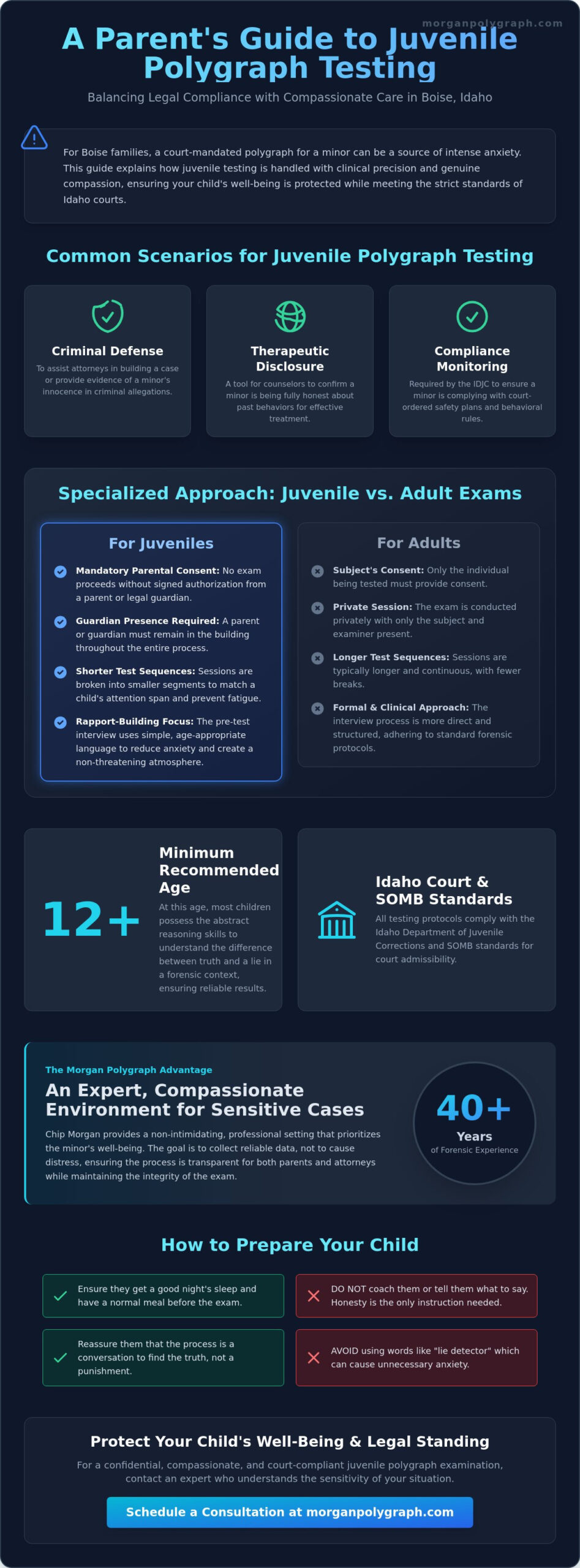
Juvenile polygraph testing Boise involves a specialized truth verification process designed specifically for minors. Unlike adult forensic examinations, these sessions require a compassionate, patient approach that accounts for a child’s unique psychological and emotional state. At Morgan Polygraph, we recognize that testing a minor is a sensitive matter. The goal isn’t intimidation; it’s the professional collection of reliable data through a modified interview technique that respects the minor’s developmental stage.
To understand the foundation of this technology, many parents and legal professionals ask What is a Polygraph? and how it measures physiological responses to stress. For juveniles, the examiner adjusts the complexity of the questions and the length of the session. This ensures the minor remains focused and understands the gravity of the process without feeling overwhelmed by a clinical environment. This distinction is vital because a child’s physiological response to fear can sometimes mimic the response to deception if the examiner is not skilled in juvenile-specific protocols.
Common Reasons for Testing Minors
Private families and legal professionals in Ada County utilize these services for several critical reasons. Defense attorneys often request juvenile polygraph testing Boise to assist in building a case or to provide evidence of a minor’s innocence in criminal allegations. In other instances, testing serves as a tool for therapeutic disclosure within specialized counseling programs. This helps therapists confirm that a minor is being fully honest about past behaviors, which is a prerequisite for successful treatment and rehabilitation. Additionally, the Idaho Department of Juvenile Corrections may require testing for post-conviction monitoring to ensure the minor is complying with court-ordered safety plans and behavioral expectations.
Age Requirements and Developmental Considerations
Determining if a minor is ready for a polygraph depends on their cognitive development rather than just their birth date. Most professional examiners recommend a minimum age of 12 for reliable results. At this stage, children typically possess the abstract reasoning skills necessary to understand the difference between a truth and a lie in a forensic context. Younger children might struggle with the physiological consistency required for a clear chart.
Parents often ask are polygraphs accurate when applied to subjects who are still developing. Accuracy remains high when the examiner uses age-appropriate language and ensures the subject understands every question before the sensors are activated. We prioritize the minor’s well-being while maintaining the integrity of the truth verification process. Each session is handled with the utmost discretion to protect the privacy of the family and the future of the child.
How Polygraph Exams Differ for Minors vs. Adults
Conducting a polygraph on a minor isn’t a standard procedure; it’s a specialized forensic application that requires a distinct set of protocols. When performing juvenile polygraph testing Boise examiners must adhere to strict ethical and legal guidelines. The most critical difference is the requirement for mandatory parental or legal guardian consent. No testing begins without a signed authorization form, ensuring the family is fully informed of their rights. This protection is non-negotiable and serves as the foundation for the entire process.
The physical environment also changes. While the minor is in the exam room with the examiner, a parent or guardian must remain in the building at all times. This presence provides a safety net for the child and maintains transparency for the family. We also shorten the testing sequences significantly. While an adult exam might involve long periods of stillness, a child’s attention span typically wanes after 20 minutes of intense focus. We break the process into smaller segments to maintain high accuracy levels and prevent fatigue from skewing the physiological data.
The Pre-Test Interview for Juveniles
Building rapport is the primary goal of the juvenile pre-test interview. We focus on reducing “situational anxiety” by creating a non-intimidating atmosphere. I explain the technology, including the pneumographs and galvanometers, as “truth verification” sensors that simply measure how the body breathes and reacts. We don’t use clinical or threatening terms. Instead, we spend time ensuring the minor understands the difference between a truth and a lie through concrete examples. This isn’t just a moral discussion; it’s a necessary step to ensure the child’s body will produce clear physiological responses during the actual test.
Simplified Questioning Techniques
We strip away legal jargon and complex sentence structures that might confuse a younger subject. Simplified questioning is a method to ensure the minor fully comprehends the examiner’s intent. Instead of asking about “collusion” or “misappropriation,” we use direct queries like “Did you help take that money?”. This clarity prevents false positives caused by confusion rather than deception.
We also use comparison questions tailored to a minor’s life experiences. An examiner might ask, “Before you were 12, did you ever break a rule at school?” to establish a baseline. When discussing these results in a legal context, attorneys often reference the Federal Stance on Polygraph Admissibility to determine how this data might be utilized in court. If you have questions about how these techniques apply to your specific situation, you can consult with an expert to learn more about our professional approach.
Idaho Standards: Admissibility and SOMB Compliance
Idaho’s legal framework for minors requires a specialized approach that balances forensic accuracy with clinical sensitivity. The Idaho Sexual Offender Management Board (SOMB) establishes the strict protocols that every examiner must follow. For juvenile polygraph testing Boise practitioners, these standards ensure the process remains ethical and age-appropriate. Most Boise courts won’t admit polygraph results as evidence in a contested trial unless both parties agree to a written stipulation beforehand. However, these tests are standard requirements for administrative hearings, probation reviews, and supervision compliance.
The Idaho Department of Corrections (IDOC) maintains a specific roster of approved providers. Using an examiner from this list is vital because the court typically rejects data from uncertified sources. These professionals understand the developmental differences between adults and adolescents, which is a critical factor in maintaining the integrity of the test. When results are used in a clinical capacity, they help verify the history provided by the minor during treatment, ensuring that the safety of the community and the rehabilitation of the juvenile remain the top priorities.
Navigating Boise Juvenile Court Requirements
Working with the Ada County Public Defender’s Office or private defense counsel often involves using a polygraph to facilitate plea negotiations or sentencing recommendations. Results frequently integrate into a psychosexual evaluation, which helps judges determine the appropriate level of supervision. This data provides a baseline for the court to understand the minor’s history and risk factors. In many cases, a stipulated agreement allows the defense and prosecution to use these findings to resolve a case without a lengthy trial. It’s a methodical process that requires clear communication between the attorney, the family, and the examiner.
Idaho SOMB and PCSOT Standards
The SOMB mandates that only court-recognized experts conduct Post-Conviction Sex Offender Testing (PCSOT) for juveniles. These examinations follow a specific rhythm designed to monitor compliance with Idaho sex offender registry guidelines and treatment plans. Research published in Polygraphs in Juvenile Offender Cases highlights how these tools function as a clinical polygraph to uncover “hidden” behaviors that might lead to re-offending. For juvenile polygraph testing Boise, the goal is transparency. Since the SOMB updated its standards in recent years, the focus has shifted toward a collaborative model where the polygraph supports the therapist’s efforts. This structured environment helps young offenders stay accountable while providing the court with the objective data it needs to manage high-stakes cases effectively.
Preparing Your Child for a Polygraph Examination
Preparing a minor for a polygraph requires a balance of transparency and composure. When scheduling juvenile polygraph testing Boise, parents often feel a mix of anxiety and uncertainty. It’s vital to remember that your child will likely mirror your emotional state. If you approach the appointment with a calm, matter-of-fact attitude, the minor is more likely to remain relaxed during the physiological data collection process.
Start by being honest about the purpose of the visit. Surprising a child at the office door creates immediate physiological stress; this can complicate the examination results. Explain that the examiner is a neutral professional whose job is to verify the truth. They aren’t there to act as an interrogator or a judge. Addressing the “lie detector” myths seen on television is also helpful. Most children expect a high-pressure room with flashing red lights or loud buzzers. In reality, our Boise facility provides a controlled, professional environment focused on scientific accuracy and respect.
Talking to Your Child About the Process
Use neutral language when discussing the upcoming appointment. Avoid using the word “test” if it triggers school-related anxiety. Instead, refer to it as a “session” or “meeting.” Explain that the sensors are completely painless and non-invasive. These tools simply measure natural body reactions like breathing, heart rate, and skin conductivity. Remind them that the primary goal is honesty. The examiner’s role is to document the truth, which provides a clear path forward for both the family and any involved legal counsel.
Logistical Preparation for Parents
Physical readiness is just as important as mental preparation. Ensure your child gets at least eight hours of sleep the night before the session. They should eat a balanced meal approximately 90 minutes before the appointment to prevent blood sugar fluctuations that might affect the data. When preparing for juvenile polygraph testing Boise, arriving at the State Street office with all necessary legal or medical documentation ensures the session starts on time.
Arrive 15 minutes early to allow the minor to acclimate to the office surroundings. Managing your own parental anxiety is perhaps the most critical step. If you are visibly distressed, you may unintentionally transfer that stress to the child, which can skew baseline readings. Trust in our decades of expertise to ensure the process is handled with the highest level of professional integrity. If you have specific questions about the upcoming session, contact Morgan Polygraph today.
Why Choose Morgan Polygraph for Sensitive Juvenile Cases
Selecting a provider for juvenile polygraph testing Boise requires a delicate balance of forensic precision and emotional intelligence. Chip Morgan brings over 40 years of specialized forensic experience in Idaho to every examination. This depth of knowledge is vital when dealing with minors, as their physiological responses can differ significantly from those of adults. We don’t just run a test; we manage a sensitive process that demands an expert’s touch. Our office is designed to be a compassionate, respectful, and non-threatening environment. This approach reduces the situational anxiety that often leads to inconclusive results in younger subjects.
Discretion is the cornerstone of our practice. We handle all juvenile and family matters with the highest level of confidentiality. Whether the case involves a private family dispute or a complex legal matter, we ensure that the privacy of the minor is protected at every stage. Our reputation as court-recognized experts means that attorneys and parents can trust the integrity of our findings. We focus on the human element of truth verification, ensuring that every individual who walks through our doors is treated with the dignity they deserve.
The Advantage of AI-Enhanced Truth Verification
We stay at the forefront of technological advancements by integrating AI-powered behavioral speech analysis into our examinations. This modern approach adds a critical layer of reliability for minors. The system uses facial microexpression recognition to identify subtle cues that the human eye might miss. By combining traditional polygraphy with these cutting-edge tools, we provide unparalleled insights into truthfulness. This dual-methodology is particularly effective for legal and therapeutic needs, as it offers a more comprehensive data set for decision-makers. It’s a forward-thinking way to ensure the highest possible accuracy in every case we accept.
Scheduling a Consultation in Boise
If you’re an attorney or a parent facing a difficult situation, taking the first step toward clarity is essential. You can contact Chip Morgan directly for a confidential case review to discuss the specific needs of your juvenile polygraph testing Boise. We are available for both court-ordered examinations and private, attorney-led cases. Our scheduling process is methodical and unhurried, allowing us to give each case the attention it requires. We understand that time is often of the essence in legal matters, so we strive to provide prompt, professional service.
For those located outside the immediate Treasure Valley area, finding a qualified professional is just as important. You can use our guide for finding a polygraph near me to locate a certified examiner who meets our high standards of excellence. To start your consultation in Boise, reach out to Chip today. We’re ready to provide the professional truth verification services you need to move forward with confidence.
Securing Your Child’s Future with Professional Truth Verification
Navigating a legal case involving a minor requires more than just technical skill; it demands a specialized approach that respects Idaho SOMB compliance and the unique psychological needs of a young person. Successful juvenile polygraph testing Boise relies on balancing rigorous scientific standards with a compassionate environment. By choosing an examiner who understands these specific nuances, you ensure the process remains legally sound while protecting your child’s well-being during a stressful time.
Chip Morgan brings over 40 years of combined polygraph testing experience to every examination. As a nationally certified and court-recognized expert, he integrates traditional methodology with state-of-the-art AI-powered deception detection tools to provide the highest level of accuracy available today. This blend of decades-long expertise and cutting-edge technology gives parents and attorneys the clarity they need for sensitive legal matters. You don’t have to face these complex challenges alone. Expert help is available to guide your family toward the truth with dignity and precision.
Contact Chip Morgan for a Confidential Juvenile Case Consultation
Frequently Asked Questions
Is juvenile polygraph testing legal in Boise, Idaho?
Juvenile polygraph testing is legal in Boise and throughout Idaho provided the minor’s parent or legal guardian gives written consent. At Morgan Polygraph, we adhere to strict ethical guidelines to ensure the process respects the minor’s rights. Most examiners won’t test children under 12 because their physiological development often makes results inconclusive. We focus on providing a professional and compassionate environment for every family.
How accurate are lie detector tests for children and teenagers?
Modern truth verification methods achieve accuracy rates between 85% and 90% when following American Polygraph Association (APA) standards. For teenagers, the physiological responses are similar to adults, making the data highly reliable. We use cutting-edge technology to ensure the most precise readings possible. Accuracy depends heavily on the examiner’s ability to build rapport with the youth before the session begins.
Can a parent be in the room during the minor’s polygraph exam?
Parents generally can’t remain in the examination room during the actual testing phase to prevent outside influence or the observer effect. We conduct a pre-test interview where parents are encouraged to participate and ask questions. This ensures the minor feels safe while maintaining the scientific integrity of the juvenile polygraph testing Boise families rely on for clear answers. We’ll explain every step to you before we begin.
How long does a juvenile polygraph examination typically take?
A standard juvenile examination takes between 90 minutes and 120 minutes to complete. This timeframe includes the initial interview, the data collection phase, and the final analysis of the charts. We don’t rush the process because building trust with a teenager takes time. Patience is key to obtaining a clear, valid result that helps resolve sensitive family or legal matters.
What happens if a minor is too nervous to take the test?
Examiners use a baseline period to account for natural nervousness, so being anxious won’t cause a false positive result. We use a professional and respectful approach to calm the minor before any questions are asked. If a minor’s anxiety levels are so high that they can’t reach a stable physiological state, we’ll stop the exam. Our goal is truth verification, not causing unnecessary stress for your child.
Is the result of a juvenile polygraph admissible in Idaho courts?
Polygraph results are generally only admissible in Idaho courts if both parties sign a written stipulation before the test. This follows the precedent set by the Idaho Supreme Court in cases like State v. Fain (1989). While they aren’t always used as direct evidence, attorneys frequently use them for negotiations or to guide investigations. We provide court-recognized expertise to assist legal teams in Boise.
How much does a juvenile polygraph test cost in Boise?
The cost for juvenile polygraph testing Boise services varies based on the complexity of the case and the specific requirements of the referral. We offer very competitive pricing for all our professional truth verification services. You should call Chip directly to discuss your specific situation and receive a clear quote. We’re committed to providing expert services that remain accessible to families in need of answers.
What qualifications should a juvenile polygraph examiner have?
An examiner must be a graduate of an APA-accredited school and maintain active membership in professional organizations like the American Polygraph Association. Chip Morgan brings over 40 years of combined experience and is a respected expert in the polygraph community. Look for professionals who use cutting-edge tools and have a proven track record in Idaho courts. Specialized training in child interviews is also a vital qualification.