

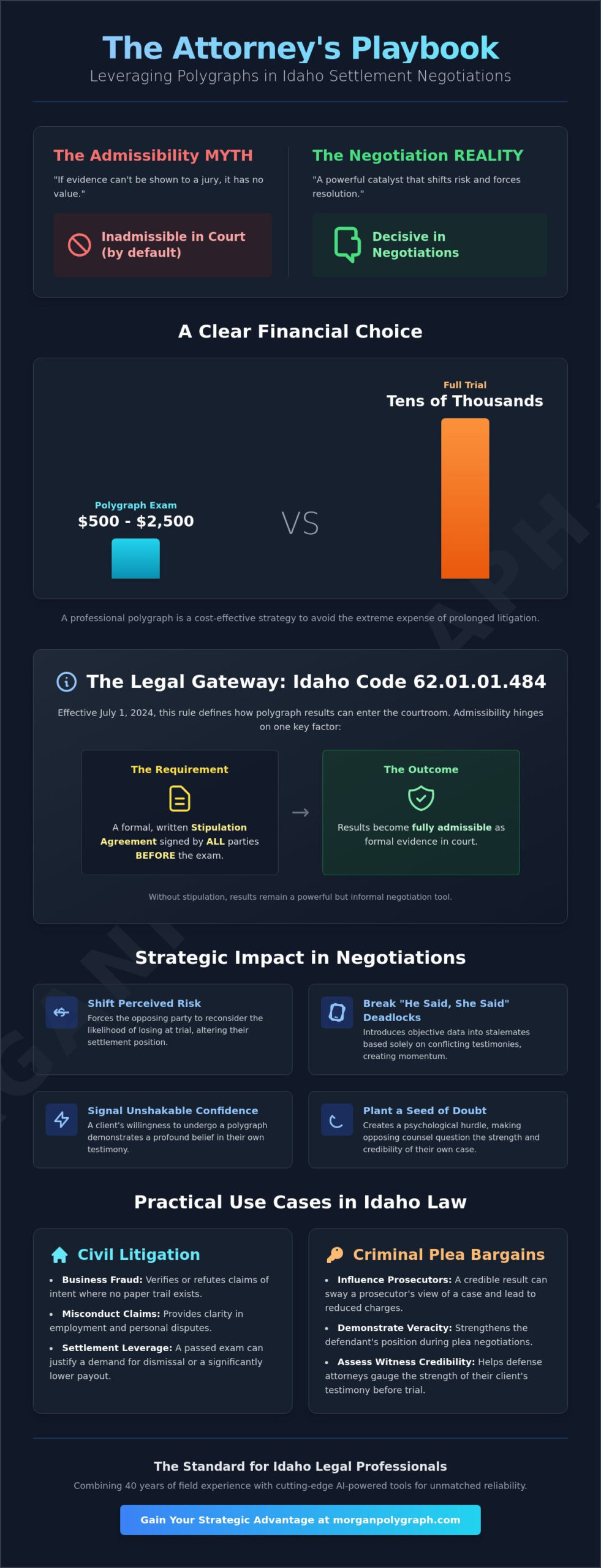
In Boise legal circles, the most powerful evidence often never reaches a jury’s ears. While many attorneys focus solely on what is admissible in court, using polygraph results in settlement negotiations Idaho has become a sophisticated strategy for breaking deadlocks. With professional exams in 2026 typically ranging from $500 to $2,500, this tool offers a cost-effective alternative to the tens of thousands required for a full trial. It’s a common misconception that a lie detector test is useless if it cannot be presented at trial. In reality, a professionally administered exam acts as a negotiation catalyst that shifts the perceived risk for the opposing party.
We understand the frustration of a case stalled by conflicting testimonies and the genuine fear of mounting trial costs in Idaho courts. It’s difficult to move forward when the truth feels like a secondary concern. This article provides a clear strategy for leveraging expert polygraph data to secure favorable outcomes. You’ll learn the exact requirements for stipulation under Idaho Administrative Code r. 62.01.01.484, effective July 1, 2024, and how to utilize court-recognized examiners to regain control of your legal narrative.
Key Takeaways
- Understand the “Admissibility Gap” and how Idaho Administrative Code r. 62.01.01.484 allows polygraphs to serve as a high-stakes negotiation tool outside the courtroom.
- Discover the strategic advantages of using polygraph results in settlement negotiations Idaho to resolve complex civil disputes and influence criminal plea bargains.
- Learn how to structure a formal stipulation agreement to transform confidential results into admissible evidence when both parties agree to the terms.
- Identify the optimal timing for disclosing truth verification reports to opposing counsel to maximize their impact on the final settlement outcome.
- See why combining 40 years of field experience with cutting-edge AI-powered tools sets a higher standard for reliability in Boise legal matters.
The Admissibility Myth vs. Negotiation Reality in Idaho
Many legal professionals in Boise mistakenly believe that if a piece of evidence cannot be shown to a jury, it has no value. This is the “Admissibility Myth.” In practice, using polygraph results in settlement negotiations Idaho is a powerful way to resolve a case before it ever reaches a courtroom. While Idaho law sets high bars for trial evidence, the informal nature of settlement discussions allows for much more flexibility. Attorneys often find that a passed exam changes the entire trajectory of a case, even if the report remains in a confidential file.
Understanding IDAPA 62.01.01.484
Effective July 1, 2024, Idaho Administrative Code r. 62.01.01.484 provides a clear boundary for truth verification in the courtroom. It states that polygraph results, and any expert or lay opinion testimony based on them, are not admissible unless all parties stipulate to their admissibility. In plain English, this means both the plaintiff and defendant must agree in writing to let the results in before the exam even takes place. The Polygraph: A Controversial Tool has long faced these hurdles in the American legal system. Without this mutual agreement, a judge will block the data from being used as formal evidence. This rule prevents a witness from simply claiming they passed a test to bolster their own credibility on the stand. It keeps the focus on traditional evidence during the trial itself.
Why Inadmissible Does Not Mean Irrelevant
Just because a test result stays out of the trial record doesn’t mean it stays out of the opposing counsel’s mind. Using polygraph results in settlement negotiations Idaho creates what experts call the “Admissibility Gap.” This is the space where attorneys evaluate the strength of their case. If a defendant in a civil fraud case passes a professional exam, the plaintiff’s attorney must reconsider the risk of going to trial. They know that even if the jury never sees the report, the witness will likely be a much more confident and credible presence on the stand. It’s a calculated risk assessment.
This shift in perception directly impacts the settlement value of a case. When one party demonstrates a willingness to undergo truth verification, it signals a high level of confidence. It forces the other side to ask themselves if their testimony will hold up under the pressure of a Boise court. By introducing these results during discovery or mediation, you aren’t just presenting data. You are humanizing your client and planting a seed of doubt in the opposition’s strategy. This often leads to faster resolutions and avoids the high costs associated with prolonged litigation. It turns a “he said, she said” stalemate into a strategic advantage.
Strategic Use Cases: Civil Settlements and Criminal Plea Bargains
Theory meets practice when an attorney decides to bring truth verification into a Boise conference room. While the previous section established the legal boundaries, the actual power of using polygraph results in settlement negotiations Idaho lies in its ability to break through entrenched positions. Whether the case involves a high stakes business dispute or a sensitive criminal allegation, the introduction of objective data forces a reassessment of the “trial risk” for everyone involved. This strategy is particularly effective when the case rests entirely on the credibility of two opposing witnesses.
Polygraphs in Civil Litigation Settlements
Civil disputes often stall when there is no physical evidence to support a claim of misconduct or fraud. In these “he-said-she-said” scenarios, a passed polygraph can be the lever that moves a stalled negotiation toward a resolution. For instance, in a business fraud case where intent is questioned, a plaintiff might use a truth verification report to confirm specific allegations. Conversely, a defendant can use a passed exam to demand a dismissal or a significantly lower settlement figure. By providing a clear, scientific basis for a client’s testimony, you create a psychological hurdle for the opposition. They must now consider the likelihood that a jury will find your client credible, even if the test itself remains outside the trial record under Idaho’s Stipulation Framework for Polygraphs.
Plea Bargaining Leverage in Idaho Criminal Cases
In the criminal justice system, particularly within the Ada County Prosecutor’s Office, polygraphs serve as a “safety valve.” Defense attorneys find that using polygraph results in settlement negotiations Idaho provides the tangible proof needed to move a prosecutor from a position of “guilt” to one of “mitigation.” These exams prove a client’s lack of knowledge or intent regarding a specific crime. This can be a game changer during plea negotiations. A passed exam might convince a prosecutor to reduce charges or even enter into a “Rule 11” plea agreement, which provides more certainty for the defendant.
In some cases, presenting these results before charges are even filed can lead to a complete dismissal of the investigation. This exculpatory use of technology allows for a discreet resolution that protects a client’s reputation from the public record of a trial. To achieve these results, you must work with a certified examiner who understands the specific technical requirements of the Idaho legal community. Accuracy is not just a goal; it’s a requirement for the other side to take your evidence seriously. If you are facing a deadlock in your current case, it may be time to consult with a court-recognized expert to explore your options.
The Stipulation Framework: Turning Results into Evidence
A stipulation agreement is a formal contract between opposing legal teams. In Idaho, this document serves as the only bridge that allows truth verification data to cross from a private law office into a public courtroom record. While the previous sections highlighted the psychological power of these tests, a stipulation turns that influence into a binding legal reality. Legal professionals must be meticulous when drafting these documents to ensure they meet the standards of Boise courts. Without a clearly defined agreement, even the most accurate test results may be dismissed by a judge before they can influence a case.
Crafting a Stipulation Agreement
A valid agreement must be specific. It typically includes the name of the examiner, the exact methodology used, and a list of the agreed-upon questions. Vague language is the primary reason these agreements fail in court. Under the Idaho Rules of Evidence, judges look for clear, written consent from all parties. If the document doesn’t specify how results will be distributed or who pays the fee, it can become a source of further litigation rather than a resolution tool. Most Boise attorneys insist on using a court-recognized examiner to ensure the technical data meets the rigorous standards required for potential admissibility.
The Strategic “Private-First” Approach
Most experienced defense attorneys in Idaho don’t start with a stipulation. Instead, they utilize a “private-first” strategy. They conduct a confidential exam under the protection of attorney-client privilege. This allows the legal team to verify their client’s position without any risk of disclosure to the prosecution or opposing counsel. If the client passes, the attorney can then offer a second, stipulated exam to the other side as a show of ultimate confidence. This removes the “gamble” of an unknown result being used against a client in court.
This two-step process mitigates the inherent risks and Scientific Doubts on Polygraph Accuracy that often worry legal practitioners. By first confirming the results in a controlled, private environment, you ensure that using polygraph results in settlement negotiations Idaho is a calculated move. High levels of polygraph accuracy are essential for this transition. When the foundation of the negotiation is a report from a court-recognized expert, the opposition is forced to confront the reality that your client is prepared to stand by their truth in any setting. This methodical approach transforms a controversial tool into a reliable pillar of your legal strategy.
How to Introduce Polygraph Results to Opposing Counsel
The success of using polygraph results in settlement negotiations Idaho depends heavily on the “Goldilocks” moment of disclosure. If you reveal the results too early, the opposing counsel has ample time to search for ways to discredit the methodology. If you wait until the eve of trial, it may appear as a desperate, last-minute tactic. In the current 2026 legal landscape, Boise attorneys find the most success by disclosing results immediately following the initial exchange of discovery but before final mediation. This timing forces the other side to re-evaluate their risk before they’ve committed the bulk of their trial budget.
The Disclosure Package
When you present truth verification data, the physical package must reflect the same level of professionalism as the exam itself. A simple one-page summary is rarely enough to move the needle. Your disclosure should be a comprehensive dossier that leaves no room for “old science” critiques. It starts with the curriculum vitae of the certified examiner to establish immediate credibility. You should also include:
- The numeric scoring charts that provide objective data points for the conclusion.
- A detailed list of the specific questions asked during the examination.
- A technical letter explaining the methodology, such as the Federal Zone Comparison Technique.
- Documentation of the state-of-the-art technology used, including any AI-powered deception detection tools.
By including these technical details, you frame the narrative around confidence. You aren’t just making a claim; you’re demonstrating that your client has already stood up to the highest standards of truth verification. This proactive approach often preempts the typical “junk science” arguments that unprepared attorneys might try to use.
Handling Rebuttals and Cross-Exams
Opposing counsel may respond to your disclosure by demanding their own “rebuttal” exam with an expert of their choosing. You should prepare your client for this possibility from the start. While a second exam might feel like a setback, the first exam often carries the most psychological weight in a negotiation. It sets the baseline for the truth. If the second exam produces similar results, the opposition’s case often collapses entirely. If they refuse to conduct their own exam after you’ve provided a comprehensive report, it highlights their own lack of evidence. Using polygraph results in settlement negotiations Idaho is about forcing the other side to produce something as tangible as the report you’ve put on the table. If you’re ready to break a deadlock in your current case, contact our team for a confidential consultation.
Why Morgan Polygraph is the Standard for Idaho Legal Professionals
The strategic use of truth verification in Idaho legal matters requires more than just a passing result. It demands an examiner whose name carries weight in Boise law offices and Ada County courts. When using polygraph results in settlement negotiations Idaho, the credibility of the expert is the primary factor that determines if the opposing counsel will listen or dismiss the report as a distraction. Morgan Polygraph has established itself as the premier choice for attorneys who need results that withstand intense scrutiny and move the needle in high stakes discussions.
The “Chip Morgan” Advantage
Chip Morgan brings over 40 years of combined polygraph testing experience to every case. As a court-recognized expert, he has built deep ties to the Idaho legal community through a reputation for unbiased, professional, and discreet truth verification. His background includes high stakes criminal and civil cases across the Pacific Northwest, making him a valuable asset on any expert witness list. Attorneys don’t just hire an examiner; they partner with a seasoned professional who understands the human stress involved in legal disputes. This experience ensures that every interaction is conducted with the compassion and respect that clients in vulnerable states deserve.
Cutting-Edge Technology in Boise
While tradition provides the foundation, innovation provides the edge. Morgan Polygraph integrates cutting-edge AI-powered deception detection tools that go far beyond the sensors of the past. By combining traditional polygraphy with behavioral speech analysis and facial microexpression recognition, the reports provide a level of data-driven objectivity that was impossible just a decade ago. This ensures that your settlement leverage is built on 2026-level technology. These advanced tools offer a layer of truth verification that traditional methods alone cannot match, providing a comprehensive behavioral profile that supports the final numeric score. This objective data is exactly what is needed to convince a skeptical prosecutor or a stubborn insurance adjuster.
Convenience is a critical factor for clients already facing the pressures of a legal battle. Our Boise-based office provides a local, discreet setting for examinations, ensuring that professional testing is accessible to the entire Treasure Valley. We understand that finding the right partner is the first step in breaking a negotiation deadlock. If you are currently finding a polygraph near me, Morgan Polygraph offers the expertise, technology, and local presence required to secure a favorable outcome. We don’t just provide tests; we provide the clarity needed to move your case forward with confidence.
Break the Deadlock with Professional Truth Verification
Understanding the “Admissibility Gap” is the first step toward resolving complex Idaho legal disputes. While courtroom rules under IDAPA 62.01.01.484 remain rigid, the flexibility of settlement discussions provides a unique opportunity to leverage scientific data. Using polygraph results in settlement negotiations Idaho shifts the risk assessment for the opposing party. It often leads to faster resolutions and significantly reduces the high costs associated with Boise trial courts. By introducing objective data early, you force the opposition to confront the strength of your client’s position.
Our team brings over 40 years of combined polygraph testing experience to your case. We are nationally certified and court-recognized experts who utilize state-of-the-art AI-powered deception detection tools to ensure every report is accurate and undeniable. This combination of traditional expertise and innovative technology provides the authority you need to secure a favorable outcome. Don’t let a “he-said-she-said” stalemate stall your progress any longer.
Contact Chip Morgan today to discuss strategic polygraph testing for your Idaho case. You have the power to change the narrative of your legal battle. Trust a proven expert to help you navigate the truth with confidence and precision.
Frequently Asked Questions
Are polygraph results admissible in Idaho courts?
Results are generally inadmissible in Idaho courts unless all parties stipulate to their entry under Idaho Administrative Code r. 62.01.01.484, which became effective July 1, 2024. This regulation covers both expert testimony and lay opinions based on the exam. While a judge may block the results at trial, they are still widely used as a private truth verification tool to guide legal strategy and influence pre-trial outcomes.
Can a prosecutor force me to take a polygraph in Boise?
A prosecutor or law enforcement officer cannot legally force you to take a polygraph in Boise. Your right against self-incrimination is protected by the Fifth Amendment of the U.S. Constitution. Taking an exam is a strictly voluntary decision. Most defense attorneys recommend conducting a private, confidential test before deciding whether to share any results with the state or the Ada County Prosecutor’s Office.
What happens if I pass a polygraph during settlement negotiations?
Passing a test while using polygraph results in settlement negotiations Idaho creates a powerful shift in the negotiation’s momentum. It provides your attorney with objective data to challenge the opposing party’s confidence. When the other side realizes your client’s testimony is backed by a court-recognized expert, they often become more willing to settle to avoid the unpredictability and high costs of a Boise trial.
How do I find a court-recognized polygraph examiner in Idaho?
You should seek out examiners who are recognized as experts by Idaho courts and hold credentials from the American Polygraph Association. Chip Morgan provides over 40 years of combined experience and is well-respected in the Boise legal community. Ensure your chosen examiner uses modern technology, such as AI-powered deception detection tools, to provide the most reliable and data-driven reports possible for your legal team.
Can polygraph results be used in Idaho divorce or custody settlements?
Polygraph results are a common feature in Idaho divorce and custody settlements, particularly when addressing allegations of infidelity or the concealment of marital assets. Although these results won’t enter a trial record without a signed stipulation, they are highly effective during mediation. They help parties reach a resolution by providing a clear path to truth verification in sensitive family matters where evidence is often limited.
What is the cost of a legal polygraph for settlement purposes in 2026?
A professional, legal-grade polygraph examination in 2026 typically costs between $500 and $2,500. This price range reflects the national average for high-stakes private testing and is influenced by the complexity of the specific case. Many legal professionals find this a cost-effective strategy compared to the significant financial burden of prolonged litigation and the expensive expert witness fees required for a multi-day trial.
Will passing a polygraph guarantee a better plea deal in Idaho?
While no result can guarantee a specific legal outcome, a passed exam is a proven way to gain leverage during plea bargaining. Presenting a clear report to the prosecutor can demonstrate a lack of intent or knowledge regarding a crime. This often leads to mitigated charges or more favorable sentencing recommendations under an Idaho Rule 11 plea agreement, providing much-needed certainty for the defendant.
How long does a legal-grade polygraph examination take?
A comprehensive, legal-grade examination typically requires 2 to 4 hours to complete. This duration allows for a thorough pre-test interview, the actual physiological testing phase, and a detailed post-test analysis of the charts. A methodical approach is necessary to ensure the highest levels of accuracy and to produce a professional report that will withstand the scrutiny of opposing counsel during settlement discussions.