
What if the “AI-powered” app on your smartphone is more likely to flip a coin than reveal the truth? It’s natural to feel anxious about the cost of expert services when you’re desperate for answers, especially when digital tools promise instant results for a few dollars. However, understanding online lie detector test accuracy vs professional examinations is vital if you need results that carry weight in legal or therapeutic settings. While a cheap app offers convenience, it lacks the clinical precision required to distinguish between situational stress and genuine deception.
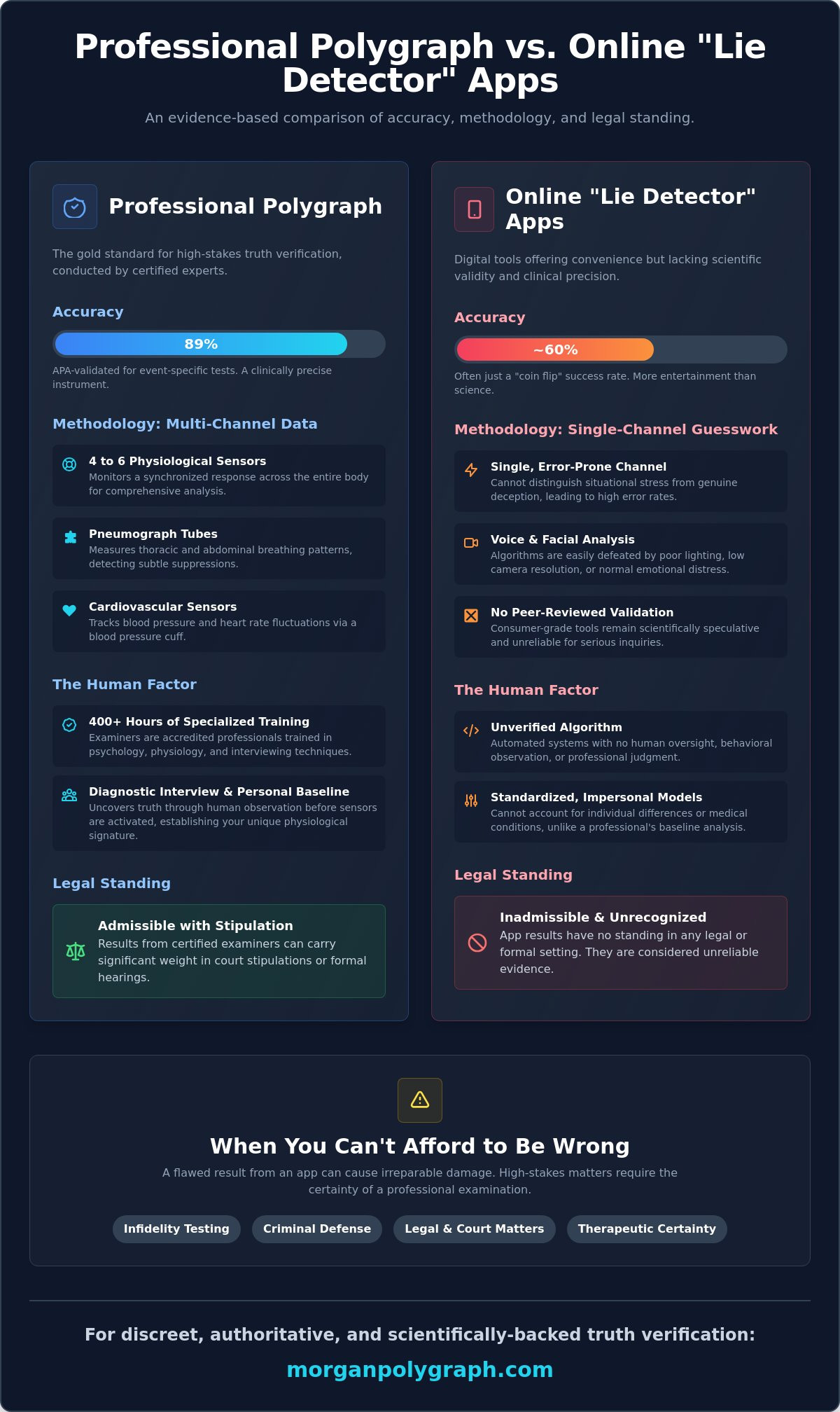
You’ll gain clarity on the methodology, legal standing, and scientific reliability of these two very different approaches. We’ll explore why American Polygraph Association research validates professional accuracy at 89 percent for event-specific tests, whereas consumer-grade devices often hover around a 60 percent success rate. This article provides the certainty you need to minimize the risk of a false positive. You’ll see why the 400 hours of specialized training required for accredited examiners, combined with multi-channel physiological data, remains the gold standard for truth verification in 2026.
Key Takeaways
- Understand why professional polygraphs utilize four to six physiological sensors to ensure precision, whereas digital apps often rely on a single, error-prone channel like voice analysis.
- Learn about the critical gap in online lie detector test accuracy vs professional examinations, particularly when results are needed for legal or therapeutic certainty.
- Discover the legal landscape in Idaho, where only results from nationally certified examiners carry the weight necessary for court stipulations or formal hearings.
- Explore how a professional diagnostic interview uncovers the truth through human behavioral observation before the technical sensors are even activated.
- Identify why high-stakes matters, such as infidelity testing or criminal defense, require the discreet and authoritative approach of a seasoned expert rather than an unverified algorithm.
The Rise of Online Lie Detector Tests: Convenience vs. Clinical Validity
In 2026, the digital marketplace is flooded with applications claiming to decode human deception with a simple smartphone download. These tools range from Voice Stress Analysis (VSA) to sophisticated AI facial coding and eye-tracking software. While they offer the allure of anonymity and immediate results, they often blur the line between entertainment and actual diagnostic science. This confusion makes it difficult for individuals in sensitive situations to understand the true gap in online lie detector test accuracy vs professional examinations. A professional polygraph is a clinical event; a mobile app is a digital estimation.
The primary appeal of these digital alternatives is their low entry cost. When someone is facing a crisis, the promise of a quick answer is tempting. However, it’s essential to consult The Science of the Polygraph to understand the depth of physiological monitoring required for a valid result. Professional equipment tracks multiple channels of data simultaneously. In contrast, most 2026 consumer apps rely on a single data point. This is scientifically insufficient for high-stakes decision-making in criminal or relationship matters.
How Virtual Lie Detectors Claim to Work
Many modern apps use webcam-based micro-expression analysis. This technology attempts to identify “leaked” emotions through facial muscle movements. Unfortunately, these algorithms are easily defeated by poor lighting, low camera resolution, or the natural variations in human facial structure. Voice stress algorithms are equally problematic. They often fail to distinguish between the “noise” of genuine emotional distress and the specific physiological signatures of deception. Without peer-reviewed validation, these consumer-grade tools remain largely speculative and unreliable for serious inquiries.
The Emotional Risk of “False Positives” in DIY Testing
The stakes are too high for guesswork. A flawed result from an unverified app can cause irreparable damage to a marriage or a legal defense. When an algorithm incorrectly flags an innocent person as deceptive, the psychological impact is profound. These “false positives” create a cycle of distrust that is difficult to break. Relying on software rather than a certified examiner significantly compromises online lie detector test accuracy vs professional standards. Choosing a cheap test might seem like a shortcut, but the emotional and legal fallout of a wrong result often costs far more than a professional examination. For matters like infidelity testing or criminal cases, certainty is the only currency that matters.
The Science of Accuracy: Physiological Sensors vs. Digital Algorithms
The core difference in online lie detector test accuracy vs professional examinations lies in the depth of data collected. While a 2026 smartphone app might analyze your voice or track your eye movements through a camera, it’s only seeing a fraction of the picture. Professional polygraph technology monitors four to six distinct physiological channels simultaneously. This comprehensive approach ensures that the examiner isn’t just looking at one isolated reaction, but a synchronized physical response across the entire body. Relying on a single channel, as most apps do, is highly prone to error because it cannot account for the complexity of human stress.
Establishing a baseline is the first step in any professional session. This is your unique physiological signature. It allows the examiner to understand how your body reacts under normal, non-threatening conditions. Online algorithms often rely on standardized models that don’t account for individual differences or medical conditions, a significant point of discussion in Psychological Science on Polygraphs. Without a personalized baseline, an app cannot accurately distinguish between your normal baseline and a deceptive response.
Multi-Channel Data: The Professional Advantage
- Pneumograph tubes: These sensors measure thoracic and abdominal breathing patterns. Apps cannot detect the subtle suppressions in breath that often accompany deception.
- Galvanometers: These detect minute changes in skin resistance, specifically sweat gland activity. This is far more precise than a camera attempting to identify a micro-expression.
- Blood pressure cuffs: A professional test tracks cardiovascular shifts and heart rate variability in real-time. This is vital data that mobile software simply cannot access.
The “Algorithm Gap” in Online Software
Software lacks the clinical intuition to filter out “noise.” if you’ve had too much caffeine, didn’t sleep well, or are simply terrified of the test itself, an AI might flag you as deceptive. It cannot distinguish between the fear of being tested and the intent to deceive. A human examiner in a controlled environment, like our Boise office, ensures data purity by eliminating external distractions that would otherwise skew results in a home setting. Professional examiners are trained to identify and account for these variables, providing a level of clinical validity that digital algorithms cannot replicate. This human element is why professional services remain the gold standard for high-stakes truth verification.
Legal Admissibility and Professional Recognition in Idaho
In the Idaho judicial system, the distinction between recreational software and forensic evidence is absolute. No Idaho court, law enforcement agency, or probation office recognizes the results of an online lie detector app. While digital platforms might offer a “percentage of truthfulness,” they lack the clinical foundation required for legal weight. Comparing online lie detector test accuracy vs professional examinations is essentially a comparison between a digital estimation and a forensic diagnostic tool. In 2026, the legal standing of a polygraph in Boise depends entirely on the credentials of the examiner and the specific context of the proceedings.
Scientific scrutiny remains a cornerstone of legal debate. The National Research Council Report previously highlighted the limitations of polygraphy in broad security screenings, which is why Idaho courts require strict adherence to validated protocols. Professional examiners serve as expert witnesses, providing a comprehensive analysis that goes far beyond a simple chart printout. This expertise is why criminal defense and civil litigation teams rely on nationally certified practitioners to support their cases. Results are generally inadmissible in Idaho courts unless all parties stipulate to their entry, making the examiner’s reputation a critical factor.
Boise Legal Standards for Polygraphy
Boise attorneys and legal professionals look for examiners who adhere to the American Polygraph Association (APA) standards. These protocols ensure that the environment, the questioning technique, and the data interpretation meet rigorous forensic criteria. A “printout” from a smartphone app is a static image with no context. In contrast, a formal expert report from a professional examiner includes a detailed breakdown of the pre-test interview, physiological data interpretation, and clinical observations. This level of detail is required for any result to be considered in probation revocation hearings or other informal judicial settings.
PCSOT and Specialized Testing Requirements
Specialized testing, such as Post-Conviction Sex Offender Testing (PCSOT), carries even higher regulatory hurdles. In Idaho, examiners conducting these tests must be certified by the Idaho Sexual Offender Management Board (SOMB). There are two levels of certification: Associate/Supervised and Senior/Approved. Attempting to use an unverified online test for compliance with probation mandates isn’t just ineffective; it can lead to severe legal consequences. Specialized training is required because these exams are diagnostic tools used for public safety and therapeutic progress, requiring a level of precision that an algorithm simply cannot provide.
When You Cannot Afford to Be Wrong: Choosing Professional Expertise
When the future of your family or your career is on the line, the margin for error is zero. This is where the debate over online lie detector test accuracy vs professional examinations becomes deeply personal. A digital algorithm cannot look you in the eye or understand the context of a complicated relationship. It simply processes isolated data points. Professional examiners, however, use a clinical approach that begins long before the sensors are attached. They provide a level of certainty that a smartphone app simply cannot replicate, ensuring that the results are not just data, but a path toward resolution.
The diagnostic interview is perhaps the most critical component of a professional polygraph. During this phase, a seasoned examiner works to clear the “fog of war” that often surrounds sensitive disputes. They help the examinee understand the process, which reduces situational anxiety and ensures that the physiological data collected is as pure as possible. This human interaction is why professional services are far more reliable than unverified software. If you’re seeking clarity, you can schedule a professional consultation to discuss your specific needs.
The Human Element: The Examiner as a Truth-Finder
Pre-test interviews are essential for refining the issues at hand. They allow the examiner to identify “noise”, such as external stressors that might otherwise look like deception to a basic algorithm. A professional is also trained to detect countermeasures. While an online test might be fooled by controlled breathing or physical movements, a Boise expert understands these tactics and can adjust the examination accordingly. The post-test debriefing also provides a safe, discreet environment for individuals to provide admissions or clarify their responses. This interaction often uncovers the truth before the sensors even start, a feat no app can achieve.
Relationship Clarity: Beyond the “Pass/Fail” Grade
Navigating a crisis of trust requires more than a simple grade. A comprehensive infidelity test involves nuanced question formulation that considers the unique history of the couple. Apps often use generic templates that fail to capture the specific details of a situation. In addition, the examiner manages the emotional volatility inherent in these tests. In one instance, a flawed online result nearly destroyed a local partnership; it was only after a professional exam that the couple found the clarity needed to move forward. The long-term ROI of a professional exam is found in the peace of mind that only verified accuracy can provide. Choosing an expert means your privacy is protected by professional ethics, not subject to the data risks of an unverified online platform.
Morgan Polygraph: Boise’s Leader in High-Accuracy Lie Detection
Morgan Polygraph stands as the premier authority for truth verification in Southern Idaho. We provide a bridge between decades of forensic experience and the sophisticated demands of 2026 technology. When you consider online lie detector test accuracy vs professional standards, the choice becomes a matter of reliability and clinical weight. Our practitioners are nationally recognized experts who understand that every case involves human lives and sensitive reputations. We don’t just provide charts; we provide a professional guarantee of precision, compassion, and the peace of mind that comes from definitive results.
Our firm specializes in high-stakes testing, including criminal and civil case polygraphs, infidelity testing, and pre-employment screening. We also maintain the specific certifications required for Post-Conviction Sex Offender Testing (PCSOT) as mandated by the Idaho Sexual Offender Management Board. This specialization ensures that our results meet the rigorous standards of both therapeutic and legal settings. Every interaction is handled with the utmost discretion, ensuring your sensitive issues remain confidential and secure. We believe that professional truth-finding requires a methodical, calm, and unhurried approach.
State-of-the-Art Technology in Boise
Our Boise facility utilizes the latest computerized polygraph systems to capture maximum data resolution. These advanced tools allow us to monitor physiological responses with a level of detail that consumer apps simply can’t achieve. Our approach combines the foundational principles of behavioral science with 2026’s most advanced detection technology. This innovative mindset positions Morgan Polygraph as a leader in technical advancements within the field. The office environment is deliberately designed to be neutral and comfortable, which is essential for maintaining the clinical accuracy of each polygraph examination. By eliminating the “noise” of a home setting, we ensure that the data collected is pure and defensible.
Next Steps: Booking Your Professional Exam
Securing an appointment for a professional exam is a straightforward process. We begin with a confidential consultation to understand the specifics of your situation and formulate the most effective questioning strategy. During the appointment, you’ll be guided through a step-by-step walkthrough, from the pre-test interview to the final data analysis. This transparency builds the confidence needed for a successful session and ensures you’re in capable hands. We respect the stress involved in this process and treat every examinee with dignity and patience. Schedule your professional polygraph in Boise today to gain the certainty you deserve.
Secure the Truth with Clinical Precision
Deciding between online lie detector test accuracy vs professional examinations is a choice that fundamentally impacts your future. You’ve seen that digital apps lack the multi-channel physiological monitoring and clinical context required for definitive answers. True resolution comes from the methodical approach of a seasoned expert who can distinguish between situational stress and genuine deception. At Morgan Polygraph, we bring over 20 years of experience in criminal and civil cases to every session in our Boise office. We combine this deep tradition with state-of-the-art 2026 detection technology to ensure you receive the most reliable results available today. Our nationally certified and court-recognized examiners handle every case with the discretion and compassion you deserve. Don’t leave your peace of mind or your legal standing to an unverified algorithm. Take the first step toward clarity and resolution by working with a team that values precision and integrity above all else.
Schedule Your Professional Polygraph in Boise Today
You deserve to move forward with the absolute certainty that only a professional examination can provide.
Frequently Asked Questions
Are online lie detector tests accurate enough for relationship issues?
No, online tests lack the clinical validity required to resolve sensitive trust issues. These digital tools often fail to distinguish between situational anxiety and genuine deception, which can lead to false accusations. A professional examiner manages the emotional volatility of relationship disputes and uses multi-channel data to provide the certainty that a simple app cannot match.
Can an online lie detector test be used in an Idaho court?
No Idaho court or law enforcement agency recognizes the results of unverified digital apps. Legal admissibility in Boise requires a nationally certified examiner and a formal stipulation between all parties involved. An app printout carries no weight in Idaho judicial settings, probation hearings, or formal legal proceedings where forensic evidence is required.
How does a professional polygraph differ from a voice stress app?
A professional polygraph monitors four to six physiological channels simultaneously to ensure data purity. Voice stress apps rely on a single audio algorithm that often fails to distinguish between emotional distress and intent to deceive. This fundamental difference is a primary driver of the gap in online lie detector test accuracy vs professional examinations.
What is the accuracy rate of a professional polygraph in 2026?
According to American Polygraph Association meta-analytic research, professional event-specific tests achieve an accuracy rate of 89 percent under validated conditions. Other independent studies place this reliability between 70 and 95 percent. These high rates are only possible when a certified examiner follows strict protocols and uses medical-grade sensors to track physiological shifts.
Why do professional polygraph tests cost more than online versions?
You’re investing in specialized expertise and forensic-grade technology. Accredited examiners must complete a minimum of 400 hours of specialized training to interpret complex human data. This professional oversight ensures a level of online lie detector test accuracy vs professional reliability that an automated, low-cost app simply won’t provide when the stakes are high.
How long does a professional polygraph exam take compared to an online test?
A professional examination typically takes between two and three hours to complete. This time is necessary for the pre-test interview, the actual data collection, and the final analysis. Online tests are often instantaneous, but they skip the critical diagnostic steps that ensure a result is both accurate and legally defensible in professional settings.
Can I fail a professional polygraph if I am just nervous?
Nervousness is expected and won’t cause you to fail. The examiner establishes a physiological baseline at the start of the session to account for your unique stress levels. This baseline allows the practitioner to distinguish between general situational anxiety and the specific physiological signatures of deception, ensuring a fair and accurate result.
What sensors are used in a professional polygraph test?
Professional systems utilize pneumograph tubes to measure thoracic and abdominal breathing patterns. They also include galvanometers to detect minute changes in skin resistance and blood pressure cuffs to track cardiovascular activity. These sensors provide the multi-dimensional data required for a high-accuracy diagnostic result that digital algorithms cannot replicate through a camera or microphone.