

What if the racing heart you fear will cause a false positive is actually a variable your examiner is already prepared to manage? It’s completely natural to feel a sense of dread before a test, especially when you’re wondering how to handle polygraph anxiety while facing sensitive or private questions. You might worry that your natural nerves will be misinterpreted as dishonesty. Most people feel significant stress in this environment, and professional examiners are trained to expect that. They don’t require you to be perfectly still or unnaturally calm to produce a valid result.
This guide explains how seasoned experts distinguish between normal physiological “noise” and the specific patterns of deception. You’ll learn actionable techniques to steady your heart rate and gain a clear understanding of the examiner’s role in ensuring accuracy. We’ll also look at the rigorous protocols, such as the American Polygraph Association’s mandate for 90-minute minimum sessions, that protect the integrity of your results. This knowledge will help you approach your appointment with the confidence that comes from understanding the science behind the sensors.
Key Takeaways
- Understand why your “fight or flight” response is a normal part of the process and why nervousness alone does not equate to a failed examination.
- Discover how professional examiners establish a physiological baseline to separate general stress from specific reactions to relevant questions.
- Learn how to handle polygraph anxiety by prioritizing physical readiness, such as proper sleep and maintaining your regular medication schedule.
- Identify the difference between the broad “noise” of general anxiety and the sharp, timed physiological spikes that indicate intentional deception.
- Recognize the value of a nationally certified examiner who uses methodical, data-driven techniques to ensure your results are both accurate and fair.
Understanding Polygraph Anxiety: Can Nervousness Cause a False Positive?
Polygraph anxiety is a physiological manifestation of the “fight or flight” response. When you enter a testing environment, your body often perceives the high stakes as a potential threat. This triggers the Autonomic Nervous System, leading to an increased heart rate, heightened sweat gland activity, and shallow respiration. Many examinees fear that these natural reactions will be misinterpreted as deception, leading to a false positive. However, the most persistent myth in this industry is that being nervous equates to failing the examination. If general nerves caused failures, almost every subject would fail, as nearly everyone is jittery during the process.
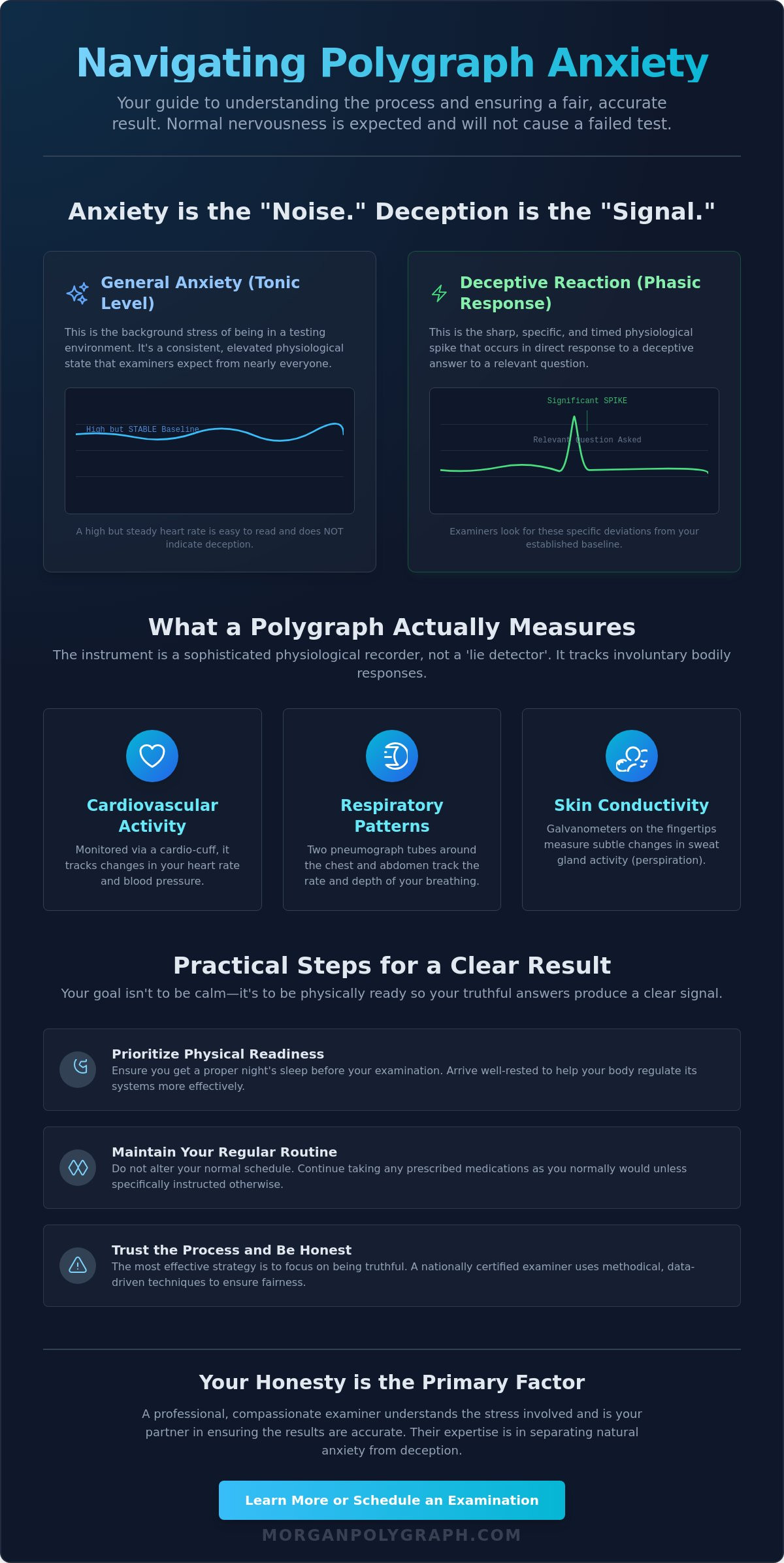
Professional examiners are trained to expect this tension. They distinguish between situational anxiety, which is the baseline stress of being tested, and deceptive stress, which is the specific physiological reaction to a perceived threat during a lie. When you are learning how to handle polygraph anxiety, it helps to realize that your examiner is not looking for a state of perfect calm. They are looking for significant, timed deviations from the baseline you establish at the beginning of the session. These specific “phasic” responses are what indicate deception, not the general “tonic” level of your nerves.
The ‘Nervous Truth-Teller’ Phenomenon
Examiners do not compare your vitals to a universal standard of “calmness.” Instead, they measure changes relative to your unique physiological signature. In our Boise office, we frequently work with subjects experiencing “white coat syndrome,” where a person’s blood pressure and heart rate rise simply because they are in a professional, clinical setting. A steady but high heart rate is actually quite easy for an expert to read. It provides a consistent background level of activity that makes sudden, erratic spikes associated with deception much more visible. Your honesty remains the primary factor in your results, regardless of your starting heart rate.
Why the ‘Lie Detector’ Label is Misleading
The term “lie detector” is a popular misnomer that often increases a subject’s stress levels. In reality, the instrument is a sophisticated physiological recorder. To understand what a polygraph measures, one must look at the specific channels recording blood pressure, pulse, respiration, and skin conductivity. The machine itself does not have a “lie” light; it simply collects data for the examiner to review.
The examiner is the professional who interprets this data within the context of the pre-test interview. This is why focusing on your honesty is far more effective than trying to force yourself to be calm. When you are truthful, your physiological responses remain consistent with your established baseline, even if that baseline is elevated by stress. Part of knowing how to handle polygraph anxiety is accepting your nerves as a background element that does not interfere with the clarity of your truthfulness. The examiner’s role is to ensure the environment remains controlled so that your nervous system can provide a clear, readable signal.
The Science of Baselines: How Examiners Separate Stress from Deception
The process of determining truthfulness begins long before the first relevant question is asked. Examiners rely on a physiological baseline to understand how your body functions under the specific pressure of the testing environment. This baseline is established using control questions, which are designed to elicit a known physiological response. By comparing how your Autonomic Nervous System (ANS) reacts to these control points versus the relevant questions, the examiner can identify specific patterns. While the technology has faced limited judicial acceptance in certain contexts due to the complexity of human emotion, the use of standardized baselines remains the industry’s most reliable method for filtering out general nerves.
Three primary sensors work in tandem to capture this data during the session:
- Cardio-cuffs: These monitor changes in blood pressure and heart rate.
- Pneumographs: Two tubes placed around the chest and abdomen track respiratory patterns.
- Galvanometers: Small attachments on the fingertips measure electrodermal activity, or minute changes in sweat gland perspiration.
As the session progresses, most subjects experience “habituation.” This is a natural process where the body’s initial spike in adrenaline begins to plateau. Knowing how to handle polygraph anxiety involves trusting this physiological settling. Your body simply cannot maintain a peak “fight or flight” state for the duration of a professional exam, which typically lasts at least 90 minutes according to American Polygraph Association standards.
The Crucial Pre-Test Interview
Before any sensors are activated, a 30 to 60 minute pre-test interview takes place. This conversation is not an interrogation; it’s a vital calibration tool. It allows the examiner to observe your “normal” communication style and physiological resting state. If you are open about your stress, the examiner can account for it. At Morgan Polygraph, we handle this phase with the highest level of professional discretion and compassion. This ensures that when the actual testing begins, your situational anxiety is already a known factor. If you’re feeling overwhelmed, you can always discuss your concerns with a specialist before the appointment.
How Modern Technology Filters ‘Noise’
The days of scratching pens on long rolls of analog paper are largely over. In our Boise office, we utilize state-of-the-art digital polygraph systems. These modern platforms use sophisticated algorithms to help examiners distinguish between a random spike caused by a cough or a sudden thought and a consistent, deceptive pattern. Digital systems provide a much cleaner data set, allowing for a more precise analysis of the physiological “signal” over the background “noise” of your anxiety. This data-driven approach is a significant advancement over older methodologies, providing a more objective basis for every conclusion.
Anxiety vs. Deception: Recognizing the Physiological Difference
Understanding the distinction between two specific types of fear is essential when learning how to handle polygraph anxiety. Most examinees experience the “Fear of the Unknown,” which is a broad, generalized stress response to the testing environment and the importance of the outcome. In contrast, “Fear of Detection” is the specific physiological reaction that occurs when a person believes a lie is about to be uncovered. While both feelings can increase your heart rate, they produce different patterns on the digital chart. Certified examiners are trained to identify these nuances to ensure that a nervous but honest person is not penalized for their temperament.
Physiologically, these differences are categorized as tonic and phasic responses. Tonic responses are the “slow, rolling waves” of general anxiety. They represent a person’s background level of stress throughout the entire process. Phasic responses are the “sharp, timed spikes” that occur in direct response to a specific question. If your heart rate remains consistently high but stable, it indicates general nerves. If it remains stable but spikes only when a specific relevant question is asked, it suggests a deceptive reaction. This is why trying to “act calm” can backfire. Attempting to suppress your natural reactions often creates artificial patterns that look more suspicious than the honest jitters of a first-timer.
The Cognitive Load of Lying
Lying is mentally taxing. It requires significantly more brain power to maintain a fabrication while monitoring an examiner’s reactions than it does to simply tell the truth. This increased cognitive load triggers specific, measurable physical shifts that are difficult to mimic. For example, a truthful but anxious person usually maintains a consistent respiratory pattern, even if it’s slightly faster than normal. A deceptive person often shows a suppressed breathing pattern or “respiratory apnea” as their brain focuses on the lie. While some psychological science says that anxiety can mimic certain signs of deception, the modern accuracy of polygraphs relies on identifying these specific cognitive markers that anxiety alone does not produce.
Common Misconceptions About ‘Failing’
One of the biggest fears for those wondering how to handle polygraph anxiety is the idea that a single “jump” on the chart results in a failure. This is a total misconception. Examiners use a “Global Scoring” method, which means they look at the entire data set across multiple charts before reaching a conclusion. A single cough, a stray thought about a different topic, or a sudden noise outside the room might cause a blip, but these are discounted if they aren’t consistent. Additionally, you should always be honest about your physical state. If you didn’t sleep well or had an extra cup of coffee, tell the examiner. They will note these factors and account for them during the data analysis phase to ensure your results remain accurate.
Practical Steps to Manage Stress Before and During Your Examination
Managing your physiological state begins with foundational physical care. Preparing your body is the first practical step in how to handle polygraph anxiety effectively. We recommend aiming for seven to eight hours of restorative sleep the night before your appointment. Fatigue can lead to erratic heart rate patterns and decreased cognitive focus, making it harder for you to follow instructions clearly. Additionally, consume a light, balanced meal a few hours before you arrive. An empty stomach or a heavy, greasy meal can cause gastrointestinal discomfort that sensors may pick up as restlessness.
Transparency regarding your health is equally vital. You should never discontinue prescribed medications in an attempt to “clear” your system for a test. Instead, provide a full list of your current medications to the examiner during the pre-test interview. Modern scoring systems account for the effects of blood pressure or anti-anxiety medications, but only if the examiner is aware of them. Arriving at our Boise office at least fifteen minutes early also helps reduce “rush anxiety.” This allows you to acclimate to the professional environment and settle into a calm, steady rhythm before the sensors are applied.
Avoid the temptation to research “pro-tips” or countermeasures on the internet. Many online forums suggest physical maneuvers like clinching muscles or biting your tongue to influence the charts. Professional examiners are specifically trained to detect these movements. Engaging in countermeasures is the fastest way to make an innocent person appear deceptive. It creates unnatural spikes in the data that do not align with honest physiological patterns. If you have concerns about the equipment, it is better to schedule a consultation with our experts to get factual answers.
Mental Preparation Techniques
Developing a focused mindset can significantly lower your baseline heart rate. Simple techniques like “box breathing”, which involves inhaling, holding, exhaling, and holding for four seconds each, can help regulate your Autonomic Nervous System. It is also beneficial to visualize the polygraph process in detail before your appointment. Understanding the sequence of events removes the fear of the unknown, allowing you to remain present and composed. Remind yourself that the truth is your best defense. When you are truthful, your body naturally returns to its baseline, regardless of initial nerves.
What to Avoid 24 Hours Before
Your choices leading up to the exam directly impact the clarity of your data. Limit your intake of excessive caffeine or energy drinks, as these can cause artificial heart rate spikes and tremors. We also advise against researching “how to beat the test.” Even for the innocent, this research creates a “guilty” mindset that can interfere with your ability to answer questions naturally. Finally, try to avoid high-stress arguments or emotionally taxing situations the night before. Protecting your peace of mind ensures that your physiological signal remains clear and unclouded by external life stressors. Knowing how to handle polygraph anxiety is largely about minimizing these external variables so your honesty can shine through.
Why Professionalism and Compassion are Key to Polygraph Accuracy
Accuracy in polygraphy is not solely a product of high-tech sensors and sophisticated software. It is a direct result of the environment in which the physiological data is gathered. When you’re considering how to handle polygraph anxiety, the professionalism of your examiner is your greatest asset. A court-recognized and nationally certified expert understands that your emotional state is an integral part of the equation, not a hurdle to be ignored. At Morgan Polygraph, we balance technical precision with a deep respect for the individual. Our Boise office is specifically designed to be professional, private, and non-threatening. This controlled environment minimizes external stressors, allowing your physiological responses to remain pure and readable.
Soft skills like empathy and patience are critical for high-quality data collection. An examiner who rushes the process or adopts an adversarial tone inadvertently creates “noise” in the charts by triggering unnecessary defensive responses. By contrast, a practitioner who treats you with compassion helps your body reach a stable state faster. This methodical approach ensures that the final result is based on your truthfulness, not your reaction to a hostile environment. We believe that professional courtesy and scientific rigor must go hand in hand to produce the most reliable findings.
The Role of the Boise Certified Examiner
Choosing a certified polygraph near you ensures that the person conducting your exam adheres to strict ethical and professional standards. These certifications require ongoing education and a commitment to neutral, objective testing. Whether we are resolving complex legal cases or sensitive infidelity tests, our duty is to the data. We provide a space where you can feel confident that your privacy is protected and your case is handled with the highest level of discretion. An examiner’s duty is to remain a neutral observer, ensuring the integrity of the process from start to finish.
Final Reassurance: The Goal is the Truth
The most effective way to understand how to handle polygraph anxiety is to remember that the examiner is a partner in finding clarity. Their goal is an accurate result, which is the same outcome you desire. View the session as an opportunity to set the record straight through a scientific, validated process. You aren’t being judged; you’re being heard through a data-driven medium. If you still have concerns or questions about the logistics of your test, we invite you to contact Morgan Polygraph for a preliminary consultation. Speaking with a professional before your appointment can provide the reassurance needed to approach the day with a calm, collected mind.
Move Forward with Clarity and Confidence
Understanding that nerves are a standard variable, not a test-breaker, is the first step toward a successful outcome. We’ve explored how modern technology filters out generalized stress and why the pre-test interview is essential for establishing your unique physiological signature. Learning how to handle polygraph anxiety is ultimately about trusting the expertise of your examiner and the precision of the equipment. Your truth deserves a clear, unbiased platform where data-driven results replace the uncertainty of fear.
Our nationally certified and court-recognized examiners utilize state-of-the-art detection technology within a discreet, compassionate Boise office environment to ensure every test is handled with the highest level of integrity. We’re here to provide the professional guidance you need to navigate this process successfully. Schedule a confidential consultation with our Boise experts to discuss your concerns. You can approach your appointment with the peace of mind that comes from being in capable hands.
Frequently Asked Questions
Can a panic attack make me fail a polygraph?
A panic attack will not result in a “deceptive” finding, but it may lead to an inconclusive result. Panic causes a global physiological surge that makes it impossible to identify the specific, timed responses required for scoring. If you experience a panic attack, the examiner will likely stop the session to let you recover. Our goal is to ensure the data is scorable and reflective of your true state, not an acute medical event.
What happens if the examiner says I am being deceptive because of my nerves?
Certified examiners do not attribute deception to general nervousness. Professional protocols require the examiner to distinguish between your baseline stress level and the specific physiological spikes that occur only when a relevant question is asked. If you are honest, your nerves will remain consistent across all questions. When learning how to handle polygraph anxiety, remember that our scoring is based on objective data comparisons, not subjective impressions of your demeanor.
Should I take anti-anxiety medication before my polygraph test?
You should only take anti-anxiety medication if it is part of your regular, daily prescription from a healthcare provider. Do not start a new medication or take an extra dose specifically for the test, as this can create erratic physiological patterns. Always inform your examiner about any substances in your system during the pre-test interview. This transparency allows us to account for any suppressed or heightened vitals while maintaining the integrity of your results.
Does the polygraph examiner know I am nervous?
Yes, examiners fully expect every subject to be nervous during the process. We use the pre-test interview to gauge your initial stress levels and establish a baseline for your “normal” state under pressure. This awareness is a fundamental part of how to handle polygraph anxiety from a professional perspective. Your jitters are considered a known variable, and the equipment is calibrated to filter out this background noise so your honesty can be clearly identified.
How long does the anxiety usually last during the test?
Most subjects experience a significant drop in anxiety after the first five to ten minutes of the actual testing phase. This is known as habituation, where your body naturally settles as the process becomes familiar. While the initial sensors might feel intimidating, the repetitive nature of the questions helps your Autonomic Nervous System return to a more stable state. This settling period is a standard part of the 90-minute session and is expected by the examiner.
Will my results be inconclusive if I can’t stop shaking?
Physical shaking can create “artifacts” or distortions in the data that may lead to an inconclusive result. Modern digital systems include motion sensors to detect these movements and alert the examiner. If you are naturally prone to tremors, inform the examiner beforehand so they can adjust the environment or provide techniques to help you remain still. We work with you to ensure the sensors can capture a clean signal despite your physical jitters.
Can I bring a support person to help with my anxiety?
Support persons are generally not permitted inside the examination room to ensure a strictly controlled environment. The presence of a third party can introduce external variables that interfere with your physiological responses and the examiner’s focus. However, a support person is welcome to wait in our professional Boise office lobby. Maintaining a private, one-on-one setting is a standard industry requirement designed to protect the accuracy and confidentiality of your specific case.
What if I have a naturally high heart rate or ‘White Coat Syndrome’?
A naturally high heart rate does not negatively impact the accuracy of the test. The polygraph doesn’t compare your heart rate to a “normal” person’s; it compares your reactions to your own established baseline. If your pulse is always 90 beats per minute due to White Coat Syndrome, that becomes your “tonic” level for the session. The examiner only looks for significant, temporary increases from that 90 BPM baseline when specific questions are asked.