
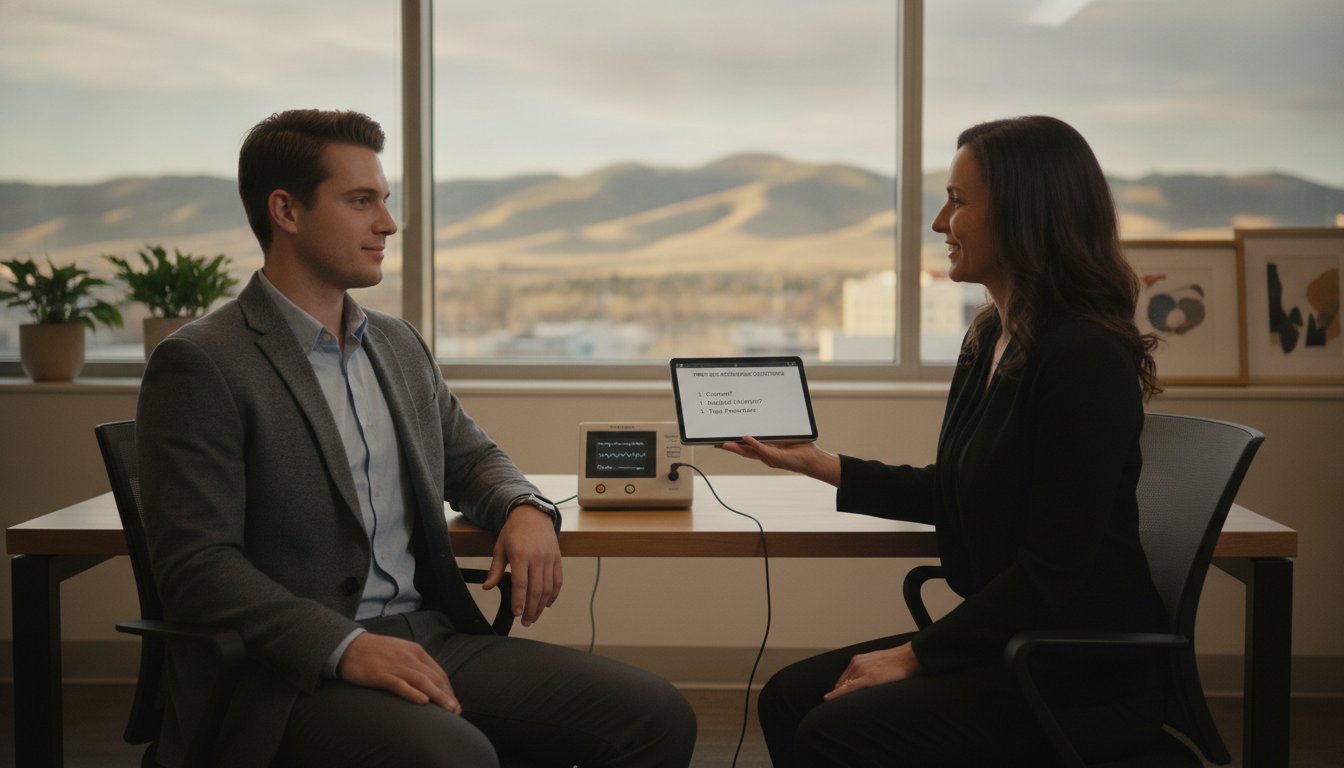
Most candidates view a polygraph as a high-stakes interrogation designed to trap them in a lie, but in a professional screening environment, the exact opposite is true. It’s natural to feel a surge of adrenaline when your career goals hinge on a physiological sensor. You might worry that a youthful mistake or a moment of nervous hesitation will disqualify you from a position you’ve worked hard to earn. Many applicants share this anxiety, fearing that “gotcha” questions will lead to an unfair disqualification.
I’ll help you prepare for this process by detailing the specific types of pre-employment polygraph questions used by certified examiners in 2026. You’ll learn about the “no surprise” rule, which ensures every question is reviewed with you before the sensors are even attached. This article provides a clear breakdown of legal inquiry categories and explains how modern, data-driven methodology focuses on professional integrity rather than personal judgment. By the end, you’ll have the transparency needed to approach your screening with calm, collected confidence.
Key Takeaways
- Understand the “No Surprise” rule, which guarantees that you’ll review all pre-employment polygraph questions with your examiner before the actual testing begins.
- Learn to distinguish between neutral baseline questions and those designed to verify your professional integrity and past employment history.
- Discover how the “One-Issue” rule prevents confusion by ensuring each question focuses on a single, clear topic for maximum data accuracy.
- Explore the legal and ethical boundaries that certified examiners follow to ensure your screening remains professional and non-judgmental.
- Gain confidence by understanding how modern digital technology and a structured pre-test interview help reduce common “exam jitters.”
The Architecture of a Polygraph: Why Questions Aren’t Surprises
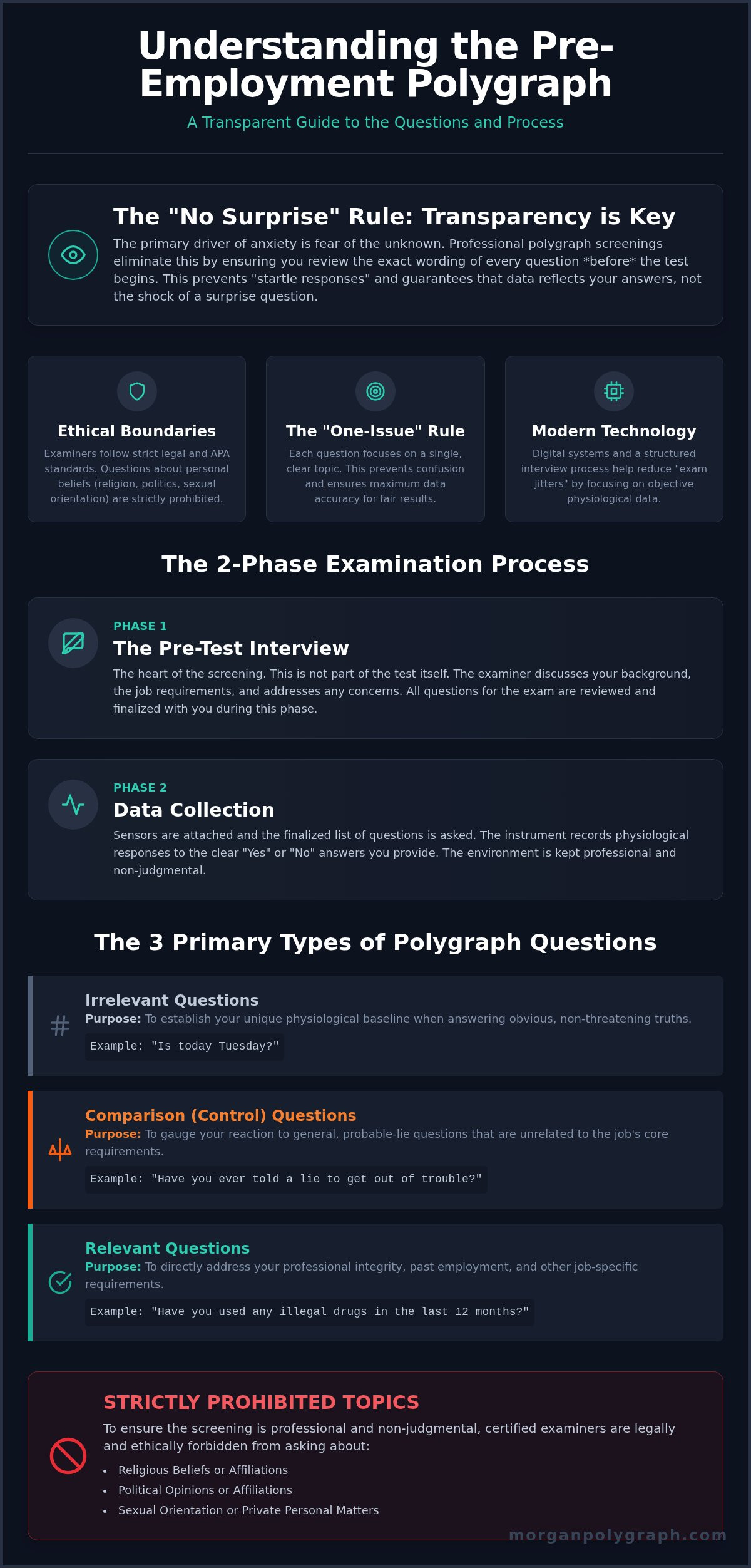
Fear of the unknown is the primary driver of anxiety during a background screening. Many candidates worry they’ll face a sudden, confusing question that triggers a false positive result. In a professional setting, especially at a court-recognized facility like Morgan Polygraph in Boise, this simply doesn’t happen. The entire process is built on a foundation of transparency known as the “No Surprise” rule. By reviewing the exact phrasing of all pre-employment polygraph questions before the sensors are even touched, the examiner eliminates the possibility of a “startle response” that could skew the data. This level of preparation ensures that any physiological reaction recorded is a response to the question’s content, not the shock of hearing it for the first time.
Professional examiners adhere to strict American Polygraph Association (APA) standards, which explicitly prohibit “gotcha” or trick questions. The goal isn’t to confuse the applicant but to collect clean, objective data. To achieve this, the examiner works with you to define every term used. For example, if a question asks about “illegal drug use,” the examiner will clarify exactly which substances are included and what timeframe is being discussed. This clarity prevents the brain from racing through “what-if” scenarios that might cause unnecessary stress. Understanding what a polygraph measures helps candidates realize that the instrument tracks physiological shifts like heart rate and skin conductivity, which are most stable when the examinee feels informed and prepared.
The Role of the Pre-Test Interview
The pre-test interview serves as the diagnostic heart of the screening. During this phase, the examiner discusses your background and the specific requirements of the job to ensure the scope of the test is clear. It’s a time to address any “exam jitters” and confirm your physical readiness for the 2026 testing standards. The pre-test interview is the essential phase where all questions are finalized to ensure no surprises. This step is vital for establishing a physiological baseline, as it allows the examiner to see how your body reacts when you’re speaking comfortably and truthfully before the formal pre-employment polygraph questions begin.
Ethical Boundaries in Employment Questioning
Integrity in testing requires strict adherence to legal and ethical boundaries. Examiners don’t have free rein to ask whatever they wish. Questions regarding your religious beliefs, political affiliations, or sexual orientation are strictly prohibited. The focus remains entirely on your professional history and honesty. Every question is formatted for a clear “Yes” or “No” answer, which allows for the most objective data collection possible. This methodical approach ensures the environment remains non-judgmental and focused solely on the facts required for the position.
The Three Primary Types of Polygraph Questions
The structure of a professional screening is far more scientific than popular media often suggests. Examiners don’t simply ask a list of random queries to see if you flinch. Instead, they utilize a calibrated sequence of pre-employment polygraph questions divided into three distinct categories. This methodology allows the examiner to distinguish between normal nervous tension and a specific physiological reaction to deception. Modern digital systems analyze these shifts with high precision, ensuring that a candidate’s future isn’t decided by simple “exam jitters.”
To provide a clear, objective result, every examination includes the following categories:
- Irrelevant Questions: Neutral facts used to establish a physiological baseline.
- Comparison Questions: General inquiries used to gauge reactions to “probable” lies.
- Relevant Questions: Direct inquiries regarding your background and professional integrity.
Irrelevant vs. Relevant: Setting the Baseline
Before addressing sensitive topics, the examiner must understand your body’s unique physiological “signature.” Irrelevant questions serve this purpose. These are inquiries with obvious, non-threatening truths, such as “Is today Tuesday?” or “Are we currently in Boise?” By establishing these facts, the examiner identifies the “noise” in your data. This process creates a standard for your calm state during the polygraph examination.
It’s also important to recognize the legal framework surrounding these screenings. While government agencies and certain security-sensitive roles have specific requirements, the Employee Polygraph Protection Act (EPPA) provides strict guidelines on how and when these tests can be administered in the private sector. At Morgan Polygraph, we ensure every session adheres to these federal standards, maintaining the highest levels of professional integrity and legal compliance.
The Science of Comparison Questions
The most misunderstood part of the process involves Comparison Questions, sometimes called the “Probable Lie” technique. These aren’t “tricks” designed to make you look guilty. Instead, they act as a measurement yardstick. These questions cover general behaviors that most people have engaged in at some point, such as “Before the age of 21, did you ever take something that didn’t belong to you?”
The design of these questions is intentionally broad to ensure a physiological reaction. A truthful person will typically show a stronger reaction to these general comparison questions than to the specific relevant questions about the job. If your reaction to a relevant question is significantly larger than your reaction to the comparison question, it indicates a need for further clarification. This data-driven approach removes subjectivity from the results.
The final category includes Relevant Questions. These focus on the core requirements of your potential role, such as your employment history or specific security concerns. Modern polygraph software compares the reactions between all three types in real time. This innovation allows for a precise, objective analysis of the data. If you have questions about how these categories apply to your specific situation, you can consult with our Boise team for a discreet explanation of the process.
Examples of Pre-Employment Questions by Category
The core objective of a professional screening is to verify the history you’ve presented on paper. While a resume provides a curated view of your achievements, pre-employment polygraph questions delve into the practical realities of your past conduct. These inquiries generally fall into four primary categories: integrity, drug activity, criminal history, and employment conduct. By standardizing these questions, examiners ensure every candidate is evaluated against the same high bar of professional ethics, regardless of the specific role they seek.
Integrity and honesty questions often serve as the foundation of the test. These verify that the information provided on your initial job application is entirely accurate. The examiner isn’t looking for minor clerical errors; they’re identifying intentional patterns of deception regarding your qualifications or background. This transparency is vital for agencies in Boise that handle sensitive data or public safety responsibilities.
Drug Use and Criminal Activity Examples
In 2026, many agencies focus heavily on recent narcotics use and undisclosed criminal acts. A typical question might be phrased as, “Since the age of 18, have you used any illegal narcotics?” This specific timeframe allows the examiner to distinguish between youthful experimentation and habitual adult use. Examiners also ask about “undetected” crimes. These are illegal acts that never resulted in an arrest or police report. This is a vital distinction because it identifies risks that a standard fingerprint check cannot uncover. Understanding how polygraph question techniques isolate these specific memories is key to a successful session. If you’re concerned about how these results are interpreted, you may find our analysis of are polygraphs accurate helpful for understanding the science of reliability.
Workplace Integrity and Theft
Workplace conduct questions are designed to protect an organization’s assets and internal culture. A common inquiry is, “Have you ever stolen more than $50 worth of property from an employer?” This question is direct and quantifiable. Examiners also look for withheld information regarding past terminations, asking, “Are you withholding any information about your previous employment termination?” This prevents candidates from obscuring serious issues like falsifying records or workplace violence that may have led to their departure from a previous firm.
To maintain fairness, professional examiners use a method called “Time-Windowing.” This involves narrowing the scope of the question to a specific, relevant period, such as the last five or ten years. This ensures that a minor mistake from decades ago doesn’t carry the same weight as a recent pattern of behavior. This structured approach helps candidates focus their thoughts and provides the examiner with clean, actionable data. At Morgan Polygraph, we believe this transparency reduces anxiety and leads to more accurate results for both the applicant and the hiring agency.
Why Phrasing and Clarity Are Vital for Accuracy
Precision in language is the cornerstone of a valid physiological assessment. When administering pre-employment polygraph questions, the examiner must ensure that every word is understood in exactly the same way by both parties. If a question is vague or overly broad, the candidate’s brain may begin to scan through dozens of irrelevant memories, creating “noise” in the data. This is why professional examiners adhere to the “One-Issue” rule. This rule dictates that each question must focus on a single, clear topic. By isolating variables, the examiner maintains the integrity of the data and ensures the final report is based on facts, not confusion.
A common pitfall in amateur or poorly regulated screenings is the use of “double-barreled” questions. These are inquiries that ask two things at once, such as “Have you ever stolen money or narcotics from an employer?” If a candidate has done one but not the other, their physiological response will be chaotic. The brain struggles to process which part of the question it is reacting to, leading to inconclusive results. Professional standards in 2026 require that these topics remain separate to provide the most accurate reading of the candidate’s honesty.
Eliminating Ambiguity in Screening
Vague phrasing is the enemy of a fair test. A question like “Have you ever been in trouble?” is unprofessional because “trouble” means different things to different people. To one person, it might mean a speeding ticket; to another, it might mean a felony conviction. In our Boise office, we replace such ambiguity with objective, legally grounded language. For instance, we ask, “Have you ever been convicted of a felony?” This phrasing leaves no room for interpretation. Before the test begins, we define specific terms like “illegal drugs” or “theft” to ensure the examinee doesn’t have a mental reservation about a specific word or phrase. This level of detail is a key requirement under the Employee Polygraph Protection Act (EPPA), which protects candidates from arbitrary or unfair questioning in the private sector.
The Psychology of Candidate Rationalization
Examiners are trained to identify and counter “rationalization.” This is the mental process where a person justifies a lie to themselves. A candidate might think, “I didn’t steal that office equipment, I just borrowed it indefinitely.” To counter this, pre-employment polygraph questions are structured so they are impossible to answer truthfully with a “Yes” if a lie is intended. We close the loopholes that allow for mental gymnastics. Precise and transparent phrasing protects the candidate from accidental physiological spikes caused by sudden confusion or moral second-guessing. This methodical approach ensures that the environment remains professional and non-judgmental. If you are an agency looking to implement these high standards, you can schedule a consultation for professional screening services to ensure your hiring process is both accurate and legally compliant.
Professional Screening in Boise: The Morgan Polygraph Approach
The integrity of a hiring process depends on both technical precision and human empathy. While understanding the structure of pre-employment polygraph questions prepares a candidate mentally, the quality of the examination environment determines the reliability of the physiological data. At Morgan Polygraph, our Boise-based examiners utilize court-recognized expertise to bridge the gap between rigorous investigative requirements and the need for a respectful, professional atmosphere. This balance is why government agencies and private firms across Idaho rely on our services for their most sensitive background screenings.
Our process is methodical and transparent. It begins with an initial agency consultation to define the scope of the inquiry and ensure all legal standards are met. Once the candidate arrives at our West State Street office, they’re guided through the pre-test interview and the examination with clear, step-by-step instructions. After the session, we provide a final certified screening report that offers background investigators a clear, data-driven assessment of the candidate’s veracity. This organized workflow ensures that no detail is overlooked and every stakeholder has confidence in the result.
State-of-the-Art Technology in Idaho
We’ve moved beyond the limitations of legacy analog systems to embrace modern, computerized data-driven detection. Our facility uses the latest digital polygraph technology to capture and analyze physiological responses with high resolution. One of the primary advantages of this technology is computerized scoring. By using advanced algorithms to evaluate the data, we add an objective layer of analysis that significantly reduces the potential for human bias in pre-employment polygraph questions results. These systems produce professional, easy-to-read reports that allow background investigators to make informed decisions based on precise metrics rather than subjective observation.
Compassionate and Discreet Service
Professionalism shouldn’t come at the expense of respect. We recognize that job candidates are often in a vulnerable state, and high levels of stress can interfere with clear data collection. Our Boise office is a comfortable, professional setting specifically designed to reduce candidate anxiety. We handle every background matter with the utmost privacy, ensuring that sensitive personal information remains confidential. For those currently researching their options or preparing for an upcoming session, our guide on finding a certified polygraph near me offers essential criteria for selecting an expert examiner who prioritizes both accuracy and candidate dignity. By maintaining a non-judgmental atmosphere, we help candidates focus on providing honest, clear answers, which ultimately leads to more reliable outcomes for the hiring agency.
Approaching Your Career with Confidence and Clarity
Understanding the structure of the screening process removes the anxiety of the unknown. It’s helpful to remember that every inquiry is reviewed in advance and that all pre-employment polygraph questions follow strict ethical standards. This transparency ensures that your professional history is evaluated fairly. By focusing on the “No Surprise” rule and the objective nature of modern digital testing, you can approach your appointment with a calm and prepared mindset. Clear communication between the examiner and the candidate is the foundation of a successful and accurate session.
At Morgan Polygraph, we combine court-recognized Idaho expertise with state-of-the-art digital technology to deliver precise results. Our nationally certified examiners are dedicated to providing a discreet and non-judgmental environment for every candidate. If you’re ready to move forward in your hiring process with confidence, schedule a confidential consultation with a certified Boise examiner today. Your professional integrity is your greatest asset, and we’re here to help you demonstrate it with absolute clarity. We look forward to assisting you in taking this next step in your career.
Frequently Asked Questions
Can I see the pre-employment questions before the test starts?
Yes, you will review every question during the pre-test interview before any sensors are attached. Professional examiners follow a “No Surprise” rule to ensure that you understand the phrasing and scope of each inquiry. This transparency is essential for preventing accidental physiological spikes caused by the shock of an unexpected question. By the time the formal exam begins, you’ll know exactly what will be asked.
What happens if I don’t understand a question during the polygraph?
You should address any confusion during the pre-test phase before the formal testing begins. If a specific term or timeframe is unclear, the examiner will work with you to define it. Once the sensors are active and the test is underway, you won’t be able to ask for clarifications. The pre-test review is the vital time to ensure you grasp every detail of the pre-employment polygraph questions.
Will my nerves or ‘white coat syndrome’ cause me to fail the questions?
General nervousness doesn’t cause a person to fail a professional screening. The examiner establishes a physiological baseline using neutral, irrelevant questions to identify your “normal” state of anxiety. Modern digital software looks for specific deviations from this baseline when you answer sensitive questions, rather than simply measuring a fast heart rate. This calibrated approach ensures that your natural “exam jitters” are accounted for in the final analysis.
How many questions are usually asked in a standard pre-employment test?
A standard examination typically includes a total of 10 to 12 questions. This list is a combination of neutral baseline questions, comparison questions, and the core relevant inquiries regarding your background. Keeping the list concise prevents “exam fatigue,” which can lead to inconsistent physiological data. A focused set of questions allows the examiner to maintain high data integrity and provide a clear, objective report to the hiring agency.
Are the questions different for a police officer versus a private security role?
The core methodology remains the same, but the specific pre-employment polygraph questions are tailored to the security risks of the role. A law enforcement screening may focus heavily on public trust and past law enforcement interactions. In contrast, a private security or courier role might emphasize asset protection and workplace integrity. Each test is designed to verify the specific qualifications and honesty required for that unique professional environment.
Can the examiner ask me about my medical history or religious beliefs?
No, professional examiners are strictly prohibited from asking about your religious beliefs, political affiliations, or sexual orientation. These topics are outside the legal scope of an employment screening. Under American Polygraph Association (APA) standards and federal law, the focus must remain entirely on your professional conduct and background. Medical history is only discussed if it’s necessary to ensure you can safely complete the physiological testing process.
What is a ‘control question’ and why is it used in employment screening?
A control question, also known as a comparison question, acts as a measurement yardstick for the examiner. These are general inquiries about past behaviors that most people have committed at some point, such as “Have you ever told a lie to stay out of trouble?” By comparing your reaction to these with your reaction to relevant job questions, the examiner can scientifically determine whether a specific response indicates deception or merely a normal reaction.
Can I refuse to answer a specific question during the exam?
You have the right to refuse to answer any question, but it’s important to understand the consequences. Most hiring agencies require full participation in the polygraph as a condition of employment. Refusing to answer a question may be viewed as a lack of transparency, which could lead to disqualification from the hiring process. If you have concerns about a specific topic, it’s best to discuss them openly during the pre-test interview.