

Imagine you’re facing serious charges for a crime committed in downtown Nampa, but you were actually miles away, alone at home. Without a doorbell camera or a witness to vouch for your location, the fear of a wrongful conviction becomes a heavy, daily burden. It’s a vulnerable position to be in, and it’s natural to feel skeptical about whether the legal system will truly hear your side of the story. Using polygraph to validate an alibi in a criminal case Nampa can bridge this gap when physical evidence is missing.
A professional polygraph examination serves as a critical strategic tool for validating alibis in Nampa criminal defense cases. By establishing a factual baseline for your whereabouts, you provide your defense attorney with the leverage needed to challenge the prosecution’s narrative. This guide explains how private examinations, protected by attorney-client privilege, can help persuade a prosecutor to dismiss charges or reconsider their position before you ever step foot in a courtroom. We’ll examine the specific role of modern technology in building a credible defense and how to navigate Idaho’s legal requirements for admissibility.
Key Takeaways
- Understand how a specialized examination can fill critical gaps when physical evidence or witness testimony is unavailable to support your whereabouts.
- Learn about the data-driven methodology that uses physiological markers to verify concrete claims regarding time and location.
- Discover why using polygraph to validate an alibi in a criminal case Nampa through a private examiner protects your legal rights via attorney-client privilege.
- Explore the strategic advantages of presenting objective results to a prosecutor to potentially facilitate a dismissal or a more favorable plea bargain.
- Follow a methodical, step-by-step guide on coordinating with your defense attorney to integrate polygraphy into your overall legal strategy.
Polygraph Testing for Criminal Alibis in Nampa
An alibi polygraph is a specialized forensic examination that focuses on verifying a person’s presence at a specific location during the commission of a crime. In Nampa, defendants often find themselves in situations where they lack traditional physical evidence, such as surveillance footage or GPS logs, to support their whereabouts. Using polygraph to validate an alibi in a criminal case Nampa provides a structured method to establish a factual baseline early in a Canyon County investigation. By providing objective data, local defense attorneys can more effectively communicate with the Nampa Police Department, potentially redirecting the focus of an active investigation before charges escalate.
Understanding Alibi Evidence in Idaho Courts
Under Idaho law, an alibi is a defense where the accused claims they were elsewhere when the crime occurred. While this sounds straightforward, the burden of proving an alibi without a digital footprint is a common hurdle in our local courts. Many residents don’t realize how difficult it is to prove they were home alone or at a private residence without witness testimony. A polygraph complements other forms of evidence, such as cell tower data, by filling the gaps that technology might miss. The Science of Lie Detection offers a perspective on how physiological monitoring can support a defendant’s statement, transforming a simple claim into a documented forensic report.
Why Nampa Defendants Turn to Private Polygraphy
The legal and emotional stakes in Canyon County are high, especially in cases involving felony theft or assault. Defendants often feel trapped in a he-said, she-said dynamic where the prosecution relies heavily on a single witness. A private polygraph offers a layer of protection and relief. It allows a defendant to verify their story in a discreet, professional environment. Defense strategies involving using polygraph to validate an alibi in a criminal case Nampa are becoming more common as attorneys seek innovative ways to protect their clients’ rights. This process is particularly effective for:
- Filling Evidence Gaps: Validating location when no cameras or third-party witnesses were present.
- Building Attorney Leverage: Giving defense counsel a tool to negotiate with prosecutors for a dismissal.
- Establishing Credibility: Moving beyond verbal assertions to a data-driven verification of the facts.
By using these examinations strategically, Nampa residents can ensure their defense is built on a foundation of verified truth rather than just a hopeful narrative. It provides a methodical way to clear one’s name before the case reaches a jury.
The Science of Lie Detection: How Polygraphy Verifies Time and Place Claims
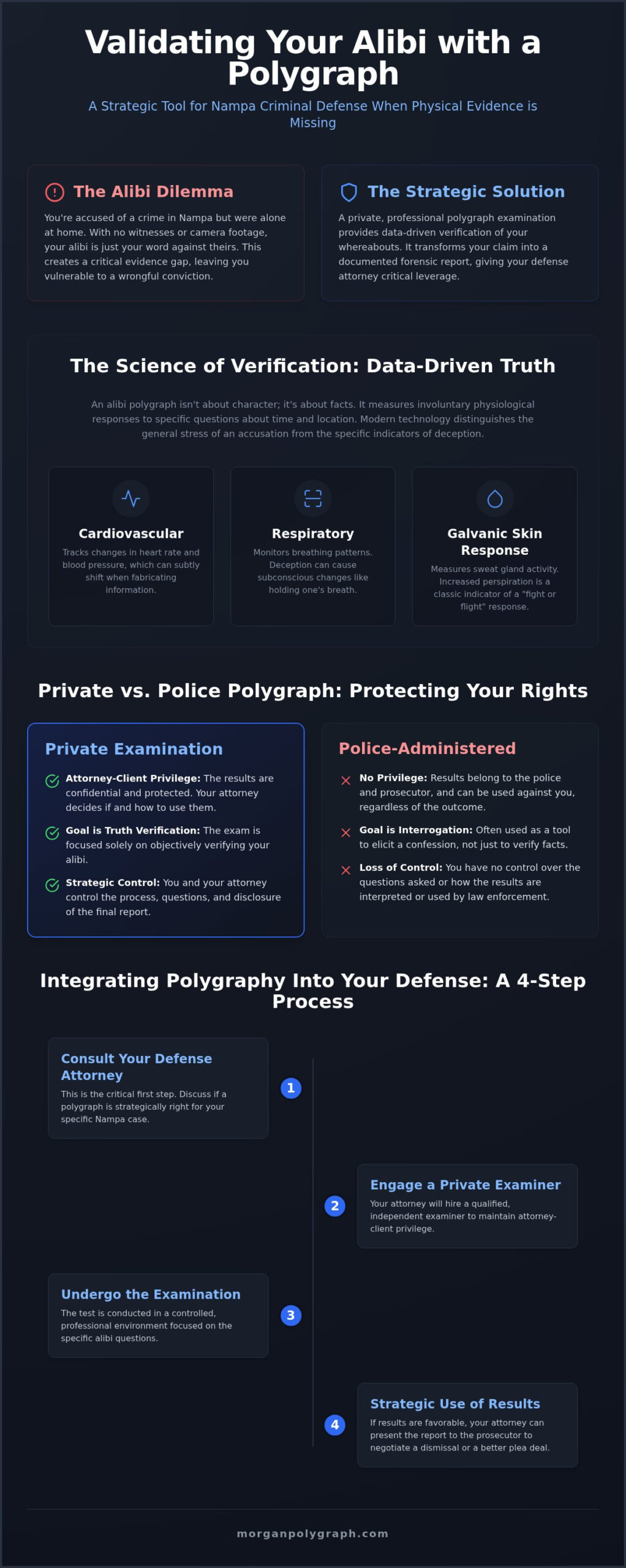
The effectiveness of a polygraph lies in its ability to record involuntary physiological responses that occur when an individual is asked specific questions. When a person provides a statement regarding their location, the instrument tracks three primary systems: respiratory cycles, galvanic skin response (sweat gland activity), and cardiovascular changes. Unlike general character assessments, alibi verification is uniquely suited for polygraphy because it deals with concrete, binary facts. You were either at the specific Nampa location at the time of the incident, or you weren’t. This clarity allows for a higher degree of precision during the examination process.
In 2026, modern technology has significantly reduced the margin of error in alibi verification through advanced data-driven detection and behavioral observation software. These innovations allow examiners to distinguish between the stress of being accused of a crime and the specific physiological indicators of deception. Using polygraph to validate an alibi in a criminal case Nampa relies on these technical advancements to provide defense attorneys with a reliable, objective report that can withstand professional scrutiny.
Physiological Markers of Truthfulness
When an individual truthfully recalls their whereabouts, the body typically maintains a stable baseline. The autonomic nervous system does not trigger the “fight or flight” response because there is no perceived threat from the question itself. However, when a person attempts to fabricate a location, the brain must work harder to maintain the lie, causing subtle but measurable shifts in heart rate and skin conductivity. You can read more about the technical process in our guide on how does a polygraph work to understand how these sensors interact with the body’s natural rhythms.
Designing Alibi-Specific Questioning Protocols
The integrity of the test depends heavily on the questioning protocol. Examiners typically use the Comparison Question Technique (CQT), which contrasts responses to the alibi issue with responses to unrelated, control questions. This method helps determine if the examinee’s physiological reactions are specifically tied to the alibi claim. We also develop “symptomatic” questions to ensure the participant isn’t distracted by outside concerns, keeping the focus entirely on the time and place in question. While there are ongoing discussions regarding the admissibility of polygraph evidence in various jurisdictions, the scientific rigor applied to these protocols makes them an invaluable tool for pre-trial negotiations. If you are facing a situation where your word is being questioned, you may want to consult with a certified examiner to discuss your specific case details.
Private vs. Police Polygraphs: Protecting Your Rights in Canyon County
Residents in Nampa often face a difficult choice when local law enforcement suggests a voluntary exam to “clear things up.” While the offer may seem like a shortcut to justice, the environment in which the test is conducted significantly alters its legal weight. Using polygraph to validate an alibi in a criminal case Nampa through a private firm ensures your rights remain protected throughout the process. The legal definition of a polygraph describes it as a device that records physiological changes, but in the hands of the Nampa Police Department, it often functions as an interrogation catalyst rather than a simple verification tool.
The Risks of Law Enforcement Examinations
Police examiners are typically investigators first. Their primary objective is often to secure a confession or gather incriminating statements that can be used later in court. When you take a test at a police station, there is no expectation of confidentiality. If the results are unfavorable, the prosecution will use those findings to build their case against you. Before agreeing to a government exam, asking are polygraphs accurate is a critical step. You must understand that even a “passed” police test doesn’t guarantee your charges will be dropped, but a “failed” one will almost certainly intensify the investigation.
The Strategic Advantage of a Confidential Private Test
A private polygraph provides a “Safe Haven” for defendants in Canyon County. Because the exam is conducted at the request of your defense counsel, the results are generally protected by attorney-client privilege. This means you can “test the waters” without the risk of the prosecution ever seeing a negative result. If the examination successfully validates your alibi, your attorney can then use that report as a powerful negotiation tool. In Idaho, the results of these tests are not admissible in court unless all parties agree, or stipulate, to their admission. This makes the private exam a low-risk, high-reward strategy for your defense.
- Confidentiality: Results stay between you, the examiner, and your lawyer.
- Zero Prosecution Access: The Nampa Police Department cannot subpoena results of a privileged private exam.
- Negotiation Leverage: A passed private test can persuade a prosecutor to reconsider the strength of their case.
- Professional Environment: Examinations are conducted in a neutral, clinical setting designed to reduce situational stress.
By choosing a private path, you maintain control over the narrative. Morgan Polygraph works directly with defense counsel in the Treasure Valley to ensure every examination meets the highest ethical and technical standards. This methodical approach allows you to establish the truth about your whereabouts while keeping your legal strategy entirely discreet.
The Step-by-Step Process: Using a Polygraph to Strengthen Your Defense
The transition from a legal theory to a verified alibi requires a methodical, multi-stage process. It begins with a private consultation between you and your defense attorney to determine if using polygraph to validate an alibi in a criminal case Nampa aligns with your broader legal strategy. Unlike a police-led interrogation, this process is structured to be transparent and controlled. Once your attorney greenlights the exam, it is scheduled at a professional, neutral facility in the Treasure Valley. This setting is vital for ensuring that the data collected is a result of the questioning rather than situational anxiety or external pressure.
The examination itself consists of three distinct phases: the pre-test interview, the data collection phase, and the post-test analysis. During the pre-test, the examiner reviews every question with you to ensure there are no ambiguities. You’ll know exactly what will be asked before the sensors are ever attached. The data collection phase involves running multiple “charts” or sequences of these questions. Finally, the examiner performs a sophisticated analysis of the physiological data to produce a formal, court-ready report that your attorney can use as leverage during plea negotiations or pre-trial motions.
Preparing for the Examination with Your Attorney
Success in an alibi verification exam depends on total transparency during the preparation phase. You must disclose all relevant details regarding your whereabouts to your examiner so they can craft precise, binary questions. On the day of the exam, focus on your physical well-being. Get adequate sleep and eat a normal meal to ensure your baseline physiological responses are stable. It’s critical to avoid researching “how to pass” or looking up countermeasures online. Modern 2026 detection software is specifically designed to identify these attempts, which can result in an “inconclusive” or “purposeful non-cooperation” finding. Honesty is your only effective strategy.
What Happens During the Alibi Verification Exam?
The physical examination involves the application of several non-invasive sensors designed to track your autonomic nervous system. These typically include:
- Pneumograph tubes: Placed around the chest and abdomen to monitor respiratory patterns.
- Blood pressure cuff: Attached to the arm to track cardiovascular changes.
- Galvanic skin sensors: Placed on the fingertips to measure sweat gland activity.
The process starts with an “Acquaintance Test,” a simple calibration run that allows the equipment to adjust to your body’s unique signatures. To maintain the highest standards of accuracy, we provide a quiet, distraction-free environment for all Nampa clients. This methodical approach ensures that the final report is based on clean, reliable data. If you are ready to take the next step in your defense, you can schedule a criminal defense polygraph to begin the verification process.
Choosing Morgan Polygraph for Criminal Defense Support in Nampa
Morgan Polygraph is dedicated to providing the Nampa legal community with innovative, data-driven solutions for complex criminal matters. When you’re facing the intense stress of a criminal investigation, you need a partner who understands the high stakes involved for your future and your family. Our approach combines decades of traditional experience with futuristic technology to ensure every result is precise and reliable. We understand the human element of this work. We treat every client with the compassion and respect they deserve during a vulnerable state, ensuring the clinical nature of the test doesn’t add unnecessary burden to an already difficult situation.
Using polygraph to validate an alibi in a criminal case Nampa requires more than just advanced equipment; it requires an examiner who understands the nuances of local defense strategy. We serve as a trusted partner for defense attorneys throughout Canyon County, providing the objective clarity needed to redirect investigations. Finding a polygraph near me with recognized Idaho credentials ensures your results carry weight in pre-trial negotiations. Our methodical and organized operation ensures that every step of the process, from the initial intake to the final report, is handled with the highest level of professionalism.
Certified Expertise for Nampa and Boise Legal Communities
Our examiners are nationally certified and possess a deep understanding of the Idaho Rules of Evidence. This expertise is critical when dealing with stipulated results in 2026, where the methodology must be beyond reproach. We have established a reputation among legal professionals in both Canyon and Ada counties for providing reliable results in high-stakes felony cases. By choosing an examiner with deep roots in the Treasure Valley, you benefit from a practitioner who is recognized and respected within the local professional community. This standing adds a layer of academic gravitas to the findings, making our reports a powerful tool in any legal defense.
Confidential Reporting and Attorney Consultation
Privacy is the cornerstone of our operation. We deliver all reports directly to your legal counsel to maintain attorney-client privilege, ensuring that the defense maintains full control over the narrative at every stage of the legal process. Our reporting is detailed and methodical. We provide a comprehensive breakdown of the physiological data collected, which is exactly what Nampa defense attorneys trust when they enter negotiations with the prosecution. If your case moves toward a stipulated agreement, our examiners are available to provide expert witness testimony to explain the scientific rigor behind the results. Contact us today to discuss your alibi validation needs in Nampa and take a proactive step toward establishing the facts of your case.
Strengthening Your Criminal Defense Strategy in Nampa
Securing your future requires a proactive approach to your legal defense. A private examination offers a protected environment to verify your whereabouts without the risks associated with police-led testing. By establishing a factual baseline through data-driven methodology, you provide your legal counsel with the objective evidence needed to challenge the prosecution’s narrative and seek a favorable resolution before reaching the courtroom.
Using polygraph to validate an alibi in a criminal case Nampa isn’t just about the truth; it’s about building strategic leverage. Our nationally certified examiners use state-of-the-art technology to produce reports that local defense attorneys trust for critical negotiations. We maintain the highest standards of discretion and professionalism, ensuring your sensitive legal matters are handled with the care they deserve. As court-recognized experts, we bridge the gap between tradition and innovation to support your case.
If you’re ready to secure a factual foundation for your alibi, Contact Morgan Polygraph for a Confidential Alibi Validation Consultation. You don’t have to face these charges without a technical advocate on your side. We’re here to help you move forward with confidence.
Frequently Asked Questions
Are polygraph results admissible in Nampa, Idaho criminal courts?
Polygraph results are generally not admissible in Idaho courts unless all parties involved in the case agree to their admission. This legal arrangement is known as a stipulation. While the results may not be used as primary evidence during a trial without this agreement, they remain a powerful tool for defense attorneys during plea negotiations or when attempting to persuade a prosecutor to dismiss charges before a trial begins.
Can a polygraph test really prove my alibi is true?
A polygraph examination verifies the physiological truthfulness of your statements regarding your location and actions. By monitoring involuntary autonomic responses, the test provides a data-driven report that supports your claim of being elsewhere during a crime. While it doesn’t replace physical evidence like video footage, it serves as a credible forensic baseline that can fill critical gaps in your defense strategy.
What happens if I fail a private polygraph test for my criminal case?
If you do not pass a private examination, the results remain strictly confidential under attorney-client privilege. Unlike a test administered by the Nampa Police Department, the findings of a private exam are not shared with the prosecution or law enforcement. This allows your defense counsel to evaluate the strength of your alibi and adjust your legal strategy without the risk of the results being used against you.
How much does a private alibi polygraph cost in the Nampa area?
The cost of a professional examination in Canyon County varies based on the complexity of the case and the specific reporting requirements of your defense attorney. Criminal defense support typically requires more extensive preparation and analysis than standard civil screenings. You should contact a certified examiner directly to discuss the details of your case and receive a precise quote for a professional forensic report.
Should I tell the Nampa Police Department I am taking a private polygraph?
You should not disclose your intent to take a private test to law enforcement without first consulting your defense attorney. Using polygraph to validate an alibi in a criminal case Nampa is a strategic decision that relies on maintaining legal privilege. Your attorney will determine if and when it’s beneficial to share favorable results with investigators to help resolve your case more quickly.
How long does an alibi-specific polygraph examination take?
A comprehensive alibi validation exam typically lasts between two and three hours. This duration allows for a detailed pre-test interview, equipment calibration, and multiple sequences of data collection. We follow a methodical process to ensure the highest levels of accuracy, which requires an unhurried environment where every physiological marker can be carefully recorded and analyzed.
Can medications affect my alibi polygraph results in Idaho?
Certain medications that influence the central nervous system, heart rate, or blood pressure can affect your physiological responses during a test. It is essential to provide your examiner with a complete list of any prescription or over-the-counter medications you’re taking. This information allows the examiner to accurately interpret your charts and ensures that your results are not unfairly skewed by your medical history.
What kind of questions will be asked during an alibi validation test?
Using polygraph to validate an alibi in a criminal case Nampa involves answering clear, binary questions that require a simple “Yes” or “No” response. These questions are specifically designed to be concrete and lack any ambiguity regarding time and location. For instance, you might be asked if you were at a specific residence in Nampa at the exact time a crime occurred. Every question is reviewed with you in advance to ensure complete clarity.