

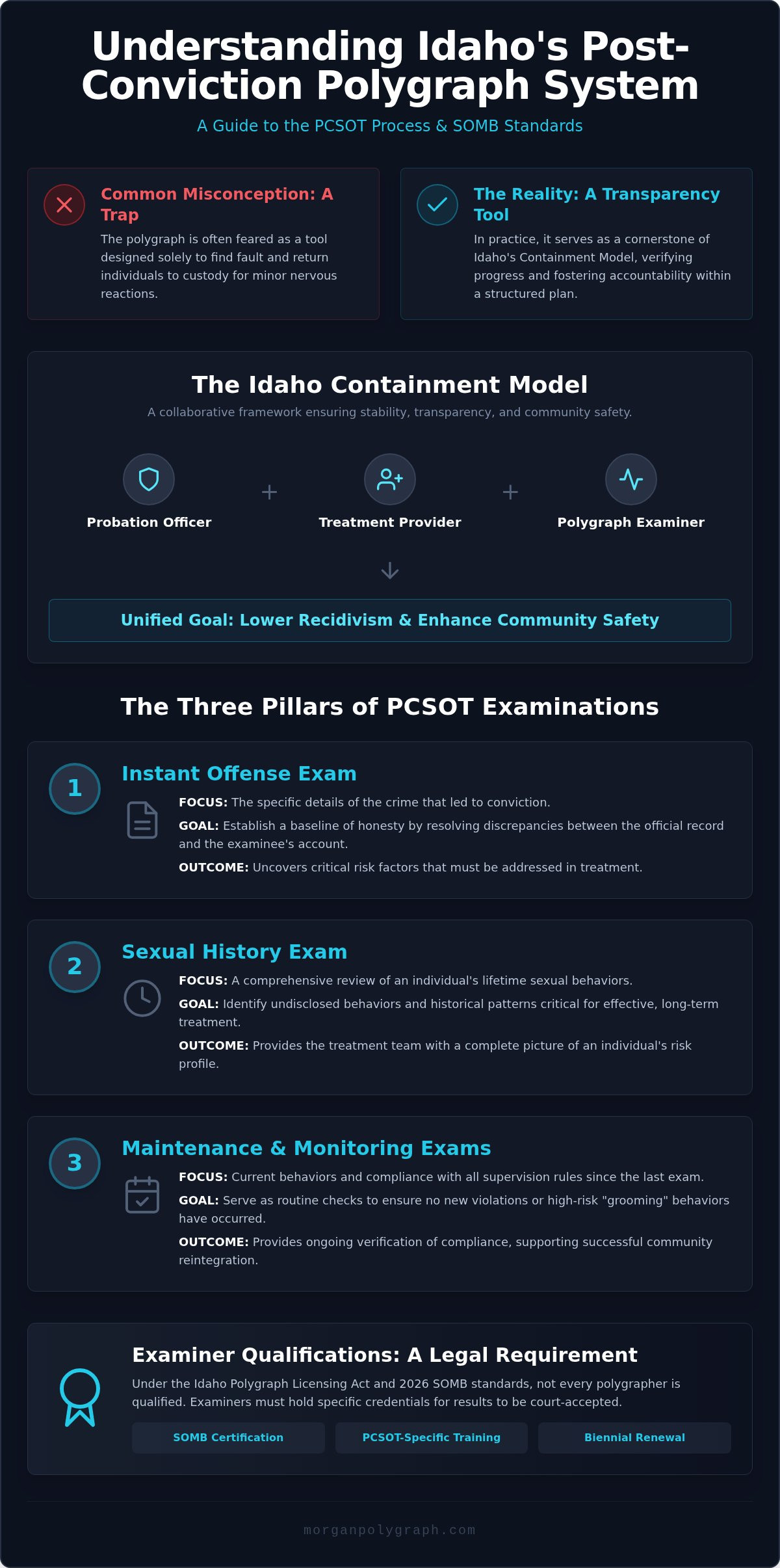
A post-conviction sex offender polygraph in Idaho is not a trap designed to send you back to custody. In reality, it’s a transparency tool that serves as a cornerstone of the state’s Containment Model. You’re likely feeling a high degree of stress about your upcoming exam, wondering if a single nervous moment will be misinterpreted as deception. It’s a common fear, but understanding the system is the first step toward managing that anxiety.
We know the stakes are high for your freedom and your future. This 2026 guide provides a comprehensive look at the Idaho SOMB requirements, the different types of PCSOT exams, and what the process actually looks like in a professional setting. You’ll learn how these tests function within your supervision plan and how to maintain compliance with your probation or parole terms. By the end of this article, you’ll have the knowledge needed to replace confusion with confidence, ensuring you’re prepared for every step of the evaluation process.
Key Takeaways
- Understand how the 2025 Idaho SOMB revisions and 2026 certification standards shape your specific legal testing requirements.
- Differentiate between the Three Pillars of testing—Instant Offense, Sexual History, and Maintenance—to understand the focus of your upcoming session.
- Shift your perspective from fear to transparency by learning why the polygraph is a tool for verifying progress rather than a trap for returning to custody.
- Implement specific physical and mental preparation strategies to reduce anxiety and ensure a professional post-conviction sex offender polygraph Idaho experience.
- Gain insight into how Idaho’s “Containment Model” uses polygraph data to support both community safety and your successful compliance with supervision terms.
The Legal Framework: PCSOT and the Idaho SOMB Standards
Post-Conviction Sex Offender Testing (PCSOT) is a highly specialized application of forensic psychophysiology used within the Idaho justice system. Unlike pre-employment or criminal investigation tests, the primary focus of a post-conviction sex offender polygraph Idaho is long-term management and community safety. These exams are strictly governed by the Idaho Sexual Offender Management Board (SOMB). The board established the February 2025 revision of its Standards and Guidelines to ensure uniform practice and high ethical standards across the state. These regulations provide a clear roadmap for how tests are conducted and how results are integrated into an offender’s legal record.
The Idaho Department of Correction (IDOC) mandates these examinations at specific intervals to monitor compliance with court-ordered supervision terms. The process relies on sophisticated technology to understand what a polygraph measures, specifically the physiological markers of the autonomic nervous system. By monitoring heart rate, respiratory patterns, and skin conductivity, examiners can verify the accuracy of an individual’s disclosures. This data-driven approach removes the ambiguity from supervision, providing probation officers and treatment providers with objective insights that verbal interviews alone cannot produce.
The Purpose of the Idaho Containment Model
Idaho utilizes the Containment Model, a proven framework where the probation officer, treatment provider, and polygraph examiner function as a unified team. Within this system, the polygraph serves as the “third leg” of the stool, providing the necessary stability for effective supervision. If any one of these three pillars is missing, the entire management plan becomes unstable. The model’s primary goal is to foster transparency, ensuring that treatment goals align with an individual’s actual daily behaviors. Research incorporated into SOMB training suggests that this collaborative approach is vital for maintaining lower recidivism rates. It encourages honesty about minor violations before they escalate into new criminal offenses, ultimately protecting Idaho communities.
SOMB Certification for Idaho Examiners
It’s vital to recognize that not every licensed polygrapher is qualified to conduct these specialized exams. Under the Idaho Polygraph Licensing Act, examiners must hold specific certifications and adhere to biennial renewal requirements to work with this population. In 2026, the SOMB maintains strict oversight, requiring practitioners to complete extensive PCSOT-specific training that exceeds general forensic protocols. This specialized education ensures the examiner understands the psychological nuances of sexual history disclosures and maintenance testing. Morgan Polygraph meets all current 2026 Idaho regulatory requirements, offering court-recognized expertise. Choosing a certified professional isn’t just a matter of preference; it’s a legal requirement to ensure your testing results are accepted by the IDOC and the SOMB.
The Three Pillars of PCSOT: Instant Offense, Sexual History, and Maintenance
The post-conviction sex offender polygraph Idaho process is structured around three specific types of examinations, each serving a distinct purpose in the offender’s management plan. These aren’t interchangeable; they’re sequential and methodical. By breaking down the testing into these categories, the supervision team can address specific risks at different stages of the rehabilitation process. This clarity helps reduce the examinee’s anxiety by defining exactly what each session will cover.
The Instant Offense Exam is typically the first step. It focuses entirely on the details of the crime that led to the current conviction. The goal is to ensure the individual has been fully honest about the circumstances of their offense. By resolving any discrepancies between the court record and the examinee’s account, the supervision team establishes a baseline of honesty. This specific application plays a vital role in sex offender treatment by uncovering risk factors that need to be addressed in therapy.
Next, the Sexual History Exam takes a broader view. This is a comprehensive review of an individual’s lifetime behaviors. It identifies patterns that might not have been captured in the specific conviction but are critical for effective treatment. Finally, Maintenance Exams and Monitoring Exams focus on the present. Maintenance tests are routine checks to ensure no new violations or “grooming” behaviors have occurred since supervision began. Monitoring exams are more targeted, often used when a probation officer suspects a specific violation or wants to verify a high-risk situation, such as a change in employment or residence.
The Disclosure Process for Sexual History Exams
Before a history exam, the examinee completes a detailed disclosure booklet. This document is a self-reported history of behaviors and experiences. The goal is “full disclosure,” which is essential for a productive therapeutic relationship. This process often follows a formal psychosexual evaluation, providing the treatment provider with the most accurate picture possible. At Morgan Polygraph, we provide a calm environment to help you work through this detailed disclosure with precision.
Maintenance Testing Intervals in 2026
In Idaho, the frequency of maintenance testing is determined by your risk level and the specific requirements of your supervision team. Most probationers undergo these exams every 6 to 12 months. Consistent, “clean” polygraph results are significant milestones. They demonstrate your commitment to the program and can eventually lead to earned discharge or a reduction in supervision intensity. The examiner’s role is to report these results objectively to the Containment Model team, documenting your successful compliance. If you have questions about your specific timeline, reviewing your status with a certified professional can provide much-needed clarity.
Addressing Misconceptions: Is the Polygraph a ‘Trap’?
The perception that a post-conviction sex offender polygraph Idaho is a ‘trap’ often stems from a misunderstanding of the exam’s purpose. In the Idaho Containment Model, the examiner isn’t looking for a reason to return you to custody. Instead, the process is designed to verify your progress and confirm that your reported behaviors match your actual actions. When a supervision team sees a pattern of consistent, honest results, it builds a foundation of trust that can lead to greater autonomy over time. The test acts as a safeguard for both the community and the individual, ensuring that the rehabilitation process remains on track.
Honesty regarding minor rule violations is almost always viewed more favorably than deception that is later uncovered during an exam. If you admit to a ‘slip’ or a technical violation during the pre-test phase, it shows you’re engaging with your treatment plan and taking responsibility. Deception, however, suggests a return to old patterns of secrecy. The Boise legal community uses these results as a diagnostic tool to guide your rehabilitation, helping your treatment provider adjust their approach to better support your success. It’s about maintaining a clear path forward, not creating a hurdle to your freedom.
Accuracy and Reliability in PCSOT
Scientific validation is a critical component of modern forensic testing. While critics often debate the general use of lie detectors, specific research into the efficacy and ethicality of PCSOT indicates it’s a highly effective tool for managing risk in a community setting. Many examinees ask: are polygraphs accurate enough to determine my future? The answer lies in the combination of advanced technology and examiner expertise. A certified Idaho examiner uses validated scoring systems to ensure the results are objective and fair, minimizing the risk of false positives caused by simple nervousness. The human element is just as vital as the sensors, as a skilled practitioner understands how to interpret data within the context of a post-conviction environment.
What Happens if You ‘Fail’ a PCSOT Exam?
A result indicating deception isn’t an automatic revocation of your probation. It’s important to distinguish between a ‘Deceptive’ test result and a ‘Technical Violation’ of your supervision terms. If the charts show a significant physiological reaction to a specific question, the examiner will conduct a post-test interview. This is your opportunity to clarify your responses or provide additional context that you might have withheld. Your supervision team then reviews the data to determine the next steps. Often, this results in an adjustment to your treatment goals or increased check-ins rather than immediate custody. The goal is to address the underlying behavior before it leads to a new offense, keeping you focused on long-term compliance.
Preparing for Your Examination in Boise
Preparation for a post-conviction sex offender polygraph Idaho begins long before you arrive at the office. Your physical state significantly impacts the quality of the physiological data collected, so physical readiness is the foundation of a successful exam. You should aim for a full night of rest and eat a balanced meal before your appointment. If you take daily medications, continue to do so as prescribed by your physician. Abruptly stopping medication or arriving in a state of exhaustion can lead to physiological responses that are difficult to interpret. Arriving physically prepared demonstrates your commitment to the process and helps ensure your data is clear.
Mental preparation is equally important. Review your disclosure materials thoroughly before you arrive. Being prepared to discuss these documents openly reduces the likelihood of surprises during the testing phase. Your goal is transparency. By viewing the post-conviction sex offender polygraph Idaho as a tool for your own progress, you can approach the session with a productive mindset. Focus on the long-term benefit of compliance rather than the immediate stress of the sensors.
Logistics for Your Boise Appointment
Our office is located at 6126 W. State Street in Boise. We recommend arriving at least 15 minutes early to complete any necessary paperwork. You’ll need to bring a valid government-issued photo ID, your court orders, and any disclosure booklets required by your treatment provider. Morgan Polygraph maintains a professional and discreet environment designed to minimize the inherent stress of court-ordered testing. We understand the sensitivity of your situation and ensure that every interaction is handled with the highest level of respect and privacy. This methodical approach helps you feel in control of the situation, which is vital for an accurate physiological reading.
Effective Communication with Your Examiner
Successful testing relies on a clear understanding between you and the examiner. You should never attempt to beat the test or use countermeasures. These techniques are easily detected by modern technology and are often viewed as a direct violation of your supervision terms. Instead, rely on honesty to ensure the examiner can provide a fair and balanced report. The pre-test interview is the most critical phase for accuracy, as it’s the period where every question is reviewed and clarified before the physiological recording begins. This phase ensures there’s no confusion about what’s being asked, which helps maintain a calm physiological state. If you are ready to proceed with a certified professional, you can schedule your Boise PCSOT examination today.
Why Morgan Polygraph is Idaho’s Choice for PCSOT
Morgan Polygraph stands as a primary resource for individuals navigating the complexities of the Idaho justice system. With decades of experience embedded in the local legal and correctional landscape, our firm provides the stability and expertise required for high-stakes testing. We maintain a strict commitment to the highest ethical standards, ensuring every post-conviction sex offender polygraph Idaho we conduct fully complies with the Sexual Offender Management Board (SOMB) 2026 guidelines. This adherence to state-mandated protocols protects the integrity of the results and the rights of the examinee.
Our approach recognizes that the PCSOT process is inherently stressful. While the technology we use is state-of-the-art, we never lose sight of the human element. Our practitioners are recognized as experts in the field, often called upon to provide court-recognized testimony. This dual focus on technical precision and compassionate interaction creates an environment where accurate data can be collected without unnecessary escalation of anxiety. We provide a calm, neutral space that allows you to focus on the task of transparency.
The Morgan Polygraph Difference
Attorneys and probation officers across the state trust our expertise because we deliver clarity. Our reports don’t just provide a result; they provide actionable data that fits seamlessly into the Idaho Containment Model. This level of detail helps treatment providers and supervision teams make informed decisions about an individual’s progress. For those seeking a polygraph near me in the Boise area, our reputation for reliability is unmatched. We prioritize precision so that your efforts toward transparency are documented accurately and professionally, supporting your long-term success in the program.
Working with Your Legal Team
We frequently coordinate with defense attorneys to ensure a fair and balanced testing environment. If your legal counsel has specific concerns about the methodology or the application of SOMB standards, we are available to discuss the technical aspects of the exam. Our team also provides expert testimony in Idaho courts, explaining the science behind PCSOT and the validity of specific test results. This collaborative relationship ensures that the polygraph remains a tool for truth rather than a source of legal ambiguity. We understand the high stakes involved in post-conviction supervision and work to ensure the process is as transparent as possible. If you require a professional and discreet testing environment, contact Morgan Polygraph for professional PCSOT services in Boise to begin your compliance journey.
Securing Your Path to Successful Compliance
Mastering the requirements of your supervision plan is essential for long-term stability and freedom. By viewing the post-conviction sex offender polygraph Idaho as a diagnostic tool rather than a hurdle, you align yourself with the core goals of the state’s Containment Model. Success in this process depends on your commitment to transparency and your choice of a qualified examiner. Remember that physical readiness and honest disclosure are your best assets during any maintenance or history exam. These sessions provide the objective data your supervision team needs to verify your progress and support your continued rehabilitation.
Morgan Polygraph offers the specialized expertise you need to navigate this sensitive process with confidence. Our team consists of nationally certified PCSOT examiners recognized by the Idaho SOMB and IDOC with over 20 years of expert experience. We utilize state-of-the-art technology to ensure every result is fair, accurate, and professional. Schedule a Professional PCSOT Examination in Boise to ensure your testing meets the highest standards of ethical practice. You have the power to turn this legal requirement into a meaningful milestone for your future.
Frequently Asked Questions
How often do I have to take a PCSOT polygraph in Idaho?
Most Idaho probationers undergo testing every 6 to 12 months as determined by their specific risk level and supervision requirements. The Idaho Department of Correction (IDOC) or your treatment provider will set the exact interval based on your progress. Higher risk individuals may require more frequent maintenance exams to ensure compliance. Consistent, truthful results over time can lead to a reduction in testing frequency as part of an earned discharge plan.
Can a failed polygraph send me back to prison in Idaho?
A deceptive result does not automatically result in a return to custody, but it does initiate a review by your supervision team. In Idaho’s Containment Model, the polygraph is a tool for management rather than a direct trigger for revocation. Your probation officer and treatment provider will evaluate the deceptive findings alongside other supervision data to determine if a formal violation or a treatment adjustment is necessary.
What is the difference between a sexual history exam and a maintenance exam?
A sexual history exam is a comprehensive review of your lifetime behaviors used to identify treatment needs, while a maintenance exam focuses on your conduct since supervision began. The history exam is typically conducted once to establish a baseline. Maintenance exams are routine checks designed to verify that you aren’t engaging in new violations. Both are essential components of a post-conviction sex offender polygraph Idaho program.
Are Idaho PCSOT polygraph results admissible in court?
Polygraph results are generally inadmissible in Idaho courts as direct evidence of a new crime. However, they are widely used and recognized in the context of probation and parole supervision. While the charts themselves might not be evidence in a trial, the statements you make during the pre-test or post-test interview can be used by your supervision team to support a probation violation or adjust your treatment requirements.
What should I do if I am nervous about my polygraph exam?
It is completely normal to feel nervous, and certified examiners are trained to account for baseline anxiety. To manage this, focus on arriving well-rested and following your normal routine regarding food and medication. During the pre-test phase, you’ll have the opportunity to review every question until you feel comfortable. Open communication with your examiner helps ensure that your physiological responses reflect honesty rather than simple situational stress.
Can I bring my attorney or therapist to the polygraph exam?
You generally cannot have an attorney or therapist present in the room during the actual physiological recording phase of the exam. This restriction ensures a controlled environment free from outside variables that could distort the data. However, you are encouraged to consult with your legal team or treatment provider before and after the session. We maintain a professional and discreet environment to ensure you feel respected throughout the process.
How long does a typical PCSOT exam take at the Boise office?
A typical post-conviction sex offender polygraph Idaho session at our Boise office lasts between two and three hours. This timeframe includes the critical pre-test interview, the actual sensor-attached recording phase, and the post-test discussion. We don’t rush the process because accuracy requires a methodical approach. Every question is reviewed in detail to ensure you fully understand the parameters before the recording begins.
What happens if I have a medical condition that affects my breathing or heart rate?
You must disclose any medical conditions or medications to your examiner during the pre-test interview. Conditions affecting your respiratory or cardiovascular systems are documented and factored into the data analysis. Modern forensic technology and validated scoring systems allow examiners to distinguish between chronic medical issues and deceptive physiological reactions. Providing accurate medical information ensures that the examiner can provide a fair and scientifically sound report to your supervision team.