

What if the most intimidating requirement of your supervision wasn’t a trap, but a vital component of your long-term success? For many people in the Boise area, the requirement to undergo specialized testing brings up intense anxiety about privacy and the fear of accidental probation violations. You aren’t alone in asking, what is a post-conviction polygraph test, or how it affects your future. It’s understandable to feel overwhelmed when you’re faced with discussing sensitive personal history in a clinical setting.
We’re here to provide clinical clarity and professional reassurance. This guide explains the purpose, process, and legal framework of Post-Conviction Sex Offender Testing (PCSOT) in 2026. You’ll gain a methodical understanding of the three primary examination phases, from initial disclosure to ongoing maintenance. We’ll also outline your rights during the process and how to ensure you remain in full compliance with Idaho court orders. By the end, you’ll see how this data-driven approach supports your rehabilitation and helps you move forward with confidence.
Key Takeaways
- Gain a professional understanding of what is a post-conviction polygraph test and how it functions as a therapeutic tool for long-term rehabilitation.
- Identify the three primary phases of testing, from initial disclosure to ongoing maintenance, to ensure you’re fully prepared for the process.
- Learn how the Containment Model fosters collaboration between your supervision team and the examiner to support successful community reintegration.
- Understand the technical standards and physical sensors used during the exam to reduce uncertainty and promote a calm, accurate testing environment.
- Recognize the legal necessity of utilizing a certified PCSOT expert in Boise to meet the specific requirements of Idaho’s supervision boards.
Defining the Post-Conviction Sex Offender Test (PCSOT)
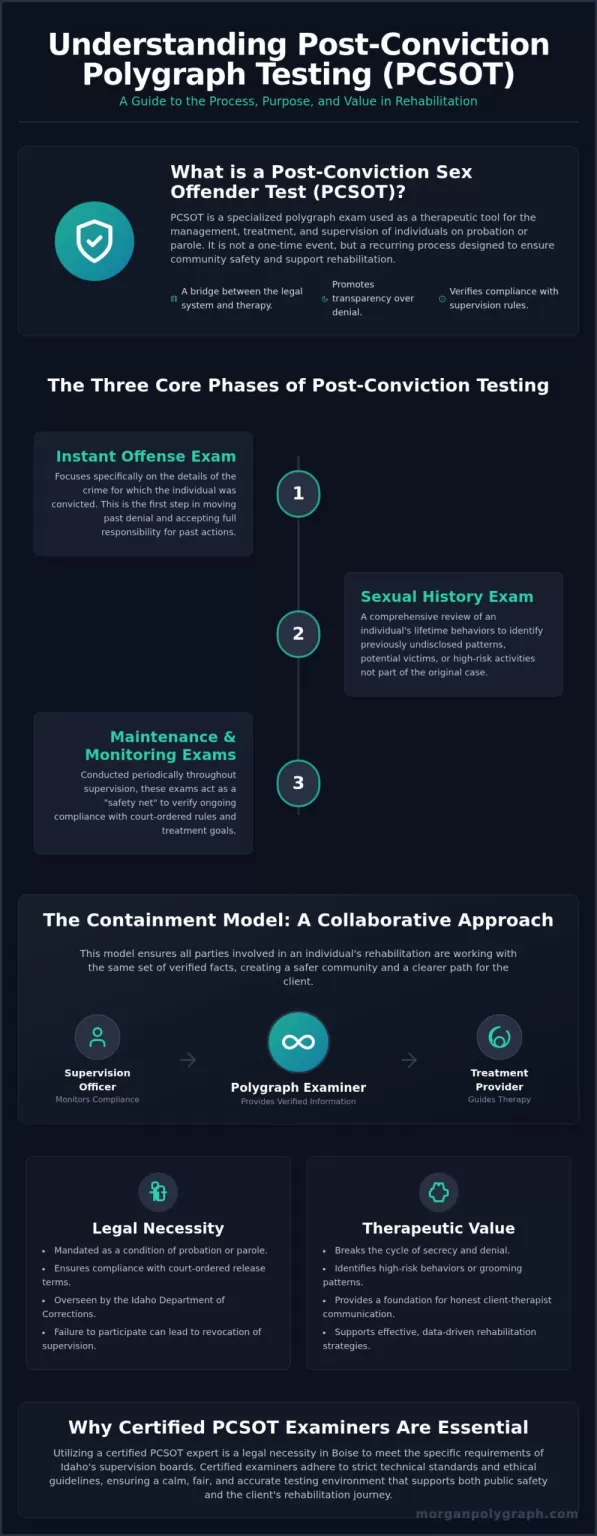
A Post-Conviction Sex Offender Test, or PCSOT, is a specialized application of polygraph technology designed to assist in the management, treatment, and supervision of individuals convicted of sexual offenses. If you’re trying to understand what is a post-conviction polygraph test, it’s best to view it as a bridge between the legal system and clinical therapy. Unlike traditional forensic exams that focus on a single event, PCSOT is a recurring process. The primary objective is to facilitate a transition from denial to full disclosure. This transparency is essential for effective treatment, as it allows providers to understand the true scope of an individual’s history and current behavior.
While criminal defense polygraphs are often used to establish innocence or verify specific alibis during a trial, PCSOT serves a broader public safety mission. It ensures community safety by verifying that an individual is complying with the strict rules of their supervision. Polygraph examinations in this context provide a level of oversight that self-reporting alone cannot achieve. This is why many wonder what is a post-conviction polygraph test when they first enter the supervision system in Idaho.
The Legal Basis for Post-Conviction Testing
Courts frequently mandate PCSOT as a standard condition of probation or parole. In Boise and throughout the state, the Idaho Department of Corrections oversees these testing schedules to ensure offenders remain in compliance with their release terms. These requirements aren’t arbitrary. Often, initial psychosexual evaluations recommend ongoing PCSOT to monitor risk factors identified during sentencing. Failure to participate in these court-ordered exams can result in serious legal consequences, including the revocation of supervision and a return to custody.
The Therapeutic Value of Transparency
Beyond legal compliance, these tests offer significant therapeutic benefits. They help clinicians identify high-risk behaviors or “grooming” patterns before a re-offense occurs. By breaking the cycle of secrecy that often accompanies sexual deviancy, the test provides a foundation for honest communication between the client and their therapist. PCSOT is a specialized management tool used within the “Containment Model” of supervision. This model ensures that all parties involved in an individual’s rehabilitation are working with the same set of verified facts, creating a safer environment for the community and a clearer path for the client.
The Three Core Phases of Post-Conviction Testing
Understanding the structured nature of supervision is key to answering what is a post-conviction polygraph test in a practical sense. It isn’t a one-size-fits-all procedure. Instead, it’s a tiered process designed to build a complete picture of an individual’s behavioral history and current compliance. This progression follows a specific timeline that aligns with the treatment phases mandated by the court, typically beginning shortly after sentencing and continuing throughout the duration of parole or probation.
Instant Offense vs. Sexual History Exams
The first phase usually begins with the Instant Offense exam. This test focuses specifically on the details of the crime for which the individual was convicted. It serves as the first major hurdle in treatment because it requires the individual to move past denial and accept full responsibility for their actions. Without this baseline of truth, therapeutic progress is often impossible. Many providers view this as the “entry point” to the rehabilitation process.
Following this, the Sexual History exam takes a much broader view. It’s a comprehensive review of an individual’s lifetime behaviors, identifying patterns that may have been previously undisclosed. This phase is critical for identifying potential victims or high-risk behaviors that weren’t part of the original criminal case. By uncovering these hidden patterns, treatment providers can develop a more effective, long-term strategy for management. The U.S. Courts on Polygraph Purpose documentation highlights that these disclosures are vital for public protection and offender accountability.
Maintenance Exams: The “Safety Net” of Supervision
Once the historical baseline is established, the focus shifts to Maintenance and Monitoring exams. These are conducted periodically to ensure the individual is adhering to their current supervision rules. These exams act as a safety net by verifying compliance with specific court orders, such as “No Contact” directives, internet restrictions, or prohibitions against visiting certain locations. They are the most common type of exam you’ll encounter during long-term supervision.
Regular testing significantly reduces the likelihood of recidivism by identifying “grooming” behaviors or boundary violations before they escalate into a new offense. If you’re navigating this process for the first time, working with a specialized PCSOT examiner can help ensure these sessions are conducted with the necessary professional discretion. These exams provide the “Containment Team” with real-time data, allowing for early intervention if high-risk behaviors emerge. This structured approach ensures that the supervision period isn’t just about monitoring, but about creating a sustainable path toward community safety.
The Containment Model: How Polygraphs Protect the Community
In Idaho, the management of individuals on supervision relies on a collaborative framework known as the Containment Model. This strategy is designed to maximize community safety through a three-pillar approach. The team consists of the treatment provider, the probation or parole officer, and the specialized polygraph examiner. Understanding what is a post-conviction polygraph test means recognizing that the examiner doesn’t work in isolation. They serve as the objective, information-gathering arm of the team, ensuring that all parties have access to the same verified facts.
Information sharing is the core of this model. When an examiner conducts a session in our Boise laboratory, the results and any disclosures are shared directly with the supervising officer and the therapist. This prevents the examinee from providing conflicting stories to different members of the team. Many individuals wonder what is a post-conviction polygraph test when they realize their results will be shared, but this transparency is exactly what protects the community. It creates a “full disclosure” requirement where holding back information is considered a violation of supervision terms. This environment of accountability encourages the individual to remain honest about their behaviors and progress.
Statistics support the effectiveness of this model. Approximately 80% of adult sex offender supervision programs in the United States utilize these examinations. The impact on community safety is significant: research shows that in about 70% of initial polygraph tests within a PCSOT program, offenders make new, supervision-relevant disclosures. This data proves that are polygraphs accurate as a decision-support tool, providing critical information that clinical interviews alone might miss.
The Role of the Idaho SOMB Standards
Adhering to the Idaho Sex Offender Management Board’s (SOMB) rigorous testing protocols is essential for maintaining the integrity of the supervision process. These standards ensure that every exam is conducted fairly and consistently. Compliance with the idaho sex offender registry often hinges on these results, as they provide the verification needed for continued community placement. By following standardized procedures, examiners ensure that the rights of the examinee are respected while prioritizing public safety.
When a Test Indicates Deception
If an exam indicates deception, it doesn’t automatically mean a return to prison. Instead, it often triggers a therapeutic intervention rather than an immediate legal consequence. The examiner typically conducts a post-test interview, which is a vital opportunity for the examinee to clarify their responses or provide additional context. This process helps the Containment Team determine whether the deceptive result stems from a specific rule violation or a psychological barrier that needs to be addressed in therapy. The focus remains on rehabilitation and preventing future incidents through early intervention.
Preparing for Your PCSOT Exam: What to Expect
Walking into a professional laboratory for an examination can feel daunting, especially when your future and freedom depend on the outcome. Understanding what is a post-conviction polygraph test from a practical perspective helps demystify the experience. The process begins with a comprehensive pre-test interview. During this phase, the examiner reviews every question with you in detail. There are no “surprise” questions during the actual exam. This phase ensures you fully understand the terminology and have an opportunity to clarify any concerns before the sensors are attached.
Managing Anxiety and Stress
It’s completely normal to feel nervous. Professional examiners expect a certain level of “baseline” anxiety and use sophisticated technology to account for it. Modern, computer-assisted polygraphs are designed to filter out general background noise from the body, focusing only on specific physiological reactions to the reviewed questions. Some people believe they should try to “beat” the test by using physical or mental countermeasures. This is a high-risk strategy that usually fails. Our laboratory uses state-of-the-art sensors, including seat activity sensors, to detect these attempts, which often results in an “inconclusive” or “purposeful non-cooperation” finding. It’s always better to rely on the accuracy of the equipment and your own honesty.
The Disclosure Process
Before your appointment, your treatment team will likely provide you with disclosure booklets to complete. These documents serve as the foundation for the examination. If “forgotten” memories surface while you’re filling out these forms or during the pre-test interview, it’s essential to share them immediately. The examiner’s goal is a valid, reliable result, not a confession. We’re looking for a clear, consistent physiological profile that matches your verbal statements. Honesty is the most effective way to ensure the test proceeds smoothly and produces a report that supports your continued progress in the supervision program.
During the session, the examiner monitors four primary physiological channels: electrodermal activity (EDA), cardiovascular activity, and two channels of respiration. You have the right to be treated with dignity and respect throughout this entire process. We maintain a clinical, professional environment at our Boise office to ensure your privacy and comfort. If you have questions about the equipment or the specific protocols we follow, don’t hesitate to ask. If you’re ready to schedule your appointment with a certified PCSOT examiner, contact our team to ensure your testing meets all Idaho court requirements.
Remember that “partial truths” are often more damaging than full disclosure. When an examinee holds back even a small detail, it can create a physiological reaction that indicates deception across the entire topic. By providing a complete and honest account from the start, you allow the technology to work in your favor, demonstrating your commitment to the rehabilitation process and community safety.
Why Professional, Certified Examiners in Boise are Essential
Selecting the right examiner is a critical decision that impacts your legal standing and your rehabilitation progress. In Idaho, the question of what is a post-conviction polygraph test often comes down to the quality of the practitioner conducting it. Morgan Polygraph brings decades of specialized experience to the Boise legal community, providing a level of expertise that general polygraphers cannot match. We understand the specific nuances of the Idaho Department of Corrections requirements and the delicate nature of therapeutic testing. Our methodical approach ensures that every client is treated with the respect they deserve during a high-stakes process.
Choosing a certified polygraph near me isn’t just about convenience; it’s a legal requirement. PCSOT examiners must complete a minimum of 40 hours of specialized instruction beyond their initial training to handle these specific cases. They also need 30 hours of continuing education every two years to maintain their standing with national boards. Our Boise laboratory uses state-of-the-art technology to ensure every report is accurate, objective, and court-admissible. This commitment to innovation ensures that your results are based on data-driven detection rather than subjective observation.
Credentials That Matter in Idaho
Attorneys and courts in Boise trust Morgan Polygraph because we adhere strictly to the American Polygraph Association standards and Idaho SOMB protocols. Our examiners are nationally certified and recognized as experts in the field. This recognition is vital when your compliance is being reviewed by a judge or a parole board. We prioritize confidentiality and professionalism, ensuring that your sensitive information is handled with the highest level of discretion. Our reputation for integrity makes us a preferred partner for the entire Containment Team.
Next Steps: Scheduling Your Examination
To move forward, you must coordinate with your probation officer and your treatment provider. They’ll typically provide the specific issues or “test questions” they want addressed based on your current phase of supervision. When you arrive at our office at 6126 W. State Street, please bring your completed disclosure booklets and any court-mandated paperwork. We provide a calm, collected environment designed to make the process as straightforward as possible.
The process of understanding what is a post-conviction polygraph test concludes with taking action to meet your supervision requirements. Our unhurried rhythm and clear instructions guide you from the initial engagement to the final report. Contact Morgan Polygraph today to schedule your certified PCSOT examination and take the next step in your successful community reintegration.
Securing Your Path to Successful Reintegration
Managing the requirements of supervision is a significant undertaking, but you don’t have to face it without clear guidance. By understanding what is a post-conviction polygraph test, you’ve already taken a vital step toward transparency and long-term success. Remember that these examinations aren’t traps. They’re essential tools within the Containment Model designed to foster honesty and protect the community. Whether you’re entering the initial disclosure phase or undergoing routine maintenance monitoring, your commitment to the process is what drives your rehabilitation forward.
At Morgan Polygraph, we’ve served the Boise, Idaho community since 2004 as nationally certified and court-recognized experts. We use state-of-the-art technology to ensure your results are accurate and your privacy is respected. Our methodical approach provides the objective data your supervision team needs while treating you with the professional dignity you deserve. If you’re ready to meet your court-ordered requirements with a team you can trust, Schedule a Certified PCSOT Exam in Boise today. We’re here to support your journey toward a stable and compliant future.
Frequently Asked Questions
Is a post-conviction polygraph test mandatory in Idaho?
Yes, participation in these examinations is typically a mandatory condition of probation or parole for individuals on the Idaho sex offender registry. These requirements are set by the Idaho Sex Offender Management Board (SOMB) and enforced by the Idaho Department of Corrections. If a court orders the testing as part of your supervision terms, failure to comply is considered a violation. It’s essential to consult your supervision officer to confirm your specific requirements.
Can I fail a PCSOT exam just because I am nervous?
You won’t fail an exam simply because you feel anxious. Professional examiners establish a physiological baseline at the start of every session to account for general test jitters. The technology focuses on specific, significant reactions to individual questions rather than your overall heart rate or stress level. Our Boise laboratory uses advanced sensors to distinguish between normal situational anxiety and the specific physiological markers associated with deception or purposeful non-cooperation.
What happens if the polygraph shows I am lying about my sexual history?
If the results indicate deception regarding your sexual history, the immediate outcome is usually therapeutic rather than legal. The examiner will conduct a post-test interview to allow you to provide clarification or additional details. These disclosures are then shared with your treatment provider to adjust your rehabilitation plan. While the goal is full transparency, a single deceptive result isn’t typically grounds for immediate revocation unless it involves a new criminal offense.
How often do I have to take a maintenance polygraph test?
The frequency of maintenance testing depends on your specific supervision level and the recommendations of your Containment Team. When asking what is a post-conviction polygraph test schedule, most individuals follow American Polygraph Association standards, which suggest exams every four to six months. However, Idaho court orders may specify a different timeline. At a minimum, you should expect to undergo at least one maintenance examination every twelve months to ensure ongoing compliance.
Are the results of a post-conviction polygraph admissible in court?
Polygraph results are generally not admissible as evidence in criminal trials in Idaho. However, they are frequently used as decision-support tools during probation or parole hearings. While the physiological charts themselves might not be admitted, any voluntary disclosures or admissions you make during the pre-test or post-test phases can be used in legal proceedings. It’s important to understand that the test’s primary role is management and treatment compliance within the Containment Model.
Who pays for the court-ordered PCSOT polygraph test?
In most cases, the individual under supervision is responsible for the cost of their court-ordered testing. While some government contracts may cover fees for certain juvenile or indigent cases, the standard practice in Boise is for the examinee to pay the examiner directly at the time of service. You should check with your probation officer to see if your specific program has a contract that affects how your testing is funded before your appointment.
Can my probation be revoked based solely on a polygraph result?
Your probation cannot be revoked based solely on a deception indicated result. Courts and supervision boards require additional evidence or a self-disclosed violation to take legal action. However, failing to attend a scheduled exam or refusing to cooperate with the examiner can lead to a violation report. Understanding what is a post-conviction polygraph test role helps clarify that it’s just one part of a broader assessment strategy used to monitor your risk.
How long does a typical PCSOT examination last in Boise?
A standard examination at our Boise office typically lasts between two and three hours. This duration includes the pre-test interview where we review your history and the specific questions being asked. The actual in-test phase, where the sensors are active, only takes about twenty to thirty minutes. We ensure the process is unhurried so that you have ample time to understand the procedure and provide accurate, thoughtful responses throughout the entire session.