
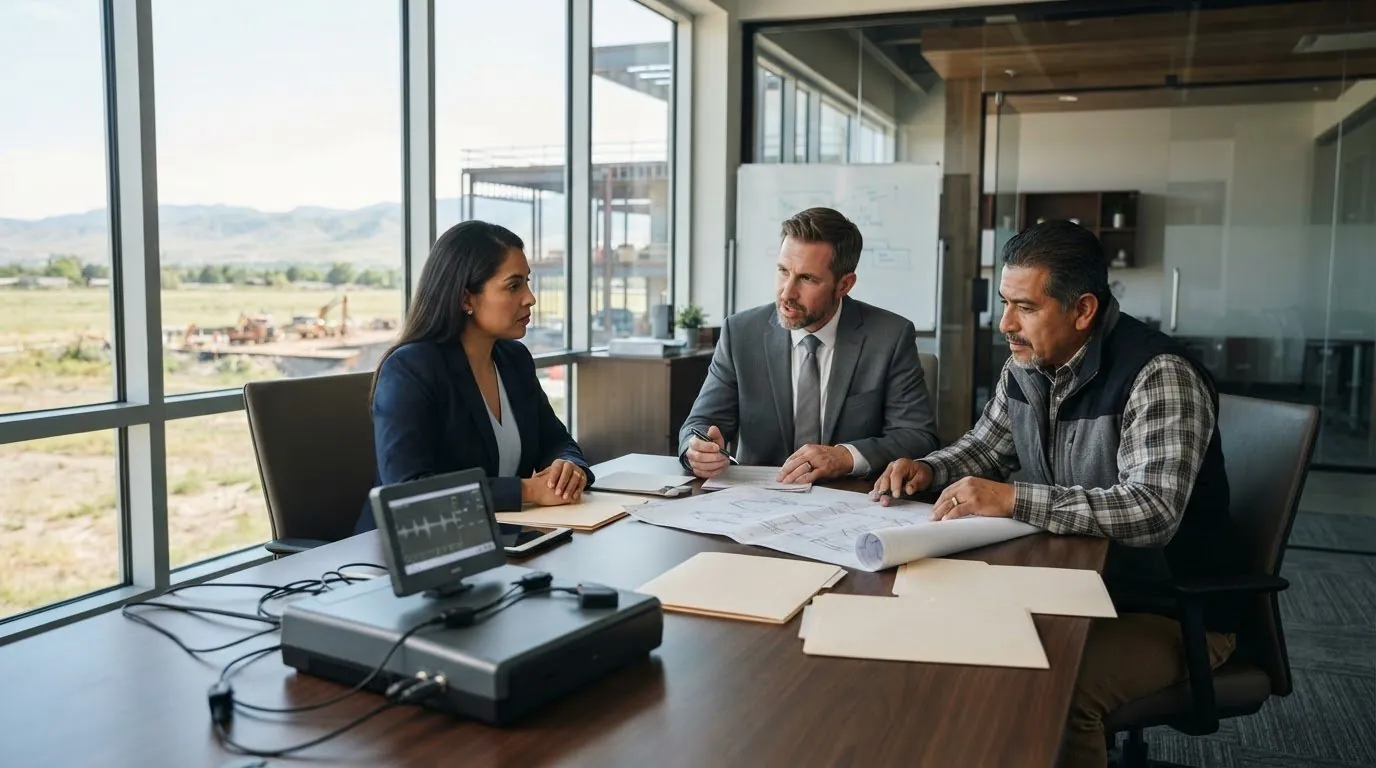
A polygraph result may inform a construction dispute without becoming courtroom evidence. If you’re considering a lie detector for construction dispute litigation Caldwell, you may want clarity when the parties disagree about what was said or done. But a test isn’t proof by itself, and it can’t guarantee that a court will admit the results.
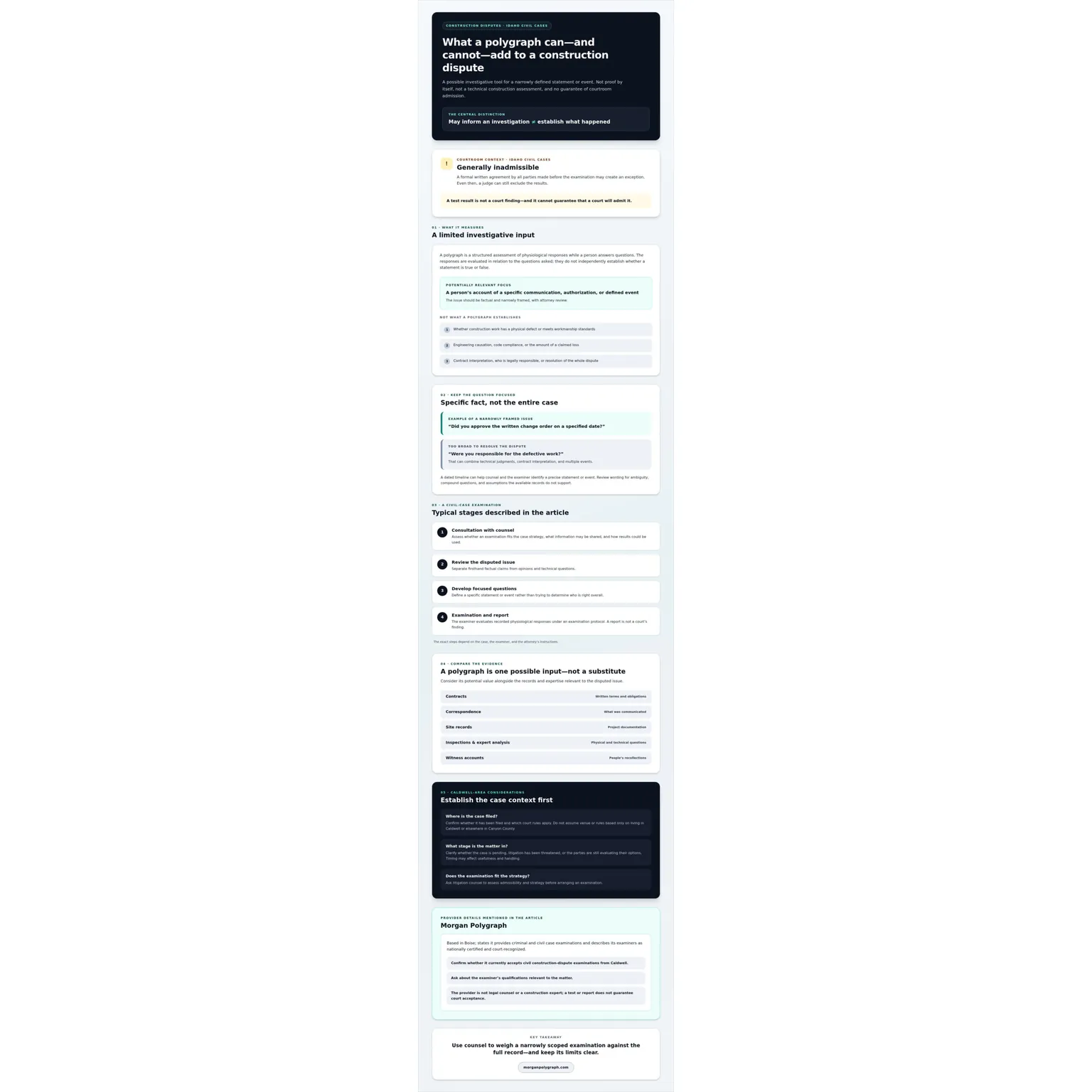
In Idaho civil cases, polygraph results are generally inadmissible. A formal written agreement by all parties before the examination may create an exception, but a judge can still exclude the results. Ask your attorney to assess whether an examination fits your case strategy before scheduling one.
This article explains what a polygraph may contribute to an investigation, what it cannot establish, and what to discuss with litigation counsel. It also outlines how to assess examiner qualifications and consider a civil-case examination. Morgan Polygraph, based in Boise, offers criminal and civil case examinations and describes its examiners as nationally certified and court-recognized. Confirm directly whether the firm accepts Caldwell construction-dispute matters.
Key Takeaways
- Understand what a polygraph assesses and why it cannot independently prove what happened in a construction dispute.
- Learn the general steps involved in scoping a civil-case examination, from defining the disputed issue to reviewing a report.
- Before scheduling a lie detector for construction dispute litigation Caldwell, ask your attorney whether an examination fits the case strategy.
- Compare a polygraph’s potential value with contracts, correspondence, site records, inspections, and witness accounts.
- When considering Morgan Polygraph, confirm whether it accepts Caldwell-area construction matters and ask about the examiner’s relevant qualifications.
Could a lie detector help with a construction dispute in Caldwell?
Conflicting accounts can complicate a construction case, especially when the parties disagree about what was authorized, promised, or communicated. A polygraph may be considered as one investigative tool when a specific statement is disputed. It does not prove the truth or settle the dispute. Before considering a lie detector for construction dispute litigation Caldwell, ask your attorney whether an examination fits the case strategy and whether the results could have an appropriate evidentiary use.
A polygraph is a structured assessment of physiological responses while a person answers questions. The responses are evaluated in relation to the questions asked, but they do not independently establish whether a statement is true or false. For background on how a polygraph works, see this overview. A polygraph also cannot determine whether construction work has a physical defect, interpret contract language, establish workmanship standards, or calculate damages. Those issues call for relevant documents, inspections, expert analysis, and legal review.
Which construction-dispute questions might be examined?
With attorney review, an examination might address a person’s account of a particular communication, whether they authorized a specified change, or what they recall about a defined event. The issue needs to be factual and narrowly framed. Broad questions such as whether someone “caused the dispute” or “did bad work” can combine several issues that a polygraph cannot resolve. It also cannot establish engineering causation, code compliance, or the amount of a claimed loss.
What Caldwell and Canyon County readers should establish first
Start with the case’s procedural context, not the person’s home address. Confirm where the case is filed, if it has been filed, and which court rules apply. Do not assume venue or applicable rules based on living in Caldwell or elsewhere in Canyon County. Ask litigation counsel to assess admissibility and strategy before arranging an examination.
Clarify whether the matter is already pending, litigation has been threatened, or the parties are still evaluating their options. Timing can affect whether an examination is useful and how it should be handled. Morgan Polygraph, based in Boise, states that it provides polygraphs for criminal and civil cases and professional reports intended for legal proceedings. Contact the company directly to confirm whether it currently accepts civil construction-dispute examinations from Caldwell. It is an examination provider, not legal counsel or a construction expert. Neither a report nor a test result guarantees court acceptance.
How a civil-case polygraph is scoped for a construction dispute
A civil-case examination should begin with a defined issue, not a general request to decide who is right. A careful scope helps separate a person’s account of an event from technical questions that require construction expertise. For general background on what to expect, review the polygraph examination process guide. The exact steps depend on the case, the examiner, and the attorney’s instructions.
The process typically involves consultation with counsel, review of the disputed issue, development of questions, the examination, and a report. Before taking steps toward a lie detector for construction dispute litigation Caldwell, ask your attorney what information may be shared, how the results could be used, and whether testing fits the case strategy. Cornell Law School’s Legal Information Institute provides context on admissibility in United States courts. A report is not a court’s finding.
Preparing focused questions from the disputed facts
Separate firsthand factual claims from opinions. “Did you approve the written change order on a specified date?” is different from “Were you responsible for the defective work?” The second question may combine technical judgments, contract interpretation, and multiple events.
A dated timeline can help counsel and the examiner identify a precise statement or event to address. Review the wording for ambiguity, compound questions, and assumptions that the available records do not support. The aim is a clear scope, not a question that tries to resolve the entire dispute.
What the examination and report can, and cannot, provide
During an examination, the examiner evaluates recorded physiological responses under an examination protocol. A report can document the examination and provide information for case review. It does not independently verify a contract, establish why a building component failed, or decide which party owes damages. Nor does it replace testimony or a court’s assessment of the evidence.
Keep the rest of the case record in view. Contracts, correspondence, photographs, site records, inspection findings, expert analysis, and witness testimony remain independently important. Consider a polygraph report alongside that material, not as a substitute for it or as an automatic court finding.
If counsel believes a civil-case examination may be relevant, you can review civil-case polygraph information from Morgan Polygraph and confirm directly whether it currently accepts Caldwell-area construction matters.
Would a Caldwell construction-dispute polygraph be admissible in court?
Do not schedule an examination on the assumption that its result will become evidence. In Idaho civil courts, polygraph results are generally inadmissible. A possible exception may apply if all parties agree in a formal written mutual stipulation before the examination. Even then, the agreement does not guarantee admission. A judge retains authority to exclude evidence under Idaho Rule of Evidence 403 if its prejudicial effect outweighs its probative value.
Admissibility can depend on the governing rules, the facts, and the case’s procedural posture. No examiner can promise that a judge will accept a result. The U.S. Department of Justice discusses federal rules on polygraph evidence, but federal guidance is not a substitute for advice about Idaho civil litigation. Ask Idaho litigation counsel to verify current rules and relevant decisions before deciding whether to test.
Investigative value is different from courtroom evidence
A result may help counsel decide what to ask next, identify an account that warrants closer review, or consider negotiation strategy. That is investigative information, not proof of liability. It does not establish that a contractor breached an agreement, caused a defect, or owes damages.
Information a lawyer uses to guide follow-up is different from evidence a court admits. A report does not automatically qualify as expert testimony, and a party’s agreement to testing or to a stipulation does not make admission automatic. For broader discussion of polygraph limitations, see this factual review of polygraph accuracy.
Questions for an Idaho construction-litigation attorney
Before pursuing a lie detector for construction dispute litigation Caldwell, ask counsel to review the rules and case law that may apply to your particular court and matter. Discuss practical consequences, including:
- Could testing affect discovery, negotiations, or trial strategy?
- Would a written agreement be relevant, and what would it need to address?
- Could sharing or relying on the results raise disclosure, confidentiality, or privilege concerns?
- Would the examination clarify a disputed fact, or distract from stronger records and technical evidence?
Do not assume that commissioning a test through an attorney automatically makes its results privileged or protected from disclosure. The answer can depend on the circumstances and applicable law. Get case-specific guidance before sharing information with an examiner or the opposing party. In a Caldwell construction case, a polygraph may be more useful for informing a decision than for securing a courtroom exhibit.
Deciding on a polygraph before litigation steps
Before scheduling a polygraph, weigh the specific disputed fact against the evidence already available and get your attorney’s guidance. A test may be worth discussing if a clearly defined statement matters to the case, but it should not distract from stronger documentary or technical evidence. The practical question when considering a lie detector for construction dispute litigation Caldwell is not simply whether someone will take a test. It is whether an examination could help counsel make an informed decision without creating avoidable risks or costs.
Start with the issue. A disagreement about whether a change was authorized differs from a dispute about why a wall cracked or whether repairs meet applicable requirements. Project records and qualified construction expertise are generally more relevant to technical questions than a polygraph.
When another source of evidence may be more relevant
Match the evidence to the issue in dispute. Contracts, change orders, invoices, payment records, emails, texts, and notices may clarify project scope, approvals, payment, or when a concern was raised. Site records, dated photographs, inspection findings, and witness accounts can add context. If the dispute turns on physical conditions or technical causation, discuss an appropriately qualified construction professional with your attorney.
A polygraph is not a substitute for discovery, an inspection, or legal analysis. Before adding an examination to the case plan, consider whether those steps could answer the disputed question more directly.
A short decision checklist for counsel and clients
Use this checklist to structure a conversation with litigation counsel before making arrangements:
- Identify the issue: What exact statement or event is disputed, and why does it matter to a claim or defense?
- Test the question: Is it fair, answerable, based on a specific fact, and within the examination’s scope?
- Compare alternatives: Could contracts, correspondence, site records, an inspection, expert analysis, or witness testimony address it more directly?
- Clarify the process: What timing makes sense, who would receive the report, and what confidentiality or disclosure concerns should counsel review?
- Consider case effects: Could testing influence discovery, negotiations, or later litigation decisions, even if the result is not admitted?
Discuss the answers with counsel before proceeding. If an examination still appears relevant, ask Morgan Polygraph about civil-case examinations and confirm directly whether it currently accepts construction-dispute matters from Caldwell. Morgan Polygraph provides criminal and civil case polygraphs, but not legal advice or construction analysis.
Discussing a Caldwell civil-case examination with Morgan Polygraph
Morgan Polygraph is based in Boise and states that it provides polygraph examinations for criminal and civil cases, with professional reports intended for legal proceedings. That may make it a provider to contact if you’re considering a lie detector for construction dispute litigation Caldwell. Confirm directly whether the company currently accepts civil construction-dispute matters from Caldwell. A service description or report intended for legal proceedings does not guarantee that a judge will accept the results.
Coordinate with your attorney before arranging an examination or sending case materials. Counsel can help determine whether testing fits the case strategy and advise what information is appropriate to share. Morgan Polygraph is an examination provider, not a law firm or construction expert.
What to have ready for an initial inquiry
Begin with a brief, factual overview rather than sending a full case file. Be prepared to describe:
- The general type of construction dispute and whether it is pending, threatened, or still being evaluated.
- The specific factual statement or event in dispute, without assuming a polygraph can resolve technical construction questions.
- What your attorney has said about considering an examination and whether counsel should coordinate the inquiry.
Ask what information the examiner needs to assess the request and how sensitive materials should be shared. Do not send documents that may be privileged or confidential until you have discussed handling and disclosure concerns with your attorney.
What to confirm before scheduling
Before making arrangements, get clear answers directly from the provider. Morgan Polygraph describes its examiners as nationally certified and court-recognized, but verify the individual examiner’s credentials and relevant experience with civil matters. Ask whether the company currently serves Caldwell-area construction disputes, what the examination and written report include, and how information is handled.
Confirm fees, scheduling, cancellation terms, and privacy practices with the provider rather than relying on assumptions. Ask your attorney to review any proposed process or agreement, particularly if the matter is in litigation. Professional reporting may support case review, but it does not establish liability or guarantee admission in court.
If counsel agrees that a civil-case examination is worth exploring, contact Morgan Polygraph to discuss your civil-case needs. Ask about the case type, examiner qualifications, report details, and Caldwell availability before deciding whether to proceed.
Take a Careful, Informed Next Step
A polygraph may offer information about a narrowly defined disputed statement, but it cannot establish construction defects, interpret a contract, or guarantee courtroom evidence. If you are considering a lie detector for construction dispute litigation Caldwell, first ask your litigation attorney whether an examination fits the case strategy and how the results could affect disclosure, negotiations, or trial planning.
Morgan Polygraph provides examinations for criminal and civil cases and describes its examiners as nationally certified and court-recognized. The company also states that it prepares professional reports intended for legal proceedings. These credentials and reports do not guarantee court acceptance, so confirm examiner qualifications and Caldwell-area availability directly before proceeding.
If your attorney agrees that an examination may be useful, contact Morgan Polygraph to discuss a civil-case examination. Ask about the process, report, and service coverage, and coordinate any sharing of case materials with counsel. With clear expectations and appropriate professional guidance, you can choose a next step with greater confidence.
Frequently Asked Questions
Can a lie detector test prove who is at fault in a construction dispute?
No. A polygraph does not inspect a building, determine code compliance, or independently establish legal liability. It assesses physiological responses during a structured examination about specific questions. Any information from an examination needs to be considered alongside contracts, project records, witness accounts, and relevant technical evidence. If you’re considering a lie detector for construction dispute litigation Caldwell, ask your attorney whether a test could serve a useful role in your case.
Are polygraph results admissible in an Idaho civil lawsuit?
Not automatically. Polygraph results are generally inadmissible in Idaho civil courts. A possible exception involves a formal written agreement by all parties before the examination, but that agreement does not guarantee admission. A judge may still exclude the results. The decision can depend on applicable evidence rules, case facts, and procedural posture. Ask Idaho litigation counsel to review current authority before arranging, sharing, or relying on a test.
Should I take a polygraph before filing a construction lawsuit?
Discuss it with your attorney before scheduling. Counsel can help determine whether the disputed issue is specific enough for examination, whether records or inspections should come first, and whether testing could affect litigation strategy or disclosure. A polygraph should not replace preserving relevant documents, meeting applicable deadlines, or seeking qualified construction and legal advice. Explain the exact factual issue you want to address, then ask whether an examination is appropriate at this stage.
Can a polygraph determine whether construction work was defective?
No. A polygraph does not evaluate materials, workmanship, engineering, building-code compliance, or the cause of a physical defect. Those questions may call for project documents, photographs, site inspections, or appropriately qualified construction expertise. An examination may address a person’s responses to narrowly framed questions about specific factual matters, subject to professional and legal review. It cannot replace technical assessment or determine who is legally responsible for a defect.
How is a polygraph used in a civil construction dispute?
A civil-case examination may be considered when a specific statement or event is disputed. The attorney and examiner should define the issue and review the proposed questions carefully. Consider any report in context with other evidence, not as a decision on the lawsuit. A polygraph does not establish damages or guarantee courtroom admission. Procedures vary by case and examiner, so discuss the proposed scope with counsel and confirm the process directly.
Does Morgan Polygraph serve clients in Caldwell, Idaho?
Morgan Polygraph is based in Boise and provides examinations for criminal and civil cases, but confirm directly whether it currently accepts and can serve your Caldwell construction-dispute matter. The company describes its examiners as nationally certified and court-recognized and states that it provides professional reports intended for legal proceedings. Verify the examiner’s credentials, service coverage, scheduling, and report arrangements. Consult your attorney before sharing sensitive case information or booking an examination.
What should I ask a polygraph examiner before scheduling a litigation-related test?
Ask about the examiner’s credentials and civil-case experience, how questions are developed, what the written report includes, privacy practices, and whether Caldwell service is available. Clarify what the examination can and cannot address. Before sharing case details or documents, ask your attorney what may be disclosed and how materials should be handled. A report intended for legal proceedings is not a promise that a court will admit the results.