
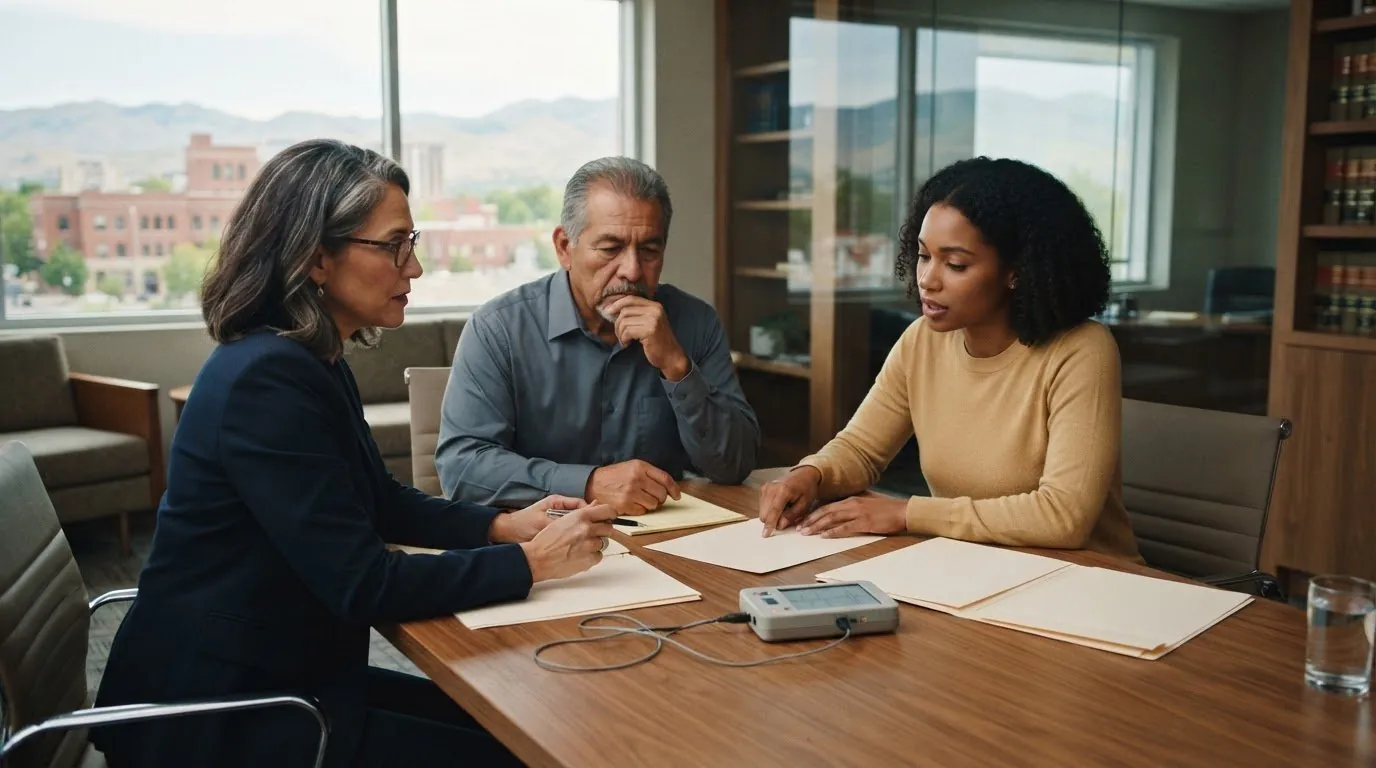
What if a polygraph could help assess a disputed account but still couldn’t prove that a will is valid? A search for “using polygraph to verify testimony in a contested will Caldwell” reflects a real concern: conflicting stories can leave families unsure which investigative step makes sense. An examination result, however, is not a substitute for evidence about the will itself.
It’s understandable to want a clearer way to evaluate testimony. In Idaho, polygraph results aren’t admissible in court unless all parties agree in a written stipulation, so a test shouldn’t be treated as guaranteed courtroom evidence. Discuss its possible role and purpose with probate counsel before moving forward.
This article explains what a polygraph may contribute, what it can’t establish, and what to ask an Idaho probate attorney. It also covers how to consider testimony alongside relevant records and why counsel should define the examination’s scope first. This context can help you decide whether an examination is an appropriate next step in a Caldwell will dispute.
Key Takeaways
- Consider using polygraph to verify testimony in a contested will Caldwell only as a counsel-directed way to examine a specific disputed account, not as a verdict on the will.
- Before contacting an examiner, ask your attorney to identify the factual issue, define the examination’s scope, and consider other ways to assess the account.
- Have Idaho probate counsel assess whether a result could be admitted or carry weight in the specific case. Taking a test alone ensures neither.
- Preserve relevant records and avoid pressuring relatives or potential witnesses while your attorney evaluates the available evidence.
- Morgan Polygraph is based in Boise and offers civil case examinations. Confirm directly whether it accepts Caldwell-area contested-will matters.
Can Polygraphs Clarify Caldwell Contested Will Testimony?
Conflicting recollections about a will can strain relationships between beneficiaries, witnesses, and family members. One person may remember a conversation about changing the will; another may dispute whether it happened or what was said. In that setting, using polygraph to verify testimony in a contested will Caldwell may be considered as a limited investigative step, but only after an attorney identifies the specific issue and assesses its relevance.
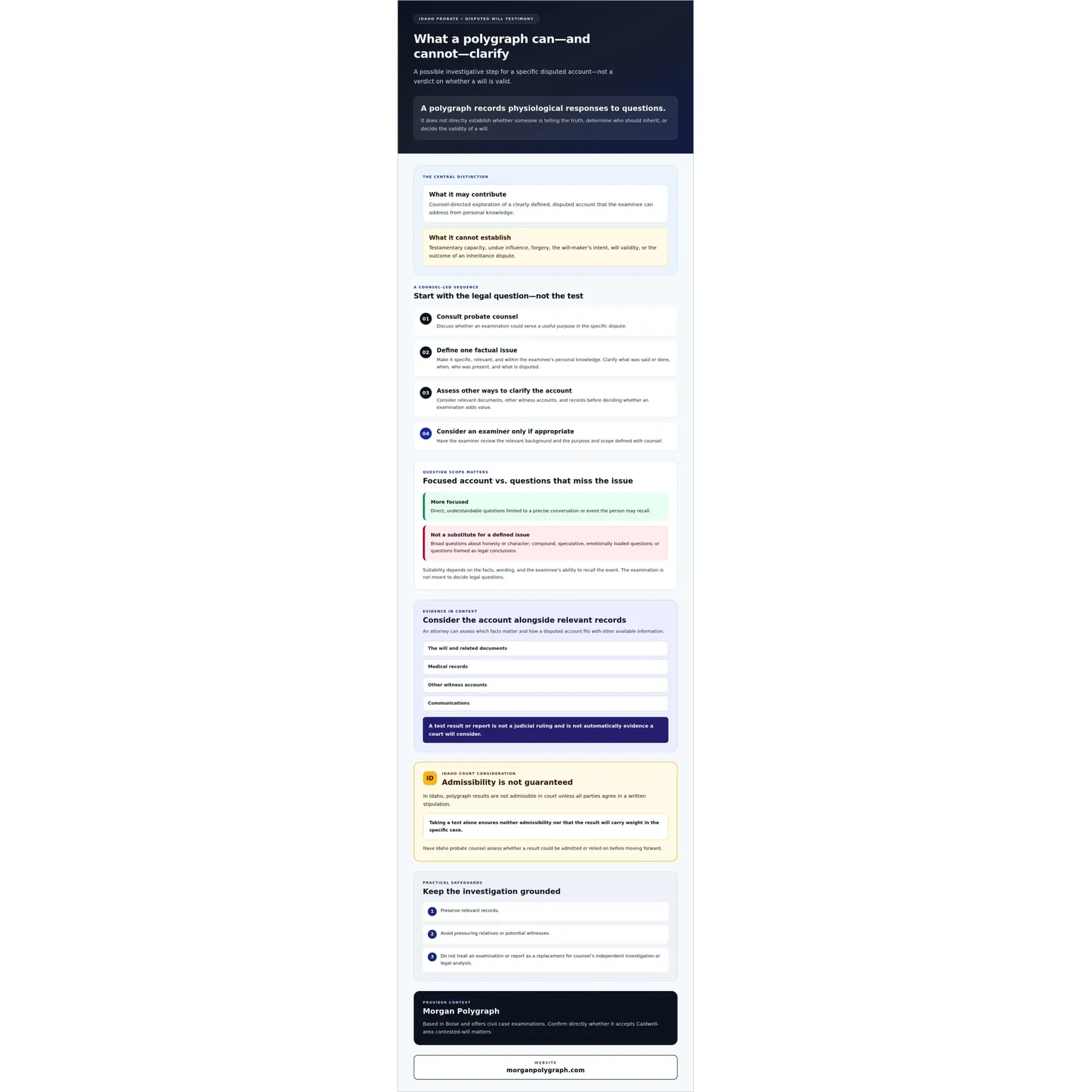
A polygraph records physiological responses to questions. It doesn’t directly establish whether someone is telling the truth, and it cannot determine whether a will is valid or who should inherit. The scientific view of polygraph testing provides background on the method and the limits of interpreting those responses. Treat any result cautiously and consider it alongside other information, not as a definitive answer.
What testimony might an examination address?
A potentially suitable examination would focus on a clearly stated factual issue that the person being examined can address. For example, counsel might assess whether a specific conversation or event is precise and relevant enough to ask about. Broad questions such as “Are you honest?” or questions about a person’s character aren’t a useful substitute for a defined issue.
Suitability depends on the facts, the wording, and the examinee’s ability to recall the event. An examination shouldn’t be assumed to establish testamentary capacity, undue influence, forgery, or the will-maker’s intent. These are legal and factual questions that require assessment in context.
Why the legal and family context matters
An Idaho probate attorney can assess which facts matter to the particular dispute and distinguish a disputed account from evidence such as the will and related documents, medical records, other witness accounts, and communications. A test result, even if useful to counsel’s assessment, is not automatically evidence a court will consider. Whether it could be admitted or relied on requires case-specific legal review.
Keep the roles clear: a polygraph may help counsel explore a disputed account, but it does not prove the will’s validity or decide the inheritance. Counsel should determine whether an examination has a clear purpose, how it fits with the available evidence, and whether its potential value justifies involving an examiner. Beyond active disputes, families often explore proactive trust administration to eliminate ambiguities in inheritance; resources from the Law Offices of Robert P. Bergman explain how establishing a trust can provide clarity and help avoid future probate challenges.
How a polygraph examination is scoped around a disputed will account
Start with the legal question, not a decision to test someone. Before considering using polygraph to verify testimony in a contested will Caldwell, work through these steps with probate counsel:
- Consult counsel about the dispute and whether an examination could serve a useful purpose.
- Identify one factual issue that is specific, relevant, and within the examinee’s personal knowledge.
- Assess alternatives, including documents, other witness accounts, and records that may clarify what happened.
- Contact an examiner if appropriate, with counsel’s defined purpose and scope available for review.
This sequence helps keep a polygraph from becoming a substitute for building the case. Before deciding whether to proceed, the examiner should review relevant background and consider whether the issue and proposed questions are suitable. An examination or report doesn’t replace counsel’s independent investigation or legal analysis.
Turning a disputed account into a focused issue
Describe the alleged statement or event precisely: what was said or done, when it occurred, who was present, and what part of the account is disputed. Counsel can help identify relevant dates, documents, people to speak with, and potential sources of corroboration. This groundwork also helps establish whether the examinee can actually recall and answer questions about the event.
Questions should be understandable, direct, and limited to the issue. Compound questions, speculation, legal conclusions, and emotionally loaded wording can obscure what is being asked. Avoid broad prompts about honesty or character. The aim is to assess a defined account, not to have an examination decide whether someone exerted undue influence or whether a will-maker had legal capacity.
What the process can and cannot produce
During a structured examination, an examiner records physiological responses to questions. A report presents the examiner’s findings; it isn’t a judicial ruling, independent proof of what happened, or a decision about the will. Morgan Polygraph’s published guide, Polygraph Examination: A Complete Guide to the Process, offers additional background on the examination process.
Legal admissibility is a separate question for counsel. The U.S. Department of Justice’s overview of federal rules on polygraph evidence provides general federal context, but it doesn’t determine how a result would be treated in an Idaho probate matter. Ask an Idaho probate attorney to assess the specific case before relying on a result.
If counsel believes an examination merits consideration, Morgan Polygraph is based in Boise and offers civil case polygraph examinations. Review its civil case polygraph examinations information and confirm directly whether it accepts Caldwell-area contested-will matters.
Would a polygraph result be admissible or persuasive in an Idaho will contest?
Taking a polygraph doesn’t ensure that a court will admit or rely on the result. For an Idaho will dispute, distinguish whether information might help counsel assess a disputed account from whether a judge may consider it as evidence. Those are separate questions. A result may be discussed with counsel even if it can’t be presented in court, but its investigative value also depends on the case and the issue examined.
Admissibility is different from investigative usefulness
The text of Idaho’s rule on polygraph admissibility states that polygraph results are inadmissible unless all parties stipulate in writing to their admission. Before applying that rule to a particular probate matter, ask an Idaho attorney to verify current law, its application to the proceeding, and any other evidentiary requirements. Don’t assume that taking a test, or having parties agree, means a judge will admit or rely on the result.
Using polygraph to verify testimony in a contested will Caldwell should begin with an attorney’s case-specific assessment, not an assumption about courtroom impact. Counsel can consider whether the information could help evaluate a disputed account while separately analyzing applicable rules, the judge’s role, and the evidence needed to address the probate issues.
Compare the examination with other evidence
Review the will, drafts, correspondence, witness accounts, and relevant records with counsel. A polygraph may suggest a lead to examine, but it doesn’t independently corroborate that account. Use the following comparison to organize questions for your attorney:
| Potential investigative lead | Possible corroborating source | Legal question for counsel |
|---|---|---|
| A disputed conversation about changing a will | Contemporaneous correspondence or another person’s account | How does the conversation relate to the issue being contested? |
| A disagreement about who was present at an event | Notes, records, or independent witness testimony | What evidence is relevant and may be presented? |
| A claim about when a draft was discussed or prepared | Drafts, dated communications, or other records | What facts must be established in the probate proceeding? |
For more background on the limits of interpreting examination results, see the published article Are Polygraphs Accurate? A Factual Look at Lie Detector Reliability. Treat it as general information, not a case-specific legal assessment. Your attorney can weigh any examination findings against the full record and determine what, if anything, they contribute.
What should Caldwell families and attorneys do before considering a polygraph?
Start with probate counsel, not an appointment. Even a well-intended request for an examination can affect family relationships or how a witness experiences the process. Before considering using polygraph to verify testimony in a contested will Caldwell, ask an Idaho probate attorney to assess the disputed fact, available evidence, and whether an examination is appropriate at all.
Preserve potentially relevant material in its original form. This may include the will and drafts, letters, emails, messages, notes, and records your attorney identifies as relevant. Don’t edit, annotate, or discard materials. Avoid pressuring relatives or potential witnesses to take a test, change an account, or discuss what they should say. Let counsel guide communications and explain what information may be sensitive.
Questions to take to an Idaho probate attorney
A focused conversation can help clarify whether an examination is worth exploring. Consider asking:
- Which disputed fact matters legally, and what evidence could independently support or contradict the account?
- Could an examination create strategic, evidentiary, privacy, or family-relationship complications?
- Are there stronger or less disruptive ways to resolve the factual uncertainty?
- Which current Idaho rules and probate procedures apply to this specific matter?
- What timing considerations matter, and should any records or communications be handled in a particular way?
Ask counsel to confirm any Caldwell or Canyon County venue and procedure questions. General online information may not address a particular probate proceeding, so don’t rely on it as a substitute for case-specific guidance.
A practical go-or-pause checklist
Before contacting an examiner, consider whether counsel has identified a focused, relevant purpose and whether the proposed examinee can address the issue. Weigh timing, privacy, alternatives, and potential effects on the dispute. An examiner can review suitability, but that review doesn’t replace the attorney’s analysis.
- Consider proceeding to a professional inquiry only if counsel sees a clear investigative purpose and believes the issue is suitable for review.
- Pause if the concern is vague, the person may not be able to address it, or documentary or witness evidence offers a stronger path.
- Protect the process by preserving records and avoiding pressure on anyone involved.
In short: clarify the legal issue, preserve the evidence, and let counsel decide whether an examination merits further consideration. If counsel recommends exploring that option, ask Morgan Polygraph about civil case examinations and confirm directly whether it accepts Caldwell-area matters. Morgan Polygraph is based in Boise; contacting the firm doesn’t replace legal advice from your probate attorney.
Discussing a contested-will polygraph with Morgan Polygraph
After discussing the disputed facts and possible next steps with probate counsel, you may decide to ask an examiner whether a polygraph is suitable. Morgan Polygraph is based in Boise and offers criminal and civil case examinations. Contact the firm to confirm whether it accepts Caldwell-area contested-will matters and can assess the specific issue your attorney has identified. Availability and suitability shouldn’t be assumed.
What to prepare for an initial inquiry
You don’t need to send a full case file or share sensitive family details before understanding what information is needed. With your attorney’s guidance, prepare a concise description of the disputed factual issue, the relevant event or conversation, and what remains in dispute. Ask counsel before sharing confidential or privileged material.
Use the initial inquiry to clarify the process, not to make a scheduling decision before counsel has weighed in. Questions to consider include:
- What examiner credentials and relevant experience can the firm confirm?
- How does the examiner assess whether the issue and proposed examinee are suitable?
- How would the examination’s scope be defined, and what would a report address?
- What confidentiality practices apply to information shared during an inquiry and examination?
- Does the firm currently accept Caldwell-area contested-will matters?
Morgan Polygraph describes its examiners as nationally certified and court-recognized. Ask the firm to explain its current credentials and what “court-recognized” means in this context. Your attorney can help determine whether the proposed scope and any report could be relevant to the case.
Keep the examination within its proper role
A polygraph provider can conduct an examination, but Morgan Polygraph doesn’t provide legal counsel or decide whether a will is valid. An examination result also can’t guarantee admissibility, accuracy, a resolution, or an effect on beneficiaries or a judge. Keep your attorney involved in decisions about whether to proceed, what information to share, and how to interpret any findings.
If you’re considering using polygraph to verify testimony in a contested will Caldwell, a measured inquiry can help clarify whether the proposed issue is within the examiner’s scope. Don’t commit before you understand suitability, reporting, confidentiality practices, and current availability.
Once your attorney has defined the purpose, you can discuss a civil-case polygraph inquiry with Morgan Polygraph and ask about practical next steps. Let counsel guide any decision to schedule or rely on examination findings.
Choose the Next Step With Care
A polygraph may be considered as a limited investigative tool for exploring a specific disputed account, but it can’t decide whether a will is valid or who inherits. Any possible value depends on a clearly defined issue, the surrounding evidence, and guidance from an Idaho probate attorney. A test result doesn’t guarantee that a court will admit or rely on it.
Before considering using polygraph to verify testimony in a contested will Caldwell, ask counsel to review the relevant records, identify what remains in dispute, and weigh alternatives, timing, and privacy. An attorney-first approach can help families make deliberate decisions while reducing unnecessary pressure on witnesses and relatives.
Morgan Polygraph is based in Boise and offers criminal and civil case examinations. The company describes its examiners as nationally certified and court-recognized; confirm current credentials and what those terms mean directly. Confirm Caldwell-area availability and examination suitability with the firm.
If your attorney believes an inquiry may be appropriate, discuss a civil-case polygraph inquiry with Morgan Polygraph. Let counsel guide a careful, informed next step.
Frequently Asked Questions
Can a polygraph be used in a contested will case in Idaho?
A polygraph may be considered during an investigation, but that’s separate from whether a court may consider its results. If you’re researching “using polygraph to verify testimony in a contested will Caldwell,” first discuss the proposed examination’s purpose with an attorney. Idaho counsel can review current rules and the specific probate proceeding before you contact an examiner. Don’t assume a result will be admitted, excluded, or decisive.
Can a polygraph prove that a will is valid or invalid?
No. A polygraph doesn’t determine a will’s legal validity, the will-maker’s capacity, undue influence, document authenticity, or inheritance rights. At most, it may be considered as a limited investigative tool focused on a specific factual account. Legal questions belong with an Idaho probate attorney, who can assess the will and related documents alongside witness accounts, medical or other relevant records, and the full circumstances. For those managing estate administration and handling formal property documentation, click here to learn more about transfer certificates.
What happens if family members disagree about what was said before a will was signed?
Identify the particular conversation or event in dispute and preserve potentially relevant records, such as correspondence, notes, or drafts. An attorney can compare the accounts with documents and other available sources before deciding whether a further investigative step has a defined purpose. Don’t pressure relatives or potential witnesses to take a test, and don’t treat someone’s refusal as evidence that their account is true or false.
How should questions be chosen for a polygraph about a disputed will?
Questions should focus on a clear factual issue that the examinee can address, with input from counsel and review by a qualified examiner. They shouldn’t ask for legal conclusions or broad judgments about honesty or character. The examiner must assess whether the issue and proposed scope are suitable before proceeding. Your attorney can help ensure the examination is considered for a defined purpose, rather than as a way to decide the will dispute.
Is a polygraph result more important than documents or witness testimony in probate?
No evidence should be assumed to outweigh the rest without reviewing the case. Counsel can assess the will, relevant drafts, correspondence, witness accounts, and other records in context, then consider whether an examination adds useful information. Admissibility and evidentiary weight are legal questions for the specific proceeding, not automatic consequences of taking a test. Ask an Idaho probate attorney to evaluate the facts and applicable law before relying on any result.
Should I contact a polygraph examiner before speaking with a probate attorney?
Speak with an Idaho probate attorney first. Counsel can identify the disputed issue, consider its legal relevance, and discuss possible consequences before you approach an examiner. If an examination merits further exploration, you can then ask about suitability, scope, credentials, reporting, and availability. Morgan Polygraph provides examinations, not legal advice. Confirm directly whether it accepts Caldwell-area matters, and let your attorney guide any decision to proceed.
How do I find a polygraph examiner for a contested will near Caldwell?
Ask about relevant examiner credentials and experience, how the disputed issue would be scoped, and the firm’s reporting and confidentiality practices. Coordinate with your probate attorney so the proposed examination addresses a clearly defined purpose. Morgan Polygraph is based in Boise and offers criminal and civil case examinations. Confirm directly whether the firm accepts Caldwell contested-will matters. No examiner or result can guarantee court acceptance or a particular outcome.