

A polygraph result may matter less than the specific case question it was designed to address. If you’re considering Ada County criminal polygraph testing, you may be wondering whether an examination could help, how sensitive information will be handled, and whether the result could be used in court. A test isn’t a legal verdict or proof of guilt or innocence. Its potential value depends on the case and how the examination is conducted.
In Idaho, polygraph results are generally inadmissible in court unless all parties agree in writing to their admission. Even an agreement doesn’t guarantee the evidence will be accepted. Discuss the legal implications with your attorney before scheduling or relying on an examination.
This guide explains how criminal testing may address a case issue, what to discuss with counsel and the examiner, and what to expect around preparation, confidentiality, and reporting. Morgan Polygraph provides criminal and civil case examinations in Boise with nationally certified, court-recognized examiners. Use this guidance to consider a discreet next step without treating a test result as a substitute for legal judgment.
Key Takeaways
- Ada County criminal polygraph testing is most useful to consider when the examination addresses a clear, case-related issue.
- Evaluate examiner qualifications, question development, report purpose, and coordination with counsel before arranging an examination.
- Keep examiner findings, legal strategy, evidence rules, and judicial decisions distinct. A test result alone doesn’t determine a case.
- Understanding the steps from attorney discussion through examination and reporting can help you prepare relevant information and know what to expect.
- Learn how Morgan Polygraph’s Boise-based criminal case examinations and professional reporting may fit your next step.
Ada County criminal polygraph testing: what the service can, and cannot, do
Criminal polygraph testing is a structured examination that evaluates a person’s responses to specific questions about a case-related issue. It can provide an examiner’s findings, but it cannot independently prove guilt or innocence or predict what a court will decide.
The examination addresses a focused issue, not a case as a whole. It differs from a police interview, which gathers information as part of an investigation; forensic evidence, such as physical or digital evidence; and legal representation, which an attorney provides. A polygraph records physiological responses during questioning for an examiner to assess. For general background on the instrument and its limitations, see this overview of what the service can, and cannot, do.
When a criminal-case examination may be considered
An attorney may consider an examination when a specific factual issue is disputed and the result could serve a defined purpose in the case. For example, counsel might explore testing related to a client’s account of a particular event. Testing isn’t suitable for every matter. The circumstances, the question being examined, and the attorney’s strategy should guide the decision. For Ada County criminal polygraph testing, define the case question before considering scheduling.
A private case-related examination doesn’t replace police procedures or an attorney’s work. Discuss its role, intended audience, and any planned use with counsel beforehand. That conversation helps clarify what the examination is meant to address and what it cannot establish.
What an examination cannot guarantee
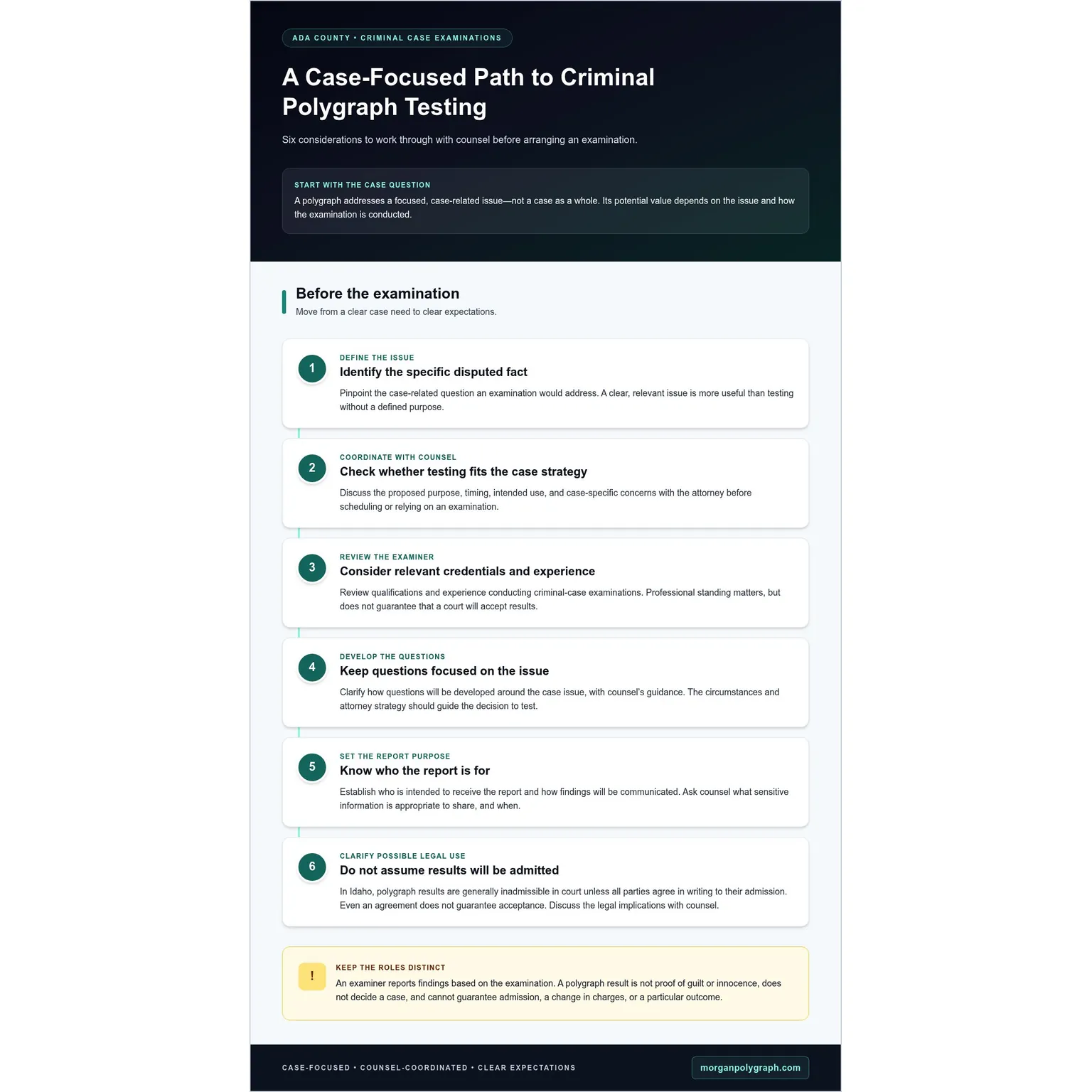
No examination result guarantees admission or acceptance in court, a change in charges, or a particular case outcome. An examiner reports findings based on the examination. Attorneys decide how those findings may inform legal strategy, prosecutors make decisions within their role, and courts determine legal and evidentiary questions. A polygraph result doesn’t decide the case.
Before arranging testing, discuss the proposed questions, purpose, and any case-specific requirements with your attorney. You can also review the site’s guide to the polygraph examination process for a practical overview. Clear expectations help keep the examination focused on its intended issue without mistaking an examiner’s findings for a legal conclusion.
How to evaluate criminal polygraph testing in Ada County
Start with the case need, not a promise of certainty. Legal strategy should guide both the timing and purpose of an examination. Before scheduling, coordinate with defense counsel and decide whether the proposed test has a clear, relevant role in the matter.
Use this checklist to keep the decision focused:
- Case relevance: Identify the specific disputed factual issue the examination would address.
- Examiner qualifications: Review relevant credentials and experience conducting criminal-case examinations.
- Question development: Clarify how questions will be developed around the issue, with counsel’s guidance.
- Report purpose: Establish who the report is intended for and how findings will be communicated.
- Counsel coordination: Discuss timing, intended use, and case-specific concerns with the attorney before proceeding.
Criminal-case experience matters because the examination must be organized around the issue and context at hand. A broad assurance of accuracy or certainty doesn’t explain whether a test is relevant to a particular case, how questions will be framed, or what a report can establish. For Ada County criminal polygraph testing, case-focused planning is more meaningful than a sweeping promise.
Questions to resolve with defense counsel
Ask what precise issue the examination would address and whether testing fits the current case strategy. Clarify who would receive the report and how counsel may use the examination. Before sharing sensitive case details, ask your attorney what information is appropriate to provide and when. This keeps communication deliberate and consistent.
Credentials, experience, and professional reporting
Morgan Polygraph’s nationally certified, court-recognized examiners conduct criminal and civil case examinations and prepare professional reports intended for legal proceedings. Clear reporting helps readers understand what was examined and what findings were reached. Credentials and report quality do not guarantee that a court will accept the results.
The U.S. Department of Justice discusses polygraph evidence in federal proceedings in its overview of polygraph results and trial use. Federal guidance isn’t a substitute for advice about an Idaho case. Ask counsel about applicable local requirements. For a discussion of criminal and civil case examinations, explore Morgan Polygraph’s case polygraph services.
Can an Ada County criminal polygraph result be used in court?
An examination does not guarantee that its results will be admitted or accepted in court. A report may be prepared for legal proceedings, but that purpose alone doesn’t determine whether it can be considered as evidence. An examiner’s professional standing and a court’s decision about evidence are separate matters.
For an Ada County case, don’t assume a general description of evidentiary rules answers the question for your circumstances. The Idaho Rules of Evidence are an authoritative starting point, but discuss how they apply, along with any other relevant legal requirements, with your attorney. Case facts and judicial decisions can affect whether particular evidence is accepted.
Court-recognized examiner versus admissible evidence
A court-recognized examiner’s qualifications describe professional standing. They don’t mean every examination or report will be admitted in a specific case. Morgan Polygraph’s examiners are nationally certified and court-recognized, and its reports are intended for legal proceedings. Neither credentialing nor report purpose guarantees court acceptance.
Keep the roles distinct:
Examiner findings
The examiner conducts the examination and reports findings. Those findings don’t decide what evidence a court may consider.
Attorney strategy
Counsel assesses whether testing fits the case and how the examination may relate to legal strategy.
Evidentiary rules
Applicable rules provide the framework for evaluating evidence. Their relevance to a particular Idaho case requires legal review.
Judicial decisions
The court decides whether evidence may be considered in the proceeding.
How to discuss possible court use
Before arranging testing, ask your attorney whether an examination has a defined role in your case. Discuss timing, who may receive the report, whether disclosure concerns apply, and which legal requirements need consideration. These questions are case-specific; an examiner cannot replace your attorney’s legal assessment.
Morgan Polygraph’s criminal-case polygraph guide for attorneys offers related background for legal professionals. For your situation, rely on counsel to evaluate how an examination and its findings may fit the case. Careful coordination helps set realistic expectations without treating a report as a ruling or guaranteed outcome.
What to expect before and during a Boise-area criminal polygraph examination
A clear process begins before the appointment. For Ada County criminal polygraph testing, coordinate with your attorney, identify the issue the examination is intended to address, then arrange the examination with that purpose in mind. The examiner needs a focused understanding of the relevant question, not an unfocused account of every case detail.
Before scheduling: coordinate the case and examination purpose
Ask counsel whether testing fits the case strategy and what information is appropriate to share. Your attorney can help determine how to communicate sensitive case details and what the examiner needs to understand the issue. Before scheduling, clarify the examination’s purpose and who is expected to receive any report. This helps set appropriate expectations about information handling.
Practical preparation can stay straightforward:
- Be ready to explain, in general terms, the specific issue counsel wants addressed.
- Ask your attorney what case information to provide and through which channel.
- Raise questions about the process or report audience before the appointment.
- Don’t try to rehearse answers or shape your responses. The examination should focus on clear, relevant questions, and you should respond truthfully.
During the appointment and after the examination
The examiner guides the appointment in a professional, structured manner, explains the process, and works with the defined issue. Listen to the instructions and ask for clarification if something is unclear. A respectful, discreet approach can help make a sensitive appointment more manageable, but don’t assume every detail is confidential or that a report will go only to a particular person. Confirm intended communication and report handling in advance.
After the examination, findings are communicated through professional reporting. Discuss the report’s purpose and audience beforehand, especially when counsel is coordinating the examination. Reporting does not guarantee a particular finding, delivery timeline, or legal effect. Your attorney can help interpret how the examination fits into the broader case strategy.
If you’re considering a Boise-area criminal examination, discuss criminal case polygraph testing with Morgan Polygraph and coordinate with your attorney about the examination’s purpose.
Arrange criminal polygraph testing with Morgan Polygraph in Ada County
Morgan Polygraph provides criminal and civil case examinations in Boise for defense attorneys and others handling case-related questions. For people dealing with an Ada County matter, the Boise office provides a local place to arrange an examination. Examiners are nationally certified and court-recognized, and reports are prepared for legal proceedings. These qualifications support a professional process, but they don’t guarantee that a report will be admitted or accepted in court.
Why Ada County clients choose a local Boise examination service
Case-related concerns can be sensitive. Morgan Polygraph emphasizes discreet, respectful interactions. The Boise office is located at 6126 W. State Street, Suite 208, Boise, Idaho 83703. A local examination service can make coordination more practical for people managing an Ada County case, while keeping the focus on the specific issue the examination is intended to address.
Testing isn’t the right step for every case. Begin by discussing the examination’s relevance and intended use with your attorney. Counsel can assess how timing and testing fit the case strategy and advise on legal questions such as disclosure or admissibility. The examiner conducts the examination and reports findings; legal strategy remains a matter for your attorney.
Take the next step with counsel-informed questions
Before arranging an examination, have a few points ready to discuss:
- The specific case issue the examination would address.
- Your attorney’s guidance about timing and the information to share.
- Who the report is intended for and how findings will be communicated.
You don’t need to prepare a rehearsed account. The goal is to understand the examination’s purpose and keep its questions focused and relevant. If you’re considering Ada County criminal polygraph testing, contact Morgan Polygraph to discuss arranging a criminal case examination. Bring counsel’s guidance into that conversation so the process starts with clear expectations.
Contact Morgan Polygraph about arranging an examination.
Take a case-focused next step
Ada County criminal polygraph testing is best considered in relation to a specific case issue, not as a standalone verdict. Before arranging an examination, discuss its relevance, timing, and intended use with your attorney. An examiner’s findings and a professional report don’t guarantee court acceptance or determine a case outcome.
Morgan Polygraph provides criminal and civil case examinations in Boise. Its nationally certified, court-recognized examiners take a discreet and respectful approach to sensitive matters.
If you and your counsel are considering whether an examination fits your situation, discuss criminal polygraph testing with Morgan Polygraph. A clear understanding of the case question and the examination’s purpose can help you take the next step with confidence.
Frequently Asked Questions
Can a polygraph be used in an Ada County criminal case?
Possibly, but an examination doesn’t guarantee that its results will be admitted or considered by a court. Whether a polygraph result may be used depends on applicable evidentiary rules, the facts of the case, and the court’s decision. Ask your attorney about current Idaho requirements and any case-specific conditions before arranging testing or relying on a result.
Is a criminal polygraph result proof that someone is guilty or innocent?
No. A polygraph result is not independent proof of guilt or innocence, and it doesn’t determine what happened or what a court will decide. An examiner reports findings from the examination. Those findings are distinct from other evidence and from legal conclusions made by attorneys or a court. Consider the result only in the context of counsel’s guidance and the broader case.
How do I arrange criminal polygraph testing in Ada County?
Start by discussing the case issue and proposed purpose of testing with your attorney. If an examination fits the case plan, contact Morgan Polygraph to discuss arranging Ada County criminal polygraph testing in Boise. Be prepared to explain the general issue and clarify who the report is intended for. Follow counsel’s guidance about what sensitive case information to share and how to communicate it.
Should I talk to my attorney before scheduling a criminal polygraph?
Yes. Discuss testing with your attorney before scheduling a case-related examination. Counsel can assess whether the proposed questions relate to a relevant issue, whether the timing fits the case strategy, and how a report may be handled or used. Your attorney can also address legal requirements that may apply. The examiner conducts the examination and reports findings, but doesn’t provide legal advice.
What happens during a criminal polygraph examination?
The examiner guides a structured examination focused on clear, case-related questions. The process includes discussing the examination’s purpose and addressing the questions being examined. Follow the examiner’s instructions and answer truthfully; don’t try to rehearse or manipulate responses. Afterward, findings are communicated through professional reporting. The result, report timing, and any legal effect can’t be guaranteed, so discuss case implications with your attorney.
Does a court-recognized examiner guarantee that results will be admissible?
No. Court recognition describes an examiner’s professional standing, not a guarantee that a particular result or report will be admitted. Morgan Polygraph’s nationally certified, court-recognized examiners prepare professional reports intended for legal proceedings, but a court makes its own evidentiary decisions. Ask your attorney to assess current Idaho standards and how they may apply to the facts of your case.