
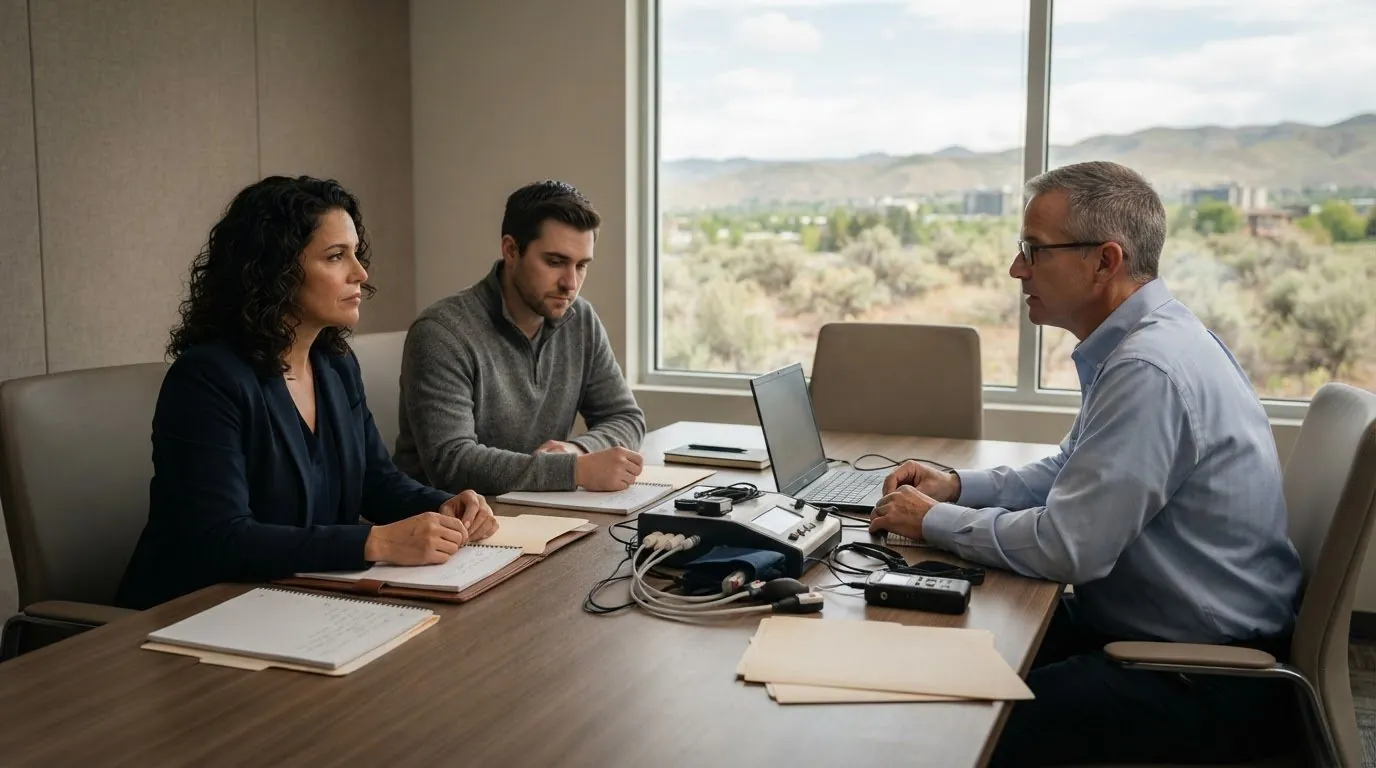
A confession can sound conclusive, but it does not settle whether the statement was accurate or freely given. If you’re considering challenging a false confession with a polygraph in Canyon County, the key question is not whether a test can prove innocence. It cannot. The question is whether a professionally conducted examination could add useful information to an investigation directed by defense counsel.
It is understandable to worry that investigators or prosecutors may treat a disputed statement as the end of the story, or that a polygraph could create new risks. In Idaho, polygraph results are generally inadmissible in court unless all parties agree to their admission, and a judge may still exclude them. Careful planning and realistic expectations matter.
This article explains what a polygraph may and may not contribute, why counsel should guide decisions about an examination, and how to preserve records that may help evaluate a confession. The circumstances of questioning, any recordings, and other evidence remain central. Morgan Polygraph, based in Boise, conducts criminal and civil case examinations and prepares professional reports, without promising a particular legal result.
Key Takeaways
- A polygraph assesses responses to carefully developed questions. It cannot independently establish that a confession was false or coerced.
- For challenging a false confession with a polygraph in Canyon County, coordinate the examination with defense counsel and clarify its purpose before proceeding.
- Preserve recordings, interview notes, and other relevant records so counsel can compare the confession with the available evidence.
- Separate investigative value from courtroom use. Admissibility depends on applicable rules, case facts, and judicial decisions.
- Prepare by sharing relevant background and, as appropriate, health and medication information with the examiner.
What a Canyon County polygraph can, and cannot, show about a disputed confession
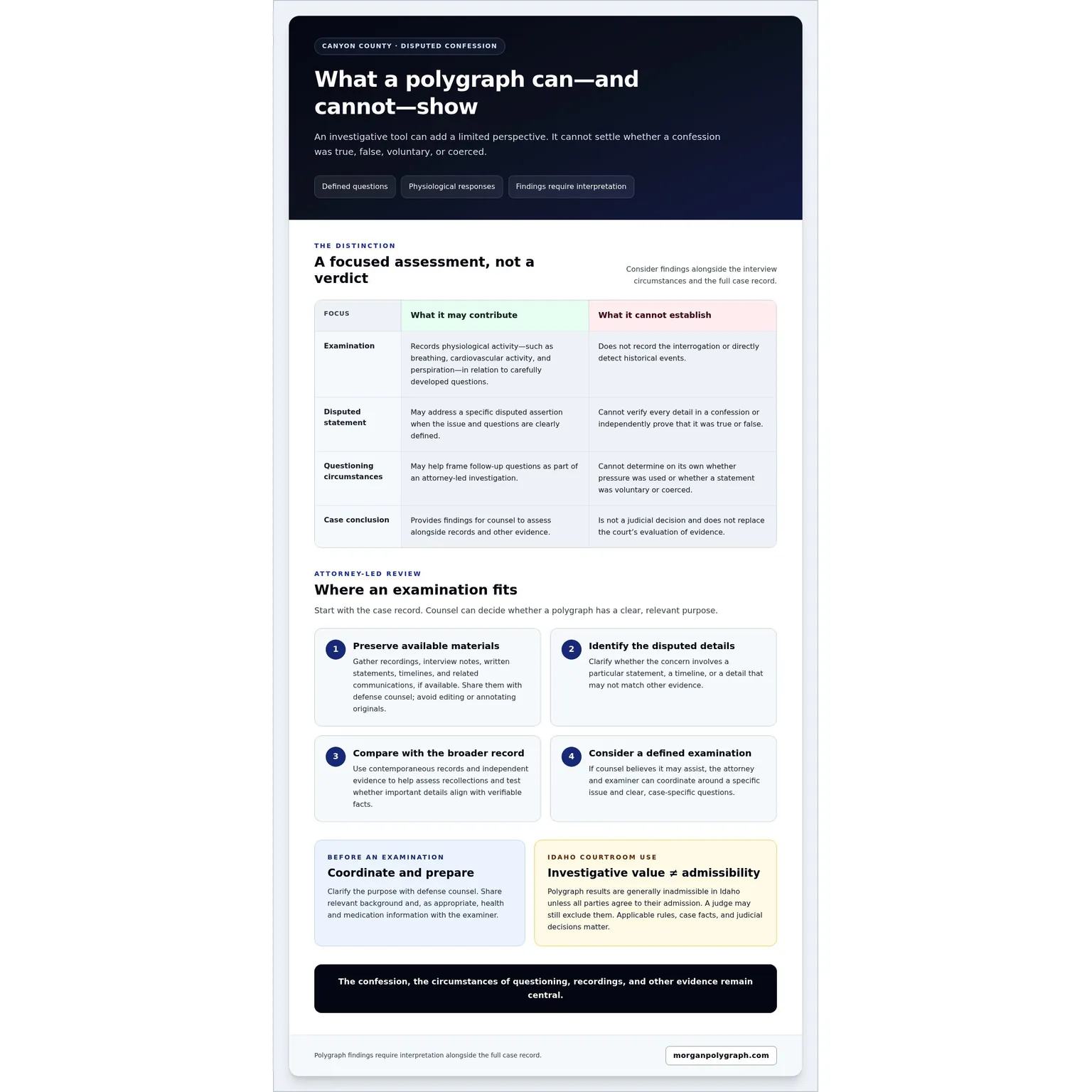
A defense polygraph may help organize one part of an attorney-led investigation, but it cannot independently establish innocence, coercion, or the truth of a confession. The examination focuses on physiological responses to carefully developed questions about a defined issue. It cannot recreate an interrogation or verify every detail of what happened in a Canyon County interview room.
That distinction matters. One question is whether the confession’s details are accurate, consistent, and supported by other evidence. Another is what happened during questioning and whether anything affected the person’s ability to speak freely. Recordings, interview notes, timelines, witness accounts, and other case materials may help counsel evaluate those issues. A polygraph cannot answer either question on its own.
A polygraph is an investigative tool for assessing responses to specific questions, not a test that proves whether a confession was true, false, voluntary, or coerced.
What does a polygraph examination assess in a confession dispute?
During an examination, sensors record physiological activity, such as changes in breathing, cardiovascular activity, and perspiration. The examiner analyzes those recordings in relation to the questions asked. The instrument does not record the interrogation or detect historical events directly. For background on what a polygraph test measures, including ongoing scientific and legal debate, see the general overview.
In a confession dispute, the wording and scope of the questions matter. An examination may address a specific disputed assertion, but a chart alone cannot determine whether police used pressure, whether a statement was voluntary, or whether every detail in the confession is accurate. Those questions require review of the broader evidence and circumstances.
Why a polygraph result is not a verdict
An examination produces findings that require interpretation, not a judicial decision. Responses have limitations, and findings should be considered alongside the full case record. Defense counsel can assess whether the examination addresses the disputed issue and how its findings relate to other evidence. A court independently evaluates evidence under applicable rules. An investigative result does not replace that process.
For an overview of the steps and preparation involved, see Morgan Polygraph’s polygraph examination process guide. Challenging a false confession with a polygraph in Canyon County should begin with counsel’s review of the statement, the interview circumstances, and the available records. An examination may add a limited perspective, but it cannot settle the dispute by itself.
How a Canyon County defense team can investigate a potentially false confession
A careful review starts with the case record, not with a test. In a Canyon County matter, defense counsel can coordinate the investigation and decide whether an examination could help explore a specific disputed issue. A practical sequence is to preserve available materials, identify which details of the confession are contested, compare those details with other evidence, and then consider whether a polygraph may add useful investigative information.
What should be preserved about the confession and interview?
Gather materials that may help counsel reconstruct what happened and when. Depending on what exists, these may include interview recordings, notes, written statements, timelines, and related communications. Share potentially relevant records with defense counsel. Avoid editing originals, adding annotations to them, or circulating them more widely. Counsel can assess what is relevant and how to handle it in the case.
Contemporaneous records can help anchor a person’s later recollection. Independent evidence can also help test whether important details in a confession align with verifiable facts.
Counsel can then distinguish disputed facts from unanswered questions. The issue may concern a particular statement, a timeline, or whether a detail in the confession matches other evidence. Comparing those points with available records helps determine whether an examination has a clear, relevant purpose.
How does an examination fit into the attorney’s investigation?
If counsel believes an examination may assist, the attorney and examiner can coordinate around a defined issue and clear, case-specific questions. The goal is not to substitute a test for corroboration, interview records, or other investigative work. The criminal-case polygraph guide for attorneys outlines how an examination may fit into a broader defense process.
The Department of Justice discussion of polygraphs illustrates why results warrant careful interpretation. An examination may help frame follow-up questions, but it cannot independently verify the circumstances of an interview or replace an evidence-based review. If you are considering challenging a false confession with a polygraph in Canyon County, counsel should also verify the Idaho rules and court procedures that apply before relying on results for a particular legal purpose.
Morgan Polygraph conducts criminal-case examinations and prepares professional reports intended for potential use in legal proceedings. Defense counsel can coordinate an examination as part of a broader review. Learn more about Morgan Polygraph’s criminal-case polygraph services.
Polygraph investigation versus courtroom challenge in an Idaho case
A polygraph’s investigative role and its possible use as courtroom evidence are separate questions. A test result does not automatically exclude a confession, require a prosecutor to change position, or determine the outcome of a case. When challenging a false confession with a polygraph in Canyon County, defense counsel should assess the examination’s purpose separately from whether a court could consider its results.
| Context | What a polygraph may contribute | Important limit |
|---|---|---|
| Investigation | Help frame questions about a specific disputed issue. | Doesn’t independently verify what happened during questioning. |
| Attorney review | Give counsel another piece of information to consider with records and other evidence. | Doesn’t replace counsel’s review of the full case record. |
| Possible negotiations | Findings may be discussed as part of case-specific conversations. | No response or change in position is assured. |
| Courtroom evidence | Potential evidentiary use can be assessed for the particular case. | Admission depends on applicable rules, case facts, and judicial decisions. |
Can a polygraph result be admitted in an Idaho courtroom?
That is a legal question for defense counsel and the court, not the examiner alone. The answer may depend on the applicable evidence rules, the case’s procedural posture, the facts, and whether any required agreement or stipulation applies. Do not assume a rule described for another state applies in Idaho, or that an examination intended for investigation will be admitted at trial.
For a Canyon County case, counsel should verify current Idaho and applicable local court requirements using authoritative sources. The judge’s decisions and the specific circumstances matter. An examiner’s report may describe the examination and its findings, but it cannot promise admissibility or decide how a court will treat them.
What investigative value may remain if trial admission is uncertain?
An examination may still help counsel organize questions, consider follow-up investigation, or evaluate how findings fit with other evidence. Any use in discussions with the prosecution depends on the case and is not guaranteed. The guide to polygraph accuracy and limitations offers further context for weighing what an examination can and cannot contribute.
Keep the distinction clear: investigative usefulness is not the same as courtroom admissibility. Counsel can determine whether an examination fits the defense strategy and verify the applicable rules before relying on it for a legal purpose.
Before a Canyon County polygraph: practical steps for the examinee and attorney
Preparation should make the examination focused, not rehearsed. Before testing, the examinee and defense attorney should agree on the issue the examination will address, provide accurate background, and understand how findings and any report may be handled. This coordination keeps the process grounded in the disputed confession rather than assumptions about what a test can prove.
What should the attorney and examiner clarify beforehand?
Before an examination, counsel and the examiner should establish its specific purpose and identify the relevant issue. They can review the case background and question wording together to make sure the questions are clear, appropriately limited, and connected to the matter under review. They should also discuss how findings and any written report will be shared or used. Do not assume an examination or its results are automatically protected from disclosure. Confidentiality and privilege depend on the circumstances and should be discussed with counsel.
- Define the purpose: Identify the particular disputed issue the examination is intended to address.
- Share accurate background: Provide relevant information about the confession and interview through the agreed attorney-examiner process.
- Clarify report handling: Discuss who will receive findings and how the report may be used in the legal matter.
- Raise health considerations: Tell the examiner about relevant health conditions and prescribed medications as appropriate.
How can an examinee prepare without trying to influence results?
Follow the examiner’s instructions and aim for ordinary rest before the appointment. There is no need to memorize answers or practice ways to respond. Rehearsing, withholding relevant information, or trying to manipulate physiological responses can interfere with a straightforward examination. Answer honestly and speak up if a question is unclear.
Be candid about relevant health factors and prescribed medications so the examiner can consider that information. Do not stop or change medication for a test unless the prescribing clinician directs you to do so. If a question raises a legal concern, or you are unsure whether to discuss a case detail, ask your defense attorney rather than guessing.
A carefully coordinated examination can support an attorney-led investigation, but it cannot promise a particular result or legal outcome. In a Canyon County case, counsel should guide the process and clarify how the examination fits into the broader review.
To discuss a criminal-case polygraph examination coordinated with defense counsel, contact Morgan Polygraph.
Discuss a Canyon County false-confession polygraph with Morgan Polygraph
For a disputed confession, a professional examination is most useful when it addresses a clearly defined question within an attorney-led investigation. Morgan Polygraph conducts criminal-case examinations and prepares professional reports intended for potential use in legal proceedings. Based in Boise, the firm serves clients in the region, including those considering an examination related to a Canyon County case.
What can clients expect from a professional criminal-case examination?
Morgan Polygraph examinations are conducted by nationally certified, court-recognized examiners. The process is structured around the issue being examined, with attention to clear questions and relevant background. A professional report documents the examination and findings for review by the attorney and client.
A report may support counsel’s evaluation of the disputed confession alongside interview records and other evidence. It does not independently establish that the confession was false or coerced, and it does not determine whether a court will admit the results. That decision depends on applicable rules, case facts, and judicial decisions.
Sensitive criminal matters call for careful handling. Counsel and the examiner can coordinate the examination’s purpose and the handling of its report, keeping expectations clear and the examination focused on its limited investigative role.
What is a sensible next step in Canyon County?
Before arranging an examination, discuss the confession and your concerns with defense counsel. Counsel can review the circumstances, identify the specific issue in dispute, and consider whether a polygraph may contribute to the investigation. Questions about statements, rights, or how results might be used belong with your attorney.
If you and your attorney are considering challenging a false confession with a polygraph in Canyon County, Morgan Polygraph can conduct a professional criminal-case examination. A discussion can focus on the examination’s scope, relevant background, and coordination with counsel, without presuming what the results will show or how they will affect the case.
Discuss a criminal-case polygraph with Morgan Polygraph.
Take a Careful, Counsel-Led Next Step
A polygraph may contribute a focused perspective to an investigation, but it cannot independently establish that a confession was false or determine how a court will treat the results. Preserve relevant records, identify the disputed issue, and coordinate any examination with defense counsel. These steps help keep the inquiry grounded in the full case record.
For those considering challenging a false confession with a polygraph in Canyon County, Morgan Polygraph conducts criminal and civil case examinations for legal and defense contexts. Its nationally certified, court-recognized examiners prepare professional reports intended for legal proceedings, but courtroom admission and case outcomes are not guaranteed.
Consult your attorney about whether an examination fits the case and how findings should be handled. To discuss a criminal-case polygraph with Morgan Polygraph, contact the Boise-based examination team. A measured, well-coordinated investigation can help you take the next step with greater clarity.
Frequently Asked Questions
Can a polygraph prove that a confession was false?
No. A polygraph cannot independently prove that a confession was false, coerced, or voluntary. It records physiological responses to specific questions for an examiner to analyze. Those findings do not directly verify what happened during an interrogation or whether each detail in a statement is accurate. Defense counsel should assess the examination, interview records, and other evidence together. Treat a polygraph as a limited investigative tool, not a verdict or substitute for corroboration.
Can a polygraph help challenge a confession in Canyon County?
It may contribute to an attorney-led investigation by addressing a clearly defined issue related to the disputed confession. When challenging a false confession with a polygraph in Canyon County, counsel can review available records and evidence, then decide whether an examination could add a useful perspective. Findings may help organize follow-up questions, but they do not establish coercion or guarantee that investigators, prosecutors, or a court will change their position.
Are polygraph results admissible in Idaho courts?
Idaho generally does not admit polygraph results as evidence unless all parties agree to admission through a formal written stipulation. Even with an agreement, a judge may retain authority to exclude the results. The specific rules, procedural posture, and facts of a case matter. Ask defense counsel to verify current Idaho requirements and applicable court decisions before relying on an examination for courtroom use. A report is not a promise of admissibility.
Should I take a polygraph before speaking with my defense attorney?
No. Speak with your defense attorney before arranging an examination or discussing case details for that purpose. Counsel can review the circumstances of the confession, identify the question that needs investigation, and consider how any examination or report may be handled. An examiner does not provide legal advice. If you are unsure what to say about the case or have concerns about your rights, raise them with your attorney first.
What evidence matters when disputing a confession?
Relevant materials may include available interview recordings, notes, written statements, timelines, and communications related to the questioning. Other evidence can help assess whether details in the confession match independently verifiable facts. No single record is guaranteed to exist or resolve the dispute. Preserve potentially relevant materials in their original form and share them with defense counsel, who can evaluate them alongside the full case record and identify gaps for further investigation.
Does a polygraph result automatically change a criminal case?
No. A result does not automatically exclude a confession, change a prosecutor’s position, or determine a case outcome. Counsel may consider the findings as one part of an investigation, but their relevance depends on the case and how they fit with other evidence. Courtroom use is a separate question governed by applicable rules and judicial decisions. Avoid making legal or case decisions based on a test result alone.
How should someone prepare for a polygraph about a disputed confession?
Coordinate with defense counsel and the examiner about the examination’s purpose, the disputed issue, and how findings or a report may be handled. Provide accurate background and disclose relevant health conditions or prescribed medications to the examiner as appropriate. Follow the examiner’s instructions, get ordinary rest, and answer honestly. Do not rehearse responses, withhold information, or try to manipulate physiological reactions. Direct legal questions to your attorney rather than guessing.