

The most powerful use of a polygraph isn’t always to convince a jury. Often, its true value lies in convincing the prosecution to never let the case reach a jury at all. When you’re facing high stakes criminal charges and there’s a lack of physical evidence to support your side, the pressure to accept an unfavorable plea deal can feel overwhelming. Understanding how attorneys use polygraph tests in criminal cases can change that dynamic entirely.
We understand the stress and vulnerability that comes with a legal battle. You deserve a defense strategy that utilizes every technical and scientific advantage available. Discover how legal professionals leverage private examinations to gain tactical leverage during plea negotiations and seek charge dismissals. We’ll explore the strategic benefits of independent testing, including how to protect results under attorney-client privilege. You will also learn how to identify a qualified examiner in Boise who follows the strict standards required for results that hold weight. This guide provides a clear look at why a methodical, data-driven approach is a critical component of modern criminal defense.
Key Takeaways
- Learn why the inadmissibility of polygraphs in court is a secondary concern compared to their power as a pre-trial investigative and negotiating tool.
- Understand how attorneys use polygraph tests in criminal cases to present “passed” results to prosecutors, potentially leading to reduced charges or full dismissals.
- Discover the critical importance of independent testing and how the Attorney-Work Product Doctrine protects results from being disclosed to the state.
- Navigate the specific nuances of Idaho law, including stipulated agreements and the impact of the State v. Fain precedent on your defense strategy.
- Identify the specific qualifications and reporting standards required to ensure a polygraph examination is respected by legal professionals and the court system.
Beyond Admissibility: The Strategic Role of Polygraphs in Criminal Defense
In a legal context, a Polygraph is an investigative tool used to verify a defendant’s or witness’s statement by measuring physiological indicators. While popular media often focuses on the courtroom drama of admitting evidence, the argument that polygraphs are “not admissible” is often a red herring in criminal defense. The reality is that the vast majority of criminal cases are resolved long before a jury is ever seated. Understanding how attorneys use polygraph tests in criminal cases requires looking past the trial itself and focusing on the pre-trial phase where the most critical decisions are made.
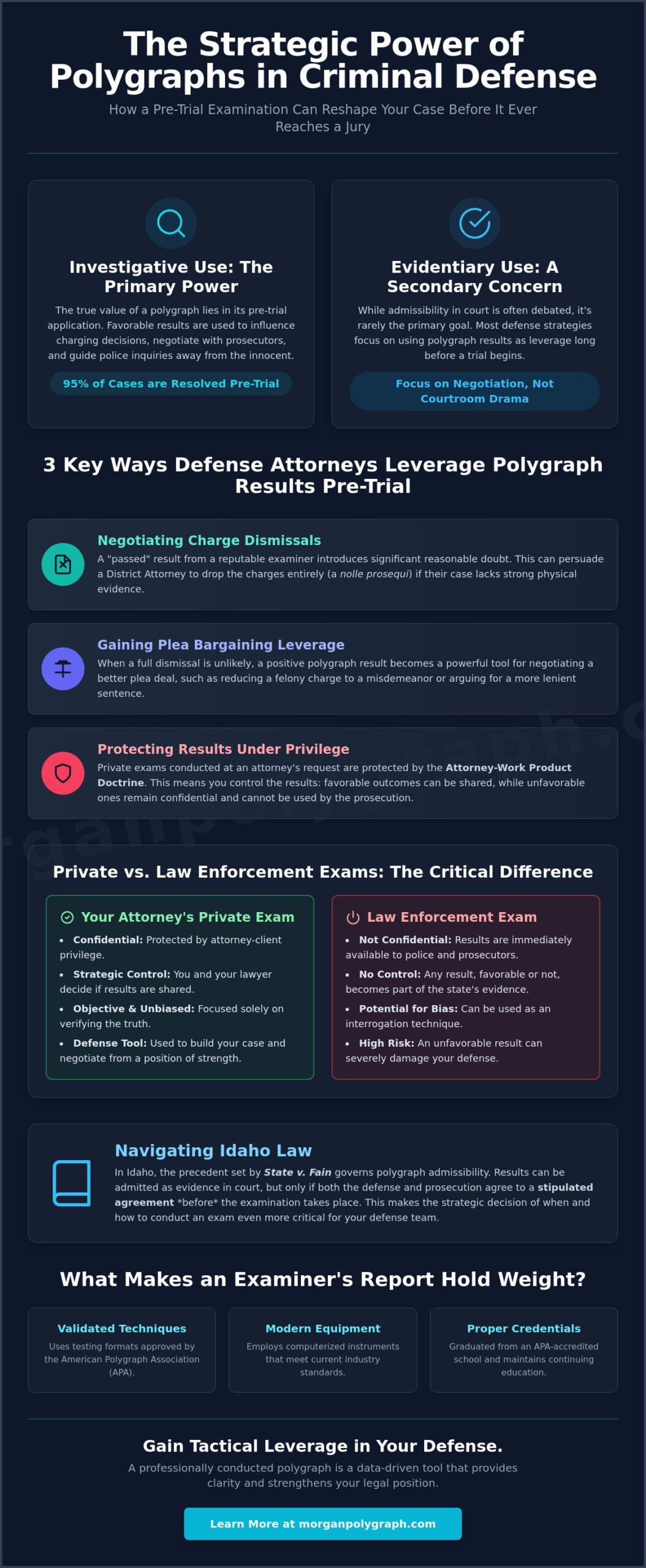
The primary power of a polygraph lies in its investigative use rather than its evidentiary use. While evidentiary use refers to presenting results as formal proof during a trial, investigative use serves as a catalyst for negotiation. A passed exam can create significant “reasonable doubt” in the mind of a prosecutor. When a District Attorney sees a clean result from a reputable examiner, it often forces them to re-evaluate the strength of their case. It shifts the momentum, moving the conversation from “when will you plead guilty” to “should we even be pursuing these charges.”
- Evidentiary Use: Formal presentation of results in court, which typically requires a stipulated agreement between all parties.
- Investigative Use: Private testing used to influence charging decisions, plea negotiations, and the direction of police inquiries.
The Burden of Proof and the ‘Truth Factor’
The polygraph serves as a strategic filter for defense counsel, providing an objective baseline to evaluate a client’s narrative before finalizing a trial strategy. For an attorney, knowing the truth is a prerequisite for effective representation. If a client passes a private examination, the attorney can move forward with a high degree of confidence, often using the results to humanize the defendant during the discovery process. It transforms the defendant from a name on a case file into a person who has proactively sought to prove their innocence. This clarity helps counsel decide whether to push for a trial or pursue a favorable plea deal based on the perceived risk.
Polygraphs as a Tool for ‘Clearing the Air’
In cases that lack physical evidence, such as “he-said, she-said” allegations, the legal system can feel like a stalemate. Innocent defendants often benefit from early testing to refocus police investigations that may have become stagnant or biased. By presenting a passed test early, a defense team can encourage investigators to look at other leads or reconsider the credibility of an accuser. You can explore more about the scientific foundations of these tests by reading about are polygraphs accurate. In high-stakes environments where your reputation is on the line, a professional examination provides a methodical way to clear the air and regain control of the narrative.
3 Key Ways Defense Attorneys Leverage Polygraph Results Pre-Trial
The strategic application of polygraphy extends far beyond the witness stand. Most defense strategies focus on creating leverage during the pre-trial phase, where the majority of legal battles are won or lost. Understanding how attorneys use polygraph tests in criminal cases allows a defense team to move from a defensive posture to an offensive one, challenging the prosecution’s narrative with objective data. While the legal definition of a polygraph focuses on its physiological measurements, its legal utility is defined by how those measurements influence a prosecutor’s decision making process.
- Negotiating Charge Dismissals: A passed private test can be a powerful tool when meeting with a District Attorney. If the results are compelling and the examiner is reputable, it may lead to a nolle prosequi, where the prosecutor formally decides not to pursue the charges.
- Plea Bargaining Leverage: When a full dismissal isn’t on the table, results are used to mitigate sentencing. Attorneys often use a “pass” to negotiate a reduction from a felony to a misdemeanor, arguing that the risk to public safety is lower than the state initially assumed.
- Client Management: Legal teams must know if their client is being entirely truthful before committing to a specific defense. A private examination acts as a “reality check,” ensuring the attorney isn’t blindsided by contradictory evidence during discovery or trial.
Negotiating with the Prosecution
One of the most high stakes tactics is the “Stipulated Polygraph.” In this scenario, both the defense and the prosecution agree in writing to abide by the results before the test is even administered. If the defendant passes, the state may agree to drop the charges; if they fail, the results may become admissible in court. This creates a high risk/reward ratio that requires absolute confidence in the client’s narrative. For those not ready for such a gamble, scheduling a private examination first allows the defense to test the waters without any obligation to share the results with the state.
Post-Conviction and Probation Utility
The role of the polygraph doesn’t end with a verdict. In Idaho, Post-Conviction Sex Offender Testing (PCSOT) is a mandatory component for individuals under the supervision of the Idaho Department of Corrections. These specialized exams ensure compliance with probation and parole requirements, providing a layer of accountability that supports continued liberty. This process often works in tandem with a psychosexual evaluation to provide a comprehensive risk assessment. By following the standards set by the Idaho Sexual Offender Management Board (SOMB), examiners help maintain the balance between public safety and the successful reintegration of the individual into the community.
Private vs. Law Enforcement Exams: Why Attorneys Prefer Independent Testing
When considering how attorneys use polygraph tests in criminal cases, the choice of who administers the examination is often more important than the test itself. Many defendants fall into the ‘Police Polygraph’ trap, agreeing to a test administered by law enforcement under the mistaken belief that it’s an objective search for truth. In reality, state-administered exams are frequently used as sophisticated interrogation techniques designed to elicit confessions or incriminating statements. Defense counsel almost always advises against these tests because any statement made during a police polygraph is fully admissible, even if the physiological results are not. This adversarial approach is designed to break down a suspect, whereas a private examination is conducted in a clinical, professional setting focused on data accuracy.
Attorneys prioritize independent testing because it provides a controlled environment where the client feels respected rather than accused. In a law enforcement setting, the stress of the environment can lead to “false positives” or inconclusive results due to the suspect’s heightened state of anxiety. By contrast, a private examiner works with the defense team to ensure the client is physically and mentally prepared for the process. This distinction is vital when the goal is to produce a report that can be used as tactical leverage during negotiations. For a report to be taken seriously by the state, it must come from a nationally certified examiner who maintains recognized standards of practice and utilizes modern, data-driven methodologies. This professional standing ensures that the findings aren’t dismissed as biased or technically flawed.
The Advantage of Confidentiality
The Attorney-Work Product Doctrine provides a critical layer of protection that state-administered tests lack. When an attorney hires an independent examiner, the results are treated as privileged communication. If a client fails the examination, those results never have to leave the attorney’s office and cannot be discovered by the prosecution. This preserves the defendant’s 5th Amendment rights while allowing the defense team to gather vital information about the case’s strengths and weaknesses without fear of self-incrimination. A private exam is a ‘no-risk’ discovery tool for the defense.
State-of-the-Art Technology and Expert Witness Status
For results to carry weight with a prosecutor or a judge, the examiner must possess ‘expert witness’ credentials. In Idaho, attorneys look for practitioners who are nationally certified and utilize the latest computerized polygraph systems. These modern systems provide a level of precision that traditional methods cannot match, utilizing advanced algorithms to analyze physiological data. You can learn more about the specific sensors and methodologies involved in a modern polygraph test to see how technology ensures reliability. This commitment to innovation ensures that the findings are robust enough to withstand professional scrutiny and support a forward-thinking defense strategy.
Navigating Idaho Law: Admissibility and Stipulated Agreements in 2026
In Idaho, the legal landscape for polygraphy is governed by specific precedents and rules of evidence that require careful navigation. The foundational case of State v. Fain (1989) established that polygraph results are generally inadmissible in Idaho criminal trials. The court’s reasoning centered on the potential for such evidence to infringe upon the jury’s role as the sole arbiter of credibility. However, this precedent also carved out a critical exception: results may be admitted if both the prosecution and the defense enter into a written stipulation before the test is conducted. This is a primary way how attorneys use polygraph tests in criminal cases to create a clear path for evidence to reach a judge or jury.
Rule 702 of the Idaho Rules of Evidence further complicates this by setting strict standards for expert testimony. A judge must act as a gatekeeper, ensuring that any expert’s methodology is scientifically valid and helpful to the trier of fact. As of July 1, 2024, Idaho Administrative Code r. 62.01.01.484 reaffirmed this stance, explicitly stating that results and related expert testimony are not admissible unless all parties have agreed to their admissibility beforehand. This codification emphasizes that the modern Idaho legal system views polygraphy as a tool of mutual agreement rather than a unilateral weapon.
The Stipulation Process in Idaho Courts
A successful “Stipulation to Admissibility” is a precise legal document. It must detail the specific issues to be tested, the qualifications of the examiner, and the agreement that results will be admitted regardless of the outcome. For a judge to consider these results, the examiner must be a certified professional who adheres to the rigorous standards of the American Polygraph Association. A common pitfall in these agreements is failing to specify the testing methodology in writing. This oversight can lead to the exclusion of evidence if the prosecutor later challenges the scientific validity of the specific technique used during the examination.
Local Boise Legal Dynamics
Legal dynamics in the Treasure Valley vary by jurisdiction. Prosecutors in Ada County and Canyon County often maintain high standards for stipulated agreements, preferring examiners who possess deep experience with high stakes criminal litigation. Utilizing a Boise based expert ensures that your examiner is familiar with the specific reporting requirements and professional expectations of local courts. If you are seeking a qualified professional to assist with your case, you can find a polygraph near me to review local contact information and credentials.
To ensure your defense strategy is built on a foundation of professional excellence and legal compliance, consider contacting a nationally certified examiner today to discuss the specifics of your case.
Expert Criminal Defense Polygraphs: The Morgan Polygraph Advantage
The effectiveness of a defense strategy often hinges on the credibility of the experts involved. When considering how attorneys use polygraph tests in criminal cases, the reputation of the examiner is a primary factor in whether a prosecutor will even entertain the results. Morgan Polygraph provides a distinct advantage through its blend of traditional experience and modern, data-driven methodologies. Our examiners are nationally certified professionals who understand that in high stakes litigation, discretion is just as important as technical accuracy. We project a persona of calm, collected confidence, ensuring that your client feels they are in capable hands during a vulnerable time.
Our state-of-the-art Boise facility is specifically designed to provide a neutral, professional environment that minimizes the stress often associated with legal testing. We don’t just administer exams; we provide comprehensive expert consultation and testimony to support Boise attorneys through every phase of a criminal case. This includes assisting with the drafting of stipulated agreements and providing clear, court-recognized reporting that meets the highest standards of the industry. By integrating new methodologies and futuristic technology, we maintain a forward-thinking approach that respects the past while actively shaping the future of the field.
Credentials That Matter to the Court
Membership in elite organizations like the American Polygraph Association (APA) isn’t just a professional affiliation. It’s a guarantee of quality that judges and prosecutors recognize. In the Boise area, having a court-recognized expert who understands Idaho’s specific legal and correctional requirements can be the difference between a dismissed charge and a lengthy trial. Our team has extensive experience working within the framework of Rule 702 and the standards set by the Idaho Sexual Offender Management Board (SOMB). This deep expertise ensures that our findings carry maximum weight in pre-trial negotiations and meet all necessary reporting standards for the Idaho Department of Corrections.
Next Steps for Legal Professionals
Engaging our services is a straightforward, methodical process designed to integrate seamlessly with your existing defense timeline. The intake process is unhurried and logical, beginning with a high-level statement of the case’s needs. To begin, the attorney typically provides the following information:
- A concise case summary outlining the primary allegations.
- Relevant police reports or discovery documents that clarify the timeline of events.
- The specific issues or questions that the defense team wish to address during the examination.
- Any unique environmental or physical considerations regarding the client.
This preparation allows us to tailor the test to the unique nuances of the case, maximizing its tactical utility. If you are ready to explore how an independent examination can benefit your client’s defense, Contact Morgan Polygraph for a confidential legal consultation to discuss the specifics of your pending criminal case.
Strengthening Your Defense with Expert Polygraphy
Strategic legal defense requires more than just reacting to the prosecution’s evidence. It involves proactively utilizing every scientific and investigative tool available to create leverage. Understanding how attorneys use polygraph tests in criminal cases is essential for any legal team seeking to maximize their tactical options, from negotiating charge dismissals to securing favorable plea agreements. By prioritizing private, independent testing, you ensure that your client’s narrative is evaluated in a professional environment while remaining fully protected by the attorney-work product doctrine.
Morgan Polygraph provides the methodical precision and academic gravitas necessary to support high stakes litigation. Our nationally certified and court-recognized examiners bring extensive expert witness experience in Idaho courts to every case. We utilize state-of-the-art computerized polygraph technology to deliver reliable, data-driven results that legal professionals can trust. When the stakes are high, you deserve a partner who understands the human element as well as the technical requirements of the law.
Schedule a Confidential Legal Polygraph Examination in Boise today to gain the tactical advantage your case requires. We are here to help you move forward with confidence.
Frequently Asked Questions
Are polygraph tests admissible in Idaho criminal courts?
Polygraph results are only admissible in Idaho criminal courts if all parties involved have signed a written agreement before the test is administered. This requirement was reinforced by the Idaho Administrative Code update on July 1, 2024. Without this prior stipulation, judges will generally exclude the results based on established legal precedents like State v. Fain, which protects the jury’s role in determining witness credibility.
Can a prosecutor force a defendant to take a polygraph test?
A prosecutor cannot legally compel a defendant to undergo a polygraph examination. The 5th Amendment of the U.S. Constitution protects individuals from being forced to provide testimony or evidence that might be self-incriminating. While law enforcement may request a test during an investigation, defendants have the absolute right to refuse without it being held against them during a trial or sentencing.
What happens if a defendant fails a private polygraph test?
If a defendant fails a private examination, the results are typically protected by attorney-client privilege and the attorney-work product doctrine. The defense isn’t under any obligation to disclose these findings to the prosecution or the court. This confidentiality allows legal teams to explore how attorneys use polygraph tests in criminal cases as a safe discovery tool to evaluate the case’s strengths and weaknesses.
How do attorneys use polygraphs to get charges dropped?
Defense counsel can use a passed examination as tactical leverage during pre-trial negotiations to encourage a prosecutor to dismiss or reduce charges. By presenting objective data from a reputable examiner, the attorney creates “reasonable doubt” before the case ever reaches a jury. Understanding how attorneys use polygraph tests in criminal cases allows defense teams to shift the momentum by challenging the state’s narrative early.
What is a ‘stipulated’ polygraph examination?
A stipulated polygraph is a formal arrangement where the defense and prosecution agree in writing that the results will be admissible in court. Both sides must agree on the examiner and the specific questions being asked. This is a high-stakes strategy because the results are entered into evidence regardless of whether they favor the defendant or the state, making total confidence in the client’s narrative essential.
Is a polygraph test result considered ‘hearsay’ in a trial?
Polygraph results are not usually categorized as hearsay; instead, they are excluded based on the Idaho Rules of Evidence regarding scientific reliability. Rule 702 requires that expert evidence be helpful to the trier of fact and based on sufficient data. Because the legal system views the jury as the primary judge of truth, polygraphs are typically excluded unless all parties waive their objections through a written stipulation.
How much weight do prosecutors give to a passed polygraph?
The weight given to a passed test depends on the prosecutor’s discretion and the reputation of the examiner. While it isn’t a “get out of jail free” card, a clean result from a nationally certified professional often forces a re-investigation of the facts. It is a powerful tool for negotiating plea bargains or moving a case from a felony track to a misdemeanor reduction.
Can a polygraph be used in a bail or bond hearing?
Judges often have broader discretion to consider various types of evidence during bail or bond hearings that wouldn’t be allowed at a formal trial. An attorney might present a passed polygraph to argue that the defendant is not a flight risk or a danger to the community. This is particularly effective in cases where the charges are based on conflicting statements rather than physical proof. While legal requirements vary by state, those in need of assistance in Ohio can rely on Andy Callif Bail Bonds to provide the professional support necessary to secure release during these critical proceedings.