

A polygraph doesn’t measure objective truth in a cosmic sense; instead, it measures your personal sincerity and the consistency of your own reality. When you’re facing an accusation rooted in a “he-said-she-said” dispute, the fear is often that a test cannot distinguish between a lie and an accuser’s sincere but incorrect belief. Utilizing a professional polygraph for false memory claims provides a data-driven way to navigate these high-stakes scenarios. It focuses on the physiological markers of deliberate deception, which remain distinct from the patterns seen in those who are being truthful about their experiences.
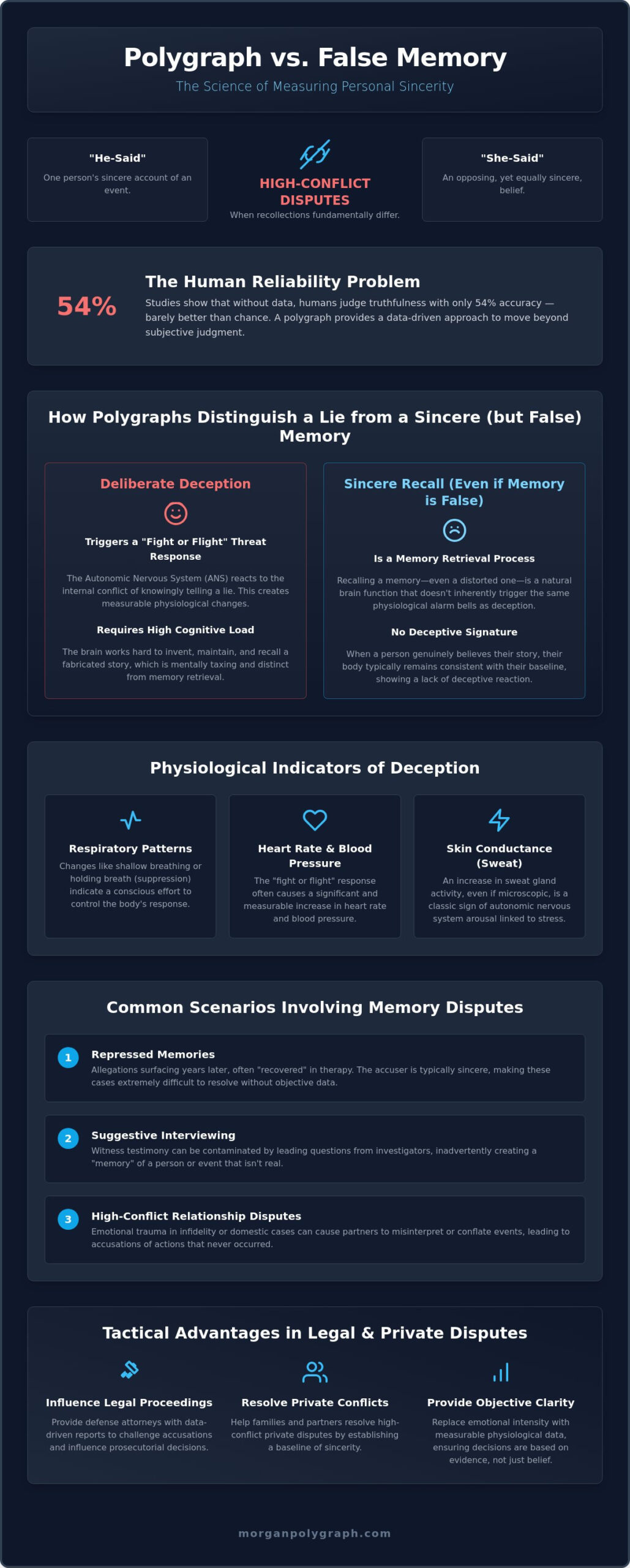
We recognize the profound vulnerability that comes with being accused of something that never occurred. You’re likely looking for a way to validate your innocence while worrying about the reliability of human recollection, which studies show humans only accurately judge about 54% of the time. This article explains how expert examiners approach the phenomenon of repressed or distorted memories. You’ll discover the tactical advantages of testing, the scientific accuracy of single-issue examinations, and how to determine if this is the right move for your legal or private case. Our goal is to provide the clarity you need to move forward with confidence.
Key Takeaways
- Learn why false memory is a recurring psychological phenomenon in legal disputes and how it complicates “he-said-she-said” scenarios.
- Understand the physiological difference between a deliberate lie and a sincere memory by examining Autonomic Nervous System responses and cognitive load.
- Discover how a professional polygraph for false memory claims focuses on the examinee’s personal sincerity rather than objective, external facts.
- Explore the tactical advantages of using polygraph results to influence legal proceedings or resolve high-conflict private disputes.
- See how modern, data-driven methodology and certified examiners provide the precision required for complex criminal and civil cases.
The Intersection of Polygraphy and False Memory Claims
A false memory is a psychological phenomenon where an individual recalls an event that did not occur or remembers it significantly differently than it actually happened. These are not mere “mistakes” or simple forgetfulness. Instead, they are vivid, detailed recollections that the person genuinely believes to be true. In the legal system, these claims can lead to devastating consequences, turning a person’s life upside down based on an internal narrative that lacks external evidence. Utilizing a professional polygraph for false memory claims provides a structured, scientific method to evaluate the sincerity of the parties involved in these complex disputes.
It’s vital to understand that a polygraph instrument is not a mind reader. It functions as a sophisticated physiological data collector. The technology monitors autonomic nervous system responses, such as changes in heart rate, respiration, and skin conductance. When a person deliberately attempts to deceive, their body typically triggers a “threat response.” However, if an individual genuinely believes a false memory, their body may not produce that same deceptive signature. Research into fMRI and false memories suggests that while different brain regions activate during sincere versus deceptive recall, the polygraph remains the primary tool for measuring the immediate physiological sincerity of a statement in a field setting.
Common Scenarios Involving Memory Disputes
- Repressed Memories: Allegations often surface years after an alleged event, sometimes “recovered” during suggestive therapy sessions. These cases are notoriously difficult to litigate because the accuser is often entirely sincere in their belief.
- Suggestive Interviewing: In criminal investigations, witness testimony can be inadvertently contaminated by investigators who use leading questions, creating a “memory” of a suspect that was never actually there.
- High-Conflict Relationship Disputes: In infidelity or domestic cases, emotional trauma can cause partners to misinterpret past events or conflate separate incidents, leading to accusations of actions that never took place.
The Objective of the Polygraph in Memory Cases
The primary goal of a polygraph for false memory claims is to establish the examinee’s consistent version of events. For an accused individual, the test serves to validate their denial by showing a lack of physiological distress when stating their version of the truth. We focus on providing a professional, data-driven report that can be used by defense attorneys to influence prosecutors or by families to resolve private conflicts. By measuring sincerity rather than objective “historical truth,” the polygraph helps clear the air in cases where two people remember the same moment in fundamentally different ways. This methodical approach ensures that decisions are based on measurable data rather than emotional intensity.
The Science of Sincerity: How Polygraphs Measure Personal Truth
The Autonomic Nervous System (ANS) serves as the foundation for modern polygraphy. It’s the part of the brain that manages involuntary functions like heart rate and breathing. When an individual knowingly provides a deceptive answer, the brain perceives this as a threat, triggering a subtle “fight or flight” response. This is fundamentally different from the “Cognitive Load” associated with sincere recall. Lying requires significant mental energy to invent and maintain a consistent narrative that doesn’t exist in reality. Conversely, recalling a memory, even a false one, is a retrieval process that doesn’t inherently trigger the same physiological alarm bells.
The physiological baseline is a recorded measurement of an examinee’s normal, resting autonomic activity, established through neutral questions to serve as a standard for identifying significant deviations during the test.
Physiological Indicators of Deception
During an examination, we monitor specific channels to capture the body’s reaction to relevant questions. These signals trigger when an examinee knowingly contradicts their own internal truth. Key indicators include:
- Respiratory Patterns: Changes such as shallow breathing or “suppression” often indicate a conscious effort to control the body’s response.
- Heart Rate and Blood Pressure: Spikes in cardiovascular activity provide measurable data points when a person perceives a question as a threat to their security.
- Galvanic Skin Response (GSR): This measures minute changes in sweat gland activity and is one of the most sensitive indicators of psychological stress.
While some critics argue that scientific evidence on polygraph tests shows potential for error, the use of validated, single-issue techniques has been shown to achieve approximately 89% accuracy according to a 2011 American Polygraph Association meta-analysis of over 11,000 results.
The Examiner’s Role in Memory Contexts
In cases involving a polygraph for false memory claims, the pre-test interview is the most critical phase. This is where the examiner establishes the examinee’s specific, consistent version of events. By crafting ‘Relevant’ questions that directly address the allegation and ‘Comparison’ questions that isolate the individual’s baseline sincerity, we can filter out general anxiety. Accurate data interpretation requires more than just reading a chart; it demands a nationally certified professional who understands the nuances of behavioral observation. Using state-of-the-art computerized systems ensures that every data point is captured with precision. If you’re facing a complex legal dispute, consulting with an experienced polygraph examiner can help determine the most effective tactical approach for your specific situation.
Polygraph vs. False Memory: Why Personal Belief is the Metric
A polygraph doesn’t validate historical facts; it validates the examinee’s sincere belief in those facts. This distinction is vital when considering a polygraph for false memory claims. If an individual has integrated a false narrative into their long-term memory to the point where they genuinely believe it occurred, their body will likely not produce the physiological stress markers associated with lying. This “Sincerity Factor” is why the test is so effective at clearing those who are being honest, but it also highlights why the test cannot be used as a standalone “truth machine” to rewrite history. It measures the person, not the event.
This creates a scenario often described as a “Clash of Truths.” In high-conflict disputes, it’s entirely possible for two people to have fundamentally different recollections of the same encounter. If both individuals are sincere in their beliefs, both could potentially pass a polygraph. This isn’t a failure of the technology; it’s a reflection of the complexity of human memory. When an accuser genuinely believes a lie, they aren’t “lying” in the physiological sense. Therefore, the test is most tactically sound when used to confirm the consistent, unwavering reality of the accused party.
The Limitation of Objective Reality
We must be clear that polygraphs verify the examinee’s internal conviction. While the Polygraph Examination Technique is highly structured to isolate deception, it doesn’t possess the capability to “see” what actually happened in the past. It only sees how your body reacts to your current recollection. Because of this, we always recommend that polygraph results be used alongside other corroborating evidence. In memory-heavy cases, the report serves as a professional validation of your personal sincerity, which can be a powerful tool for your legal team or for personal resolution.
Handling Uncertainty in the Examination
Uncertainty is the enemy of a valid polygraph result. We refuse to test on questions that include qualifiers like “to the best of my knowledge” or “as far as I can remember.” If an examinee’s memory is hazy or uncertain, the results will be inconclusive or unreliable. A valid examination requires 100% certainty from the examinee. You must be able to state a clear “yes” or “no” based on a firm recollection. You might wonder, are polygraphs accurate when dealing with such subjective recall? They are, provided the examiner adheres to strict protocols that eliminate “gray areas” before the sensors are ever attached. This methodical approach ensures that the data we collect is a true reflection of your personal reality.
Tactical Use of Polygraphs in Legal and Private Disputes
A professional polygraph report serves as a powerful strategic asset in both judicial and private contexts. While much of the public debate centers on court admissibility, the most effective use of a polygraph for false memory claims often occurs before a case ever reaches a courtroom. Defense attorneys and private individuals use these results to disrupt the momentum of false accusations by providing objective, physiological data that supports a consistent denial. When an examiner with national certification delivers a formal report, it carries weight with prosecutors, grand juries, and mediators who are searching for a way to break through a “he-said-she-said” impasse. The report carries weight.
The data collected during an examination doesn’t just provide a “pass” or “fail” result. It provides a foundation for further investigative efforts. For example, if an accused individual passes a polygraph, their legal team may use that result to argue for the inclusion of expert witness testimony regarding memory distortion or suggestive interviewing techniques. This methodical approach ensures that the defense is built on a verifiable baseline of sincerity rather than just a conflicting narrative.
Criminal Defense and False Allegations
In criminal litigation, the goal is often exoneration before a formal charge is even filed. A passed examination can fundamentally shift the direction of an investigation, prompting law enforcement to look more closely at the potential for witness contamination. Defense teams frequently use these results during plea negotiations or when presenting evidence to a grand jury to demonstrate that their client’s version of events is not a fabrication. It’s common for a criminal defense attorney near me to recommend private, confidential testing as a first step. This allows the defense to assess the viability of the test result without any risk of the data being shared with the prosecution unless it is strategically beneficial.
Private and Relationship Clarity
Beyond the legal system, memory-based disputes can cause irreparable damage to families and partnerships. When one person recalls an event that the other insists never happened, the resulting gridlock can be paralyzing. Utilizing an infidelity test allows couples to address specific, time-bound claims that are otherwise impossible to verify. These examinations provide a discreet environment where individuals can present their truth without the emotional interference of a high-conflict argument. The resulting data helps guide personal decisions and provides the finality needed to begin the healing process. Confidentiality is our highest priority in these sensitive matters, ensuring that your private issues remain protected throughout the entire process.
If you’re currently handling a situation where a false memory is being used as a weapon against you, it’s essential to act methodically. You can schedule a professional consultation to discuss the specifics of your case and determine if a polygraph is the right tactical move for your defense or personal resolution.
Professional Polygraph Services in Boise: The Morgan Polygraph Approach
Navigating a polygraph for false memory claims requires an examiner who understands the delicate balance between psychological theory and physiological data. At Morgan Polygraph, we provide Boise and the surrounding Idaho communities with a level of expertise that bridges the gap between decades of traditional experience and the latest technological advancements. Our approach is rooted in a commitment to precision, ensuring that every client receives a fair, unbiased, and scientifically sound evaluation. We recognize the stress involved in these cases and maintain a professional environment designed to put you at ease while capturing the most accurate data possible.
Expert Credentials and Recognition
Selecting a polygraph near me involves more than just proximity; it requires finding a practitioner with a proven track record in the legal community. Our examiners are nationally certified and have extensive experience providing testimony in both criminal and civil litigation. We don’t rely solely on automated charts. Instead, we integrate modern behavioral observation techniques with traditional physiological data to provide a comprehensive analysis of sincerity. This methodical approach is why our reports are recognized and respected by legal professionals throughout the state.
What to Expect at Our Boise Office
Our facility, located at 6126 W. State Street, is designed to be a neutral, discreet, and controlled environment. We guide you through the entire polygraph examination process in a step-by-step manner to eliminate any ambiguity or unnecessary anxiety. Before the sensors are ever attached, we conduct a thorough pre-test interview to ensure you’re fully prepared and that the questions are framed accurately. This preparation is vital for maintaining the integrity of the test, especially when dealing with the complexities of memory-based allegations. Every step we take is designed to ensure the highest possible level of accuracy for your specific case.
If you’re ready to move forward, the first step is a private consultation. We’ll discuss the details of your situation, review the tactical viability of a polygraph for false memory claims, and provide a clear path toward validating your truth. You can reach out to our team to schedule your appointment and begin the process of clearing your name with confidence. We handle every inquiry with the utmost discretion and professional respect.
Securing Your Truth Through Professional Validation
Distinguishing between objective history and a person’s sincere recollection is essential for resolving complex memory disputes. A polygraph for false memory claims provides the physiological data needed to confirm your personal reality when traditional evidence is absent. By focusing on sincerity rather than subjective interpretation, we offer a methodical way to navigate high-stakes legal and private challenges with confidence.
Our team of Nationally Certified Examiners utilizes state-of-the-art technology to deliver precise results in a confidential and professional environment. As court-recognized experts, we understand the tactical nuances required to support your case effectively. You don’t have to face these accusations without a scientific baseline to validate your integrity.
Schedule a confidential consultation with Morgan Polygraph in Boise today to discuss how we can help you find clarity and resolution. We’re here to ensure your voice is heard through a reliable, data-driven process.
Frequently Asked Questions
Can a polygraph distinguish between a real memory and a false memory?
No, a polygraph cannot distinguish between a real memory and a false one because the instrument measures sincerity rather than objective history. When using a polygraph for false memory claims, the focus is on whether the examinee believes they’re telling the truth. If a memory is genuinely held as real, the body won’t trigger the physiological stress response associated with deliberate deception.
What happens if I genuinely don’t remember the event I’m being tested on?
You cannot be tested on an event you don’t remember because a valid polygraph requires a clear “yes” or “no” answer based on firm recollection. If you’re uncertain or your memory is hazy, the test will likely result in an inconclusive finding. Examiners require 100% certainty from the examinee to ensure the physiological data collected is accurate and reliable.
Will I fail the polygraph if I am nervous about a false accusation?
Nervousness alone does not cause a person to fail a polygraph examination. Examiners use a pre-test interview and specific comparison questions to establish a baseline for your situational anxiety. The sensors look for physiological spikes that occur only when you’re being deliberately deceptive, which is a distinct reaction from the general stress of being falsely accused.
Can someone pass a polygraph if they have convinced themselves their lie is true?
Yes, it’s possible for a person to pass if they genuinely believe their version of events is accurate. Because the instrument measures the body’s reaction to perceived deception, a person who isn’t “lying” to themselves won’t trigger the autonomic nervous system response. This is why polygraphs validate an individual’s personal sincerity rather than verifying objective, external facts or historical events.
How are polygraph results used in Idaho courts for false memory cases?
In Idaho, polygraph results aren’t generally admissible as primary evidence unless both legal parties agree to a “stipulation” before the test. However, they’re frequently used tactically during pre-trial negotiations or to influence a prosecutor’s decision to file or dismiss charges. A professional report from a certified examiner provides a data-driven foundation that can be a powerful tool for any defense team.
Can a polygraph ‘unlock’ a repressed memory that I’ve forgotten?
No, the polygraph is not a therapeutic tool or a method for memory retrieval. It’s a data-collection instrument designed to verify your current belief in a specific statement. If a memory is repressed or completely forgotten, it cannot be used as the basis for a structured examination. The process requires the examinee to have a conscious, accessible recollection of the events in question.
Is it possible for two people to pass a polygraph while telling contradictory stories?
Yes, this occurs when both individuals are sincere in their conflicting beliefs. If an accuser has an integrated false memory and the accused is telling the truth about their innocence, both may show no signs of physiological deception. This scenario illustrates why the polygraph validates the person’s sincerity rather than the event itself, making it a measure of personal truth.
How do I choose the right examiner for a complex memory-based case?
You should prioritize an examiner with national certification and recognized court experience. Look for a professional who uses computerized, state-of-the-art technology and adheres to American Polygraph Association standards. Choosing a specialist who understands the psychological nuances of recall ensures that your polygraph for false memory claims is handled with the necessary precision, academic gravitas, and absolute discretion.