

What if the outcome of a million-dollar wrongful death suit hinges entirely on the word of a single witness whose story keeps shifting? It’s a question that keeps many Idaho legal teams awake at night. In Boise courtrooms, you often face the exhausting reality of conflicting testimonies and high emotional stakes where every detail matters. Proving a case by a preponderance of evidence is a heavy burden, especially when key facts remain obscured by human memory or intentional omission.
You likely understand that traditional discovery methods sometimes reach a dead end, leaving families and attorneys in a state of painful uncertainty. This article shows you how a professional polygraph for wrongful death civil litigation Idaho provides the critical clarity needed to break through these deadlocks. By integrating modern, data-driven methodology with a compassionate approach, certified examiners help you secure the evidence required for a favorable resolution. We’ll explore how these examinations strengthen your position during settlement negotiations, validate witness credibility, and provide legal counsel with expert-backed reports that turn clinical data into a powerful tool for justice.
Key Takeaways
- Learn how to manage the “preponderance of evidence” burden in Idaho civil courts when conflicting witness accounts are the primary form of available data.
- Understand how a polygraph for wrongful death civil litigation Idaho identifies physiological markers of deception to verify witness statements during the discovery phase.
- Discover how expert-backed reports strengthen a plaintiff’s position and provide defense attorneys with a reliable tool to vet their clients during settlement negotiations.
- Explore the “stipulated polygraph” process, where both parties agree on result admissibility to provide court-recognized clarity in Boise legal proceedings.
- Find out why a discreet, state-of-the-art testing environment is essential to handle the sensitive emotional nature of wrongful death matters with professionalism.
Wrongful Death Civil Litigation in Idaho: The Evidentiary Challenge
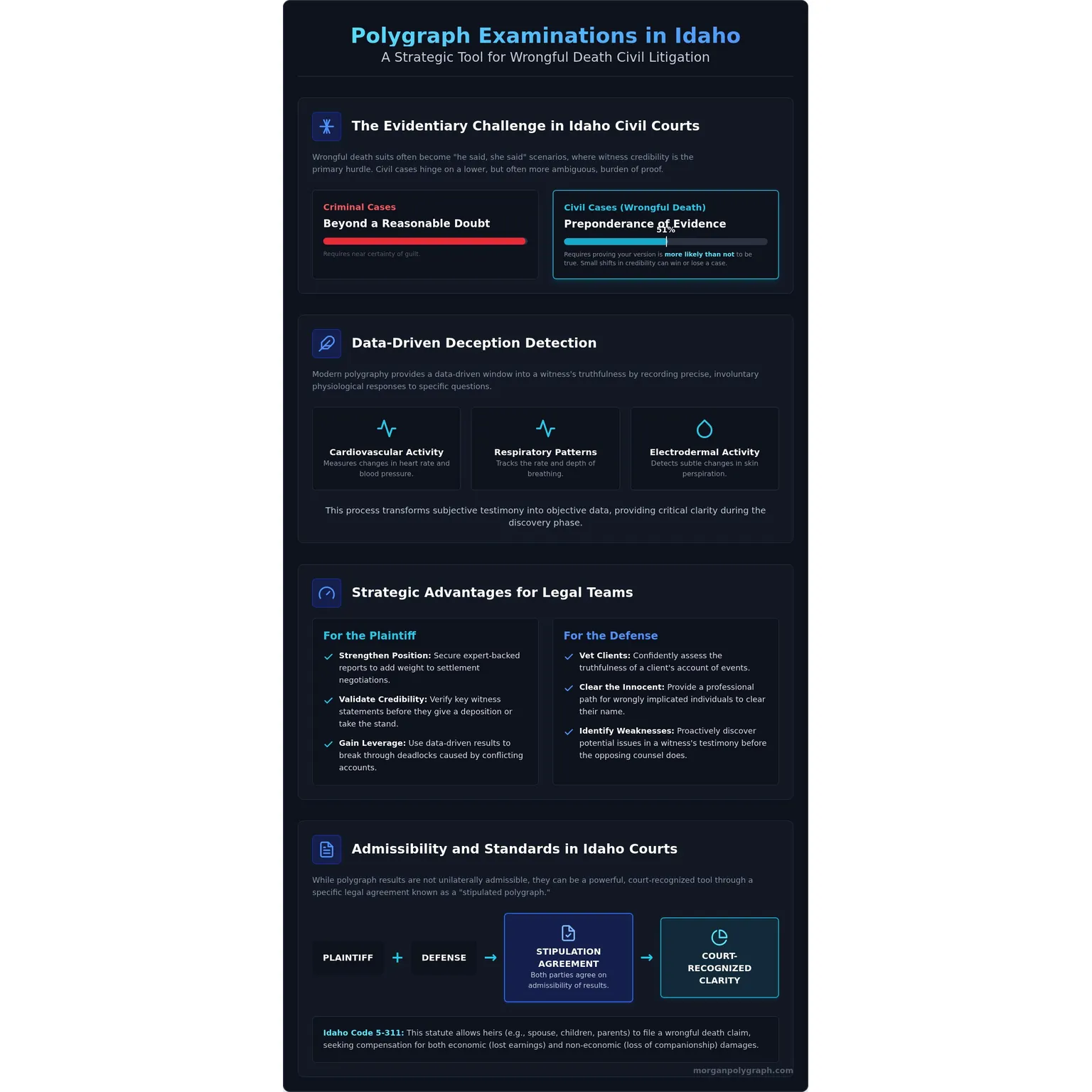
Idaho wrongful death suits aren’t just legal battles; they’re deeply personal quests for accountability. When a family loses a loved one due to negligence, the legal system provides a path through Idaho Code 5-311. However, the path is rarely straight. Boise courtrooms often become stages for “he said, she said” scenarios where the truth is buried under layers of grief and conflicting memories. Establishing negligence or intent requires more than just a tragic outcome. It requires evidence that can withstand rigorous scrutiny and cross-examination. The strategic application of a polygraph for wrongful death civil litigation Idaho can serve as an innovative bridge between uncertainty and a settlement-ready case.
Understanding Idaho Code 5-311 for Heirs
Under Idaho law, specific individuals hold the legal standing to file a claim. These typically include the surviving spouse, children, or parents of the deceased. The law distinguishes between economic damages, such as lost future earnings and funeral expenses, and non-economic damages, which address the profound loss of care and companionship. In the context of Idaho civil law, a wrongful death is defined as a fatality resulting from the wrongful act or neglect of another person or entity, which entitles the heirs to seek financial compensation. Identifying the responsible party is only the first step; proving their liability is where the real challenge begins.
The Burden of Proof: Preponderance vs. Beyond Reasonable Doubt
Unlike the “beyond a reasonable doubt” standard used in criminal trials, civil litigation operates on a “preponderance of evidence.” This means the plaintiff must prove that their version of events is more likely than not to be true. It’s a lower threshold, but it makes witness credibility the most significant hurdle in Boise litigation. In a system where a 51% certainty can determine the outcome, small shifts in credibility can win or lose a case.
Conflicting depositions often stall progress and diminish settlement values. When two parties offer fundamentally different accounts of an accident, legal teams must find ways to verify the facts. This is where expert testimony and specialized tools become vital. While Polygraph technology and controversy are often discussed in the media, the strategic use of a polygraph for wrongful death civil litigation Idaho offers a methodical way to assess witness reliability. By using data-driven detection, attorneys can gain the leverage needed to move a case toward a successful settlement. These expert-backed reports provide the clarity required when the preponderance of evidence feels just out of reach.
Using Polygraph Testing to Resolve Conflicting Testimonies
When physical evidence is scarce, the outcome of a case often depends on the integrity of the spoken word. Modern polygraph technology doesn’t just detect lies; it records precise physiological markers such as changes in heart rate, respiratory patterns, and electrodermal activity. These involuntary responses provide a data-driven window into a witness’s truthfulness. In the discovery phase, a polygraph for wrongful death civil litigation Idaho acts as a catalyst for truth, helping legal teams separate factual timelines from embellished memories. This is especially vital in cases of medical malpractice or vehicular neglect, where a few seconds of disputed action define the entire claim.
There’s also a significant psychological component to this process. Being accused of contributing to a wrongful death is a heavy burden that carries immense social and legal pressure. For those wrongly implicated, the examination offers a professional path to clear their name and restore their reputation within the Boise community. Utilizing a polygraph for wrongful death civil litigation Idaho during the early stages of a lawsuit allows all parties to proceed with a clearer understanding of the facts at hand.
Verifying Witness Credibility in Boise
Depositions are frequently derailed by contradictory statements that lead to expensive delays. A professional polygraph examination allows attorneys to screen key witnesses before they ever take the stand, ensuring their client’s position is built on a solid foundation. This proactive approach reduces the risk of surprise testimony that could jeopardize a high-stakes civil suit. By addressing “he-said-she-said” scenarios early, legal counsel can focus their resources on the most reliable evidence.
Case Study Applications: From Neglect to Intent
In vehicular manslaughter civil suits, the exact speed or the color of a traffic light is often a point of contention. Polygraphs help validate claims of professional negligence or elder abuse by testing the specific details of the alleged neglect. While traditional evidence provides the framework, the Idaho Administrative Code on Polygraphs clarifies that these results are a specialized resource that requires careful adherence to regulatory standards. Polygraphs supplement traditional discovery tools by providing objective physiological data to support or challenge narrative evidence. For those seeking to solidify their evidentiary standing in complex cases, consulting with a nationally certified examiner can provide the necessary clarity to move forward.
Why Civil Attorneys Use Polygraphs for Settlement Negotiations
Settlement negotiations represent the most frequent resolution for civil claims in Boise. While the previous sections focused on identifying truth, the practical application of a polygraph for wrongful death civil litigation Idaho often centers on financial leverage. Attorneys recognize that a certified examination report acts as a powerful catalyst during mediation. It provides a tangible data point that can shift the momentum of a negotiation from speculation to substantiated fact. By introducing a “passed” examination early, plaintiffs can demonstrate a level of transparency that often forces opposing counsel to reconsider their defensive strategy.
This shift is particularly effective when dealing with insurance adjusters. Adjusters operate on risk assessment and mathematical probability. When a claimant provides a professionally administered polygraph result, it increases the perceived risk of taking the case to a jury. The probative value of polygraph evidence in these informal settings is substantial; it suggests that the witness will remain credible and consistent under cross-examination. Consequently, this often leads to higher settlement offers and a significant reduction in the overall cost of litigation by avoiding a protracted trial.
Leverage in Mediation and Arbitration
Mediators in Idaho frequently look for “bridge” evidence to bring two polarized parties together. Polygraph results serve as persuasive evidence that encourages transparency between opposing counsels. If one side is willing to undergo a rigorous examination, it signals a high degree of confidence in their narrative. To understand the scientific foundation behind these results, legal teams often review data on are polygraphs accurate to present the findings with authority. This transparency often breaks the deadlock in complex wrongful death negotiations.
Vetting Your Own Case Before Trial
Boise attorneys have an ethical duty to pursue factual clarity for their clients. Utilizing a polygraph for wrongful death civil litigation Idaho allows a defense or plaintiff’s attorney to vet their own client’s testimony in a controlled, confidential environment. Identifying potential weaknesses or inconsistencies before they are exposed in a public courtroom is a critical component of modern legal strategy. This methodical approach ensures that when an attorney steps into a Boise courtroom, they do so with a clear, expert-backed understanding of their case’s strengths.
- Assessing the viability of a claim before investing significant firm resources.
- Preparing clients for the intensity of future depositions.
- Providing an objective basis for deciding whether to accept a settlement offer or proceed to a jury trial.
Admissibility and Standards for Idaho Civil Polygraph Exams
In Idaho civil courts, the use of polygraph results follows a specific set of procedural rules. While results are generally inadmissible as standalone evidence, they become a powerful asset when both parties agree to their entry. This arrangement, known as a stipulated polygraph, allows legal teams to move past evidentiary roadblocks in 2026. For a polygraph for wrongful death civil litigation Idaho to hold weight, the process must be handled with extreme precision. A court-recognized examiner is non-negotiable because the integrity of the data determines its utility in a Boise courtroom.
Navigating Stipulated Agreements in Civil Suits
A stipulated agreement is a legal contract where both the plaintiff and defense agree on the conditions of the test and the subsequent use of the results. This framework usually outlines specific question sets, the choice of examiner, and the weight the findings will carry during mediation or trial. Common clauses in Idaho polygraph stipulations might include provisions for a second opinion or the exclusion of specific sensitive topics. Choosing the right professional is the first step in this process. You can find guidance on finding a certified polygraph near me to ensure your examiner possesses the necessary credentials for civil litigation.
Expert Witness Testimony and the Daubert Standard
In Boise, judges apply the Daubert standard to assess whether scientific evidence is reliable enough for the jury to hear. This means an examiner must be prepared to testify about their methodology, the known error rates of the technology, and whether the techniques are peer-reviewed. Nationally certified examiners use state-of-the-art computerized instruments that meet these high scientific standards. Professional affiliations, such as membership in the American Polygraph Association, establish the academic gravitas required to survive a Daubert challenge. These affiliations signal to the court that the examiner adheres to a strict code of ethics and validated testing protocols.
The final product of this process is a comprehensive professional report. These documents translate complex physiological data into a clear narrative that Boise attorneys can use to build their cases. When you need to resolve a complex dispute, it’s essential to partner with a court-recognized expert who understands the nuances of the Idaho legal system. By following these rigorous standards, the polygraph for wrongful death civil litigation Idaho becomes a bridge to a resolution based on verified facts rather than speculation.
Morgan Polygraph: Specialized Civil Litigation Support in Boise
Morgan Polygraph stands as a pillar of reliability in the Boise legal community. Our practitioners bring decades of experience to the table, having served the Idaho legal landscape with unwavering discretion. We understand that wrongful death cases aren’t just files; they represent families seeking closure and attorneys striving for justice. Our state-of-the-art facility on W. State Street provides a calm, neutral environment designed to minimize the stress inherent in these proceedings. By choosing a polygraph for wrongful death civil litigation Idaho at our office, you’re partnering with nationally certified examiners who prioritize precision and empathy.
The Morgan Polygraph Advantage for Legal Teams
For Boise attorneys, the quality of a report often defines the utility of the evidence. We provide detailed, professional reporting specifically designed to meet the rigorous needs of civil litigation and stipulated agreements. Our commitment to ethical testing standards ensures that every examination is conducted with the utmost integrity, protecting the privacy of all involved parties. We specialize in the nuances of complex Idaho wrongful death scenarios, where the interpretation of physiological data requires a seasoned hand. This expertise allows us to deliver results that legal teams can rely on during critical mediation or discovery phases.
Next Steps for Attorneys and Families
Preparing for an examination is a straightforward process when guided by experts. We recommend that examinees arrive well-rested and prepared to discuss the relevant facts openly in a controlled setting. During the initial consultation, we’ll explain the methodology and the physical environment to ensure everyone feels at ease. If you’re new to this technology, reading about what is a polygraph test can provide a helpful foundation for what to expect. Once the examination is complete, we provide a prompt, comprehensive analysis to help you move forward with confidence.
Scheduling a confidential consultation for your wrongful death case is the first step toward gaining the clarity you need. We invite legal counsel and families to reach out to our Boise office to discuss their specific needs. Our methodical approach ensures that every case is handled with the systematic care it deserves. Trust your sensitive legal matters to a team that bridges traditional experience with innovative technology to support the Idaho legal community.
Achieving Resolution Through Verified Evidence
Resolving a wrongful death suit requires more than just a narrative; it demands a foundation of verified truth. We’ve explored how identifying physiological markers of deception can break through the “he-said-she-said” deadlock that often stalls Boise legal proceedings. By utilizing a polygraph for wrongful death civil litigation Idaho, legal teams gain the objective data needed to strengthen settlement negotiations and meet the preponderance of evidence burden. Whether you’re navigating a stipulated agreement or vetting a witness before a deposition, the integration of modern technology with seasoned expertise provides a clear path forward.
Morgan Polygraph brings decades of experience and nationally certified examiners to every case. As court-recognized experts, we’re committed to providing the discreet, professional reporting your legal strategy requires. Contact Morgan Polygraph for Expert Civil Litigation Support in Boise to discuss your case in a confidential environment. You don’t have to navigate these high-stakes challenges without the clarity that expert-backed evidence provides.
Frequently Asked Questions
Are polygraph results admissible in Idaho wrongful death cases?
Polygraph results are generally inadmissible in Idaho courts unless both parties agree to their entry through a stipulated agreement. In 2026, this remains the standard for civil litigation. While judges rarely allow them as independent evidence, they carry significant weight when both legal teams agree on the examiner and the protocol. This consensus allows the findings to be considered during mediation or trial proceedings to resolve disputed facts.
How can a polygraph help in a civil settlement negotiation?
A polygraph for wrongful death civil litigation Idaho serves as a powerful catalyst during settlement negotiations by providing objective, data-driven clarity. When a witness or party “passes” a certified examination, it increases the perceived risk for the opposing side to proceed to a jury trial. This often forces insurance adjusters and defense counsel to offer more favorable terms, as it substantiates the narrative and reduces the uncertainty caused by conflicting testimonies.
What is a stipulated polygraph examination in Idaho?
A stipulated polygraph is a formal legal agreement where both the plaintiff and the defendant agree to the admissibility of the test results before the examination occurs. This contract typically specifies the chosen examiner, the scope of the questions, and how the results will be used in court. By reaching this agreement, parties can bypass general Idaho rules and use the findings as court-recognized evidence to resolve complex and sensitive factual disputes.
Can a witness be forced to take a polygraph in a civil suit?
No, a witness cannot be legally compelled to undergo a polygraph examination in an Idaho civil suit. Participation is entirely voluntary and usually requires the consent of the individual and their legal counsel. However, a witness’s willingness to sit for a test often signals transparency and confidence in their account. Conversely, refusing a test is a right that cannot generally be used against a party or witness in a court of law.
How long does a civil litigation polygraph exam take?
A professional civil litigation polygraph examination typically requires two to three hours to complete. This timeframe includes an extensive pre-test interview, the actual data collection phase, and a post-test analysis of the physiological charts. Each session is conducted with methodical precision to ensure the highest level of accuracy. The unhurried pace allows the examiner to establish a baseline and address any situational stress the examinee might be experiencing during the process.
What happens if a witness fails a polygraph during discovery?
If a witness fails an examination during the discovery phase, it often leads legal teams to re-evaluate their case strategy or settlement expectations. While the results might not be admissible without a prior stipulation, the “failed” status provides a clear signal that the testimony may not hold up under cross-examination. Attorneys use this information to identify factual weaknesses and decide whether to proceed with litigation or seek an earlier resolution to mitigate their client’s risk.
How do Boise attorneys typically use polygraph results?
Boise attorneys use polygraph results as a strategic tool to vet their own clients and verify critical timelines in complex cases. By utilizing a polygraph for wrongful death civil litigation Idaho, counsel can determine the reliability of a witness before investing significant resources. These results are also frequently introduced during mediation to persuade opposing parties of a claim’s validity. This helps break deadlocks in cases where physical evidence is limited or entirely absent.
Are polygraphs for civil cases different from criminal ones?
The core technology and methodology remain consistent across both criminal and civil cases, but the application differs significantly. Civil cases often focus on negligence, intent, or specific professional standards rather than criminal guilt. Because the burden of proof in civil litigation is a “preponderance of evidence,” the clarity provided by a polygraph can be more influential in reaching a resolution. Examiners tailor the question sets to address the specific liability issues relevant to the lawsuit.