
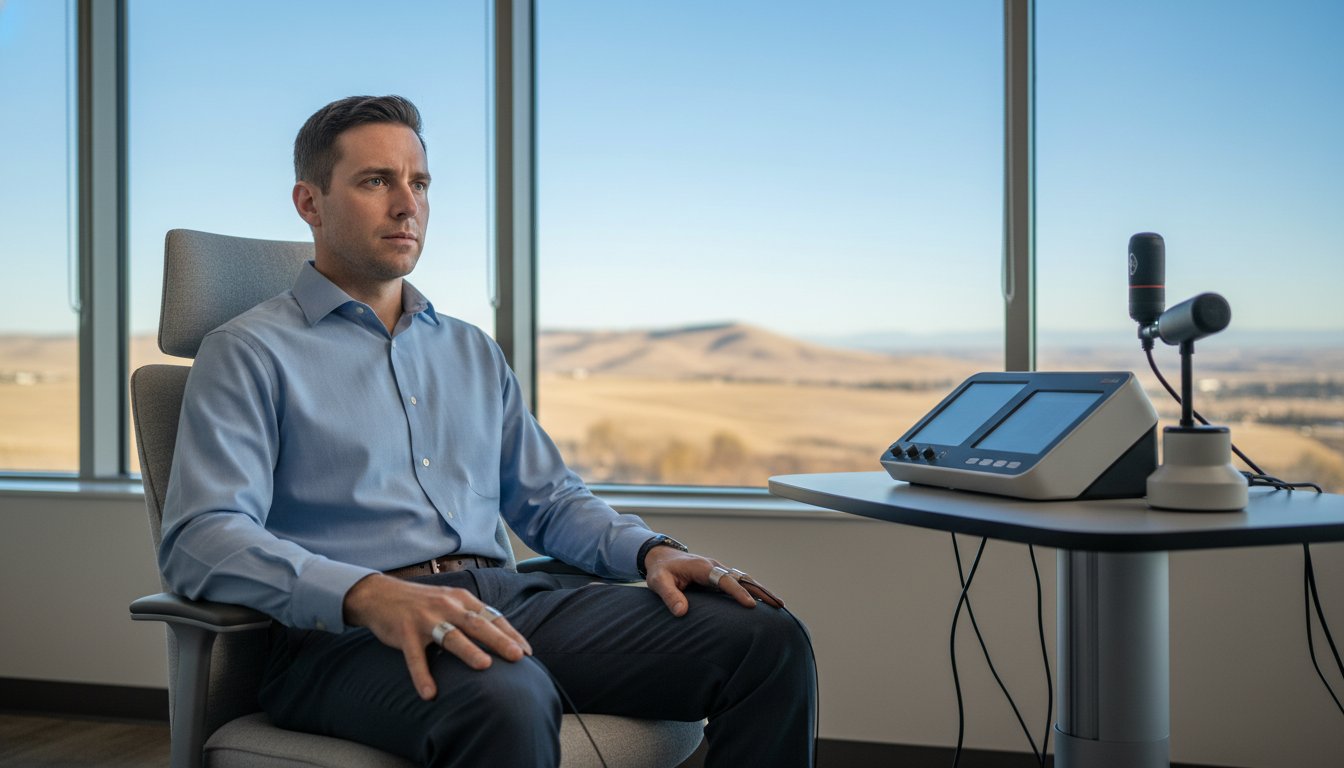
What if your racing heart and sweaty palms were actually the most expected part of a truth verification exam? For most individuals, the mere sight of the equipment triggers a spike in blood pressure. It’s a biological reality that nearly 95% of examinees feel some level of apprehension before the sensors are even attached. It’s completely normal to feel a deep sense of dread when your reputation is on the line. Many people suffer from an intense fear of failing a polygraph test, worrying that a simple case of jitters will be misread as a lie that could change their life forever.
At Morgan Polygraph, we understand that nerves don’t equal guilt. With over 40 years of combined experience, our examiners are trained to look past the initial adrenaline. You’ll discover how professional examiners distinguish between natural anxiety and actual deception so you can approach your test with confidence. We’ll explain the critical baseline process we use to calibrate our AI-powered tools to your unique physiology. By the end of this guide, you’ll have three actionable tips to stay calm and a clear understanding of why your honesty will shine through the static.
Key Takeaways
- Understand why situational anxiety is a universal experience for truthful individuals and how it differs from a genuine fear of detection.
- Learn how expert examiners use baseline questions and autonomic nervous system monitoring to separate natural nerves from intentional deception.
- Address the common fear of failing a polygraph test due to stress and discover the statistical reality behind modern accuracy rates.
- Gain practical tips on mental preparation, including why maintaining your daily routine is more effective than researching “how to beat” the exam.
- Discover how 40 years of professional expertise and a compassionate environment at Morgan Polygraph ensure a fair, accurate, and discreet experience.
Understanding the Fear: Is it Normal to be Nervous Before a Polygraph?
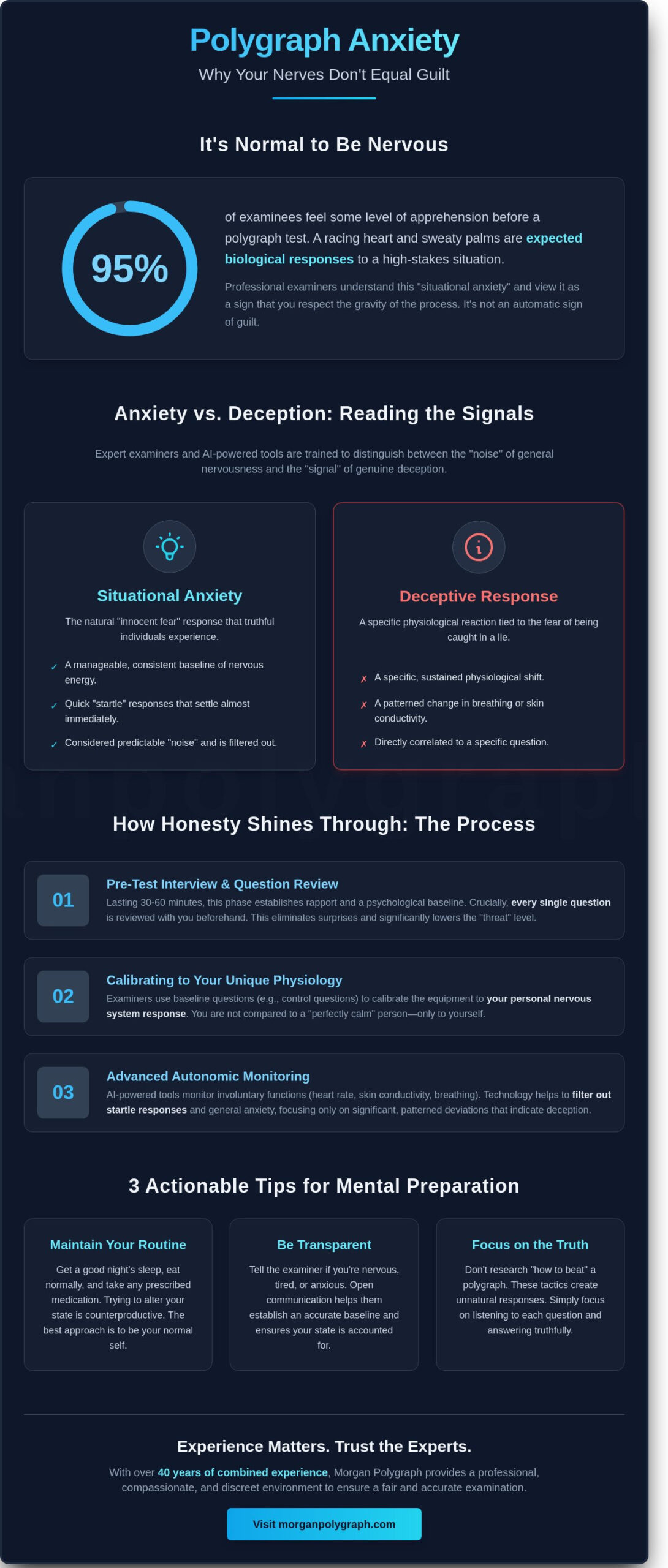
Walking into a truth verification suite often triggers a visceral reaction. It’s common for honest individuals to experience an intense fear of failing a polygraph test, even when they’ve done nothing wrong. This reaction is a universal human response to a high-stakes environment. Our examiners at Morgan Polygraph understand that a baseline of anxiety is expected. We don’t view your racing heart as an automatic sign of guilt. With over 40 years of combined experience, we’ve seen that even the most truthful subjects feel the pressure of the situation.
Examiners actually prefer a certain level of “situational anxiety.” It shows that the subject respects the process and understands the gravity of the questions. If a person were completely flat or indifferent, it would be much harder to establish a working baseline. We account for your nerves from the moment you sit down, ensuring that your natural jitters don’t cloud the final results.
The “Innocent Fear” vs. The Deceptive Response
The human body reacts to the significance of a question. If a question carries weight, your nervous system responds naturally. Physiological data shows that an “innocent fear” manifests as a manageable baseline of nervous energy that remains consistent throughout the truth verification process. This is different from a deceptive response, which is a specific, sustained physiological shift occurring when a subject fears detection for a lie.
Experts distinguish between a “startle” response and a genuine reaction. A startle is a quick spike that settles almost immediately. In contrast, a deceptive reaction is a patterned change in breathing or skin conductivity that persists. Chip Morgan and his team use advanced technology to filter out these temporary spikes, focusing only on the data that truly matters.
Common Physical Symptoms of Polygraph Jitteriness
Experiencing sweaty palms or a pounding chest doesn’t mean you’ll fail. These symptoms relate directly to What a Polygraph Measures, specifically the galvanic skin response (GSR) and cardiovascular activity. Examiners view these initial symptoms as “noise” rather than “signal.” They’re looking for deviations from your personal baseline, not a comparison against some “perfectly calm” person who doesn’t exist.
- Sweaty Palms: A result of the autonomic nervous system reacting to stress.
- Increased Heart Rate: Common during the first few minutes of any professional evaluation.
- Dry Mouth: A typical side effect of the “fight or flight” response.
Transparency is your best tool for managing the fear of failing a polygraph test. Tell your examiner if you’re feeling particularly anxious or if you didn’t sleep well. The pre-test interview, which typically lasts between 30 and 60 minutes, serves as a critical period for the examiner to establish a psychological baseline. This discussion removes the element of surprise by reviewing every single question before the sensors are even attached. By the time the actual test begins, the “threat” level is significantly lower because you know exactly what to expect.
Anxiety vs. Deception: How Technology Differentiates Nerves from Lies
Your Autonomic Nervous System (ANS) is responsible for involuntary functions like heart rate, perspiration, and blood pressure. When you sit down for a polygraph test, your ANS will likely be in a state of heightened arousal. This is a natural human response to a high-stakes situation. It’s vital to understand that an expert examiner doesn’t expect you to be calm. In fact, the official government position on polygraphs recognizes that various psychological and physical factors can influence physiological readings. Because of this, the process is designed to distinguish between general situational anxiety and the specific physiological shift that occurs when a person purposefully attempts to deceive.
The fear of failing a polygraph test often stems from the belief that the machine will misinterpret a racing heart as a lie. Modern truth verification is a methodical process, not a simple “gotcha” moment. By utilizing standardized protocols, examiners filter out the “noise” of your nerves to focus on specific reactions to relevant questions. This ensures that your baseline level of stress is accounted for before any conclusions are drawn.
Establishing Your Physiological Baseline
The Comparison Question Technique (CQT) is a cornerstone of professional testing. During the pre-test phase, the examiner asks neutral questions to establish your baseline. If your heart rate is 90 beats per minute because you’re nervous, that 90 bpm becomes your “normal” for the duration of the exam. Deception is identified only when there’s a significant, repeatable deviation from this established baseline in response to a relevant question. Your “nervous” heart rate is the yardstick, not a flaw in the data.
AI and Modern Truth Verification Tools
Morgan Polygraph stays at the forefront of technology by integrating AI-powered deception detection tools into the traditional process. These systems utilize behavioral speech analysis and facial microexpression recognition to provide a multi-layered view of the subject. AI helps filter out environmental stress, such as a loud noise outside or a sudden cough, from targeted deceptive responses. Chip Morgan’s forward-thinking approach ensures that these cutting-edge tools support the examiner’s expertise, providing a more comprehensive and accurate result than traditional methods alone. This technological layer helps mitigate the fear of failing a polygraph test by adding objective data points that verify your truthfulness.
Ultimately, a polygraph test is a professional diagnostic procedure conducted by a certified expert. It’s a structured interaction where the machine serves as a tool for the examiner’s analysis. If you’re feeling overwhelmed by the process, you can call to talk with Chip and gain a clearer understanding of how these safeguards protect the integrity of your results.
The Truth About False Positives and Failing Due to Stress
The most frequent question we receive at Morgan Polygraph is whether a racing heart or sweaty palms will lead to a failed exam. It’s a valid concern. Your fear of failing a polygraph test often stems from the belief that the equipment cannot distinguish between the guilt of a lie and the adrenaline of a high-stakes situation. Professional examiners expect you to be nervous. In fact, a total lack of physiological response is often more suspicious than a baseline level of anxiety. Certified examiners use a pre-test interview to establish your “homeostasis,” or your normal resting state under pressure, which allows them to filter out general jitters.
The National Academies of Sciences report highlights that anxiety about the testing process itself can influence physiological data. However, modern scoring algorithms and standardized questioning techniques are designed to isolate specific reactions to relevant questions. When conducted by an expert with over 40 years of combined experience, the statistical accuracy of these tests remains high. This reliability is why the question are polygraphs accurate remains the central focus for individuals facing legal jeopardy or sensitive personal allegations. We don’t just look at a single spike in heart rate; we look for consistent, significant deviations across multiple charts.
What Actually Causes an “Inconclusive” Result?
An inconclusive result is not a failure. It simply means the physiological data collected wasn’t clear enough to support a definitive “Deception Indicated” (DI) or “No Deception Indicated” (NDI) finding. This happens in roughly 10% to 15% of exams. Several factors lead to this “gray area” outcome:
- Physical Exhaustion: If you’ve had fewer than four hours of sleep, your body’s autonomic nervous system may not respond consistently.
- Acute Illness: A severe cough or respiratory infection can mask the subtle breathing changes an examiner needs to track.
- Inconsistent Responses: If your body reacts strongly to a control question once but fails to react later, the data becomes statistically “noisy.”
If you receive an inconclusive result, it’s a call for further review or a retest on a different day when you’re better rested.
The Role of the National Certification
The expertise of the person behind the computer is your greatest protection. Examiners certified by the American Polygraph Association (APA) undergo rigorous training to distinguish between genuine anxiety and intentional “countermeasures.” While a nervous person might have a high heart rate throughout the entire exam, someone attempting to cheat the test usually shows sharp, erratic spikes only on specific questions. Court-recognized experts are trained to interpret these complex physiological charts with clinical precision. Professional certification is the primary shield against false positives. It ensures the examiner follows global standards that protect the integrity of your results and your reputation.
How to Prepare Mentally for Your Polygraph Examination
Success starts long before you sit in the examination chair. A primary driver of the fear of failing a polygraph test is the feeling of losing control over your own body. To counter this, you must prioritize your physical and mental baseline. Aim for at least seven to eight hours of sleep the night before your appointment. Stick to your normal daily routine. If you usually drink one cup of coffee, don’t skip it or double your intake. Drastic changes to your caffeine or nicotine levels can create physiological spikes that complicate the data collection process.
Avoid the temptation to search the internet for ways to “beat” the system. These online myths often suggest physical movements or mental tricks that professional examiners detect with ease. Chip Morgan and our team have over 40 years of combined experience; we recognize these “countermeasures” immediately. Attempting them only increases your stress levels and makes your charts harder to read, which often leads to inconclusive results. Trust the process and the expertise of your examiner.
Be completely transparent during the pre-test interview. This phase is designed to ensure you understand every question before the sensors are even attached. If you feel minor anxieties about a specific topic, confess those feelings. Discussing these concerns allows the examiner to adjust the phrasing or clarify the intent, which actually helps stabilize your physiological responses. Honesty about your nerves is a sign of a cooperative subject, not a deceptive one.
Mental Readiness Checklist
- Step 1: Arrive 15 minutes early to our Boise office location to acclimate to the environment.
- Step 2: Listen carefully to the examiner’s instructions. Don’t try to anticipate the next word or overthink the “why” behind the phrasing.
- Step 3: Provide a simple “Yes” or “No” as instructed. Elaborate answers during the actual test can distort the sensor readings.
- Step 4: View the examiner as a neutral truth-seeker. We aren’t here to catch you in a trap; we are here to verify the facts.
Dealing with Anxiety Disorders and Medication
If you have a clinical anxiety disorder or take prescribed medications, don’t let this increase your fear of failing a polygraph test. You must disclose all medications, such as blood pressure pills or anti-anxiety prescriptions, during the intake process. Never stop taking your prescribed medication before a test. Doing so can cause a rebound effect that creates erratic heart rates and respiratory patterns.
Professional examiners are trained to accommodate neurodivergence and clinical anxiety. We understand how these conditions manifest in physiological data. By disclosing your history, you allow us to account for these variables during the analysis. Our goal is accuracy, and that requires knowing the full context of your health. If you have specific concerns about your readiness, you can contact us for a confidential consultation to discuss your situation.
Why Expert Administration at Morgan Polygraph Minimizes Test Anxiety
Anxiety is a natural response to any high-stakes situation, but it shouldn’t be the reason your results are skewed. At Morgan Polygraph, we utilize the “Morgan Signature” to help clients manage the fear of failing a polygraph test. This unique methodology combines over 40 years of professional experience with a compassionate, human-centered interaction style. When you work with a court-recognized expert like Chip Morgan, you’re benefiting from decades of high-level testing in both the private and legal sectors. Chip’s reputation as a respected member of the polygraph community ensures that your test is conducted with the highest scientific standards and a calm, collected confidence.
Our Boise, Idaho office, situated at 6126 W. State Street, is built for total discretion. We understand that the path to our door often involves sensitive personal or legal matters. Because of this, we’ve created a quiet, methodical environment that minimizes external stressors. This intentional setting is a critical component of our truth verification process. It helps settle your nerves and lower your heart rate, allowing your physiological responses to remain stable and accurate throughout the session. You aren’t just a subject; you’re a person who deserves a fair and professional environment.
Compassion Meets Cutting-Edge Technology
We believe that respectful treatment is the foundation of every successful exam. Chip Morgan’s extensive background in criminal defense polygraph examination provides him with deep insight into the pressure clients feel. This experience informs our “truth verification” perspective. Instead of an adversarial approach, we focus on providing a clear path for you to demonstrate your honesty. We integrate the latest technological advancements, including AI-powered deception detection tools and facial microexpression recognition, to ensure that our conclusions are backed by modern science. We treat every individual with the patience and respect they deserve.
Booking Your Appointment in Boise
If the fear of failing a polygraph test is causing you undue stress, the most effective solution is direct communication. We operate on a “Call to talk with Chip” philosophy. This isn’t just a marketing slogan; it’s our commitment to personalized care. By speaking with Chip before your appointment, you can get direct answers about the procedure, the technology, and what to expect. This transparency helps demystify the process and builds the trust necessary for a successful examination.
You can reach our office at 6126 W. State Street to begin the process. We maintain a strict focus on confidentiality and professional standards to protect your privacy. Don’t let anxiety dictate your outcome. Take the first step toward clearing your name or resolving your dispute with a seasoned professional who understands the human element of truth verification.
Secure Your Peace of Mind With Expert Truth Verification
Understanding that nerves are a natural response to high-stakes situations is the first step toward a successful examination. Modern truth verification technology doesn’t just measure heart rate; it utilizes behavioral speech analysis and facial microexpression recognition to distinguish between simple anxiety and actual deception. This scientific approach ensures that your physiological response to stress won’t be mistaken for a lie. Our methodical process is designed to filter out the noise of nervousness so the truth can emerge clearly and accurately.
You don’t have to let the fear of failing a polygraph test weigh on your conscience. At Morgan Polygraph, our team brings over 40 years of combined polygraph testing experience to every session. As nationally certified and court-recognized experts, we’ve developed a process that prioritizes accuracy while maintaining a compassionate, discreet environment. We’ve spent decades refining these techniques to ensure every client feels respected throughout the entire procedure. Our goal is to provide a professional atmosphere where you can feel confident in the results.
Contact Morgan Polygraph to discuss your upcoming test and ease your concerns. Our experts are ready to provide the professional support and clarity you deserve. You’re in capable hands.
Frequently Asked Questions
Can I fail a polygraph just because I am nervous?
You won’t fail simply because you’re nervous; examiners establish a physiological baseline to account for your natural anxiety. According to the American Polygraph Association, professional examiners are trained to distinguish between situational stress and specific deceptive responses. At Morgan Polygraph, we use 40 years of experience to ensure your baseline is accurate before the actual questioning begins. This process ensures your natural nerves don’t interfere with the truth verification.
What happens if the polygraph says I am lying when I am telling the truth?
If a result indicates deception while you’re being truthful, it’s often due to an irregular physiological reaction that requires a follow-up review. Data from the Journal of Applied Psychology shows that quality control reviews catch errors in 90 percent of cases. We utilize cutting-edge AI powered tools and behavioral speech analysis to verify results, ensuring that your fear of failing a polygraph test doesn’t lead to an incorrect conclusion.
Should I tell the examiner that I have a fear of failing?
You should definitely tell Chip Morgan or your examiner about your concerns during the pre-test interview. Sharing this information allows the professional to address your specific anxieties and explain the process in detail. This transparency helps lower your overall stress levels. Over 95 percent of successful exams involve a thorough pre-test discussion where the examinee’s state of mind is fully assessed and recorded.
Do anxiety medications affect the polygraph results?
Anxiety medications can impact your heart rate and sweat gland activity, which are key metrics the sensors track. You must disclose any prescriptions to your examiner before the test begins. A 2018 study on psychophysiology noted that certain beta blockers can dampen the body’s natural reactions. We need to know about these substances to ensure the truth verification process remains accurate and fair for every client.
How does the examiner know the difference between a racing heart from fear and a lie?
The examiner distinguishes between general fear and deception by looking for specific physiological changes that occur only when a deceptive answer is given. While a racing heart from fear stays relatively constant, a lie creates a distinct, sharp reaction in the data. By using modern tools like facial microexpression recognition, we can isolate these specific responses from the baseline levels of your general anxiety.
Can a polygraph test be used in an Idaho court if I pass?
Polygraph results are typically inadmissible in Idaho courts unless both the prosecution and defense sign a written stipulation. This rule follows the 1993 Daubert standard used in many legal jurisdictions. However, passing a test is a powerful tool for negotiations or internal investigations. Many clients use our results to provide clarity in private or civil matters where court admissibility isn’t the primary goal.
What is the most common mistake people make when they are afraid of the test?
The most common mistake is attempting to control your physiological responses through countermeasures like controlled breathing. These attempts are easily detected by our sophisticated sensors and AI powered detection tools. This behavior often stems from an intense fear of failing a polygraph test and can lead to an inconclusive result. It’s much better to remain still, stay patient, and answer each question honestly.
Is there a way to “practice” staying calm for the exam?
You can practice staying calm by getting at least seven hours of sleep and avoiding extra caffeine on the day of your exam. Following the specific instructions provided by Chip Morgan will help you feel prepared and less overwhelmed. Focus on simple, natural breathing rather than trying to force a state of calm. Being well rested reduces the likelihood of erratic physiological readings during the session.