
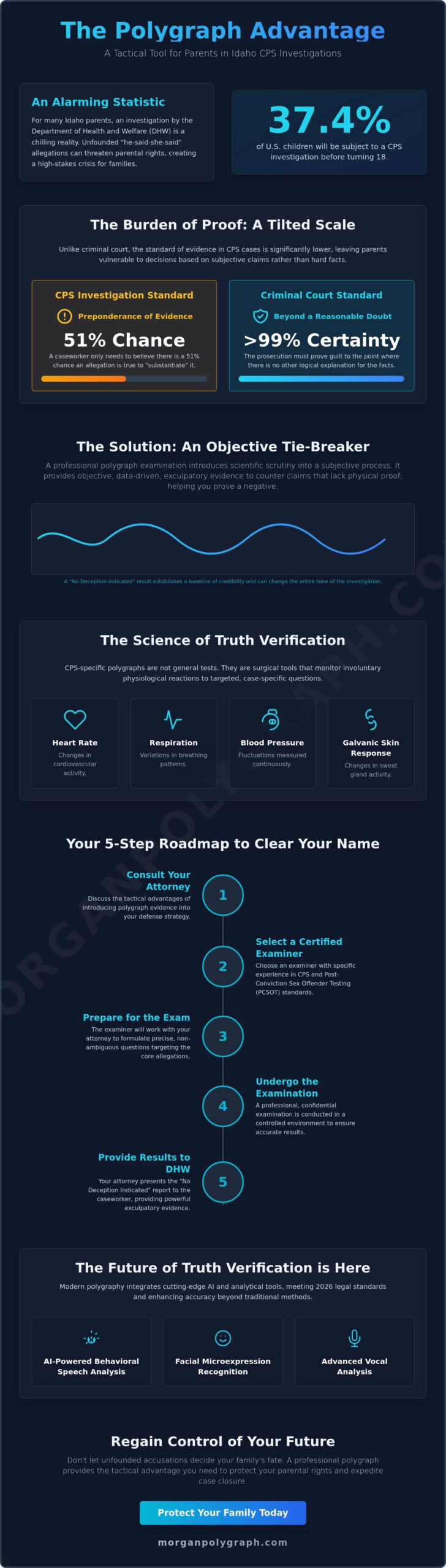
Did you know that 37.4% of children in the United States will be the subject of a Child Protective Services investigation before they turn 18? For many Idaho parents, this statistic becomes a chilling reality when the Department of Health and Welfare (DHW) opens a file based on hearsay or “he-said-she-said” allegations. It’s natural to feel a sense of panic when your parental rights are threatened by claims that lack physical evidence. We believe you deserve a professional and compassionate way to defend your home. This guide explains how using polygraph in Idaho CPS cases to prove innocence serves as a vital tactical tool to shift the burden of proof and regain control of your future.
You’ll discover how a certified polygraph examination provides your attorney with the exculpatory evidence necessary to expedite a case closure. We’ll examine the 2026 legal standards for admissibility through stipulation, the impact of recent legislation like House Bill 776, and how cutting-edge AI tools like behavioral speech analysis are modernizing truth verification. This article provides a clear roadmap for anyone looking to clear their name with DHW and protect their family from unfounded accusations.
Key Takeaways
- Learn how the Department of Health and Welfare (DHW) uses truth verification results to unsubstantiate false allegations and expedite the closure of a file.
- Understand the physiological science behind targeted CPS exams, which monitor heart rate and respiration to address specific abuse or neglect claims.
- Discover the tactical advantage of using polygraph in Idaho CPS cases to prove innocence by providing your attorney with objective, exculpatory evidence.
- Follow a proven five-step strategy to integrate a professional exam into your defense, including how to select a certified examiner experienced in PCSOT work.
- See how traditional expertise meets 2026 technology through the use of AI-powered behavioral speech analysis and facial microexpression recognition.
The Role of Polygraph Testing in Idaho CPS Investigations
An investigation by the Idaho Department of Health and Welfare (DHW) is a high-stakes crisis that puts your family’s future on the line. Unlike criminal cases where the standard is “beyond a reasonable doubt,” CPS operates under a “preponderance of evidence” standard. This means a caseworker only needs to believe there is a 51% chance that an allegation is true to “substantiate” a finding of abuse or neglect. This low threshold often leaves parents vulnerable to life-altering decisions based on thin evidence. Because the stakes include the potential loss of parental rights, many families are turning to truth verification as a proactive shield. We view the process as more than just a test; it’s a professional method for using polygraph in Idaho CPS cases to prove innocence before a caseworker makes a final determination.
To understand the utility of this tool, it helps to define what a polygraph test is in a modern legal context. It is a scientific method of recording physiological changes in response to specific questions. In Idaho, these examinations are most effective in scenarios involving alleged physical or sexual abuse where there are no witnesses or physical evidence. By providing a clear, data-driven report, you give the DHW a reason to pause and reconsider the narrative provided by an accuser.
Why ‘He-Said-She-Said’ Cases Require Objective Data
CPS caseworkers frequently rely on subjective interviews and child statements gathered during forensic evaluations. While these interviews are standard, they aren’t infallible. Children can be coached, or family dynamics can lead to skewed perceptions. Traditional forensic interviews often lack the physiological confirmation needed to separate fact from fiction. A professional polygraph examination acts as an objective tie-breaker. It introduces a layer of scientific scrutiny that subjective interviews cannot match, helping to stabilize an investigation that feels like it’s spiraling out of your control.
Proving a Negative: The Polygraph’s Unique Value
It’s notoriously difficult to prove you didn’t do something. In a DHW investigation, the burden of proof often feels like it’s shifted onto the parent to disprove a negative. Using polygraph in Idaho CPS cases to prove innocence is one of the few ways to address specific physical acts directly. The exam focuses on concrete “did you” or “did you not” questions rather than vague intentions. When you present a “No Deception Indicated” result to your caseworker early in the process, you establish a baseline of credibility. This professional transparency can change the entire tone of the investigation, moving the focus away from suspicion and toward a factual resolution.
How Polygraph Examinations Address Specific Abuse and Neglect Allegations
A CPS-specific polygraph is not a general personality test. It is a surgical truth verification tool designed to address the core allegations of a case. When using polygraph in Idaho CPS cases to prove innocence, the exam focuses exclusively on the specific incidents cited in the Department of Health and Welfare (DHW) report. This targeted approach ensures that the data collected is relevant to the legal crisis at hand. By isolating the alleged act, we provide a clear path for parents to demonstrate their truthfulness regarding specific events that could otherwise lead to the removal of their children.
During the examination, we monitor four primary physiological markers: heart rate, respiration, blood pressure, and galvanic skin response (sweat). These involuntary reactions are controlled by the autonomic nervous system. When a person attempts to deceive, these markers typically shift in predictable ways. In Idaho, professional examiners typically employ the “Control Question” or “Directed Lie” techniques. These methods compare your physiological responses to neutral questions against your responses to the specific allegations. Understanding Idaho’s rules on polygraph admissibility is essential, as these techniques are designed to meet the high standards required for potential stipulation by all parties involved in a CPS matter.
Customizing Questions for CPS Allegations
The success of an exam depends on the precision of the questions. We work in a collaborative process with the parent and their defense attorney to craft narrow “yes or no” questions. These questions focus on specific physical acts or incidents of alleged neglect. Professional examiners never use broad or subjective questions like “Are you a good parent?” or “Do you love your children?” because they don’t produce reliable physiological data. Instead, we focus on the facts of the investigation to ensure the results are defensible and clear. If you are facing an active investigation, you can speak with a certified examiner to discuss how we tailor our questions to your specific case.
Accuracy and Reliability in 2026
As of May 2026, the integration of AI-powered analysis has further refined the accuracy of truth verification. Modern software helps examiners interpret complex physiological data with higher precision than manual scoring alone. Many parents ask, are polygraphs accurate? When conducted by a nationally certified expert using 2026 standards, accuracy rates are consistently high. However, the reliability of the test is heavily dependent on the examiner’s experience in interpreting the data within the high-stress context of a CPS investigation. Using polygraph in Idaho CPS cases to prove innocence requires an examiner who understands the nuances of family law and the specific pressures parents face during a DHW inquiry.
Admissibility and Weight: How Idaho Courts and DHW View Polygraph Results
Many parents get stuck on whether a test is “admissible” in a courtroom. While it’s a valid concern, it often misses the immediate goal of a CPS investigation. In Idaho, there’s a vital distinction between courtroom admissibility and investigative utility. Using polygraph in Idaho CPS cases to prove innocence is often most powerful during the administrative phase. This is when the Department of Health and Welfare (DHW) is still deciding whether to substantiate a claim. A passed exam can serve as the catalyst for a caseworker to “unsubstantiate” a case, effectively closing the file before it ever reaches a judge’s bench.
According to the Idaho Rules of Administrative Procedure, polygraph results are generally inadmissible in administrative hearings unless all parties agree to a stipulation. However, this rule doesn’t prevent the DHW from using the results to inform their internal findings. In fact, stipulated polygraphs; where both your attorney and the state’s counsel agree to the test; can be a decisive path toward a settlement. This cooperative approach shows you have nothing to hide and are willing to use scientific methods to verify the truth. When both sides agree to the results beforehand, the polygraph moves from a tactical tool to a legally binding piece of evidence.
Using Results to Influence Caseworker Recommendations
A “No Deception Indicated” (NDI) result carries significant weight with CPS supervisors. It can directly influence the terms of a Safety Plan. For example, if a parent is accused of physical abuse, a passed polygraph can justify moving from supervised visitation to unsupervised contact. It provides the “reasonable efforts” documentation a caseworker needs to recommend case closure. The psychological impact of professional truth verification often shifts the caseworker’s perspective from skepticism to cooperation, providing the objective data they need to feel confident in your home’s safety.
Polygraphs in Family Court vs. Criminal Court
Judges in Idaho child protection cases often have broader discretion than those in criminal trials. While criminal courts have rigid exclusionary rules, family court judges may consider polygraph results as a “basis of opinion” for expert witnesses. If an expert is testifying about a parent’s risk level or the validity of an allegation, they can cite the polygraph results as part of their comprehensive evaluation. This is why it’s critical to use a court-recognized expert like Chip Morgan. An examiner with decades of experience and a respected reputation in the legal community ensures that the results are treated with the professional gravity they deserve during an IDAPA appeal or a family court hearing.
5 Steps to Using a Polygraph to Clear Your Name in an Idaho CPS Case
Clearing your name requires a methodical approach. It is not just about taking a test; it’s about the strategic integration of truth verification into your overall legal defense. When you are facing the Department of Health and Welfare (DHW), every piece of evidence matters. Following a structured process ensures that the results are credible and useful for your attorney. Here are the five essential steps for using polygraph in Idaho CPS cases to prove innocence.
- Consult Your Legal Counsel: Always talk to your attorney before scheduling an exam. They will determine if the results should be used to influence a Safety Plan or if they should be kept as part of your confidential defense file.
- Select a Specialized Examiner: You need a professional who understands the nuances of family law. Search for a polygraph near me that is certified and has specific experience in CPS or PCSOT work.
- Define the Allegations: Provide the examiner with the official ‘Notice of Investigation’ from DHW. This ensures the test questions are narrow and directly address the specific claims made against you.
- Ensure a Professional Setting: A valid exam must be conducted in a controlled, professional office environment. Avoid ‘mobile’ or ‘online’ services that lack the sophisticated equipment and AI-powered tools used in modern 2026 truth verification.
- Strategic Disclosure: Once you have a ‘No Deception Indicated’ result, your lawyer can present it to the DHW supervisor. This objective data provides the caseworker with a factual basis to recommend case closure.
When is the Best Time to Take the Test?
Timing is a critical factor in CPS investigations. Testing early in the process, ideally before the DHW reaches a final ‘substantiation’ decision, can stop an investigation before it gains momentum. Under the April 2026 House Bill 776, certain risk factors must be verified within 12 hours for infants. While that timeline is fast, providing truth verification results early in any investigation shifts the burden of proof back to the state. You should never take an exam ‘on the fly’ or without proper legal guidance; preparation ensures the most accurate and defensible outcome.
Preparing for the Examination
A successful examination starts with a good night’s rest and a clear mind. During the pre-test interview, the examiner will review every question with you to ensure there are no surprises. It’s a transparent process designed to build a baseline of your physiological responses. Modern 2026 standards incorporate AI-driven behavioral analysis, making it virtually impossible to ‘trick’ the sensors. Honesty is your only viable strategy. If you’re ready to provide your attorney with the evidence needed to protect your family, you can schedule a confidential consultation to discuss your case details.
Why Morgan Polygraph is the Trusted Choice for Boise Families
Morgan Polygraph stands out as a beacon of stability for those facing the high-pressure environment of a DHW inquiry. With over 40 years of combined testing experience, Chip Morgan has built a reputation as a court-recognized expert who understands the Idaho legal ecosystem. This depth of knowledge is vital when using polygraph in Idaho CPS cases to prove innocence. We don’t just provide a score. We provide a professional, compassionate interaction that respects the dignity of every client. Our approach combines decades of traditional expertise with the most advanced truth verification tools available in 2026. This unique positioning makes us a trusted resource for Boise families who need more than just a test; they need a credible advocate for the truth.
Cutting-Edge Technology in Truth Verification
At Morgan Polygraph, we don’t just follow the future; we help shape it. While traditional metrics like heart rate and respiration remain the foundation of our work, we’ve integrated AI-powered tools to enhance accuracy for life-altering CPS decisions. Our examinations now utilize behavioral speech analysis and facial microexpression recognition. These tools provide an extra layer of verification, ensuring that physiological data is cross-referenced with subtle non-verbal cues. This dual-layered approach is especially beneficial in high-stakes family cases where emotional stress can sometimes complicate traditional readings. By utilizing these 2026 standards, we provide Boise families with the highest level of confidence in their results. This technological edge allows us to stay at the forefront of deception detection, providing your attorney with evidence that is both modern and scientifically sound.
Confidentiality and Professionalism in Boise
We understand that discretion is your primary concern. Our Boise office is designed to provide a quiet, controlled environment where you can speak freely. Every step of the examination process is handled with the utmost privacy, ensuring that your sensitive family matters remain confidential. Once the testing is complete, we craft detailed, professional reports specifically formatted for use by Idaho attorneys. These reports don’t just state a result. They provide the expert analysis necessary to support your defense strategy and communicate effectively with DHW supervisors. We pride ourselves on being methodical, organized, and approachable. If you’re ready to take a proactive step toward clearing your name, call Chip Morgan today at our Boise office. We are here to discuss your case with total confidentiality and help you navigate the path back to a stable family life.
Secure Your Reputation and Restore Your Family’s Peace of Mind
Facing a CPS investigation is one of the most stressful experiences a parent can endure. However, you don’t have to navigate this process without objective evidence. By using polygraph in Idaho CPS cases to prove innocence, you provide your attorney with the scientific documentation needed to challenge hearsay and unsubstantiate false claims. We’ve explored how modern truth verification combines 40 years of traditional expertise with 2026 AI technology to offer unparalleled accuracy. Whether you’re dealing with initial allegations or navigating an administrative appeal, a professional exam serves as a powerful shield for your parental rights.
Chip Morgan is a nationally recognized expert in truth verification with over 40 years of experience. As a certified and court-recognized examiner in Idaho, he provides the professional and discreet service your family deserves. Don’t let unfounded accusations dictate your future. Talk to Chip Morgan about your Idaho CPS case today to begin the process of clearing your name with the Department of Health and Welfare. You have the power to take control of your situation and protect what matters most. We are here to help you move forward with confidence and clarity.
Frequently Asked Questions
Does Idaho CPS have to accept my polygraph results as proof of innocence?
The Idaho Department of Health and Welfare (DHW) is not legally mandated to accept polygraph results as absolute proof. However, caseworkers often use truth verification as a key investigative tool to “unsubstantiate” a case. Using polygraph in Idaho CPS cases to prove innocence is effective because it provides the department with objective, physiological data to justify closing a file before it reaches the administrative hearing stage.
Can I take a polygraph if I have a pending criminal charge related to the CPS case?
You can undergo an examination even with a pending criminal charge, but you must coordinate this strictly with your defense attorney. Since CPS and criminal cases often run parallel, your lawyer needs to ensure the results are handled as confidential work-product. A private exam ensures the state cannot access the data unless your counsel chooses to disclose it as part of a defense strategy.
How much does a professional polygraph test cost for a CPS case in Idaho?
Professional polygraph services in Boise do not have a single fixed price because the complexity of each CPS case varies. Morgan Polygraph provides a precise quote during a confidential, no-obligation consultation to ensure your specific needs are met. As of January 2026, full payment is required at the time of service, and we accept all major credit cards to maintain a methodical and professional process.
Will my nerves cause me to fail the polygraph even if I am innocent?
Simple nervousness will not cause you to fail a professional examination. Certified examiners use a pre-test interview to establish a physiological baseline of your autonomic nervous system. Our 2026 standards also integrate AI-powered behavioral speech analysis to differentiate between the natural anxiety of a DHW investigation and the specific markers of deception.
What happens if the polygraph results are ‘inconclusive’?
An inconclusive result means the physiological data did not meet the required threshold for a definitive finding. This occurs in approximately 10% to 15% of cases nationally. When this happens, we review the data to identify external factors like lack of sleep or specific medications. We may then schedule a follow-up session to ensure we reach a clear and accurate determination.
Can I use a polygraph to prove that someone else is lying about me to CPS?
You cannot force another person to undergo testing, but your own passed results can effectively impeach an accuser’s credibility. By successfully using polygraph in Idaho CPS cases to prove innocence, you provide documented evidence that the alleged act did not happen. This creates a factual contradiction that forces DHW caseworkers to re-evaluate the reliability of the person who made the initial report.
Is there a difference between a private polygraph and one requested by the police?
Private polygraphs offer a critical layer of confidentiality that police-requested exams lack. When you hire a private examiner, the results are protected by attorney-client privilege and belong to you and your legal counsel. If the police request a test, they own the data and can use it as evidence against you in a criminal proceeding without your consent.
How long does a CPS-related polygraph examination usually take?
A comprehensive CPS-related polygraph examination typically takes between 2 and 3 hours to complete. This timeframe allows for a detailed pre-test interview, multiple rounds of physiological data collection, and a thorough analysis of the results. We ensure the process is unhurried and professional to maintain the highest levels of accuracy for your case.