

What if the machine didn’t catch the truth, but the examiner simply misread the data? Many people assume a failed test is the end of the road, but in reality, a polygraph result is a technical audit rather than an absolute final judgment. You might be asking, can I get a second opinion on a polygraph? The answer is a definitive yes. When your reputation or legal standing is on the line, relying on a single interpretation of complex physiological charts can feel like a gamble you can’t afford to lose.
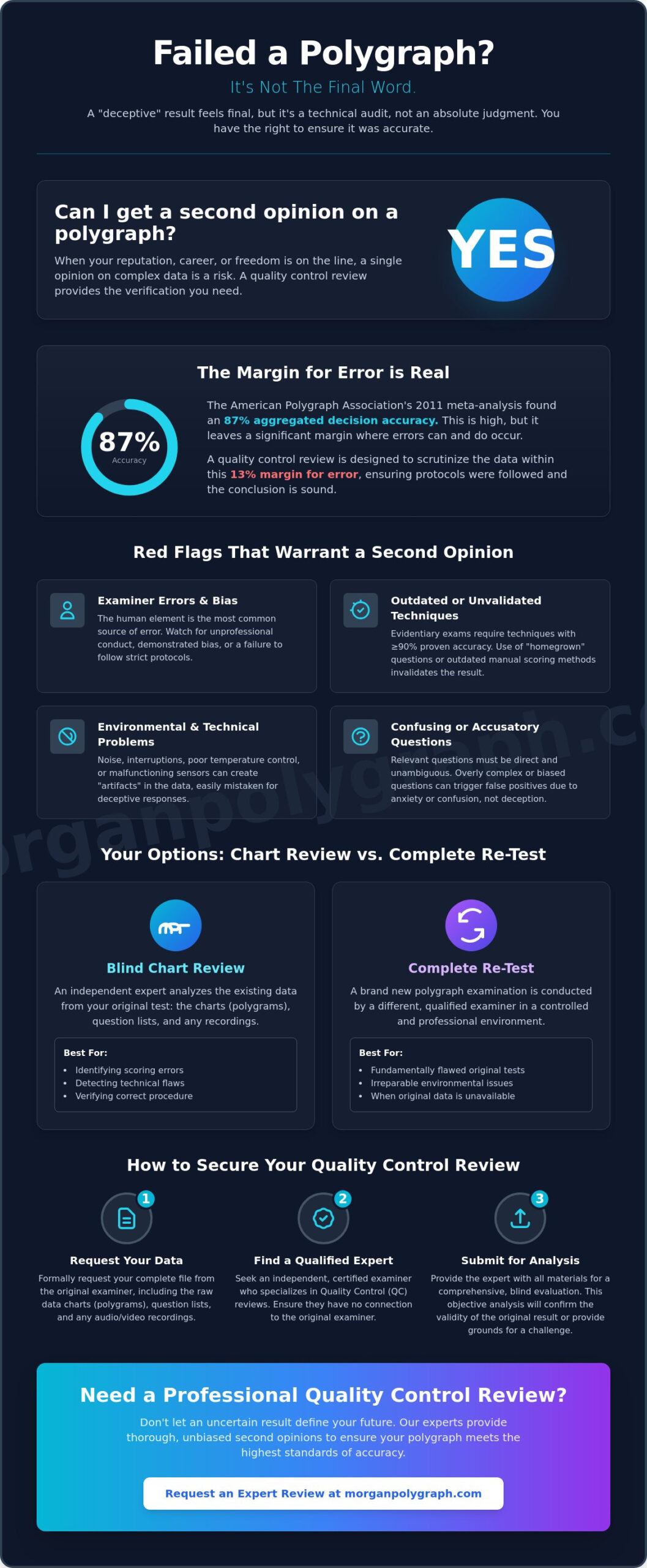
We understand the deep anxiety and confusion that comes with a “deceptive” result, especially when you know you’ve been honest. You’re not alone in seeking clarity. The American Polygraph Association’s 2011 meta-analysis found an aggregated decision accuracy of 87%, which leaves a margin for error that a professional review can address. This guide will show you how to obtain a professional quality control review to ensure your test meets the highest standards of accuracy. We’ll explore the technical requirements for evidentiary exams, the $200 average hourly cost for expert re-evaluations, and how a second set of eyes can provide the peace of mind or admissible evidence you need to move forward.
Key Takeaways
- Identify the specific technical triggers that justify a formal audit and answer the question, “can I get a second opinion on a polygraph,” when results seem inconsistent.
- Recognize common examiner errors, such as outdated manual scoring or missed physiological artifacts, that often warrant a professional quality control review.
- Learn to distinguish between a blind chart review of existing data and a complete re-test to determine the most effective strategy for your legal or personal situation.
- Follow a clear, step-by-step process to secure your original polygrams and question lists from the initial examiner for an independent expert evaluation.
- Understand how the integration of AI-powered deception detection tools provides an objective layer of accuracy and fairness in modern truth verification reviews.
Why You Might Need a Second Opinion on a Polygraph Test
A failed examination doesn’t have to be the final chapter in your story. Many individuals facing a “Deception Indicated” result immediately ask, can I get a second opinion on a polygraph? This is a reasonable response when the outcome contradicts the hard facts of your case or your personal truth. Whether you’re dealing with a sensitive relationship issue or a high-stakes legal matter in Idaho, understanding that a polygraph is a technical evaluation, not an infallible oracle, is the first step toward clarity.
Inconsistent results often stem from a disconnect between the physiological data and the actual events. If you’ve been falsely accused, the anxiety of the situation can sometimes be misinterpreted by an examiner who isn’t adhering to strict protocols. You might also feel that the examiner’s professionalism was lacking or that they displayed a clear bias during the pre-test interview. These factors can skew the data before the sensors are even attached. Seeking a second opinion ensures that your physiological charts are evaluated by a neutral, expert third party who isn’t influenced by the initial examiner’s impressions.
Signs of an Unreliable Polygraph Examination
Not all examinations are conducted with the same level of rigor. To determine if your test was valid, you should first look at the techniques used. The American Polygraph Association (APA) requires examiners to use validated techniques that maintain a demonstrated average accuracy of 90% or greater for evidentiary exams. If the examiner used outdated manual scoring or failed to maintain a controlled environment, the results are suspect. Common red flags include:
- Environmental Distractions: Noise, interruptions, or even poor temperature control in the testing room can cause physiological spikes unrelated to deception.
- Confusing Questions: “Relevant questions” must be clear and direct. If they were accusatory, overly complex, or changed during the test, they can trigger a “false positive” response.
- Equipment Issues: Sensors that are loose or malfunctioning can produce “artifacts” in the data that an inexperienced scorer might mistake for a reaction to a lie.
The Role of Quality Control in Truth Verification
Quality control (QC) is the gold standard in professional truth verification. In federal and law enforcement agencies, every single polygraph chart is reviewed by a second, independent expert to ensure accuracy. This process isn’t just about catching mistakes; it’s about validating the science. For a comprehensive Polygraph overview, one can see that the scientific debate often centers on the human element of interpretation. This is why a second opinion is so vital.
A third-party review can restore trust in a therapeutic or legal setting by providing an objective analysis of the raw data. When we look at the question, are polygraphs accurate, the answer often depends on the skill of the person scoring the charts. A 2011 APA meta-analysis found an aggregated decision accuracy of 87%, but that number assumes the examiner followed every protocol perfectly. If you suspect yours didn’t, a quality control review is your best path to a fair re-evaluation.
Common Examiner Errors That Warrant a Quality Control Review
Errors in truth verification are rarely caused by the equipment itself. Instead, they almost always stem from the human element of the process. If you’re asking, can I get a second opinion on a polygraph, you’re likely sensing that something went wrong during the technical phase of your exam. Industry standards in 2026 require examiners to follow strict protocols to maintain the 85% to 95% accuracy rates cited by the American Polygraph Association (APA). When these protocols lapse, the validity of the entire test is compromised.
One frequent issue is the use of unvalidated testing formats. For an evidentiary examination to be considered reliable, it must use techniques with a demonstrated accuracy of at least 90%. If an examiner uses a “homegrown” question set or an outdated manual scoring method rather than standardized algorithms, the result is technically deficient. Insufficient data collection also plagues the industry. An examiner should never render a final decision based on only one or two charts; a minimum of three high-quality charts is typically required to ensure the physiological responses are consistent and not just random spikes.
Technical Errors in Chart Analysis
Modern polygraphy relies on the Empirical Scoring System (ESS), a standardized, evidence-based method for assigning values to physiological data. Many older examiners still rely on subjective “eyeballing,” which introduces personal bias into what should be a scientific measurement. Computerized scoring algorithms like PolyScore or OSS-3 have demonstrated accuracy rates around 90%, often outperforming human scorers who lack recent training. A TDA error is a mistake in the Test Data Analysis phase. These errors occur when an examiner fails to identify “artifacts,” such as a cough, a deep breath, or intentional movement, and incorrectly scores those reactions as signs of deception. If your results were “Inconclusive,” it often points to poor data quality or the examiner’s inability to filter out these environmental distractions.
Procedural Mistakes and Examiner Conduct
The pre-test interview is a critical phase where the examiner sets the psychological “baseline” for the examinee. If this interaction is overly accusatory or aggressive, it can create “outside issue” stress that leads to a false positive. Similarly, the formulation of “comparison questions” is a delicate science. If these questions aren’t properly balanced against the relevant questions, the test will naturally skew toward a deceptive result regardless of the truth. To avoid these pitfalls, an examiner must stay current with the industry, completing at least 30 continuing education hours every two years. Ensuring your examiner is nationally certified is the only way to guarantee a valid polygraph examination. If you suspect your test was handled unprofessionally, you can consult with an expert to review the original charts for procedural flaws.
Re-Testing vs. Chart Review: Which Second Opinion is Right?
Deciding how to challenge an unsatisfactory result is just as critical as the decision to challenge it at all. When you ask, can I get a second opinion on a polygraph, you’re choosing between two distinct professional paths: a technical chart review or a complete re-test. Each option serves a specific purpose depending on whether the suspected error lies in the interpretation of the data or the physical conduct of the exam itself.
A chart review is essentially a technical audit of the existing physiological data. A second, independent expert performs a “blind” evaluation of the polygrams without knowing the first examiner’s conclusion. This process focuses purely on the Test Data Analysis (TDA) phase to see if the scores were assigned correctly. From a financial standpoint, a quality control review is often the more accessible choice. Expert reviews typically cost around $200 per hour, while a full specific-issue examination averages $800 nationally. In legal contexts, a formal Quality Control (QC) report can be a powerful tool for criminal defense, providing a basis to challenge the original examiner’s testimony or the admissibility of the test results.
When to Choose a Chart Review
A chart review is the best course of action when you believe the first examiner simply misread the physiological data. This is frequently the case in an infidelity test dispute where the charts are available but the “Deception Indicated” result feels like a false positive. It acts as a quick sanity check. If a second expert reviews the same charts and finds the scoring was subjective or failed to account for breathing artifacts, you have immediate grounds to dispute the original finding without the stress of sitting for another exam.
When a Full Re-Test is Necessary
There are times when the original data is so compromised that a review is impossible. If the testing environment was loud, the equipment was outdated, or the relationship with the first examiner turned hostile, a fresh start is required. A full re-test involves a new examiner, a different location, and a revised set of questions to ensure a clean baseline. This rigorous approach is even emphasized for those learning how to become a polygraph examiner; students are taught that a compromised environment renders the data invalid. If the first session was fundamentally flawed, a second opinion must come from a brand-new examination to ensure fairness and accuracy.
How to Successfully Request a Polygraph Review
Once you decide to challenge an examination result, the process shifts from emotional frustration to technical preparation. The question of can I get a second opinion on a polygraph depends heavily on your ability to secure the raw data from the original session. You aren’t just asking for the final “Pass” or “Fail” letter; you need the actual physiological evidence that led to that conclusion. This data allows a new expert to perform a “blind” review, where they score the charts without being influenced by the previous examiner’s opinion.
To begin this process, you should follow a methodical four-step approach:
- Step 1: Request the full “Polygrams” (the charts) and the exact question list used during the test.
- Step 2: Secure the written report and any numerical scoring sheets the examiner produced.
- Step 3: Contact a certified expert like Chip Morgan for a confidential consultation to discuss the feasibility of a review.
- Step 4: Submit these materials for a formal blind review to ensure an unbiased second opinion.
Gathering Your Documentation
You have a right to access your test data, but how you ask for it matters. If you encounter resistance, it’s helpful to state that the materials are needed for “quality control purposes” or “counsel’s review.” As of May 2026, American Polygraph Association standards require practicing examiners to maintain all materials related to an exam for a minimum of three years. This includes the digital files from the polygraph software. Always request “uncompressed” digital data if possible. Modern truth verification relies on cutting-edge AI-powered tools that analyze micro-fluctuations in physiological responses; these tools require high-resolution data that hasn’t been flattened into a simple PDF image.
Working with Your Attorney
In legal settings, a second opinion is often the key to a “Rule 702” hearing. This is the stage where a judge decides if an expert’s testimony is reliable enough to be admitted as evidence. A Quality Control review can identify technical errors that make the original test inadmissible in criminal defense or civil litigation. If you’re searching for a certified polygraph near me in Idaho, working with a local Boise expert ensures your reviewer understands the specific requirements of regional courts. If you’re ready to move forward with a technical audit of your results, you can schedule a professional consultation today to begin the review process.
Professional Polygraph Reviews in Boise: The Morgan Polygraph Advantage
When your reputation or legal standing is at stake, the question of can I get a second opinion on a polygraph requires a local expert who understands both the science and the Idaho legal environment. Morgan Polygraph stands as a pillar of truth verification in the Boise area, offering over 40 years of combined experience. Our background includes extensive expert testimony and thousands of examinations, providing a level of authoritative insight that few in the Pacific Northwest can match. We don’t just review charts; we provide a comprehensive technical audit that stands up to the highest levels of scrutiny.
As court-recognized experts serving Boise, Meridian, Nampa, and the greater Treasure Valley, we provide a bridge between traditional polygraphy and futuristic technology. We understand that behind every chart is a person facing a life-altering situation. Our team maintains a calm, collected confidence that helps clients feel they’re in capable hands. Whether you’re a defense attorney seeking to challenge a result or an individual looking for clarity in a personal dispute, our methodical approach ensures that every physiological reaction is weighed with professional precision.
State-of-the-Art Technology in Idaho
While many competitors discuss technology in a purely theoretical sense, we’ve actively integrated cutting-edge AI-powered deception detection tools into our review process. If you’re wondering, can I get a second opinion on a polygraph that is truly objective, our use of behavioral speech analysis and facial microexpression recognition provides the answer. These tools support our traditional chart scoring by identifying micro-fluctuations that the human eye might miss. By using AI to eliminate human bias, we offer Boise residents a final truth verification process that is both innovative and scientifically grounded. This dual-layered approach is why Chip Morgan is trusted by legal professionals throughout Idaho for objective, data-driven reviews.
Confidentiality and Professionalism
We recognize that truth verification often involves deeply personal and sensitive issues. Our commitment to discretion is absolute, especially when handling reviews for infidelity or family disputes. We provide a professional, compassionate, and respectful environment for all clients, ensuring that your sensitive information is handled with the utmost privacy. Our expert reports are specifically designed for use by defense attorneys and court officials, providing the technical clarity needed for legal proceedings. We take the time to explain the findings in plain English, avoiding the technical jargon that often leads to confusion in a crisis. If you feel your original test was flawed or unfair, don’t leave your future to chance. Call to talk with Chip and Schedule your second opinion review today to ensure your case is evaluated with the expertise it deserves.
Secure Your Reputation with an Expert Review
A polygraph result is a complex data set, not an unchangeable verdict. You’ve learned that technical errors in chart analysis or procedural lapses can skew results, but these flaws can be identified through a methodical quality control audit. By gathering your documentation and understanding the difference between a blind chart review and a full re-test, you position yourself to challenge inaccuracies with evidence rather than just emotion. When you find yourself asking, can I get a second opinion on a polygraph, remember that the science allows for, and often requires, independent oversight to ensure total fairness.
Don’t let a single misinterpretation define your future. With over 40 years of combined experience and the integration of state-of-the-art AI-powered technology, our nationally certified and court-recognized examiners provide the objective clarity you need. Whether you’re navigating a legal defense or a personal relationship crisis, you deserve a review that meets the highest 2026 industry standards. Get a Professional Second Opinion from Chip Morgan and restore your peace of mind. Your path to a fair and accurate outcome starts with a single, confidential conversation.
Frequently Asked Questions
Can I get a second opinion if I failed my first polygraph test?
Yes, you can absolutely seek a professional review after a failed examination. It is standard practice in federal agencies for all charts to undergo an independent quality control review to ensure the initial examiner didn’t misinterpret the data. If you feel your result was a false positive, a second expert can verify if the scoring was accurate or if physiological artifacts were incorrectly identified as deception.
How much does a polygraph chart review cost compared to a new test?
A quality control review is significantly more affordable, typically costing $200 per hour for a Level One evaluation. In contrast, a new single-issue polygraph examination carries a national average cost of approximately $800. Most technical reviews take about one hour to complete, making it a cost-effective first step before deciding whether to invest in a completely new examination.
Will a second examiner automatically know the results of my first test?
Not if you request what is known as a blind review. In this professional process, the second examiner evaluates the raw physiological data and question lists without any knowledge of the first examiner’s conclusion. This ensures the review is entirely objective. You should specify this preference when asking, can I get a second opinion on a polygraph, to maintain the integrity of the results.
Is a second opinion on a polygraph admissible in an Idaho court?
Admissibility in Idaho courts depends on the specific judge and the nature of the case. However, a technical review from a court-recognized expert is often used during Rule 702 hearings to challenge the reliability of the original test. Even if the results aren’t admitted as direct evidence, the review can provide your attorney with the technical grounds needed to cross-examine the initial examiner effectively.
What happens if the second opinion contradicts the first polygraph result?
A contradiction typically suggests that a scoring error occurred or that the first examiner failed to account for environmental distractions. This discrepancy provides powerful leverage in legal negotiations or therapeutic settings. While it doesn’t automatically erase the first result, it creates “reasonable doubt” regarding the initial findings and often justifies a request for a brand-new examination conducted under stricter protocols.
Can AI provide a more accurate second opinion than a human examiner?
AI scoring algorithms like PolyScore and OSS-3 have demonstrated accuracy rates of approximately 90%, which often exceeds the consistency of manual human scoring. These tools are excellent for eliminating subjective bias from the Test Data Analysis phase. At Morgan Polygraph, we use these cutting-edge tools to support our expert reviews, providing a dual-layered approach that combines technological precision with decades of traditional experience.
How long does it take to get a second opinion on my polygraph charts?
Most professional quality control reviews are completed within 24 to 48 hours after we receive your materials. This timeframe allows the expert to score the charts, run the data through AI algorithms, and draft a formal report. Because we understand the high stress involved in these cases, we prioritize efficiency without compromising the methodical rigor required for a court-recognized truth verification audit.
What materials do I need to provide for a professional quality control review?
You must provide the original polygrams, the complete question list, and the examiner’s written report. American Polygraph Association standards require examiners to maintain these records for at least three years. Digital data is the most useful format for a can I get a second opinion on a polygraph request. It allows us to use high-resolution analysis tools to identify micro-fluctuations in your physiological responses.