

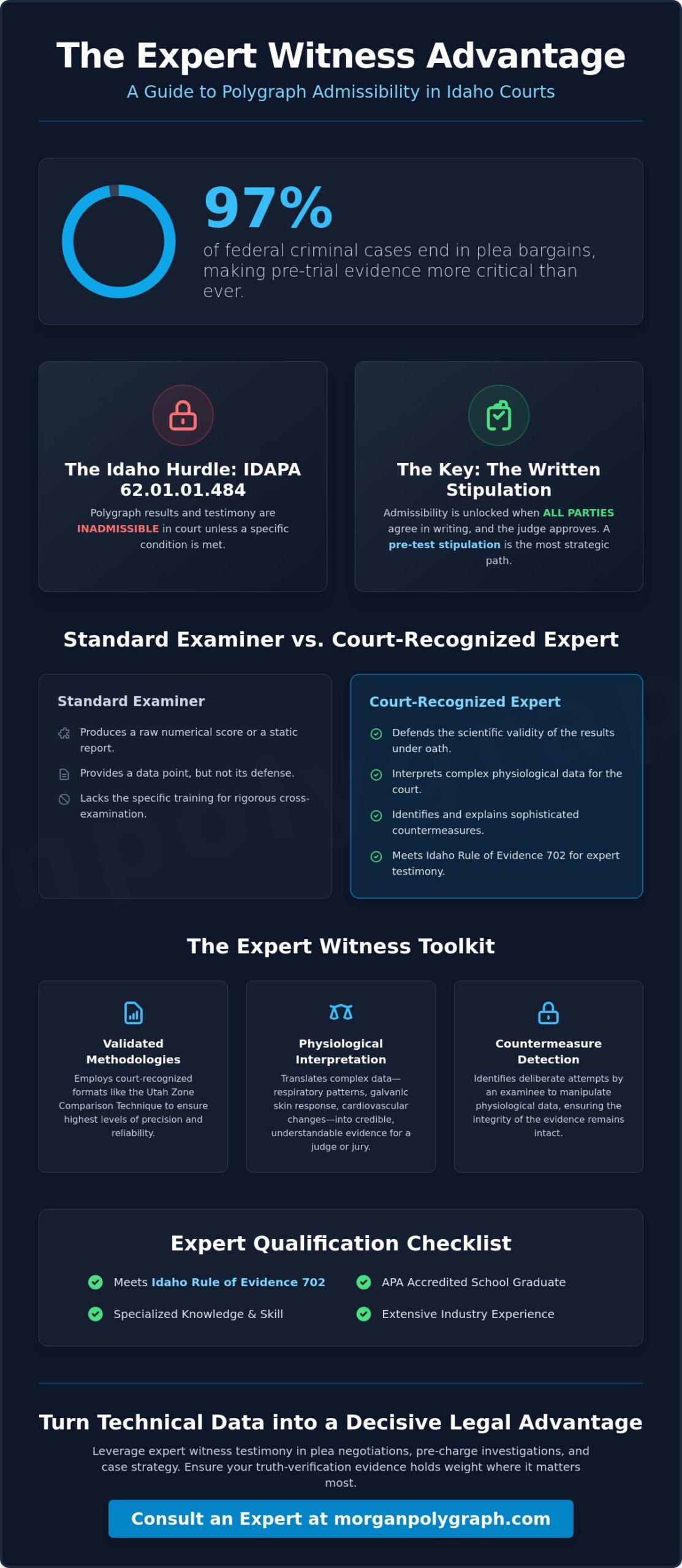
With 97% of federal criminal cases ending in plea bargains, the most powerful evidence in your arsenal might never reach a jury. You probably recognize the frustration of holding truth-verification data that feels locked behind Idaho’s strict legal barriers. It’s natural to fear that IDAPA 62.01.01.484 makes expert witness polygraph testimony Idaho practitioners provide a dead end for your litigation strategy. However, the reality is that admissibility is often a matter of strategic negotiation rather than a closed door.
This guide helps you manage the specific legal requirements to ensure your evidence holds weight. You’ll learn how to use formal stipulations to clear the path for court recognition and how to leverage polygraph results in high-stakes plea negotiations. We’ll provide a clear roadmap for meeting Idaho Rule of Evidence 702 standards while utilizing modern, AI-enhanced methodologies that build undeniable credibility. By the end of this article, you’ll understand how to turn technical data into a decisive legal advantage in Boise and throughout Southern Idaho.
Key Takeaways
- Understand the distinction between a standard examiner and a court-recognized expert witness within the Idaho judicial system.
- Navigate the specific requirements of IDAPA 62.01.01.484 to secure the legal stipulations necessary for admissible evidence.
- Strategically utilize expert witness polygraph testimony Idaho services to gain leverage during plea bargain negotiations and pre-charge investigations.
- Identify the essential certifications and APA-accredited training standards that validate an expert’s credibility in 2026.
- Access professional consultations in Boise to integrate advanced truth-verification technology into your criminal or civil case strategy.
The Role of an Expert Witness in Idaho Polygraph Testimony
In the Idaho judicial system, the distinction between a polygraph examiner and a court-recognized expert is the difference between a raw data point and a powerful legal tool. An expert witness polygraph testimony Idaho professional provides a service that extends far beyond the physical administration of a test. While a standard examiner might simply produce a numerical score, a court-recognized expert possesses the specialized training to defend the scientific validity of that score under rigorous cross-examination. In Boise and throughout Southern Idaho, judges look for witnesses who can bridge the gap between complex physiological data and the practical needs of the court. This role requires an authoritative understanding of how the body reacts to the stress of deception and the ability to communicate these findings with calm, collected confidence.
A standard examination report is often a static document. In contrast, expert testimony is a dynamic process where the practitioner explains the logic behind the results. They interpret the nuances of respiratory patterns, galvanic skin responses, and cardiovascular changes for a jury or judge who may have no prior exposure to forensic psychophysiology. This interpretation is vital because it transforms abstract charts into credible evidence that can influence the direction of a case. The expert’s presence in the courtroom adds a layer of academic gravitas, ensuring that the truth verification process is viewed as a methodical and scientific endeavor rather than a mere procedural box to check.
Beyond the Chart: What an Expert Provides
The foundation of any credible testimony rests on the specific methodology employed. Professionals often utilize validated formats like the Utah Zone Comparison Technique to ensure the highest levels of precision. During testimony, the expert addresses the underlying science of Polygraph technology and accuracy, providing the court with a clear understanding of error rates and reliability. They also provide a critical layer of security by identifying countermeasures. These are deliberate attempts by an examinee to manipulate physiological data. A seasoned expert can detect these subtle anomalies, ensuring the integrity of the evidence remains intact.
Qualifying as an Expert in Boise Courts
To be recognized as an expert in Idaho, a practitioner must meet the requirements of Idaho Rule of Evidence 702. This rule focuses on the expert’s specialized knowledge, skill, and experience. Graduation from an American Polygraph Association (APA) accredited school is a non-negotiable standard for establishing this credibility. Chip Morgan’s extensive background, which includes decades of combined industry experience, provides an immediate sense of authority in the courtroom. His status as a court-recognized expert means he doesn’t just present data; he provides a methodical defense of the examination’s results, making him a trusted resource for legal counsel in both criminal and civil cases.
Navigating IDAPA 62.01.01.484 and Admissibility Rules
Effective July 1, 2024, Idaho Administrative Code r. 62.01.01.484 established a clear boundary for truth verification in the courtroom. It explicitly states that results and related expert witness polygraph testimony Idaho practitioners provide are inadmissible unless all parties agree via a written stipulation. This regulation often acts as a deterrent for ill-prepared counsel, but for strategic litigators, it serves as a procedural roadmap. The stipulation is the only recognized path to having these findings considered as evidence. It requires a mutual agreement between the prosecution and the defense, which the presiding judge must then approve. The judge’s role is to ensure that the agreement is fair and that the evidence won’t unduly mislead the jury.
Timing is everything when drafting these agreements. Most experienced attorneys seek a pre-test stipulation. This ensures that both sides are committed to the outcome before the physiological data is even collected. A post-test stipulation is significantly harder to achieve, as the “losing” side has little incentive to allow the evidence into the record once the results are known. While Idaho’s stance is unique, it’s helpful to understand how it differs from the federal rules on polygraph evidence, which have shifted from the Frye standard to the more flexible Daubert criteria. In Idaho, the focus remains on the specific administrative code and the qualifications of the expert rather than a broad federal standard.
The Mechanics of a Legal Stipulation
A robust stipulation agreement is more than a simple consent form. It’s a detailed contract that should specify the choice of examiner, the specific methodology used, and the exact scope of the questions. It’s often beneficial to include provisions for how a “failed” or “inconclusive” result will be handled. This level of detail prevents future disputes and ensures the court views the process as methodical and transparent. Before drafting these documents, consulting with a court-recognized examiner in Boise can help clarify the technical parameters that the court will expect to see.
Idaho Rules of Evidence vs. Administrative Code
While IDAPA 62.01.01.484 provides the primary hurdle, Idaho Rule of Evidence 702 still governs the expert’s participation. The judge maintains a gatekeeping role, balancing the probative value of the testimony against the potential for unfair prejudice. Historically, Idaho courts have been cautious regarding lie detector reliability, but a well-qualified expert can demonstrate that modern, data-driven detection is a far cry from the controversial methods of the past. By focusing on the scientific foundation and the professional standing of the witness, you can address the court’s concerns about the “prejudicial” nature of the evidence and ensure it’s presented with the necessary academic gravitas.
Strategic Use of Polygraph Experts in Criminal Defense
Defense counsel often views the polygraph as a high-risk gamble, but when used as a clearing tool, it becomes a surgical instrument. Before formal charges are even filed, a passed examination can halt a felony investigation in its tracks. By presenting verified findings early, an attorney provides the Prosecution with a reason to look elsewhere. This shifts the focus from a defendant’s potential guilt to the reliability of the accuser or the physical evidence. It’s a proactive measure that establishes a narrative of cooperation and honesty from the outset. This early intervention can save a client from the reputational and financial damage of a public trial.
During the intense pressure of plea negotiations, the involvement of an expert witness polygraph testimony Idaho professional provides a layer of credibility that a simple letter from counsel cannot match. The expert doesn’t just deliver a result; they explain the data-driven detection methods used. This makes it difficult for a prosecutor to dismiss the results as mere subjective interpretation. This verified truth helps build a stronger defense narrative. It humanizes the defendant by providing a scientific basis for their claims of innocence. In a system where 97% of federal cases end in plea bargains, having expert witness polygraph testimony Idaho as leverage can be the difference between a prison sentence and a favorable resolution.
Pre-Trial Leverage and Plea Negotiations
In high-stakes cases, presenting polygraph results directly to Prosecutors can encourage case dismissal or a significant reduction in charges. This isn’t about replacing the judicial process. Instead, it’s about providing the state with a logical “off-ramp” when their evidence is thin. A passed exam can change the entire trajectory of a felony investigation. It forces the state to reconsider the perceived risk of taking a case to trial when a court-recognized expert is prepared to testify to the defendant’s truthfulness. This strategy is particularly effective when the case relies heavily on witness credibility rather than physical evidence.
The Polygraph in Civil Litigation
While criminal cases often dominate the legal conversation, expert testimony is equally vital in civil disputes involving fraud, internal theft, or complex relationship issues. In depositions and hearings, an expert provides a methodical breakdown of the examination process. This helps clarify facts in high-stakes disputes where financial or reputational damage is significant. For those seeking a deeper understanding of the technical steps involved, exploring the methodology behind criminal and civil case polygraphs can provide the necessary context for legal preparation. This clarity avoids ambiguity during the discovery phase and strengthens the client’s position before reaching the courtroom.
Qualifying Your Expert: Education and Certification
The weight of expert witness polygraph testimony Idaho courts receive depends entirely on the expert’s foundational training. Graduation from an American Polygraph Association (APA) accredited school is the non-negotiable baseline for any practitioner entering a courtroom. These institutions ensure that the examiner understands the physiological principles and psychological nuances of truth verification. In 2026, maintaining “Expert” status requires more than a diploma. It demands a commitment to rigorous continuing education. The field evolves rapidly, and an expert who hasn’t updated their methodology in the last twelve months risks being dismantled during cross-examination by better-informed counsel.
Professional affiliations further solidify a witness’s standing. Membership in the APA and local Idaho associations signals a commitment to ethical standards and peer-reviewed practices. When an expert has published in industry journals, their credibility increases exponentially. These publications demonstrate that the practitioner is not merely following a script but is actively contributing to the scientific advancement of the field. This academic engagement makes their testimony far more resilient against claims of subjectivity. It shows the court that the expert is a recognized authority among their peers, which adds a necessary layer of academic gravitas to the proceedings.
The Importance of Proven Experience
A pristine resume is meaningless without a proven testimony track record. When vetting a professional, it’s essential to evaluate their history in Idaho courts. Specialized training in Post-Conviction Sex Offender Testing (PCSOT) is often a prerequisite for experts involved in high-stakes management cases. This specific certification requires an additional layer of forensic knowledge that standard examiners lack. For legal professionals, choosing a certified examiner with this level of background is the most effective way to ensure the evidence withstands judicial scrutiny.
State-of-the-Art Technology in the Courtroom
Modern digital polygraph systems have transformed how data is presented to a jury. These systems use sophisticated sensors to capture minute physiological changes with clinical precision. By employing computer-aided chart analysis, an expert can provide an objective, data-driven report that significantly reduces the “human error” argument often used by opposing counsel. This technology-first approach ensures that the findings are based on empirical evidence rather than intuition. To secure this level of technical proficiency for your case, you should schedule a consultation with a Boise-based expert who utilizes the latest forensic tools.
Morgan Polygraph: Idaho’s Trusted Legal Expert
Morgan Polygraph stands as a pillar of reliability for the Idaho legal community, led by Chip Morgan, a court-recognized expert with decades of combined industry experience. Based in a professional office at 6126 W. State Street in Boise, the firm provides a controlled and discreet environment for sensitive truth verification. Every examination is handled with a level of academic gravitas that reflects the principal expert’s standing in the professional community. Unlike standard providers, Morgan Polygraph delivers comprehensive reports designed specifically to meet the rigorous demands of Idaho legal proceedings. These documents provide a methodical breakdown of physiological data, ensuring that counsel has a clear, defensible record for use in negotiations or trial settings.
The firm bridges the gap between traditional forensic experience and futuristic technology. By integrating AI-powered tools, such as behavioral speech analysis and facial microexpression recognition, Morgan Polygraph offers a level of precision that few others can match. This commitment to innovation ensures that the expert witness polygraph testimony Idaho practitioners provide is backed by the most modern data-driven detection methods available in 2026. Throughout every case, the firm maintains the highest ethical standards and total confidentiality. This measured approach builds the necessary confidence for clients who are often in vulnerable states, ensuring they feel they are in capable and trustworthy hands.
Serving the Idaho Legal Community
The firm’s expertise extends across Southern and Southwest Idaho, supporting defense attorneys, law enforcement agencies, and court-ordered examinations. Whether the case involves complex criminal allegations or sensitive civil disputes, the focus remains on providing objective, scientific clarity. Legal professionals rely on these services to verify client statements and build a more robust defense narrative. To understand why this specialized skill set is vital for your case, you can review the importance of expert witness testimony for court proceedings in the local judicial system. This level of specialization avoids the ambiguity often found in general investigative services.
Next Steps for Legal Professionals
Engaging a court-recognized expert requires a systematic approach to ensure availability and proper preparation. Legal professionals should begin by scheduling a confidential consultation to discuss the specific parameters of their case, including the scope of questions and the necessary legal stipulations. During this initial phase, you can request detailed fee schedules and verify expert witness availability for upcoming hearings or depositions. The process is designed to be unhurried and logical, guiding you from the initial request to the delivery of the final expert report. When you are ready to secure a methodical and organized truth verification partner, Consult with an Idaho Polygraph Expert to begin the process.
Advancing Your Litigation Strategy with Verified Truth
Successful litigation in Idaho requires a methodical approach to truth verification. You’ve seen how navigating IDAPA 62.01.01.484 through strategic stipulations can open doors that once seemed closed. By integrating expert witness polygraph testimony Idaho courts respect, you gain a decisive advantage in both civil disputes and high-stakes criminal defense. The transition from raw data to admissible evidence depends on the credibility of your practitioner. It’s not just about the test; it’s about the expert’s ability to defend the science behind it.
Morgan Polygraph provides the clinical precision and academic gravitas your case deserves. With decades of Idaho legal experience and APA accredited education, our team ensures your evidence withstands the most rigorous judicial scrutiny. We’re proud to be nationally certified and court-recognized experts who bridge the gap between traditional forensic experience and modern, AI-enhanced methodology. Taking the next step in your legal strategy starts with a commitment to verified facts and professional integrity. We look forward to helping you build a stronger, more transparent narrative for your clients.
Secure Expert Polygraph Testimony for Your Case
Frequently Asked Questions
Are polygraph results admissible in Idaho courts?
Polygraph results are generally inadmissible in Idaho courts unless a formal agreement exists between all legal parties. Per IDAPA 62.01.01.484, which became effective July 1, 2024, the results and any associated expert witness polygraph testimony Idaho practitioners provide require a written stipulation to be considered as evidence. Without this mutual consent, the court will typically exclude truth verification data from the record.
What is a “stipulated” polygraph examination?
A stipulated polygraph examination is a forensic test conducted under a pre-arranged legal contract between the prosecution and the defense. This agreement outlines that both sides will accept the results as admissible evidence regardless of the outcome. It often specifies the examiner, the methodology used, and the exact questions to be asked. This contract is the primary path to overcoming general admissibility hurdles in the state.
How much does an expert witness polygraph testimony cost?
The cost for expert witness services depends on the complexity of the case, the volume of data to be analyzed, and the expert’s availability for court appearances. Legal professionals should request a specific fee schedule that outlines costs for the examination, detailed report preparation, and hourly rates for testimony. These professional fees reflect the high level of specialized skill and academic gravitas required for court-recognized expertise.
Can a polygraph expert testify in a criminal trial?
A polygraph expert can testify in a criminal trial if a legal stipulation is in place or if the testimony is permitted for specific post-conviction purposes. In many instances, the expert’s role is most prominent during pre-trial hearings or sentencing phases. Their presence provides a scientific foundation for the defendant’s claims, helping the court understand the physiological data captured during the examination.
What qualifications should an Idaho polygraph expert have?
An Idaho polygraph expert must have graduated from an American Polygraph Association (APA) accredited school and maintain active continuing education credits. They should also demonstrate a history of court recognition and membership in professional forensic organizations. For cases involving specific populations, such as Post-Conviction Sex Offender Testing, the expert must hold additional certifications required by the Idaho Sex Offender Management Board.
Can polygraph results be used in Idaho plea negotiations?
Polygraph results are frequently used in Idaho plea negotiations to influence the Prosecution’s perspective on a case. Since 97% of federal criminal cases end in plea bargains, providing verified truth-verification data can be a powerful tool for defense attorneys. A passed exam often leads to reduced charges or even case dismissals by shifting the perceived risk for the state.
Does the judge or the jury decide if polygraph evidence is allowed?
The presiding judge acts as the gatekeeper and makes the final decision on whether polygraph evidence is allowed in the courtroom. Under Idaho Rule of Evidence 702, the judge evaluates the expert’s qualifications and the relevance of their testimony. They balance the probative value of the expert witness polygraph testimony Idaho provides against the potential for unfair prejudice before the jury ever sees the results.
How do I find a court-recognized polygraph examiner in Boise?
You can find a court-recognized polygraph examiner in Boise by contacting Morgan Polygraph at their professional office located at 6126 W. State Street. Chip Morgan is a seasoned practitioner with decades of experience serving the Southern Idaho legal community. His firm is known for integrating modern methodology with traditional forensic standards, making them a trusted resource for defense counsel and law enforcement alike.