

What if the only thing standing between your professional reputation and a career-ending allegation is a data-driven science your employer isn’t legally allowed to force you to use? Facing a workplace harassment claim is an isolating experience, especially when the investigation relies on subjective accounts rather than hard facts. You’re likely searching for a way to prove your innocence and wondering if a polygraph for workplace harassment claims can provide the objective evidence needed to clear your name.
We understand that the fear of wrongful termination and reputational damage is overwhelming. Moving through the complex intersection of the federal Employee Polygraph Protection Act and Idaho Code Section 44-903 requires a careful, expert approach. This article explains your legal rights, the specific exemptions that allow for voluntary testing, and how modern technology like behavioral speech analysis is changing the field. You’ll learn how to find a certified examiner in Boise who can help you provide the clarity your case deserves.
Key Takeaways
- Understand the critical legal distinctions between mandatory and voluntary testing under federal EPPA guidelines and Idaho’s specific labor protections.
- Discover how a voluntary polygraph for workplace harassment claims provides objective, data-driven evidence to help resolve complex “he-said, she-said” disputes.
- Learn the strategic advantages of securing an exculpatory result to influence employer decisions or settle sensitive civil litigation.
- Identify the professional criteria for selecting a court-recognized examiner who utilizes modern technology and thorough pre-test interviews for precise results.
Understanding the Role of Polygraph in Workplace Harassment Investigations
Workplace harassment allegations present a unique challenge for both the accused and the employer. Unlike theft or physical property damage, harassment often occurs behind closed doors, leaving investigators with nothing but conflicting testimonies. In these high-stakes environments, a polygraph for workplace harassment claims serves as a bridge between uncertainty and clinical clarity. By measuring physiological indicators, the examination provides a layer of objective data that standard verbal interviews simply cannot replicate.
The “He-Said, She-Said” Dilemma
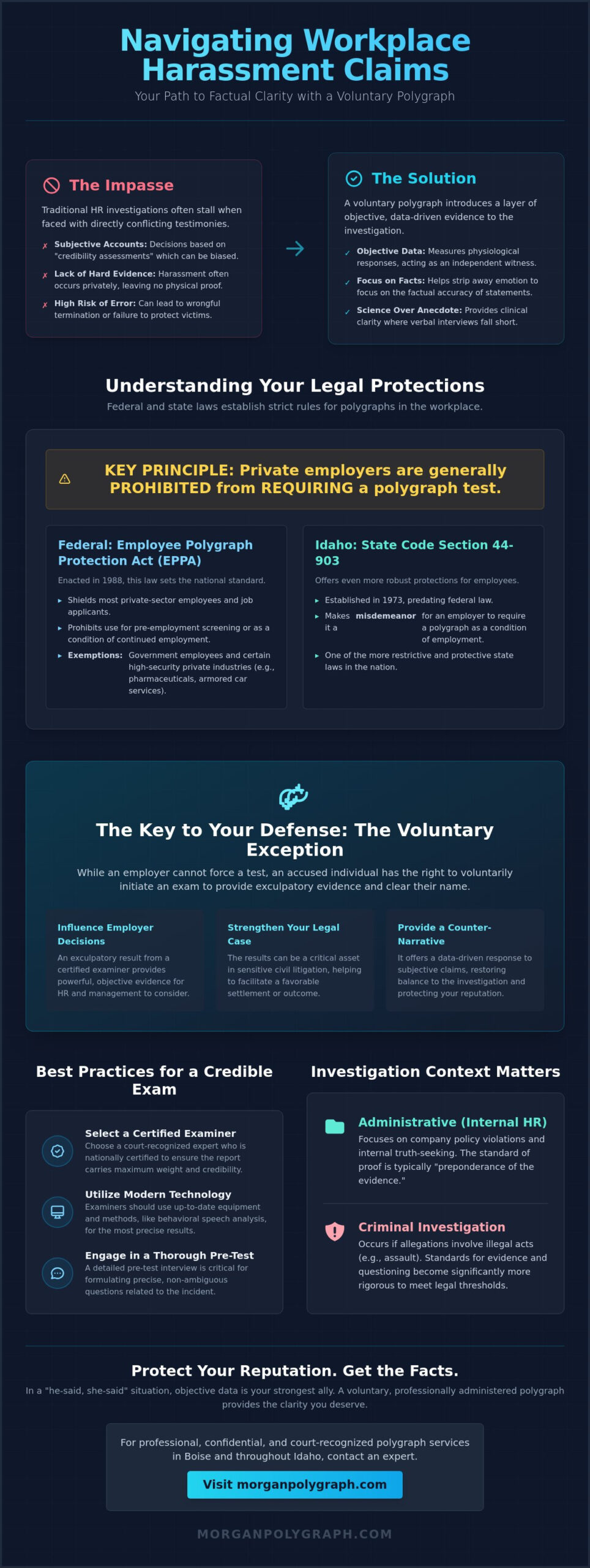
Traditional human resources investigations frequently reach an impasse. When one person’s account directly contradicts another’s, HR professionals are often forced to make decisions based on “credibility assessments” which are inherently subjective. This subjectivity can lead to wrongful terminations or a failure to protect victims. A professional examination introduces much-needed objectivity into this emotional landscape. Physiological data acts as an independent witness, recording the body’s autonomic responses to specific, incident-related questions. This process helps strip away the emotional weight of the claim, focusing instead on the factual accuracy of the statements provided. It’s a method that prioritizes science over anecdotal evidence.
Administrative vs. Criminal Context
It’s vital to distinguish between an internal administrative review and a criminal investigation. Most harassment claims begin within the company’s HR department as a violation of workplace conduct. However, if the allegations involve physical assault or other illegal acts, the matter may escalate to criminal charges. The protocols for a polygraph examination shift depending on these contexts. For administrative disputes, the focus is often on policy violations and internal truth-seeking. In criminal cases, the standards for evidence and the nature of the questioning become significantly more rigorous to meet legal thresholds.
The Employee Polygraph Protection Act (EPPA) sets the federal baseline for how these tests can be used in the private sector. While the law generally restricts employers from mandating tests, individuals often seek out independent exams to defend their reputations and provide a counter-narrative to subjective witness statements. Utilizing a nationally certified examiner ensures that the resulting report carries the necessary weight and credibility. These experts act as neutral third parties, committed to the integrity of the data rather than the interests of any specific side. This commitment to precision is why a polygraph for workplace harassment claims remains a powerful tool for those seeking to clear their name or verify a difficult truth in 2026.
The Employee Polygraph Protection Act (EPPA) and Workplace Misconduct
Understanding the legal boundaries is essential for anyone involved in a polygraph for workplace harassment claims. Enacted in 1988, the Employee Polygraph Protection Act (EPPA) is the primary federal statute designed to prevent private employers from using lie detector tests for pre-employment screening or as a condition of continued employment. While the law is broad, it isn’t absolute. In 2026, the intersection of federal law and state-specific regulations like Idaho Code Section 44-903 creates a complex environment for both employers and staff.
Who is Protected by EPPA?
Most private-sector employees are shielded from mandatory testing. This protection extends to both job applicants and current staff. However, government entities at the federal, state, and local levels are exempt from these restrictions. Certain high-security industries, such as armored car services or pharmaceutical companies that manufacture controlled substances, also maintain specific exemptions. In Idaho, protections are even more robust. Idaho Code Section 44-903, which was established in 1973, makes it a misdemeanor for any employer to require a polygraph as a condition of employment. This means that while federal law allows narrow windows for testing, Idaho law remains one of the more restrictive in the nation.
The Voluntary Testing Exception
The most effective way to use a polygraph test in a harassment dispute is through the voluntary exception. An accused individual can choose to initiate their own exam to provide exculpatory evidence. This is a critical legal path because it bypasses the prohibitions against employer-mandated testing. In 2026, these voluntary exams are more reliable than ever. New systems now integrate behavioral speech analysis and facial microexpression recognition alongside traditional physiological sensors, offering a level of precision that was unavailable in previous decades.
Choosing to undergo a test requires clear written consent. You also maintain the absolute right to stop the exam at any time. Defense attorneys often suggest independent testing so that results can be reviewed privately before they’re shared with an HR department or legal counsel. This proactive step allows you to maintain control over your defense strategy and reputation. If you’re currently facing a dispute, speaking with a qualified Boise examiner can help you understand how to document your side of the story with clinical accuracy. Employers who attempt to bypass these consent rules or penalize employees for refusing a test face significant federal fines and civil litigation.
Why Accused Individuals and Attorneys Seek Independent Polygraph Exams
Facing an allegation feels like being trapped in a narrative you didn’t write. While the legal framework often focuses on protecting employees from employer-mandated testing, it frequently overlooks the strategic power of a voluntary polygraph for workplace harassment claims. For those who are wrongly accused, an independent exam isn’t just a test; it’s a decisive tool for reclaiming the truth. Legal counsel often utilizes these results to shift the momentum of a case, providing a data-backed counter-argument that can lead an employer to dismiss a claim before it reaches a public courtroom or results in a permanent mark on a personnel file.
Beyond the immediate legal benefits, there’s a significant psychological advantage. Allegations of misconduct strip away a person’s sense of agency, leaving them vulnerable to “he-said, she-said” dynamics that HR departments are often ill-equipped to resolve. By choosing to undergo clinical testing, you move from a defensive posture to an active one. This proactive approach is particularly effective when building a defense against wrongful termination. A passed exam provides a concrete piece of evidence that challenges the accuser’s narrative, often forcing the opposing side to reconsider the strength of their position during settlement negotiations.
Clearing Your Name in the Public Record
Harassment allegations can haunt a professional career for decades, appearing in background checks or triggering reviews of professional licenses. A professional report from a certified polygraph near me serves as a permanent, exculpatory record. In 2026, where digital footprints are permanent and professional reputations are fragile, having a scientific document that verifies your integrity is essential for protecting your future employability and standing in the Boise professional community. It’s about ensuring that a single false claim doesn’t define the rest of your career.
The Attorney-Client Privilege Advantage
One of the most critical strategies used by defense attorneys is the “discovery” test. When an attorney retains an examiner, the results are typically protected by attorney-client privilege and work-product doctrines. This means if the results are unfavorable, they don’t have to be disclosed to the employer or the opposing counsel. However, if the results verify your innocence, they become a powerful weapon for settlement negotiations or court submission. Examiners work closely with legal teams to formulate precise, relevant questions that address the specific core of the polygraph for workplace harassment claims, ensuring the data is both clinically accurate and legally robust.
Best Practices for Conducting a Workplace-Related Polygraph in Idaho
Achieving a reliable outcome in a polygraph for workplace harassment claims depends heavily on the technical and procedural rigor of the examination. In 2026, the process has evolved beyond simple physiological monitoring to include sophisticated data-driven analysis. For an exam to be considered credible by legal counsel or an employer, it must follow a strict protocol that begins long before the sensors are attached. This methodical approach ensures that the resulting data is both clinically accurate and resistant to the “he-said, she-said” ambiguities common in harassment disputes.
Selecting a Certified Examiner in Boise
Credentials are the foundation of report credibility. In Idaho, it’s vital to select an examiner who holds national certification from organizations such as the American Polygraph Association (APA) or the American Association of Police Polygraphists (AAPP). These affiliations signal that the practitioner adheres to the highest ethical and scientific standards. Beyond certification, you should verify the examiner’s specific experience with civil litigation and workplace misconduct cases. A neutral, professional environment is also essential. A dedicated Boise office provides a controlled setting that minimizes external stressors, allowing for the precise measurement of autonomic responses without interference.
Question Formulation for Harassment Claims
The accuracy of the test often hinges on how questions are phrased. Professional examiners avoid “legal” or “subjective” terminology. For instance, asking “did you harass the claimant” is ineffective because “harassment” is a legal conclusion that varies by perspective. Instead, examiners focus on specific behavioral facts. A more effective question would be “did you touch [Name] on the shoulder on May 12th?” Behavioral questions like these produce significantly higher accuracy rates than broad, subjective accusations because they focus on verifiable physical actions rather than legal interpretations.
Questions regarding are polygraphs accurate in 2026 often center on these phrasing nuances. Modern examinations frequently utilize “Single Issue” formats for harassment cases. This focus allows the examiner to gather deeper physiological data on a specific incident rather than diluting the results with multiple, unrelated inquiries. When combined with behavioral speech analysis and facial microexpression recognition, these protocols provide a comprehensive truth-detection profile. Once the test is complete, a professional post-test review is conducted, followed by the delivery of a detailed report. If you need to establish the facts of a workplace incident, contact a certified examiner in Boise to discuss your specific requirements.
Morgan Polygraph: Professional Integrity for Boise Workplace Disputes
Establishing the truth in a professional environment requires more than just technical skill; it demands a deep understanding of the human and legal stakes involved. Morgan Polygraph has served the Boise community for decades, providing a foundation of trust for those facing the most difficult professional crises. Our practitioners understand that a single allegation can disrupt a career built over decades, which is why we approach every polygraph for workplace harassment claims with clinical precision and personal respect. By combining long-term industry experience with a commitment to objective truth, we offer a path toward resolution that prioritizes facts over hearsay.
Our firm is recognized by Idaho legal and governmental bodies for our rigorous standards and professional integrity. In an era where “he-said, she-said” narratives often dominate HR investigations, we provide a data-driven counter-narrative. We utilize state-of-the-art technology that aligns with 2026 industry advancements, including the integration of AI-powered deception detection tools. These modern methodologies, such as behavioral speech analysis and facial microexpression recognition, enhance the accuracy and reliability of our examinations, ensuring that every report we produce stands up to the closest scrutiny.
Expertise in Sensitive Workplace Investigations
Harassment accusations carry a heavy emotional and professional weight. At Morgan Polygraph, we specialize in handling these sensitive cases with the utmost discretion. We’ve built a history of providing expert testimony and comprehensive professional reports for Boise attorneys, helping them navigate complex civil and criminal litigation. Our office on W. State Street is designed to be a neutral, calm environment where clients can feel secure. This local accessibility allows us to work closely with Boise-based legal teams to formulate the precise, factual questions necessary to resolve a dispute effectively. We don’t just provide a service; we provide the expert documentation needed to protect a professional reputation.
Your Path Forward
Taking the first step toward clearing your name requires a methodical and organized approach. When you or your client enters our Boise suite, you’ll be guided through a clear, step-by-step process designed to ensure precision and comfort. We begin with a thorough pre-test interview to establish the specific facts of the workplace incident, ensuring that the examination remains focused on the core issues of the claim. Our examiners are nationally certified and committed to a process that is as transparent as it is accurate. If you’re ready to move past the uncertainty of an allegation, we are here to help you document the truth with confidence.
Schedule a Professional Consultation with Morgan Polygraph Today
Securing Your Professional Reputation with Data
The path to resolving a workplace dispute is rarely straightforward, but you don’t have to navigate it without objective evidence. Understanding your rights under the EPPA and Idaho state law is the first step in building a robust defense. While mandatory testing is prohibited, a voluntary polygraph for workplace harassment claims allows you to provide a clinical, data-driven account of the facts. This proactive strategy often changes the trajectory of an investigation, offering clarity when witness statements remain contradictory. It’s a powerful way to regain control over a narrative that feels increasingly out of your hands.
At Morgan Polygraph, we combine decades of experience with state-of-the-art 2026 technology to ensure the highest levels of accuracy and reliability. Our nationally certified examiners are court-recognized experts in Idaho, committed to handling every case with the utmost discretion and professional integrity. Whether you’re working with legal counsel or seeking personal clarity, we provide the methodical expertise required to protect your future and your standing in the Boise community. It’s time to move beyond allegations and focus on the verifiable truth.
Contact Morgan Polygraph for a Confidential Case Review
Frequently Asked Questions
Is it legal for my employer to ask me to take a polygraph for a harassment claim?
It is generally not legal for a private employer in Idaho to require a polygraph as a condition of employment. Idaho Code Section 44-903 specifically prohibits mandatory testing and classifies violations as a misdemeanor. While federal EPPA guidelines allow narrow exemptions for investigations involving specific economic loss, harassment claims rarely meet these criteria. Government entities and high-security firms remain the primary exceptions to these restrictive federal and state laws.
Can I take a polygraph test voluntarily to prove I didn’t harass someone?
Yes, you can choose to undergo a polygraph for workplace harassment claims on a voluntary basis. Many individuals use this strategy to provide objective evidence and clear their names when an investigation reaches a “he-said, she-said” impasse. It is essential to provide written consent and ensure the exam is conducted by a certified professional. Independent testing allows you to control the results before deciding to share them with an employer or legal counsel.
Are workplace polygraph results admissible in Idaho courts?
Polygraph results are generally not admissible in Idaho administrative hearings unless all involved parties agree to their admission. In civil or criminal court, admissibility often depends on specific judicial discretion and the agreement of both legal teams. Even when not entered as formal evidence, a passed exam remains a powerful tool during settlement negotiations. It provides a data-backed counter-narrative that can influence an employer’s final decision during an internal HR review.
What happens if I refuse to take a polygraph requested by my employer?
If you refuse a polygraph requested by a private employer, they cannot legally terminate or discipline you based solely on that refusal. Both federal and Idaho state laws provide protections against retaliatory actions for exercising your right to decline a lie detector test. Since Idaho law makes mandatory testing a misdemeanor, employers must be extremely cautious. They cannot use your refusal as the primary justification for any adverse employment action or disciplinary measures.
How accurate are lie detector tests for sexual harassment allegations?
Accuracy in 2026 has reached new levels through the integration of AI-powered deception detection and behavioral speech analysis. When conducted by a nationally certified examiner using “Single Issue” protocols, these exams provide a highly reliable physiological profile. The precision of the results depends heavily on the formulation of factual, behavioral questions rather than subjective legal terms. This clinical approach ensures that the data accurately reflects the truth of the specific incident being investigated.
Does the EPPA apply to government employees or police officers?
No, the Employee Polygraph Protection Act does not apply to federal, state, or local government employers. Police departments, federal agencies, and other public sector entities are exempt from the federal restrictions that govern private businesses. This means government employees may be subject to different testing requirements as part of their employment or internal investigations. However, these individuals still maintain specific constitutional rights and internal department protections during any formal questioning process.
What is the cost of a private workplace polygraph exam in Boise?
While specific pricing for a polygraph for workplace harassment claims varies based on the complexity of the case, Morgan Polygraph offers competitive rates in the Boise area. We provide a free initial consultation to discuss the details of your situation and determine the most appropriate testing protocol. Readers should contact a certified examiner directly to receive a personalized quote. This ensures the pricing reflects the specific technical requirements and the number of issues addressed during the exam.
Can my employer fire me based solely on a failed polygraph test?
No, a private employer cannot terminate your employment based solely on the results of a polygraph examination. Federal law requires that an employer have additional supporting evidence before taking adverse action against an employee. In Idaho, where labor laws are particularly protective, relying exclusively on a lie detector result for disciplinary decisions would likely lead to significant legal liability. The test should always be viewed as one component of a much broader, multi-faceted investigation.