

What if the key to ending months of circular arguments isn’t more talking, but a definitive, data-driven baseline of truth? When you’re considering using a polygraph for infidelity suspicions, you’ve likely reached a point of emotional exhaustion where the fear of being gaslighted outweighs the comfort of a simple “trust me.” It’s a heavy burden to carry the uncertainty of your marriage’s future while wondering if your intuition is right or if you’re simply seeing shadows. You deserve a professional, unbiased perspective that cuts through the noise of conflicting stories and emotional distress.
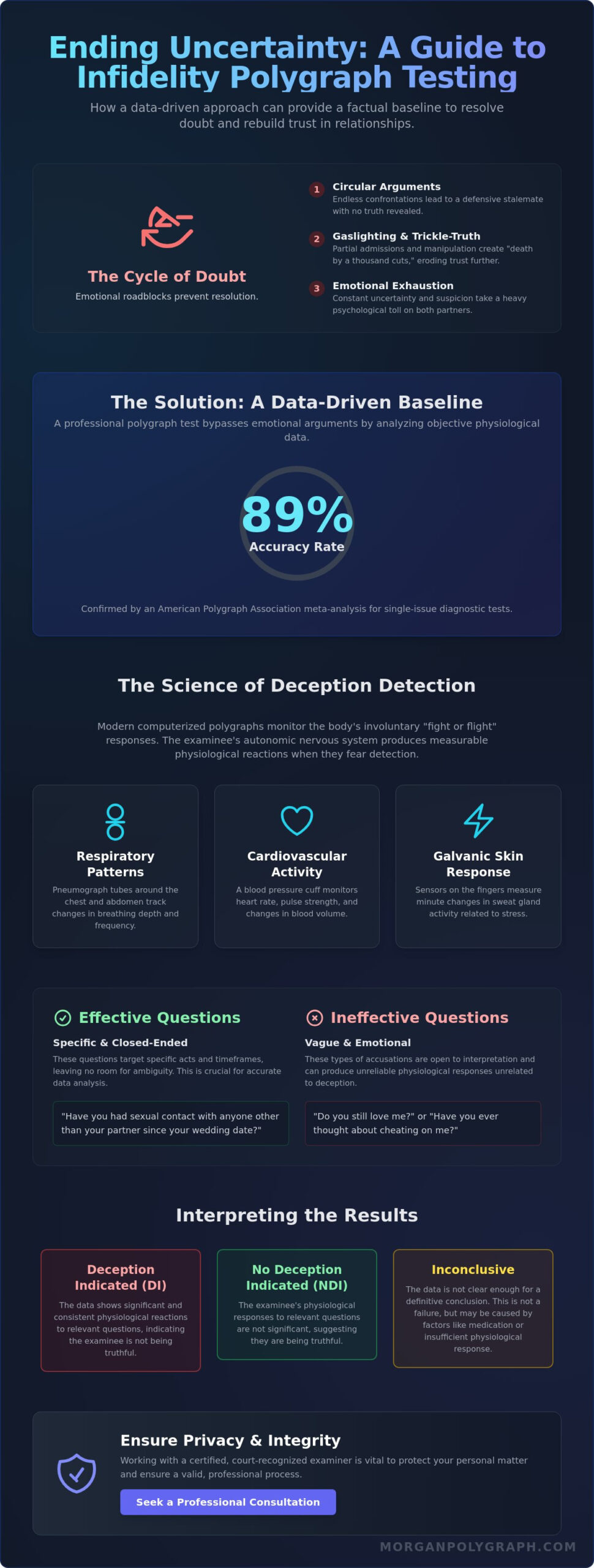
We understand the sensitivity of your situation. This 2026 guide explains how professional polygraph examinations provide a factual foundation to resolve these doubts and begin the process of rebuilding relationship trust. We’ll examine the clinical reality of modern testing, including how the American Polygraph Association’s meta-analysis confirmed an 89% accuracy rate for single-issue diagnostic tests. You’ll learn what to expect during the professional examination process and how definitive evidence can finally offer the peace of mind you need to move forward.
Key Takeaways
- Stop the cycle of circular arguments by establishing a factual baseline that addresses gaslighting and defensive narratives.
- Explore the clinical side of deception detection, where modern instruments monitor physiological responses to provide objective data.
- Learn the essential role of specific, closed-ended questions when using a polygraph for infidelity suspicions to avoid the pitfalls of vague accusations.
- Gain clarity on how to interpret professional results, including what an inconclusive finding actually means for your situation.
- Understand why working with a certified, court-recognized examiner is vital for maintaining the privacy and integrity of your personal matter.
Navigating Infidelity Suspicions: Why Circular Arguments Fail
Relationships thrive on transparency. When that transparency vanishes, the vacuum is filled with suspicion, leading to a cycle of circular arguments that rarely produce the truth. These confrontations typically end in a defensive stalemate where one partner feels gaslighted and the other feels interrogated. The psychological toll is heavy. This constant state of uncertainty can lead to severe emotional exhaustion and a total breakdown of household stability. Using a polygraph for infidelity suspicions is often the most direct way to bypass these emotional roadblocks and secure a factual baseline.
The core issue in these disputes is the reliance on circumstantial evidence. While intuition is a powerful internal compass, it lacks the objective weight of physiological data. To understand the technical background of how these measurements are recorded and analyzed, one can look into The Science of Polygraphy. By moving the conversation from “he-said, she-said” to data-driven detection, couples can stop the cycle of endless questioning and begin to address the reality of their situation.
The ‘Trickle-Truth’ Trap
Trickle-truth occurs when a partner reveals only the specific details they believe you’ve already discovered or can prove. This behavior is a defensive tactic designed to minimize consequences, but it creates a “death by a thousand cuts” effect. Each new admission feels like a fresh act of infidelity, damaging trust even more than the original incident. It’s a manipulative process that keeps the betrayed partner in a state of perpetual trauma. A professional polygraph examination demands a structured pre-test interview where a full narrative is established. This creates an environment of complete disclosure from the start, making it impossible for the partner to hide behind partial admissions.
When to Consider a Professional Examination
It’s vital to distinguish between healthy suspicion based on behavioral changes and pathological jealousy, sometimes referred to as Othello Syndrome. If a partner is experiencing delusional fixations despite a complete lack of evidence, a test might not provide the intended relief. However, for most people, the impact of unresolved doubt is a legitimate threat to mental health. Deciding to proceed with using a polygraph for infidelity suspicions is a significant step toward clarity. Many couples find that a professional test serves as a clinical prerequisite for entering couples counseling. It ensures that future therapy sessions are built on a foundation of honesty rather than hidden secrets or ongoing deception.
The Science of Truth: How Infidelity Polygraphs Work
A professional polygraph serves as a clinical diagnostic tool designed to measure involuntary physiological activity. When an individual is being deceptive, their body undergoes specific changes that are nearly impossible to suppress. By using a polygraph for infidelity suspicions, you are opting for a data-driven approach rather than a subjective interpretation of body language. Modern computerized systems have replaced the old analog “ink and paper” machines, allowing for far greater precision in data collection. These digital systems use sophisticated algorithms to record and analyze physiological shifts, providing a level of accuracy that traditional methods could not achieve.
The process relies on the “Psychological Set” theory. This principle posits that an examinee will focus their physiological attention on the questions that pose the greatest threat to their well-being. The psychological science of polygraphs suggests that when a person fears detection, their autonomic nervous system produces measurable reactions. During the exam, a professional monitors several distinct channels:
- Respiratory Patterns: Pneumograph tubes placed around the chest and abdomen track breathing depth and frequency.
- Cardiovascular Activity: A blood pressure cuff monitors heart rate, pulse strength, and blood volume changes.
- Galvanic Skin Response: Specialized sensors measure skin conductance, which changes based on sweat gland activity related to stress.
Autonomic Nervous System Indicators
The autonomic nervous system controls functions we don’t consciously direct, such as the “fight or flight” response. When a person is untruthful, this system triggers subtle physiological spikes. To ensure these spikes are meaningful, a professional examiner first establishes a physiological baseline. This involves asking neutral questions to see how the examinee’s body reacts when they are clearly telling the truth. The pre-test interview is equally critical. It ensures the examinee fully understands every question, removing any ambiguity that could lead to an accidental reaction. This methodical preparation is why Morgan Polygraph emphasizes a calm, controlled environment for every client.
Accuracy and Reliability in 2026
A common concern is whether general nervousness will cause a person to “fail” a test. However, examiners are trained to distinguish between the constant hum of anxiety and the specific, sharp deviations associated with deception. A detailed analysis of the accuracy of polygraph tests confirms that when conducted by a certified expert, these examinations provide a reliable baseline for relationship resolution. In 2026, the industry standard remains the American Polygraph Association (APA) accreditation. Using a polygraph for infidelity suspicions is most effective when the examiner is nationally certified, ensuring the testing protocols meet the highest scientific and ethical standards.
Questioning for Clarity: Designing Effective Fidelity Exams
Precision is the cornerstone of a valid examination. When using a polygraph for infidelity suspicions, the results are only as reliable as the questions themselves. Vague inquiries like “Have you ever been unfaithful?” are ineffective because they allow for subjective interpretation. One person might define unfaithfulness only as a physical act, while another might include emotional affairs or online interactions. To eliminate this ambiguity, questions must be closed-ended, specific, and agreed upon by all parties before the sensors are even attached.
Effective questioning focuses on concrete details such as specific timeframes, named individuals, or clearly defined physical acts. This level of detail removes the “gray areas” that often fuel relationship arguments. The process also relies on Comparison Questions. These are designed to establish the examinee’s unique physiological reaction to a known stressor. By comparing the reactions between these and the relevant questions, the examiner can accurately interpret the data. Research supported by the National Institute of Justice regarding the Validity of Polygraph Examinations highlights the necessity of these structured protocols to maintain high accuracy rates.
The Art of the ‘Relevant Question’
Crafting the perfect question requires a neutral, unbiased perspective. The goal is to isolate the specific suspicion without introducing “emotional noise” that could skew the physiological data. For example, instead of asking about general behavior, an examiner might ask, “Since January 2025, have you had sexual contact with anyone other than your spouse?” This clarity is essential for specialized cases, such as a sex addiction polygraph, where boundaries must be explicitly defined to provide the clarity the partner needs.
Standard Exam Protocols
A professional examination follows a strict three-phase protocol: pre-test, in-test, and post-test. During the pre-test, the examiner and examinee review every question. “Surprise” questions are never used in a certified polygraph examination because they induce a startle response that ruins the data. The in-test phase occurs in a quiet, distraction-free environment to ensure the sensors capture only the intended physiological responses. Finally, the post-test involves a detailed analysis of the charts. This methodical approach ensures that using a polygraph for infidelity suspicions remains a clinical, objective process rather than a confrontational one.
Interpreting the Results: Moving Toward Resolution
The conclusion of an exam isn’t just a verdict; it’s a diagnostic baseline. When using a polygraph for infidelity suspicions, the goal is to replace agonizing doubt with actionable information. Professional results are categorized into three primary outcomes: No Deception Indicated (NDI), Deception Indicated (DI), and Inconclusive. NDI signifies that the physiological data doesn’t show the markers of untruthfulness regarding the specific questions asked. Conversely, a DI result indicates that the autonomic nervous system reacted significantly to relevant inquiries, suggesting that the examinee wasn’t being fully honest.
Sometimes, the data doesn’t provide an immediate path forward. A 2011 meta-analysis by the American Polygraph Association (APA) found an inconclusive rate of 11% for single-issue tests and 13% for multi-issue exams. These results don’t mean someone is lying. Instead, they often stem from physiological factors like extreme physical fatigue, certain medications, or inconsistent breathing patterns that prevent a clear reading. A professional examiner identifies these issues early to maintain the integrity of the clinical baseline. This is why using a polygraph for infidelity suspicions is treated as a methodical process rather than a simple pass or fail event.
The Path to Healing After NDI Results
A “pass” or NDI result often brings immediate relief, but it also raises a difficult question: Why did the relationship reach this point of crisis? Once innocence is established, the focus shifts from investigation to restoration. This result acts as a catalyst for rebuilding shattered trust. It allows couples to stop the interrogation and start discussing the underlying emotional needs that were previously obscured by suspicion. Transitioning back to intimacy requires patience, and the objective data from the exam provides the security needed to begin that journey without the weight of hidden doubt.
Handling ‘Deception Indicated’ Findings
Receiving a DI result is undeniably painful, yet it’s often the first step toward genuine honesty. The examiner’s role is to present these findings objectively and without judgment. This isn’t a moment for condemnation, but for clarity. During the post-test interview, the examinee is given the opportunity for full disclosure. This therapeutic window allows for the whole truth to emerge, finally ending the cycle of trickle-truth mentioned earlier in this guide. Whether the partnership continues or dissolves, having the facts allows both parties to make informed decisions about their future. If you’re ready to find this clarity, you can schedule a confidential consultation to discuss your specific situation.
Professional Fidelity Testing in Boise: The Morgan Polygraph Difference
Choosing a provider for a relationship crisis requires more than just technical skill. It requires a partner who understands the local landscape and the weight of your situation. At Morgan Polygraph, we provide the Boise community with a professional, discreet environment where sensitive matters are handled with the highest level of clinical precision. Using a polygraph for infidelity suspicions is a deeply personal decision. We respect that vulnerability by ensuring every interaction is grounded in compassion and authority. Our Boise facility is specifically designed to offer a neutral, quiet space that prioritizes your privacy while utilizing state-of-the-art computerized detection technology.
We bridge the gap between rigorous physiological science and the emotional sensitivity required during relationship disputes. In a field where accuracy is paramount, we rely on established protocols rather than guesswork. Our examiners are seasoned experts who maintain a calm, collected confidence, helping to steady the environment for both parties. This methodical approach ensures that the data collected is reliable and that the final report provides the factual baseline needed to resolve long-standing doubts.
Certified Expertise in Idaho
Because Idaho does not have a state-specific licensing requirement for examiners, the burden of verifying credentials falls on the client. This makes American Polygraph Association (APA) accreditation the essential gold standard for your peace of mind. As a leading provider of a polygraph near me for Treasure Valley residents, we strictly adhere to these national standards. Our practitioners are recognized within the professional community for their expertise and commitment to ethical testing. We have extensive experience conducting specialized infidelity tests, ensuring that every examination is handled with absolute confidentiality and court-recognized rigor.
The Morgan Polygraph Process
Our process is designed to be logical, transparent, and unhurried. We guide you through each stage to ensure you understand the methodology and the results. The standard engagement follows these steps:
- Confidential Consultation: We begin with a phone consultation to discuss the specifics of your case and provide an accurate quote.
- Booking and Preparation: An appointment is secured with a non-refundable deposit. We provide clear instructions to ensure the examinee is physically and mentally prepared for the session.
- Pre-Test Interview: The examiner meets with the examinee to review the history of the suspicion and finalize the specific, agreed-upon questions.
- Data Collection: The in-test phase utilizes modern sensors to monitor autonomic nervous system activity in a distraction-free room.
- Reporting: After a thorough analysis of the charts, we provide a detailed written report outlining the findings.
Using a polygraph for infidelity suspicions can be the most stressful moment of a relationship crisis. We focus on patience and empathy throughout this process, ensuring you feel you’re in capable hands. If you are ready to move past the uncertainty and secure the peace of mind you deserve, contact our Boise office to begin your journey toward clarity.
Taking the Final Step Toward Factual Resolution
Suspicion shouldn’t be a permanent state in your relationship. By choosing a data-driven path, you replace the exhaustion of circular arguments with the precision of physiological evidence. We’ve discussed how a structured examination bypasses “trickle-truth” and provides a clinical baseline for either rebuilding trust or moving forward with certainty. Using a polygraph for infidelity suspicions is a proactive step toward ending the stalemate of conflicting narratives and emotional distress.
Clarity is within reach. Our team of Nationally Certified Examiners and Court-Recognized Experts provides the technical accuracy you need within a Discreet & Professional Boise Facility. We’re here to help you navigate this transition with the respect and expertise your situation demands. Schedule a Confidential Infidelity Consultation in Boise today. You deserve the peace of mind that only the truth can provide.
Frequently Asked Questions
Can someone ‘fail’ an infidelity polygraph just because they are nervous about the relationship?
Nervousness doesn’t cause a person to fail a professional examination. Examiners establish a physiological baseline during the pre-test phase to distinguish between a person’s general state of anxiety and the specific, sharp deviations associated with deception. This baseline allows the sensors to account for the natural stress of the situation, ensuring that only reactions to relevant questions are analyzed for deceptive markers.
How many questions can I ask during a relationship lie detector test?
Standard protocols typically limit the exam to three or four specific relevant questions. When using a polygraph for infidelity suspicions, asking too many questions can dilute the physiological focus and reduce the overall accuracy of the data. Focusing on a few high-impact, closed-ended questions ensures that the autonomic nervous system provides a clear and interpretable response for the examiner to analyze.
Is the polygraph result admissible in an Idaho divorce court?
Polygraph results are not generally admissible in Idaho courts unless all parties involved have stipulated to their admission beforehand. While they are powerful tools for finding personal clarity and resolving private disputes, they are rarely used as primary evidence in legal proceedings. Most clients utilize these tests to establish a factual baseline for their own peace of mind or as a prerequisite for therapy.
What happens if the examinee is taking medication for anxiety or depression?
Examinees must disclose all current medications during the pre-test interview so the examiner can account for them. Certain anti-anxiety medications or antidepressants can dampen physiological responses, which might lead to an inconclusive result rather than a clear pass or fail. A professional examiner will evaluate whether the examinee is in a fit physiological state to provide reliable data before the testing begins.
How long does a typical infidelity polygraph examination take to complete?
A comprehensive examination typically lasts between two and four hours. This timeframe is necessary to conduct a thorough pre-test interview, formulate and review the questions, perform multiple rounds of physiological data collection, and analyze the results. Using a polygraph for infidelity suspicions is a methodical process that cannot be rushed if you want to ensure the highest level of clinical precision.
Can I be in the room while my partner is taking the polygraph test?
No, the spouse or partner cannot be present in the examination room. A professional test requires a controlled, distraction-free environment to ensure the sensors capture only the examinee’s involuntary physiological responses. The presence of another person can introduce emotional variables or “outside noise” that could skew the data and lead to an invalid or inconclusive result.
What is the difference between a private examiner and a police polygraph?
Private examiners focus on providing clarity and resolution for civil matters, such as relationship disputes or pre-employment screening, in a clinical and non-confrontational setting. Police polygraphs are strictly investigative tools used to narrow down suspect lists in criminal cases. While the technology is similar, the environment and the goal of a private exam are centered on the client’s need for personal truth.
Are the results of an infidelity polygraph kept confidential?
Yes, the results of the examination are kept strictly confidential. The final written report is only released to the individual who authorized and scheduled the test, or to those specifically designated in a written release. Privacy is a cornerstone of professional practice, ensuring that your sensitive relationship matters are handled with the utmost discretion and care.