
In Idaho’s legal system, a polygraph isn’t just a test; it’s a precision instrument that requires a mutual agreement to even enter the courtroom. You’re likely feeling the weight of legal uncertainty or perhaps anxiety about how the Idaho court polygraph procedure actually unfolds. It’s common to feel overwhelmed by the specific 2024 regulatory shifts regarding admissibility and examiner standards. These concerns are valid because the path to a credible result is paved with strict procedural requirements that demand expert attention.
This guide provides the expert clarity you need to handle these complexities with confidence. You’ll gain a clear understanding of the “stipulation” requirement that governs admissibility in administrative hearings following the July 2024 code changes. We also provide a step-by-step breakdown of the examination process and guidance on selecting a practitioner who meets the Idaho Sexual Offender Management Board’s rigorous standards. We’ll examine the technical protocols, the specialized requirements for post-conviction testing, and how modern data-driven methodologies ensure your case is handled with the highest level of professional integrity and discreet care.
Key Takeaways
- Understand how the “stipulation” requirement under IDAPA 62.01.01.484 dictates the admissibility of results in Idaho legal proceedings.
- Gain a step-by-step overview of the Idaho court polygraph procedure, ensuring you’re prepared for every phase from pre-test disclosures to data collection.
- Learn the critical distinctions between general examinations and specialized Post-Conviction Sex Offender Testing (PCSOT) protocols required by state boards.
- Discover the specific credentials and expert witness experience necessary to select a polygraph examiner recognized by Idaho’s judicial districts.
- Explore how integrating modern physiological sensors and validated methodologies provides the clinical precision needed for high-stakes criminal and civil cases.
Idaho Admissibility: Understanding IDAPA 62.01.01.484
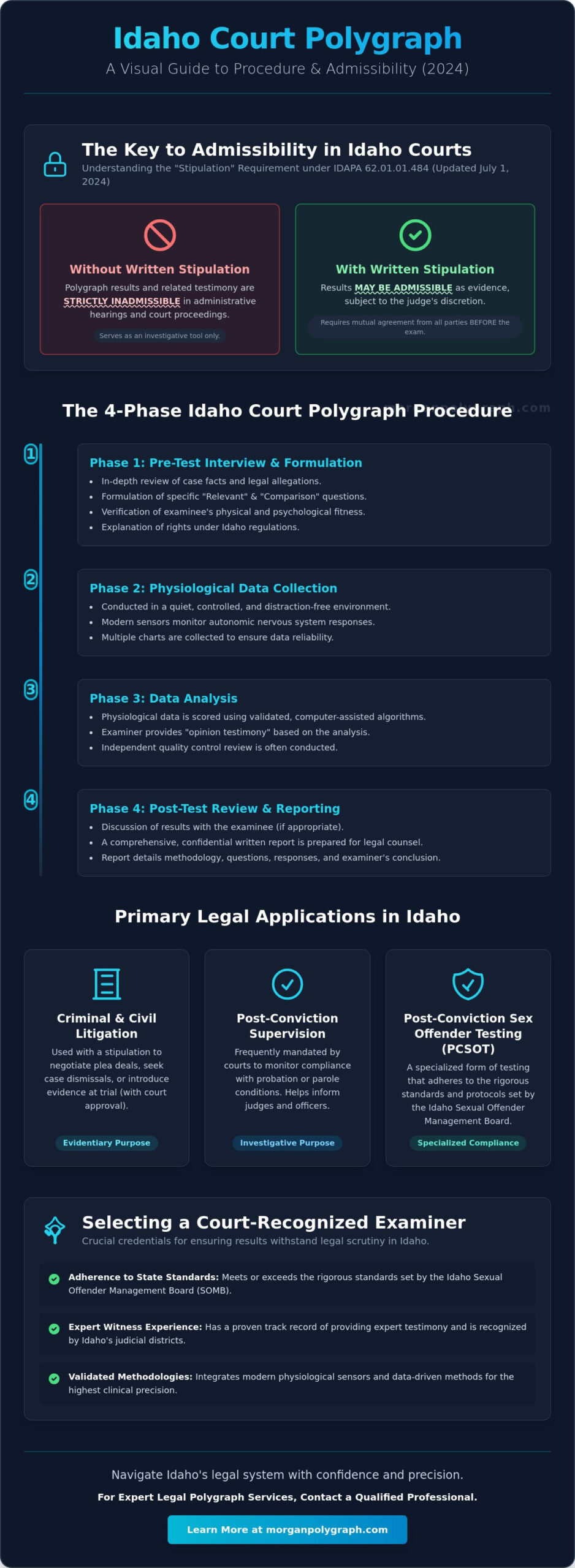
Idaho’s legal framework regarding truth verification is built on the principle of mutual consent. Under IDAPA 62.01.01.484, which was updated on July 1, 2024, polygraph examination results and any related expert testimony are strictly inadmissible in administrative hearings unless every party involved agrees to their admission. This regulation reflects a broader judicial philosophy observed across the state’s courtrooms. In criminal and civil litigation, the Idaho court polygraph procedure centers on the “stipulation.” Without this formal, written agreement, the data collected during an exam remains an investigative tool rather than a piece of evidence.
A Polygraph technology overview demonstrates how these instruments monitor autonomic nervous system responses. Because these responses are interpreted by an examiner, Idaho courts treat the results as “opinion testimony” rather than absolute physical fact. This distinction is why Idaho’s standards for expert or lay opinion differ from jurisdictions that might allow results under broader scientific evidence rules. Even when a stipulation exists, the judge retains discretionary power. The court acts as a gatekeeper, ensuring the exam’s methodology was sound and the examiner’s credentials meet professional standards before allowing the jury to hear the findings.
The Power of the Written Stipulation
For a polygraph to influence a case’s outcome, the prosecution and defense must execute a valid written stipulation before the exam occurs. This document typically outlines the scope of the questions and the specific examiner to be used. Defense attorneys frequently use this procedure to negotiate plea deals or seek case dismissals. If the client passes a stipulated exam, the prosecution may agree to drop charges or reduce them significantly. It’s a high-stakes strategy because a failure under a signed stipulation can be equally damaging. Before proceeding, it’s vital to understand the foundational mechanics of a polygraph test to ensure the legal strategy is sound and the client is prepared for the environment.
When Courts Order a Polygraph
While admissibility for trial is limited, courts in Southern Idaho and the Boise area frequently mandate polygraphs for post-conviction supervision. This is especially common in probation or parole compliance cases. In these instances, the Idaho court polygraph procedure serves an “investigative” rather than “evidentiary” purpose. The results help probation officers and judges monitor compliance with court orders. For example, a judge might use periodic testing to inform sentencing recommendations or to determine if a defendant is adhering to specific behavioral restrictions. This methodical use of technology assists in maintaining public safety while providing a structured, data-driven path for rehabilitation and monitoring.
The Step-by-Step Idaho Court Polygraph Procedure
The Idaho court polygraph procedure follows a standardized, four-phase protocol designed to withstand rigorous legal scrutiny. Every examination is conducted with a focus on clinical precision and respect for the individual’s privacy. This methodical approach ensures that the data collected is both reliable and defensible in a court of law. By adhering to these strict phases, we bridge the gap between biological data and the legal requirements established by the state’s judicial system.
Phase 1: The Pre-Test Interview
The process begins with an extensive review of case facts and legal allegations. We collaborate with the examinee to ensure they understand the purpose of the exam and their rights under IDAPA 62.01.01.484. A critical component of this phase is formulating “Relevant” and “Comparison” questions. This custom-tailored approach is essential for maintaining high polygraph accuracy by eliminating ambiguity. Before moving forward, we verify the examinee is physically and psychologically fit. This step prevents results from being compromised by temporary health issues or extreme fatigue.
Phase 2: Physiological Data Collection
Inside our Boise testing suite, we maintain a quiet, controlled environment to minimize external distractions. We use state-of-the-art sensors to monitor three primary systems: respiration patterns through pneumograph tubes, electrodermal activity via specialized finger plates, and cardiovascular activity with a precision blood pressure cuff. Our practitioners maintain absolute clinical neutrality during the questioning series. This disciplined environment is a hallmark of our methodical and organized operation, providing the stability required for accurate data acquisition. The sensors capture minute physiological shifts that are invisible to the naked eye but essential for objective analysis.
Once data collection is complete, we move into Phase 3: Post-Test Analysis. We apply validated scoring algorithms to the physiological charts to provide an objective interpretation. This isn’t a subjective “hunch” but a data-driven conclusion based on established scientific principles. Finally, in Phase 4, we prepare a comprehensive report for legal counsel. This documentation includes a breakdown of the methodology and results, serving as the foundation for expert witness testimony in Idaho’s 4th Judicial District. If your case requires this level of technical detail, you can consult with our lead practitioner to discuss the specific requirements for your legal team.
Specific Legal Applications: From Criminal Defense to PCSOT
Idaho’s legal landscape requires distinct testing protocols depending on the case type. The Idaho court polygraph procedure adapts to meet these varied demands, whether the goal is investigative clarity or post-conviction compliance. In felony criminal defense, practitioners use these exams to clarify a defendant’s involvement or establish innocence when physical evidence is sparse. Civil litigation often involves high-stakes disputes where truth-verification serves as a deciding factor in resolving claims without a paper trail. Family law cases, particularly those involving sensitive domestic allegations or custody disputes, benefit from the clinical neutrality of a formal exam. All these applications must align with the Idaho Rules of Administrative Procedure to ensure findings are handled within the appropriate legal framework.
Post-Conviction Sex Offender Testing (PCSOT)
The Idaho Sexual Offender Management Board (SOMB) mandates specific testing cycles for individuals under supervision. These include “Maintenance” exams to ensure compliance with treatment rules and “Monitoring” exams to detect any new or undisclosed illegal activity. Results from these tests are vital for maintaining the idaho sex offender registry standards and ensuring public safety. Examiners in the Treasure Valley work closely with parole officers and specialized therapists to maintain a transparent chain of information. This collaborative approach ensures that the supervision team has a clear, data-driven picture of the individual’s behavior and risk level.
Psychosexual Evaluations and Polygraphy
Polygraph data serves as a foundational component of a comprehensive psychosexual evaluation. There’s a significant procedural overlap between behavioral assessment and physiological testing. By integrating polygraph results, clinicians can verify the historical accuracy of an examinee’s self-reported data. This specialized Idaho court polygraph procedure ensures that all parties receive an objective, data-driven foundation for clinical recommendations. It removes the guesswork from the assessment process, allowing the court to make informed decisions based on validated physiological responses rather than just verbal testimony. This methodical integration of technology and behavioral science is essential for high-stakes judicial determinations.
Selecting an Idaho Court-Recognized Polygraph Examiner
The choice of an examiner is as critical as the legal strategy itself. When navigating the Idaho court polygraph procedure, the credibility of the results hinges entirely on the practitioner’s standing within the professional community. An examiner must demonstrate a deep understanding of Idaho’s specific judicial expectations, particularly within the 4th Judicial District. This district, which includes Boise, requires reports that are not only technically accurate but also formatted for rigorous legal scrutiny. Expert witness experience is essential for any practitioner whose findings will be presented in a courtroom.
Credentials That Matter in Court
National certification from the American Polygraph Association (APA) or the American Association of Police Polygraphists (AAPP) is the non-negotiable gold standard for Boise attorneys. These affiliations ensure the examiner adheres to validated testing methodologies and ethical standards. For cases involving post-conviction supervision, the examiner must hold specific certification from the Idaho Sexual Offender Management Board (SOMB). This requires a minimum of 40 hours of formal PCSOT training for associate levels, while senior examiners must have completed at least 100 examinations, including 10 sexual history and 10 maintenance exams, within a three-year period. Local Boise expertise is superior to out-of-state contractors because an examiner who regularly interacts with Idaho’s judicial districts understands the unique procedural nuances and evidentiary preferences of local judges.
The Red Flags of Substandard Testing
Substandard testing introduces significant legal risk. One primary red flag is an examiner who deviates from standardized APA protocols, such as skipping the pre-test interview or using unvalidated question formats. Relying on a non-certified polygraph near me search result can lead to inadmissible data that fails to support your case during a critical hearing. Additionally, “online lie detector” services are entirely disregarded by the court; they lack the physiological sensor arrays required for a legitimate Idaho court polygraph procedure. These digital shortcuts don’t monitor respiration, cardiovascular activity, or electrodermal responses, making them useless in a legal setting.
The technological landscape of 2026 demands the use of advanced digital systems. Modern polygraph instruments use sophisticated algorithms and high-resolution sensors to capture data that older, analog machines simply cannot match. This technical precision allows an examiner to provide credible expert witness testimony that stands up to cross-examination. If you’re currently preparing for a legal proceeding, you should schedule an examination with an Idaho-recognized expert to ensure your data meets the highest standards of the court. Evaluating an examiner’s history of court-recognized reports is a necessary step to protect your interests and maintain the integrity of your legal defense.
The Morgan Polygraph Approach to Legal Examinations
Morgan Polygraph has established a reputation for excellence by bridging traditional expertise with futuristic technology. We’ve spent decades working alongside Idaho defense firms and government agencies to provide reliable data in high-stakes environments. Our specific approach to the Idaho court polygraph procedure is rooted in a commitment to being discreet and trustworthy. We handle every piece of sensitive legal data with the highest level of confidentiality, ensuring that our clients feel they’re in capable and seasoned hands. This professional focus is essential when dealing with the complexities of felony cases or high-value civil litigation.
Our Boise facility is a core component of our methodology. It’s designed specifically for professional, low-stress legal testing. We understand that the physical environment directly impacts physiological responses. By maintaining a clinical yet approachable atmosphere, we help examinees remain focused, which leads to cleaner and more reliable data. This methodical and organized setting is a hallmark of our operation, reflecting our deep respect for the human element involved in truth verification.
Expert Testimony and Litigation Support
We don’t just provide a report; we offer comprehensive litigation support that extends into the courtroom. This includes providing clear, authoritative testimony on polygraph methodology in Idaho’s judicial districts. We assist counsel with drafting the precise “stipulation” language required to satisfy the court’s admissibility standards. Our lead practitioner is skilled at bridging the gap between complex technical data and jury understanding, making physiological findings accessible and compelling. We also prepare attorneys for the cross-examination of polygraph evidence, helping them identify procedural flaws or technical inconsistencies in opposing reports.
Contact Our Boise Office for a Legal Consultation
Attorneys should seek early engagement in the criminal defense timeline to maximize the strategic value of a polygraph exam. Integrating truth verification early in a case allows for better negotiation with prosecutors and more informed defense strategies. We provide clear, straightforward instructions for legal teams looking to schedule an exam for a client, ensuring the process is systematic and unhurried. Our goal is to provide the data-driven foundation your case requires while maintaining the highest levels of professional integrity. To begin the process, schedule a court-recognized polygraph in Boise today and ensure your legal team has the support of a seasoned industry expert.
Securing Your Legal Strategy with Technical Precision
Success in the Idaho judicial system requires more than just a test; it demands a rigorous adherence to state-specific protocols. You now understand that admissibility hinges on a valid written stipulation under IDAPA 62.01.01.484 and that choosing an examiner with specialized PCSOT and legal expertise is non-negotiable. Mastering the Idaho court polygraph procedure allows you to bridge the gap between complex physiological data and clear, persuasive evidence. By focusing on nationally certified practitioners and modern digital systems, you ensure your results withstand the scrutiny of the 4th Judicial District.
Our team provides the methodical and discreet support required for high-stakes litigation. We’re recognized by Idaho courts and defense attorneys for our commitment to clinical accuracy and professional integrity. Don’t leave your case to chance with unverified testing methods. It’s time to leverage decades of experience to strengthen your position in the courtroom. Contact Morgan Polygraph for Court-Recognized Legal Testing and gain the confidence that comes from working with a seasoned expert. We’re here to guide you through every step of this sensitive process with the respect and expertise you deserve.
Frequently Asked Questions
Are polygraph results admissible in Idaho courts in 2026?
Polygraph results are generally inadmissible in Idaho courts unless all parties involved enter into a formal, written stipulation before the exam. This baseline rule, reinforced by the July 2024 updates to IDAPA 62.01.01.484, applies to both administrative hearings and trial proceedings. While results don’t serve as absolute evidence, they’re frequently used in pre-trial negotiations, plea bargaining, and sentencing recommendations when the defense and prosecution agree to their use.
What happens if I fail a court-ordered polygraph in Boise?
Failing a court-ordered examination in Boise can lead to increased supervision, mandatory treatment adjustments, or a probation violation hearing. Because these exams are often a condition of parole or probation, a “deceptive” result serves as a critical investigative lead for your supervision officer. You should consult with your legal counsel immediately to address the clinical findings and the Idaho court polygraph procedure followed during your specific test.
Can a judge force me to take a polygraph in a criminal case?
A judge cannot compel a defendant to take a polygraph in an active criminal trial due to constitutional protections against self-incrimination. However, polygraphs are often mandated as a condition of post-conviction supervision or as part of a voluntary plea agreement. In these specific contexts, a refusal to participate can result in the loss of certain legal privileges or may be considered a violation of your supervision terms.
How much does a court-admissible polygraph cost in Idaho?
The cost of a court-admissible polygraph varies based on the complexity of the case and the examiner’s level of certification. Factors such as the number of questions, the type of testing required, and the necessity for expert witness testimony will influence the final fee. You should contact a certified examiner directly to receive a professional quote tailored to the specific requirements of your legal team and the judicial district involved.
What is the difference between a private polygraph and a court polygraph?
A court polygraph requires higher standards of documentation and strict adherence to validated judicial protocols compared to a standard private exam. While a private test might focus on personal matters like relationship testing, a court-recognized exam must follow specific APA techniques and include a report formatted for legal scrutiny. This ensures the Idaho court polygraph procedure meets the rigorous standards expected by judges in Idaho’s 4th Judicial District.
How do I find a court-recognized polygraph examiner in Southern Idaho?
To find a recognized examiner in Southern Idaho, you should verify their standing with the American Polygraph Association (APA) and the Idaho Sexual Offender Management Board (SOMB). Local defense attorneys often maintain a list of practitioners who have a proven history of providing expert testimony in Boise courts. Choosing an examiner with a local facility ensures they’re familiar with the regional procedural nuances and specific judicial expectations of the area.
Does the Idaho Department of Corrections accept private polygraph results?
The Idaho Department of Corrections typically only accepts results from examiners who are specifically certified and approved by the Sexual Offender Management Board (SOMB). Private exams conducted by non-certified practitioners generally won’t satisfy the strict requirements for probation or parole monitoring. It’s essential to confirm that your chosen practitioner is on the state-approved roster before scheduling any maintenance or monitoring exam for official supervision purposes.
Can I use a polygraph for an Idaho child custody case?
Polygraphs can be used in child custody cases if both parties stipulate to the exam or if a judge suggests one to clarify sensitive domestic allegations. While the results are rarely the sole factor in a custody determination, they provide a data-driven foundation for a judge’s assessment of parental fitness. These exams are handled with extreme discretion to protect the privacy of the family while providing the court with additional investigative clarity.