

What if the most intimidating part of a lie detector exam isn’t the technology, but the fear of a question you didn’t see coming? It’s completely normal to feel a sense of apprehension when wondering what questions are asked in a polygraph test, particularly when your reputation or career is on the line. You might worry about intrusive personal inquiries or false positives triggered by simple nerves. We understand that this process can feel vulnerable. That is why we prioritize a methodical, discreet approach that puts your mind at ease through transparency and professional respect.
In this 2026 guide, you’ll discover exactly how professional examinations are structured to ensure fairness and clinical accuracy. We’ll break down the three essential categories of questions, from neutral baselines to the specific issues at hand. You’ll also learn about the strict protocols that prohibit surprise questions and protect your privacy under federal and state regulations. By the end of this article, you’ll have the mental preparation needed for a successful pre-test interview and a clear understanding of the data-driven methodology that maintains a high standard of reliability in every exam.
Key Takeaways
- Understand the “No Surprise” rule, which ensures every single question is reviewed and finalized during the pre-test interview before any sensors are attached.
- Gain clarity on what questions are asked in a polygraph test by categorizing them into relevant inquiries, comparison baselines, and neutral irrelevant statements.
- Discover why professional protocols require simple “Yes” or “No” responses to eliminate vocal artifacts and ensure the highest levels of data-driven accuracy.
- Identify how examination questions are specifically tailored for different scenarios, including sensitive relationship testing and rigorous pre-employment screenings.
- Learn how to practically prepare for your appointment at our Boise office by prioritizing honesty during the critical question-review phase.
Understanding the Structure of Polygraph Questions
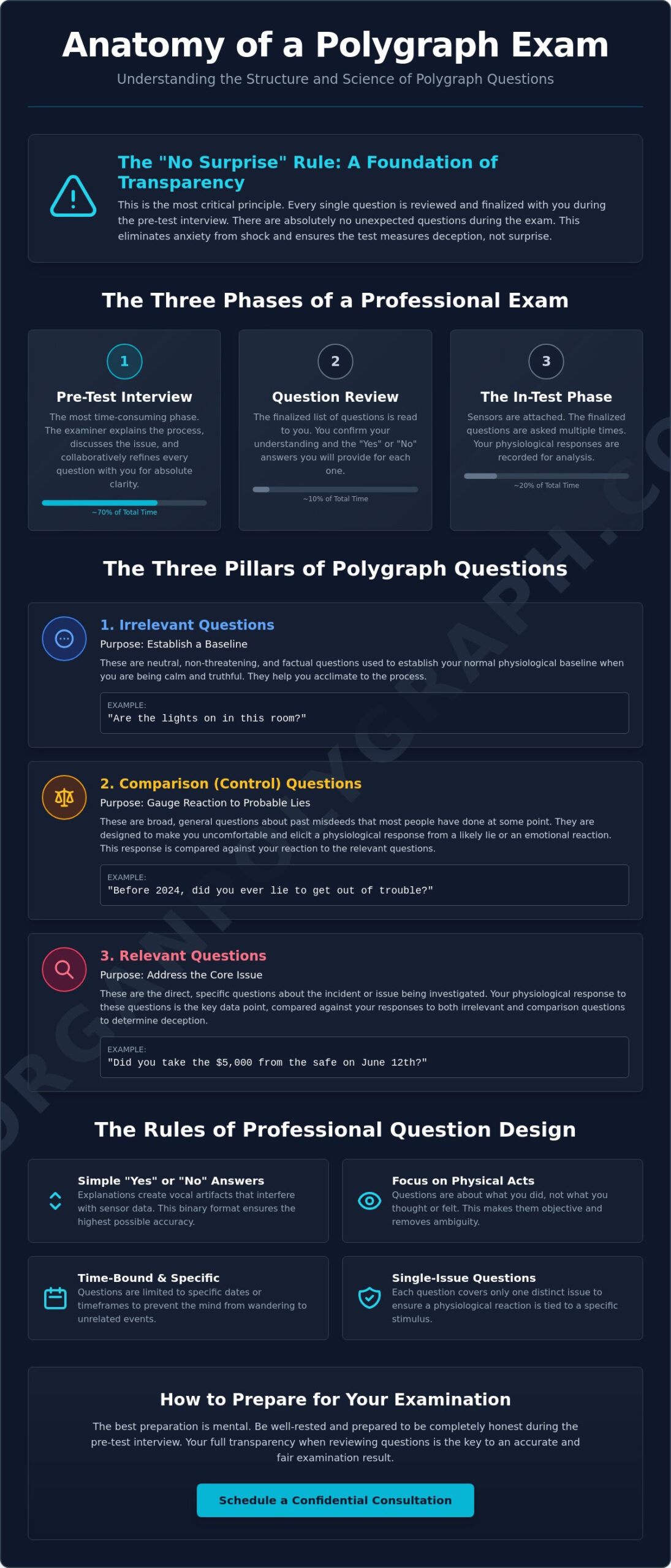
Professionalism in deception detection begins with absolute transparency. One of the most significant misconceptions about a Polygraph is the idea that the examiner will catch the subject off guard with unexpected inquiries. In reality, the “No Surprise” rule is a fundamental ethical requirement of modern examination protocols. Every question that will be asked during the actual test is reviewed, word for word, with the examinee during a detailed pre-test interview. This ensures that the subject fully understands the scope of the inquiry and that there’s no ambiguity that could lead to an erratic physiological response.
When clients ask what questions are asked in a polygraph test, they’re often relieved to learn that the process is entirely transparent. The examiner’s role is to act as a neutral technician, not an interrogator. By reviewing the questions beforehand, the examiner eliminates the element of shock. This is critical because the instrument is designed to measure physiological changes related to deception, not the startle response from a surprise. All questions must be answered with a simple “Yes” or “No.” This requirement is a technical necessity. Long, explanatory answers create vocal artifacts that interfere with the sensitivity of the sensors, making the data difficult to score accurately.
The Pre-Test Interview Phase
The pre-test interview is the most time-consuming part of the process. It often lasts significantly longer than the actual test. During this phase, the examiner works with the examinee to refine the wording of each question until it’s perfectly clear. We establish a shared understanding of what constitutes a “truth” versus a “lie” regarding the specific issue. This collaboration ensures that the examinee isn’t left wondering about the meaning of a term mid-test. Clarity helps maintain a stable physiological baseline and reduces anxiety related to the unknown.
The Objective Nature of Professional Questions
Professional questions are designed to be entirely objective. We avoid subjective language such as “often,” “usually,” or “sometimes” because these terms are open to interpretation. Instead, questions focus on specific physical acts. For example, instead of asking “Are you a dishonest person?”, an examiner might ask “Did you take that money from the safe on June 12th?”. This precision allows for a clear, distinct physiological reaction point for the examiner to score. Key characteristics of professional questions include:
- Physical Acts: Inquiries focus on what you did, not what you thought or felt.
- Time-Bound: Questions are limited to specific dates or timeframes to prevent the mind from wandering to unrelated past events.
- Exclusivity: Each question covers a single, distinct issue to ensure the physiological reaction is tied to a specific stimulus.
By framing questions around concrete actions rather than internal feelings, the examiner ensures that the data collected is as reliable and data-driven as possible. This methodical approach is what separates a professional examination from the dramatized versions often seen in popular media.
The Three Pillars: Relevant, Comparison, and Irrelevant Questions
Understanding what questions are asked in a polygraph test requires looking at the three distinct categories used by professional examiners. A high-quality exam isn’t a random list of queries. It’s a calculated sequence designed to produce measurable, clinical data. These three pillars-relevant, comparison, and irrelevant questions-work together to create a physiological map of the subject. By using this structured polygraph examination technique, we’re able to distinguish between situational stress and genuine deception with high levels of precision.
Irrelevant questions serve as the foundational baseline. These are neutral, factual queries such as “Is today Tuesday?” or “Are we currently in Boise, Idaho?”. They’re designed to be answered truthfully and without any emotional effort. Their purpose is simple: to stabilize your physiology and establish a baseline of what your body looks like when you’re being honest and calm. These “warm-up” queries help the subject settle into the rhythm of the exam before more sensitive topics are introduced.
Relevant Questions: The Heart of the Exam
Relevant questions get to the core of the investigation. In a criminal defense case or a civil dispute, these are the direct inquiries about the specific incident under review. For instance, an examiner might ask, “Did you take that vehicle without permission on May 10th?”. These are never “trick” questions. We limit them to the most critical facts to ensure total clarity. Because we review these word-for-word during the pre-test interview, you’ll know exactly which specific actions are being scrutinized before the sensors are even attached.
Comparison and Irrelevant Question Examples
Comparison questions, sometimes called control questions, are perhaps the most misunderstood part of the process. They focus on minor, common transgressions that most people have committed at some point in their lives. A typical example might be, “Before 2026, did you ever tell a lie to get out of trouble?”. The examiner actually expects a physiological response here. By comparing how your body reacts to these “minor” lies versus the relevant questions, we can determine the final score. If a person is truthful about the relevant issue, they’ll typically show a stronger reaction to the comparison questions than the relevant ones.
This Comparison Question Technique (CQT) remains the industry standard for achieving high-accuracy results. It’s a methodical process that relies on data-driven detection rather than gut feelings. If you’re preparing for a professional polygraph exam, understanding these categories can significantly reduce the anxiety of the unknown. Our goal is to provide a clear, fair environment where the truth can be documented with scientific precision and respect for your privacy.
Specific Question Categories for Legal, Personal, and Therapeutic Exams
The effectiveness of a deception detection exam relies heavily on customization. While the underlying technology remains consistent, the specific inquiries vary significantly based on the client’s needs and the legal context of the case. In Boise, professional examiners must adhere to rigorous standards to ensure that results are reliable for legal defense or treatment monitoring. When considering what questions are asked in a polygraph test, it’s essential to understand that the focus shifts from general background information to highly specific, verifiable actions depending on the exam’s purpose.
Infidelity and Relationship Testing Questions
Relationship exams require a high level of sensitivity and precision. We move away from subjective, emotional inquiries that the instrument cannot accurately measure. For instance, a question like “Do you still love your ex-partner?” is ineffective because love is an internal emotion, not a verifiable fact. Instead, we focus on physical boundaries and specific romantic or sexual contact. A professional examiner will ask, “Since you began your relationship with Jane, have you had sexual contact with anyone else?”. This clarity is vital for obtaining a definitive result. If you’re seeking more depth on how these exams help restore trust, our infidelity test guide provides comprehensive guidance on the process.
Criminal Defense and Civil Case Questioning
In legal contexts, we coordinate closely with defense attorneys to address specific allegations or evidence. These questions must meet the high standards required for court-recognized examinations. We act as neutral, third-party fact-finders. The inquiries are designed to address the “gravamen” or the heart of the legal issue. For example, in a theft case, the question would focus on the actual taking of the property rather than the intent behind it. This methodical approach ensures that the data collected is objective and holds up under professional scrutiny.
Therapeutic and PCSOT Requirements
Post-Conviction Sex Offender Testing (PCSOT) follows a very different structure. These exams are often part of a larger psychosexual evaluation and are used to monitor compliance with treatment or parole conditions. There are two primary types of questions used here:
- Sexual History Questions: These look back at a subject’s entire life to ensure full disclosure of past behaviors.
- Maintenance Questions: These focus on a specific, recent period-usually the last six months-to ensure the subject hasn’t violated any supervision rules.
In these specialized cases, the examiner frequently utilizes the Comparison Question Technique to establish a clear physiological baseline. This ensures that the monitoring process is data-driven and provides treatment providers with the factual information they need to manage risk effectively. Whether for a personal matter or a legal requirement, knowing what questions are asked in a polygraph test helps you approach the appointment with a sense of calm and prepared confidence.
Why Questions Are Phrased for ‘Yes’ or ‘No’ Answers
One of the most common inquiries regarding what questions are asked in a polygraph test involves the rigid requirement for single-word responses. Many examinees feel anxious about being limited to a simple “Yes” or “No,” fearing they won’t be able to explain the nuances of a complex situation. However, this binary format isn’t intended to trap the subject. It’s a scientific necessity designed to ensure the integrity of the data collected by the sensors. By restricting the response, the examiner can isolate the body’s involuntary reaction to the question itself rather than the physical effort of speaking.
The goal is to create a controlled environment where the only variable is the examinee’s internal reaction to the stimulus. When you provide a narrative answer, you introduce noise into the data. Professional examiners prioritize this binary structure because it allows for a clear, distinct physiological reaction point. This precision is what makes the process a clinical examination rather than a standard interview or interrogation.
The Science of the Binary Answer
When a person speaks at length, their heart rate, blood pressure, and respiratory patterns shift naturally to accommodate the physical act of talking. These shifts are known as “vocal artifacts.” If an examinee were allowed to provide long explanations, these artifacts would blend with the autonomic nervous system’s response to the question, making the resulting charts difficult to score with any degree of clinical accuracy. In polygraphy, the stimulus-response relationship refers to the involuntary physiological change that occurs in the autonomic nervous system immediately following the presentation of a specific verbal question. The examiner insists on a forced-choice answer to elicit this measurable response at a precise moment, ensuring that every movement in the data can be traced directly to a specific stimulus.
Addressing Nuance During the Interview
The solution to the “complicated truth” isn’t found during the test itself, but during the pre-test interview. This is where you have the opportunity to disclose any “buts” or “excepts” related to the incident. If you have a concern that a specific question might trigger a reaction because of a minor, unrelated detail, we build that context directly into the phrasing. For example, if we are discussing a specific incident and you have a minor related memory that worries you, we might phrase the question as: “Other than what we discussed, did you lie about any part of that report?”.
This transparency protects you from “false” reactions caused by minor guilt or cognitive dissonance. By the time the sensors are active, the questions are tailored so that a simple “Yes” or “No” is the most honest answer possible. This methodical preparation ensures that your physiology remains stable and that the final results are based on the facts of the case. If you’re ready to proceed with a transparent and data-driven examination, you can schedule your professional polygraph in Boise today.
Preparing for Your Examination at Morgan Polygraph in Boise
Arriving at our Boise office located at 6126 W. State Street is the final step in a process designed for clarity and respect. While much of your preparation involves understanding what questions are asked in a polygraph test, your physical and mental state on the day of the exam are equally important. We recommend wearing comfortable, non-restrictive clothing that allows the sensors to be placed accurately. During the examination, you’ll be asked to sit still with your feet flat on the floor. This isn’t to make you uncomfortable; it ensures the sensors capture pure data without physical interference. A calm, steady posture helps maintain a consistent baseline, which is vital for an accurate reading.
The most critical factor in a successful examination is total honesty during the question-review phase. If you are looking for a certified polygraph near me, our facility offers a clinical environment specifically tailored for these sensitive procedures. We prioritize your privacy and use modern, computerized systems to maintain the highest levels of accuracy. We understand that the process can be stressful, so we focus on creating an environment of collected confidence where you feel in capable hands.
The Day of the Exam: A Step-by-Step Walkthrough
When you check in, you’ll complete necessary consent forms and privacy disclosures. We take the time to explain your rights and the regulations that govern the industry. We then move into a detailed pre-test interview. This is where we verify that you understand exactly what questions are asked in a polygraph test and that the wording is precise for your situation. We then conduct an “Acquaintance Test.” This is a short demonstration where you are asked to intentionally lie about a simple fact, such as a number on a card. It shows you exactly how the sensors react to your specific physiology and builds confidence in the technology. Only after you are comfortable and we’ve completed a final review of every question will the official “Chart” phase begin. This adherence to the “No Surprise” rule is a cornerstone of professional ethics that ensures the process remains transparent and fair.
Professional Standards and Certifications
Choosing a nationally certified examiner in Idaho is essential for results that carry weight in legal or professional settings. Our lead examiner’s expertise is grounded in long-term industry experience and a strict commitment to American Polygraph Association (APA) standards. We maintain a high standard of clinical precision in every case we handle. We combine traditional methodology with futuristic, data-driven detection to provide the most reliable results possible. Our Boise office is designed to be a neutral, quiet space that minimizes external distractions and preserves your confidentiality. You deserve a process that is methodical, organized, and respectful of the human stress involved in these situations.
Contact Morgan Polygraph today to schedule your confidential exam.
Moving Forward with Confidence and Clarity
A professional polygraph examination is a transparent, data-driven process designed to provide clarity in sensitive situations. By understanding the “No Surprise” rule and the methodical structure of the pre-test interview, you can approach your appointment with a sense of calm. You now know that every inquiry is reviewed for total accuracy and that binary answers are a scientific requirement for clinical precision. This structured approach eliminates the fear of the unknown and ensures that the final results are based on verifiable facts rather than situational anxiety.
When you’re clear on exactly what questions are asked in a polygraph test, you’re better prepared to participate in the process honestly and effectively. Our Boise office provides a discreet environment where your privacy is the highest priority. We combine decades of experience with state-of-the-art polygraph technology to deliver results you can trust. Whether you’re navigating a legal matter or a personal relationship issue, we’re here to help you document the truth with respect and expertise.
Schedule your professional polygraph examination with Morgan Polygraph in Boise today. Our nationally certified examiners provide court-recognized expertise in Idaho, ensuring your case is handled with the clinical precision it deserves. We look forward to helping you find the answers you need.
Frequently Asked Questions
Will I be asked about my sexual orientation or religious beliefs?
No, professional examiners do not ask questions regarding your sexual orientation, religious beliefs, or political affiliations. Federal laws like the Employee Polygraph Protection Act (EPPA) and state regulations in Idaho strictly prohibit these intrusive inquiries. Our protocols focus exclusively on the specific issue under investigation, whether it is a legal matter or a relationship concern. We maintain a clinical, respectful environment that prioritizes your privacy and legal protections at all times.
Can the examiner ask me questions I haven’t seen before the test?
No, surprise questions are strictly forbidden in a professional polygraph examination. Every single question is reviewed word for word during the pre-test interview before any sensors are attached. This ensures you have a complete understanding of the phrasing and intent of each query. This transparency is a fundamental ethical requirement. It eliminates the risk of a “startle response,” which could otherwise interfere with the accuracy of the physiological data collected during the exam.
What happens if I feel nervous during the irrelevant questions?
Nervousness is a normal part of the process and is factored into the examiner’s data-driven analysis. Irrelevant questions are neutral, factual queries used to establish your physiological baseline in the testing environment. Because these questions are non-threatening, they allow the examiner to identify your natural state of anxiety. This baseline helps us distinguish between general nerves and the specific autonomic responses associated with deception during the relevant portion of the examination.
Are there questions about my childhood or family history?
Typically, no, as professional examinations focus on specific, verifiable actions rather than broad personal histories. In most criminal, civil, or relationship cases, the inquiries are limited to the incident at hand. Some specialized tests, such as PCSOT, may involve a review of history during the pre-test interview to establish context for treatment providers. However, the actual test questions are always limited to the specific issues finalized during your consultation to maintain clinical focus.
How many questions are asked in a typical polygraph session?
A standard polygraph chart usually contains between 10 and 12 questions, although this number can vary based on the specific protocol used. It is important to remember that the charting phase is only a small part of the overall appointment, which typically lasts 2 to 4 hours. Most of that time is spent in the pre-test phase. This is where we carefully determine what questions are asked in a polygraph test to ensure they are clear, objective, and fair.
Can I change the wording of a question if I don’t like it?
Yes, you are encouraged to collaborate with the examiner to ensure every question is clear and accurate. If you find a specific term ambiguous or confusing, we will refine the wording during the pre-test interview. Our goal is to reach a phrasing that you can answer with a definitive and honest “Yes” or “No.” This collaborative approach is essential for reducing situational stress and ensuring the highest levels of data integrity during the charting phase.
What is the difference between a ‘Relevant’ and a ‘Comparison’ question?
Relevant questions address the heart of the investigation, while comparison questions serve as a physiological benchmark. A relevant question might ask, “Did you take that vehicle?”, whereas a comparison question focuses on minor, common transgressions like “Before 2026, did you ever tell a lie?”. By comparing your body’s reaction to these two different types of stimuli, the examiner can accurately determine the final score. This methodical comparison is a key component of the Comparison Question Technique.
Do polygraph questions include inquiries about drug or alcohol use?
Inquiries about substance use are common in pre-employment screenings for sensitive sectors, but they are rarely included in relationship or civil cases unless specifically requested. When we address these topics, we focus on verifiable actions within specific timeframes. Understanding what questions are asked in a polygraph test regarding drug or alcohol use allows you to prepare for the necessary disclosures during the pre-test review. We handle these inquiries with the same level of professional discretion as all other case details.