

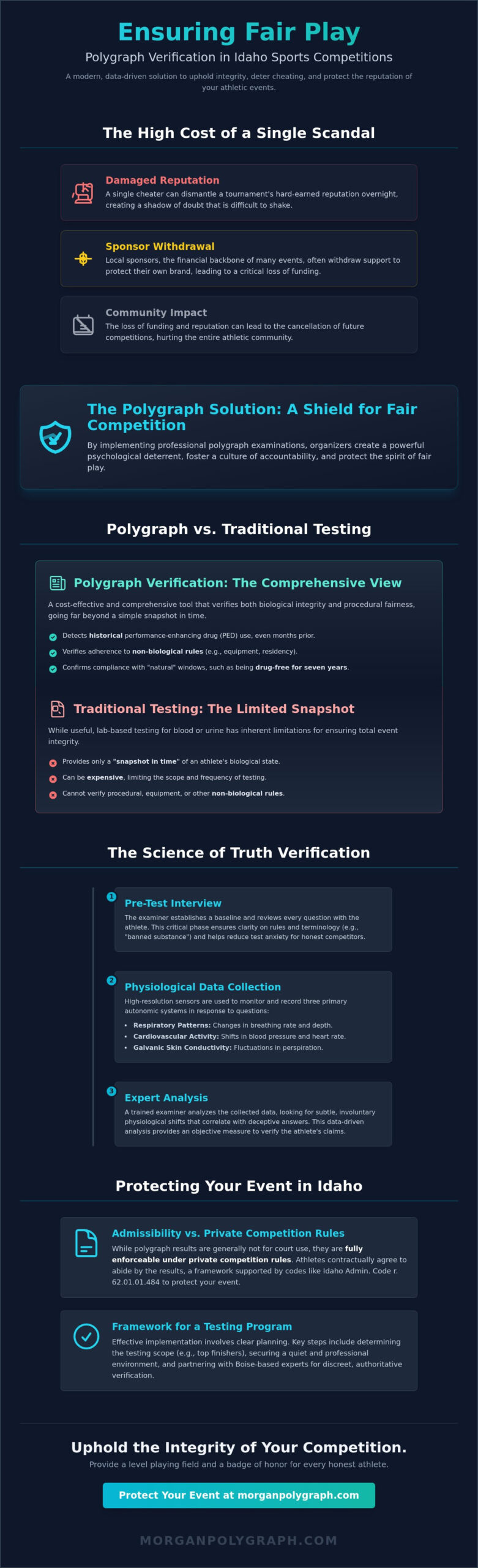
A single athlete’s choice to gain an unfair advantage can dismantle the hard-earned reputation of an entire tournament overnight. For organizers and participants alike, the shadow of a cheating scandal is a heavy burden that is difficult to shake. Implementing a polygraph for sports competitions Idaho has become a sophisticated solution for those who demand absolute transparency in their events. Whether it is a high-stakes fishing tournament on Lake Coeur d’Alene or a natural bodybuilding stage in Boise, these examinations offer a methodical way to verify that every competitor is playing by the rules.
You likely agree that maintaining a level playing field is essential for the longevity of any sport, yet proving a “clean” status can be incredibly challenging in events where traditional drug testing isn’t always practical. We’ll show you how professional polygraph services protect the integrity of Idaho’s athletic community by acting as both a deterrent and a badge of honor for honest competitors. This guide explores the practicalities of testing in 2026, the legal considerations regarding private examinations, and how specialized methodology ensures results are handled with the highest level of discretion and expertise.
Article Highlights:
- Understand why organizers utilize a polygraph for sports competitions Idaho to verify rule adherence and uphold natural standards.
- Explore the data-driven methodology behind biofeedback tracking. This process monitors respiratory and cardiovascular responses to detect banned substance use or performance violations.
- Clarify the distinction between court admissibility and contractually binding rules under Idaho Admin. Code r. 62.01.01.484 to protect your event.
- Gain a practical framework for planning a testing program. This includes determining your testing scope and securing a professional, quiet environment for examinations.
- Learn how Boise-based expertise provides the authoritative verification required to resolve private sports disputes with confidence and discretion.
The Rise of Polygraph Testing in Idaho Sports Competitions
Sports polygraphy is a specialized application of truth verification technology designed to ensure all participants in a contest adhere to established rules. In recent years, the use of a polygraph for sports competitions Idaho has surged as organizers seek robust ways to maintain “natural” standards. It isn’t just about catching rule-breakers; it’s about establishing a culture of accountability. When athletes know that their claims of being “clean” or following equipment regulations will be scrutinized by a professional examiner, the temptation to gain an unfair advantage diminishes significantly. This psychological deterrent is particularly effective in high-stakes environments where the pressure to win is immense. Professional angling tournaments, powerlifting meets, and natural bodybuilding shows are among the most common sectors utilizing these services to protect the spirit of fair play.
Why Integrity Matters in Idaho Athletics
Integrity is the lifeblood of local sports. When a cheating scandal hits a regional tournament, the fallout extends far beyond a single trophy. Local sponsors, who provide the financial backbone for many Idaho events, often withdraw support to protect their brand reputation. This loss of funding can lead to the cancellation of future competitions, hurting the entire community. To combat this, several Idaho-based organizations have implemented strict verification protocols. For instance, natural bodybuilding federations operating in Boise and Twin Falls now require top finishers to undergo examination to validate their drug-free status. The deterrent value of these tests in 2026 is defined by their capacity to prevent fraud by ensuring that the risk of detection far outweighs the potential rewards of cheating.
Polygraph vs. Drug Testing: A Complementary Approach
While traditional lab-based testing remains a staple in many athletic programs, it has limitations that truth verification can address. Understanding What is a Polygraph helps clarify why it’s a vital tool. Lab panels for blood or urine are often expensive and only provide a snapshot of an athlete’s biological state at a single moment. In contrast, a polygraph can detect historical performance-enhancing drug (PED) use that may have cleared the athlete’s system months prior. Polygraphs are also uniquely suited to verify non-biological rules. These include:
- Compliance with residency requirements for local tournaments.
- Verification that no prohibited equipment modifications were made.
- Confirmation of adherence to specific “natural” windows, such as being drug-free for seven years.
- Ensuring catch locations and methods in professional angling align with tournament bylaws.
By using a polygraph for sports competitions Idaho, organizers can implement a cost-effective, comprehensive screening process that traditional chemical testing simply cannot match. This dual approach ensures that both biological integrity and procedural fairness are upheld throughout the event.
How Sports Polygraph Exams Detect Performance Violations
The mechanics of a polygraph for sports competitions Idaho center on the precise measurement of autonomic physiological responses. During an examination, the practitioner monitors three primary systems: respiratory patterns, galvanic skin conductivity, and cardiovascular activity. When a competitor provides a deceptive answer, the central nervous system triggers subtle, involuntary shifts in these channels. For athletes, whose bodies are often highly tuned, these signals can be remarkably distinct. Modern equipment in 2026 utilizes high-resolution sensors to capture these data points, ensuring even the most minor physiological deviations are documented for analysis.
A successful examination begins long before the sensors are attached. The pre-test interview is a critical phase where the examiner establishes a baseline and reviews every question with the athlete. This process ensures there’s no confusion regarding the terminology used, such as what constitutes a “banned substance” or a “PED cycle.” By maintaining a compassionate and professional demeanor, the examiner helps reduce “test anxiety,” which is a common concern for honest competitors. It’s vital to distinguish these services from employment-related mandates. While Idaho Code § 44-903 strictly prohibits polygraphs as a condition of employment, sports organizations use these tests as a voluntary, contractual requirement for tournament eligibility.
The Science of Deception Detection in Athletes
Athletes present unique physiological profiles that require specialized expertise. A marathon runner or a professional cyclist may have a resting heart rate significantly lower than the general population. Nationally certified examiners are trained to interpret these data-driven baselines without misidentifying high physical fitness as a lack of response. In 2026, many leading practitioners have integrated AI-powered behavioral speech analysis to complement traditional biofeedback. This technology analyzes vocal patterns and micro-hesitations, providing an additional layer of reliability. For organizers planning an event, working with a specialized truth verification expert ensures these nuances are handled with clinical precision.
Common Questions in Athletic Polygraph Exams
Clarity is the cornerstone of an effective sports examination. Questions are structured as simple “Yes/No” inquiries to eliminate any room for interpretation. Examiners often differentiate between “ever” and “recent” use to align with specific tournament windows. For example, a natural bodybuilding show might ask: “Since January 1st, have you used any anabolic steroids?” or “Have you ever used a prohibited masking agent to hide PED use?” These questions are tailored to the specific rules of the Idaho sporting body, ensuring every participant is held to the same rigorous standard of integrity.
Idaho Regulations: Admissibility vs. Private Competition Rules
A common objection among critics is the belief that because polygraph results are not automatically admissible in a court of law, they hold no value for athletic organizations. This perspective overlooks the fundamental difference between criminal litigation and private contractual agreements. In the context of a polygraph for sports competitions Idaho, the examination serves as a private verification tool rather than a legal judgment. When athletes register for a sanctioned event, they enter a voluntary contract. This agreement allows organizers to set standards for participation that exceed general state law, provided those standards don’t violate protected civil rights or employment statutes.
Navigating IDAPA 62.01.01.484 for Sports
While the Idaho Athletic Commission primarily focuses on licensing and medical safety, understanding the broader administrative framework like Idaho Admin. Code r. 62.01.01.484 is crucial for tournament directors. This code outlines the regulatory environment for sanctioned events and administrative hearings. For many Idaho sports federations, truth verification is used as a basis for internal disciplinary actions, such as disqualification or the stripping of titles. To ensure these actions are defensible, it’s essential to consult with a certified polygraph examiner who understands how to align testing protocols with administrative standards. By including a “stipulation to admissibility” in the athlete’s initial contract, organizers create a clear path for using results in private hearings or internal appeals.
Ensuring Legal and Ethical Testing
Ethical testing in 2026 relies on informed consent and transparency. Idaho sports organizations must prioritize the voluntary nature of these exams to remain compliant with state privacy expectations. A well-structured waiver should clearly state the purpose of the test, the specific rules being verified, and how the data will be stored. This protects the organizer from liability while reassuring the athlete that their privacy is respected. Professional practitioners adhere to American Polygraph Association (APA) standards, which mandate strict confidentiality of all physiological data. It’s a proven fact that polygraphs are accurate when conducted by court-recognized experts who follow validated testing formats. Maintaining this high standard of ethics ensures that the polygraph for sports competitions Idaho remains a respected pillar of the local athletic community.
Planning a Polygraph Program for Your Idaho Sporting Event
Organizing a polygraph for sports competitions Idaho requires a methodical approach to ensure both logistical efficiency and athletic fairness. Organizers must first determine the specific scope of their testing program. Some federations choose to test all top-tier finishers to validate podium results; others prefer a random selection process to maintain a consistent deterrent effect across the entire field of competitors. Once the scope is defined, partnering with a certified examiner is the next critical step. This professional manages the complex schedule and maintains the rigorous documentation necessary to defend the tournament’s integrity if a result is challenged.
Establishing clear protocols for results is equally important. Event directors need a pre-defined strategy for “Inconclusive” or “Deception Indicated” findings. This protocol might include a secondary examination or an immediate administrative review of the specific rule violation in question. Having these procedures in writing before the event begins prevents confusion. It ensures every athlete is treated with the same level of respect and clinical objectivity throughout the process.
Logistics for On-Site Tournament Testing
Implementing a mobile testing setup requires careful coordination with the venue. A quiet, private room is mandatory. Examinations cannot be conducted in high-traffic areas where noise or interruptions might interfere with physiological readings. For multi-day events in Idaho, managing athlete flow is essential to prevent long wait times that could increase pre-test stress. Organizers should secure a dedicated space that provides discretion. This allows athletes to enter and exit the testing area without unnecessary public scrutiny or distraction.
Communicating with Athletes and Stakeholders
Transparency is the most effective tool for building trust among competitors and sponsors. Testing requirements should be clearly communicated in registration materials and discussed during athlete briefings well before the Idaho competition starts. Providing educational resources, such as a detailed guide on what a polygraph test is, helps reduce anxiety by demystifying the process for those who have never been tested. Finally, a clear appeals process must be in place. If an athlete disputes a finding, they should have a structured path to request a review or a second opinion from a qualified expert. To begin developing a customized integrity program for your next event, contact an Idaho polygraph specialist to discuss your specific requirements.
Trust Morgan Polygraph for Idaho Athletic Verification
Morgan Polygraph stands as the gold standard for truth verification in the state. For those organizing a polygraph for sports competitions Idaho, our Boise-based firm offers a level of expertise that is unmatched. We combine decades of traditional experience with the most advanced technologies available in 2026. Our practitioners are not just technicians; they are court-recognized experts who understand the nuances of athletic integrity and rule adherence. This level of authority is vital when resolving private sports disputes that could otherwise damage a tournament’s reputation. By choosing a seasoned expert, you ensure that every result is defensible and grounded in scientific methodology.
Expertise You Can Count On
Our nationally certified examiners are deeply rooted in the Idaho community. We understand the specific demands of Southern Idaho’s athletic landscape, from the high-desert powerlifting meets to the competitive angling circuits on our local rivers. This regional knowledge allows us to tailor every examination to the specific rules of the event. If you are a tournament director or an athlete searching for a polygraph near me, our Boise office provides a professional and neutral environment for all testing needs. We prioritize discretion and accuracy, ensuring every result is supported by data-driven analysis and behavioral observation.
The Future of Sports Integrity in Boise
We are actively shaping the future of truth verification through constant innovation. In 2026, our integration of AI-powered deception detection sets us apart from general investigative firms. This technology analyzes micro-expressions and physiological data with unprecedented precision, offering the most reliable results for Idaho sports organizations. We don’t believe in a one-size-fits-all approach. Instead, we offer customizable testing packages designed to meet the unique requirements of various federations and sporting bodies. Whether you need random screening for a large field or targeted testing for top finishers, we provide a systematic operation that guarantees integrity.
Every interaction we have with an Idaho athlete is grounded in respect and compassion. We recognize the stress involved in competition and the vulnerability athletes feel during an examination. Our goal is to provide a calm, collected environment where the truth can be verified without unnecessary pressure. This balance of clinical precision and human empathy makes us the preferred choice for athletic verification in the Treasure Valley. Contact us today for a confidential consultation to see how we can protect the fairness of your next polygraph for sports competitions Idaho.
Upholding the Spirit of Fair Play in Idaho Athletics
Maintaining a level playing field requires more than just good intentions; it demands a systematic approach to truth verification. By implementing a polygraph for sports competitions Idaho, tournament directors can effectively deter rule violations and provide honest athletes with the verification they deserve. We’ve established how modern biofeedback and clear contractual waivers create a defensible framework for even the highest-stakes events in the region.
Morgan Polygraph brings over 50 years of combined experience to every examination. Our nationally certified and court-recognized examiners are Boise-based, yet we maintain full travel availability throughout Idaho to serve your specific venue needs. We bridge the gap between traditional reliability and innovative detection technology to protect your event’s reputation. Secure the integrity of your next Idaho competition; contact Morgan Polygraph today. Your commitment to transparency ensures the longevity and prestige of Idaho’s sporting community for years to come.
Frequently Asked Questions
Are polygraph results for sports competitions admissible in Idaho courts?
Polygraph results are generally not admissible in Idaho courts unless every party involved agrees to their admission through a formal stipulation. While they are a powerful tool for private administrative decisions, the Idaho legal system treats them as inadmissible in standard litigation. For a polygraph for sports competitions Idaho, the value lies in the private contract between the athlete and the organizer rather than a courtroom setting.
Can an athlete refuse a polygraph test in an Idaho competition?
Athletes have the right to refuse a test; however, doing so almost always violates the terms of participation in sanctioned events. Most Idaho sporting federations include a mandatory testing clause in their registration waivers. Refusal typically leads to immediate disqualification, forfeiture of prizes, and potential bans from future competitions. Participation is voluntary, but compliance with the integrity rules is a prerequisite for entry.
How accurate are polygraph tests for detecting PED use?
Polygraph examinations are highly reliable when conducted by certified experts using validated, data-driven methodology. They are particularly effective at detecting performance-enhancing drug (PED) use because they focus on the athlete’s behavior and history rather than just a biological sample. This allows examiners to identify usage that occurred outside the detection window of traditional lab tests, providing a comprehensive view of the competitor’s adherence to natural standards.
What happens if an athlete gets an ‘Inconclusive’ result?
An inconclusive result is not a determination of guilt or deception; it simply means the physiological data was insufficient for a definitive conclusion. In these cases, organizers usually schedule a re-test with a different question set or a different examiner to resolve the ambiguity. If the second test remains inconclusive, the tournament’s administrative board will review the athlete’s history and other evidence to make a final eligibility determination.
How much does it cost to hire a polygraph examiner for a sports event in Idaho?
The cost of hiring an examiner for an Idaho event depends on several logistical factors, including the number of athletes being tested and the duration of the competition. Fees typically account for the examiner’s specialized skill, the use of high-resolution equipment, and travel requirements to venues outside of Boise. Organizers should contact a professional firm directly to receive a customized quote based on their specific tournament scope and location.
Do athletes need to prepare in any specific way for a sports polygraph?
Athletes should focus on maintaining their normal routine to ensure stable physiological readings during the exam. It is recommended to get adequate sleep, stay hydrated, and avoid excessive caffeine or stimulants immediately before the test. The most important preparation is the pre-test interview. This is where the athlete reviews all questions with the examiner to ensure complete understanding, which helps minimize unnecessary anxiety during the polygraph for sports competitions Idaho.
Is the polygraph process different for professional vs. amateur Idaho sports?
The fundamental methodology remains the same regardless of the competition level, though the specific inquiry focus may vary. Professional events often have more extensive banned substance lists and stricter residency or equipment rules compared to amateur local meets. Whether the event is a regional powerlifting show or a statewide angling tournament, the examiner tailors the question set to match the specific bylaws and integrity standards of that particular organization.
Can a polygraph detect ‘blood doping’ or other non-chemical cheating?
Yes, a polygraph can effectively detect non-chemical cheating methods like blood doping or equipment tampering. Unlike drug tests that look for chemical markers, a polygraph verifies the truthfulness of the athlete’s statements regarding their actions. If an athlete is asked if they have utilized prohibited blood transfusions or modified their gear, the exam monitors for deceptive physiological responses, making it a versatile tool for ensuring overall competition fairness.