
What if your intuition is right, but your evidence is nothing more than a collection of behavioral myths and digital breadcrumbs? You have likely spent sleepless nights wondering if you’re being gaslit or if your suspicions are actually the catalyst for damaging a healthy relationship. It’s an agonizing cycle of anxiety that leaves you feeling manipulated and exhausted. You aren’t looking for more body language tips; you’re looking for the truth.
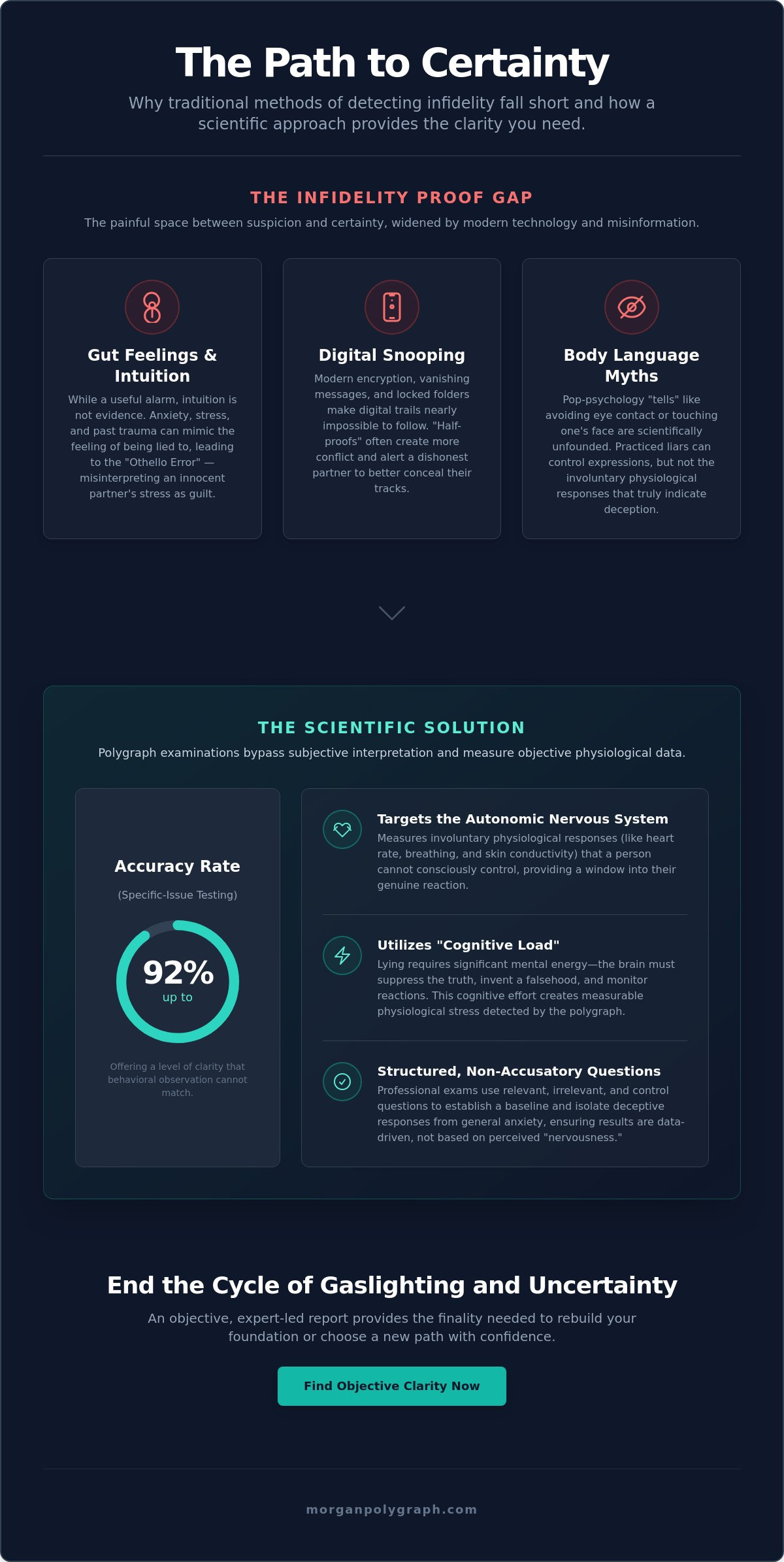
We understand that at this stage, only objective evidence can provide the peace of mind you need to either rebuild your foundation or choose a new path. By utilizing professional infidelity polygraph questions, you can move past subjective gut feelings and access data-driven results. In 2026, specialized examinations reach accuracy rates between 89% and 92% for specific-issue testing, offering a level of clarity that behavioral observation simply cannot match. This guide details how modern physiological testing works, why it’s the most reliable method for confirming relationship integrity, and how these professional methods provide the absolute clarity you deserve.
Key Takeaways
- Learn why modern digital encryption makes traditional “snooping” unreliable and why a scientific approach is necessary to bridge the infidelity proof gap.
- Understand why common behavioral myths and body language “tells” are scientifically unfounded and often lead to false suspicions.
- Discover how professional infidelity polygraph questions are structured to distinguish between physiological truth and emotional anxiety.
- Get practical guidance on proposing a polygraph examination to your partner as a constructive tool for rebuilding trust rather than a confrontational ultimatum.
- Find out how an objective, expert-led report can end the cycle of gaslighting and provide the finality needed to move forward.
The Infidelity Proof Gap: Suspicion vs. Certainty in 2026
The Infidelity Proof Gap defines the painful space between a nagging suspicion and the absolute certainty required to make life-altering decisions. In 2026, this gap is wider than ever. While technology has made it easier to connect, it has also provided sophisticated tools for concealment. For the partner seeking the truth, this often results in a cycle of gaslighting, where their reality is constantly challenged by the person they trust most. This psychological manipulation leads to chronic stress, sleeplessness, and a desperate need for objective, verifiable data. The primary goal of utilizing professional infidelity polygraph questions is to bypass this emotional turmoil and access the physiological truth that remains hidden behind spoken words.
The Problem with Gut Feelings and Intuition
Intuition often acts as a necessary alarm system, but it should never be mistaken for a final conclusion. While your “gut” might tell you something is wrong, it cannot specify exactly what is happening or provide the closure needed to move forward. Anxiety and past relationship trauma can often mimic the physical sensations of being lied to, which frequently leads to false accusations that unintentionally damage healthy bonds. To understand the mechanism behind professional testing, it’s helpful to first ask: What is a Polygraph? The Othello Error occurs when a suspicious person misinterprets a truthful partner’s natural fear or anxiety as a definitive sign of guilt. This is why professional examiners rely on calibrated physiological data rather than subjective interpretations of “nervousness.”
Why Digital Snooping Often Fails
Digital forensics once provided a clear trail, but the rise of 2026 encryption standards has changed the landscape. Features like vanishing messages, end-to-end encryption, and biometric-locked folders make it remarkably easy to erase digital footprints in seconds. Beyond the technical hurdles, unauthorized access to a partner’s device carries significant legal and ethical risks that can complicate future legal or civil proceedings. Often, “half-proofs” like a suspicious social media interaction don’t provide clarity; they simply alert a dishonest partner to hide their tracks more effectively. Relying on fragments of digital data rarely bridges the gap, making professional infidelity polygraph questions a more direct and reliable route to the facts. By moving from the role of a “digital detective” to a client of a professional examiner, you ensure the process remains discreet and the results are based on science rather than speculation.
Why Behavioral Signs and Body Language Myths Fail
Pop culture often presents a simplified version of deception detection. You’ve likely heard that a partner who touches their nose or shifts in a chair is hiding something. These “tells” are staples of pop psychology, yet they lack scientific validation. The reality is that humans don’t have a universal “Pinocchio’s nose.” Deception doesn’t manifest in a single, predictable physical gesture. Instead, professional examiners focus on the Autonomic Nervous System, which regulates involuntary functions like heart rate and skin conductivity. While a person can practice their facial expressions, they cannot easily suppress the physiological shifts that occur when they face specific infidelity polygraph questions.
Lying requires immense mental energy. The brain must simultaneously construct a false narrative, suppress the truth, and monitor the listener’s reaction. This “Cognitive Load” creates physiological ripples that are nearly impossible to detect with the naked eye but are clearly visible on a computerized polygraph chart. Unlike a casual observer who might misinterpret a twitch, a professional examiner uses data-driven detection to separate genuine stress from the physiological markers of deception.
Debunking the Eye Contact Myth
Many believe that a lack of eye contact confirms guilt. In fact, practiced liars often maintain intense, deliberate eye contact to appear more convincing. Conversely, looking away is frequently a sign of social anxiety or the brain’s need to process complex information. This is often referred to as “visual accessing cues.” Scientific studies have repeatedly shown that looking in a specific direction, such as up and to the left, is not a reliable indicator of fabrication. Relying on these visual cues often leads to false accusations. If you’re seeking a more reliable path to truth, you might consider how specialized relationship testing can provide the data that visual observation lacks.
The Science of Deception Detection
Deception is a cognitively demanding task. When an individual attempts to deceive while facing potential consequences, the body’s flight-or-fight response activates. This involuntary reaction is what professional equipment monitors. While some skeptics point to the National Research Council findings regarding the limitations of general screening, specific-issue testing remains a distinct and more accurate application. By measuring internal shifts in respiration and blood pressure, examiners can determine if a subject is experiencing the physiological stress of deception. You can learn more about how these metrics ensure results are reliable by exploring are polygraphs accurate. This transition from observing outward behavior to measuring internal data is what makes professional infidelity polygraph questions so effective in 2026.
Formulating Infidelity Polygraph Questions: Relevant vs. Control
Professional examinations aren’t disorganized interrogations. They are highly structured data-collection sessions designed to isolate specific physiological responses. To achieve this, an examiner utilizes a three-tier question structure. Irrelevant questions, such as “Is your name John?”, establish a baseline of normal physiological activity. Comparison questions, often called control questions, measure how a subject reacts to general honesty or minor past transgressions. Finally, the relevant infidelity polygraph questions address the core issues, such as “Since your marriage, have you had sexual contact with anyone other than your spouse?” This methodical approach allows the examiner to compare reactions across different categories, providing a level of clarity that a standard argument can’t reach.
The finality of a professional report is often the only way to end the cycle of circular arguments. In high-emotion situations, a neutral, third-party expert provides the necessary distance for an objective assessment. This is why a polygraph examination is conducted in a controlled, clinical environment. It replaces the chaos of domestic suspicion with a systematic process. While it’s helpful to understand the scientific view on polygraph validity, modern testing in 2026 utilizes advanced scoring algorithms that significantly reduce the margin for human error. The result is a document that serves as a definitive record of the truth.
The Role of a Certified Examiner
Online lie detectors and mobile applications are deceptive scams. These tools don’t monitor actual physiological data and provide zero valid evidence for relationship decisions. A certified examiner follows strict American Polygraph Association (APA) standards to ensure every test is ethical and accurate. They collaborate with the client to build a specific “test deck” of questions. This preparatory phase ensures that every query is clear, direct, and understood by the subject before the actual examination begins. This level of precision is what separates a professional service from a generic online tool.
Obtaining Court-Recognized Standards of Truth
Expertise is vital even in private relationship matters. There is a significant difference between a basic polygrapher and a forensic psychophysiologist who understands the complex interplay between psychology and physical data. Professional documentation follows court-recognized standards, which adds a layer of academic gravitas to the findings. If a relationship ultimately ends, these professional reports can be utilized in civil disputes or mediation processes. Having a clear, objective record provides the absolute clarity required to either rebuild a life together or move on with confidence.
How to Propose an Infidelity Test to Your Partner
Proposing a physiological examination is a delicate process that requires a calm, non-confrontational environment. You shouldn’t raise the topic during a heated argument or late at night when emotional reserves are depleted. Instead, choose a neutral time to frame the request as a constructive path toward rebuilding trust. Explain that the current state of suspicion is unsustainable for both parties and that you want to move past the “gut feelings” that currently dominate the relationship. If your partner asks, “Don’t you trust me?”, respond with empathy but maintain firm boundaries. You might say, “I want to trust you, but the uncertainty is preventing us from moving forward. This process provides a way for us to establish a shared, objective reality.”
It’s vital to set clear expectations before the appointment. Discuss what happens if they refuse the test or if the results indicate deception. Having these boundaries in place beforehand prevents emotional paralysis when the results are delivered. The goal isn’t to “catch” a liar; it’s to obtain the verifiable data necessary to make an informed decision about your future. If you’re ready to move toward a resolution, you can consult with a professional examiner to understand the best approach for your specific situation.
The Nothing to Hide Framework
A professional polygraph test protects the innocent just as much as it identifies the guilty. For a partner who has been truthful, this is a definitive opportunity to clear their name and end the cycle of accusations permanently. Many individuals fear “false positives” due to their natural nervousness. However, a seasoned examiner is trained to distinguish between situational anxiety and the specific physiological markers associated with infidelity polygraph questions. Emphasizing that the process is a tool for transparency rather than a trap can help a hesitant partner see the long-term value of the examination.
Preparing for the Results
The path to truth often begins well before the sensors are attached. During the mandatory pre-test interview, many subjects experience a significant shift in perspective. This is frequently where “trickle-truth,” the slow and painful release of partial information, finally turns into a full disclosure. It’s also common for subjects to offer what is known as a “parking lot confession” just before the test begins, realizing that the computerized system will likely detect any remaining secrets. You must have a plan for both “Pass” and “Fail” outcomes. Knowing your next steps ensures that the clarity you receive leads to productive action rather than further confusion.
Finding Clarity with Morgan Polygraph in Boise
Morgan Polygraph provides a professional sanctuary for those navigating the most challenging moments of their lives. Our Boise office is intentionally designed to ensure absolute discretion and confidentiality, providing a neutral space where the search for truth is handled with the utmost respect. Dan Morgan brings decades of specialized experience to every examination, utilizing court-recognized expertise to deliver the objective evidence that Idaho families require. When you’re facing the weight of infidelity polygraph questions, you need more than a generic service; you need a seasoned professional who understands the complex interplay between physiological data and human emotion.
Booking a specialized infidelity test is a straightforward process handled with the highest level of privacy. From the initial contact to the delivery of the final report, our operation is methodical and organized. We recognize that the decision to seek a polygraph is often a last resort, and we’re committed to providing a clinical environment that minimizes stress while maximizing the precision of the results. You can expect a professional, unhurried experience that prioritizes your need for absolute clarity.
Discretion and Professionalism in Idaho
Our Boise office setting is specifically configured for client comfort and confidentiality. We understand that local residents value their privacy, especially when dealing with sensitive civil and private matters. This local trust is built on a foundation of reliability and specialized skill that generic firms simply cannot match. We offer a range of services tailored to complex relationship dynamics, including:
- Relationship and infidelity testing designed to establish a shared, objective reality.
- Criminal and civil case polygraphs for comprehensive legal and private support.
- Specialized examinations for complex cases involving sex addiction or habitual deception.
- Pre-employment screening for positions requiring the highest levels of trust.
Every practitioner at Morgan Polygraph is recognized within their professional community for their adherence to strict ethical standards. This commitment ensures that your sensitive family issues are handled by an expert who is both authoritative and approachable. Our focus on integrating modern technology ensures that the results you receive are based on the latest advancements in the field of polygraphy.
Take the First Step Toward the Truth
The cycle of suspicion, anxiety, and sleeplessness doesn’t have to be your permanent reality. While the process of seeking the truth is difficult, it’s the only way to move beyond the paralysis of gut feelings. By choosing a professional path, you’re opting for data-driven results that cannot be argued away or dismissed as subjective bias. We invite you to contact our Boise office for a confidential consultation to discuss your specific needs and how our methodology can provide the peace of mind you deserve.
The truth is the only foundation upon which you can rebuild your life or choose a new direction. Don’t let another night of uncertainty pass without taking action. Schedule your confidential infidelity exam today and secure the objective proof you need to move forward with confidence.
Establish a Foundation of Truth
Moving from the anxiety of suspicion to the clarity of certainty is the only way to truly begin the healing process. You’ve learned that behavioral myths and digital breadcrumbs often fail to provide the whole story. By utilizing professionally structured infidelity polygraph questions, you replace subjective arguments with data-driven results. This methodical approach ensures that your decisions are based on physiological facts rather than emotional manipulation or the exhaustion of “trickle-truth” confessions.
Morgan Polygraph brings over 30 years of professional experience to every case, combining state-of-the-art polygraph technology with the expertise of nationally certified and court-recognized examiners. Whether your goal is to rebuild your relationship or find the strength to move on, we provide the objective evidence required for a definitive resolution. Our discreet Boise office is dedicated to handling your sensitive family issues with the highest level of privacy and clinical compassion.
Get the Truth Today: Schedule a Confidential Infidelity Test
You don’t have to live with the weight of uncertainty any longer. Taking this professional step is a courageous act of self-respect that paves the way for a more honest and peaceful future.
Frequently Asked Questions
Can someone pass an infidelity polygraph if they believe their own lies?
No, the polygraph monitors autonomic nervous system responses that are involuntary and difficult to manipulate through conscious belief. Even if an individual has attempted to rationalize their behavior or “re-write” their memory, the conflict between the actual event and the verbal denial typically produces detectable physiological shifts. A computerized system analyzes these internal markers with a level of precision that bypasses a subject’s personal narrative or self-deception.
How long does a relationship polygraph test usually take in Boise?
A professional relationship examination at our Boise office typically requires between two and three hours to complete. This timeframe isn’t spent entirely on the sensors; it includes a comprehensive pre-test interview, the formulation of specific infidelity polygraph questions, the data collection phases, and a preliminary analysis of the results. This unhurried approach ensures that the subject is comfortable and that the data collected is of the highest possible quality.
What questions are asked during an infidelity lie detector test?
The examination utilizes a three-tier structure consisting of irrelevant, comparison, and relevant questions. Relevant questions are the core of the test and are designed to be direct and unambiguous, such as “Since your marriage, have you had sexual contact with anyone other than your spouse?” These are reviewed with the subject beforehand to ensure there is no confusion regarding the definitions or the scope of the inquiry.
Is a polygraph test result admissible in Idaho civil courts?
Polygraph results are generally not admissible in Idaho courts unless both legal parties stipulate or agree to their entry before the test is conducted. While they aren’t a standard part of courtroom evidence, they are frequently used in civil mediation, private settlements, and relationship counseling to establish a factual baseline. Most clients utilize these results for private resolution rather than as a primary tool for litigation.
What if my partner is taking medication for anxiety or blood pressure?
Most medications for anxiety or blood pressure won’t prevent a successful examination, but they must be disclosed during the pre-test interview. These substances can sometimes dampen physiological responses, but an experienced examiner can account for these baseline shifts during the analysis. It’s important that the subject doesn’t discontinue prescribed medication before the test, as the goal is to monitor their body in its normal, everyday state.
Can a polygraph distinguish between physical cheating and emotional infidelity?
Yes, the polygraph can distinguish between different types of betrayal if the infidelity polygraph questions are structured to isolate those specific behaviors. Separate questions can be formulated to address physical contact, digital relationships, or emotional affairs. By narrowing the focus of each query, the examiner can provide a clear report that specifies exactly which boundaries were crossed and which remained intact.
How much does a private infidelity polygraph cost in 2026?
The cost of a private examination is determined by the complexity of the case and the specific number of issues being tested. Because every relationship situation is unique, we provide customized quotes based on the requirements of your specific inquiry. We recommend contacting our Boise office for a confidential consultation to discuss your needs and receive accurate information regarding the investment required for your session.
What happens if the test result is inconclusive?
An inconclusive result means the physiological data was not strong enough to definitively indicate either deception or truthfulness. This occurs in a small percentage of cases and can be caused by physical exhaustion, extreme illness, or inconsistent breathing patterns. If a result is inconclusive, the examiner will discuss the possible reasons and may suggest a follow-up session or a refinement of the question set to achieve a clear outcome.