

What if the most intimidating part of your supervision was actually the very tool that validates your hard work and honesty? For many Idahoans, the requirement for a Boise polygraph for parole violations feels like a technical trap, especially when your future depends on the results. It’s completely natural to feel a sense of dread when facing Idaho Department of Correction (IDOC) or Federal testing mandates. You might worry that a technical glitch or a spike in heart rate will be misinterpreted as a lie, even when you’ve followed every rule of your release. The confusion between varying agency requirements only adds to that pressure.
The cost for a professional examination varies based on the complexity of the case and the specific certification required for the examiner. Factors such as whether the test is a standard compliance check or a specialized PCSOT examination will influence the final fee. Because these tests require high levels of precision and adhere to strict state standards, we recommend contacting a certified examiner directly. They can provide a professional quote tailored to your specific Boise polygraph for parole violations and supervision requirements; furthermore, if you are currently coordinating with a defense attorney, you may want to find out more about Legal Representation Fees to help manage your overall budget.
This guide clarifies the testing process to replace that anxiety with calm, collected confidence. You’ll discover how professional examinations serve as a bridge to compliance rather than a barrier. We will detail the specific standards set by the Idaho Sexual Offender Management Board (SOMB) in 2025; explain what to expect in a controlled, professional testing environment; and show you how to find a certified Boise examiner who prioritizes both precision and respect. Understanding the methodology behind modern detection is the first step toward successfully navigating your parole requirements and maintaining your place in the community.
Key Takeaways
- Understand the specific roles of the Idaho Department of Correction and local judges in mandating examinations to ensure long-term supervision success.
- Learn the critical distinctions between general maintenance exams and specialized Post-Conviction Sex Offender Testing (PCSOT) to properly prepare for your specific Boise polygraph for parole violations.
- Gain insight into how modern technology distinguishes between normal physiological anxiety and actual deception, helping you approach the test with a calm mindset.
- Follow a practical checklist for physical and mental preparation, including dietary considerations and reviewing parole conditions, to ensure optimal testing conditions.
- Identify the importance of selecting a nationally certified examiner who understands Idaho’s unique regulatory standards and provides a respectful, clinical environment.
Understanding Parole Polygraph Requirements in Boise, Idaho
In the Boise metropolitan area, the Idaho Department of Correction (IDOC) maintains a rigorous standard for community supervision. A Boise polygraph for parole violations is frequently mandated by local judges and parole officers to ensure that individuals are adhering to the specific conditions of their release. This requirement isn’t meant to be a trap. Instead, it serves as a clinical tool to verify compliance and provide an objective measure of progress. Whether you’re under state supervision or federal oversight, the goal remains the same: ensuring public safety while supporting your successful reintegration into the Ada County community.
The legal framework for these examinations is well-established. For those under federal supervision, 18 U.S.C. § 3563 provides the authority for judges to include polygraph testing as a discretionary condition of probation or supervised release. On a state level, Idaho administrative rules give parole officers the latitude to require testing as part of a comprehensive supervision plan. Understanding the technology is the first step in reducing anxiety. If you’ve ever wondered, What is a Polygraph? it’s essentially a combination of medical sensors that monitor physiological signals to help examiners determine the veracity of a statement. While some tests are strictly court-ordered, many Boise residents choose to undergo testing as a show of voluntary compliance, providing tangible evidence of their commitment to their parole terms.
The Role of Polygraphs in Idaho Community Supervision
The IDOC utilizes polygraph testing as a primary monitoring tool, especially for high-risk supervision cases. Parole officers in Boise don’t use these results in isolation. They use them to adjust treatment plans, identify potential triggers, and verify that prohibited contacts aren’t occurring. A successful examination can lead to increased trust and potentially less restrictive supervision over time. Conversely, a Boise polygraph for parole violations that indicates deception may lead to a more intensive case management approach to prevent a formal revocation.
Statutory Authority and Your Rights
Your parole agreement likely contains “Sample Condition Language” that specifically outlines your obligation to submit to testing. It’s vital to remember that while you’re required to participate, you still maintain specific legal protections during the process. Examinations must be conducted by court-recognized Boise examiners who adhere to strict ethical and professional standards. These protections ensure that the environment remains clinical and respectful. Using a certified professional ensures that the data collected is accurate, reliable, and handled with the utmost discretion, protecting both your legal standing and your privacy.
Types of Parole Examinations: Compliance vs. PCSOT
Not all polygraph tests serve the same function. When you’re scheduled for a Boise polygraph for parole violations, the specific type of examination determines the focus of the questions and the technical standards applied. Understanding these categories helps you prepare mentally and ensures you’re meeting the exact requirements of your supervision plan. These tests generally fall into two categories: specialized risk management and general compliance monitoring.
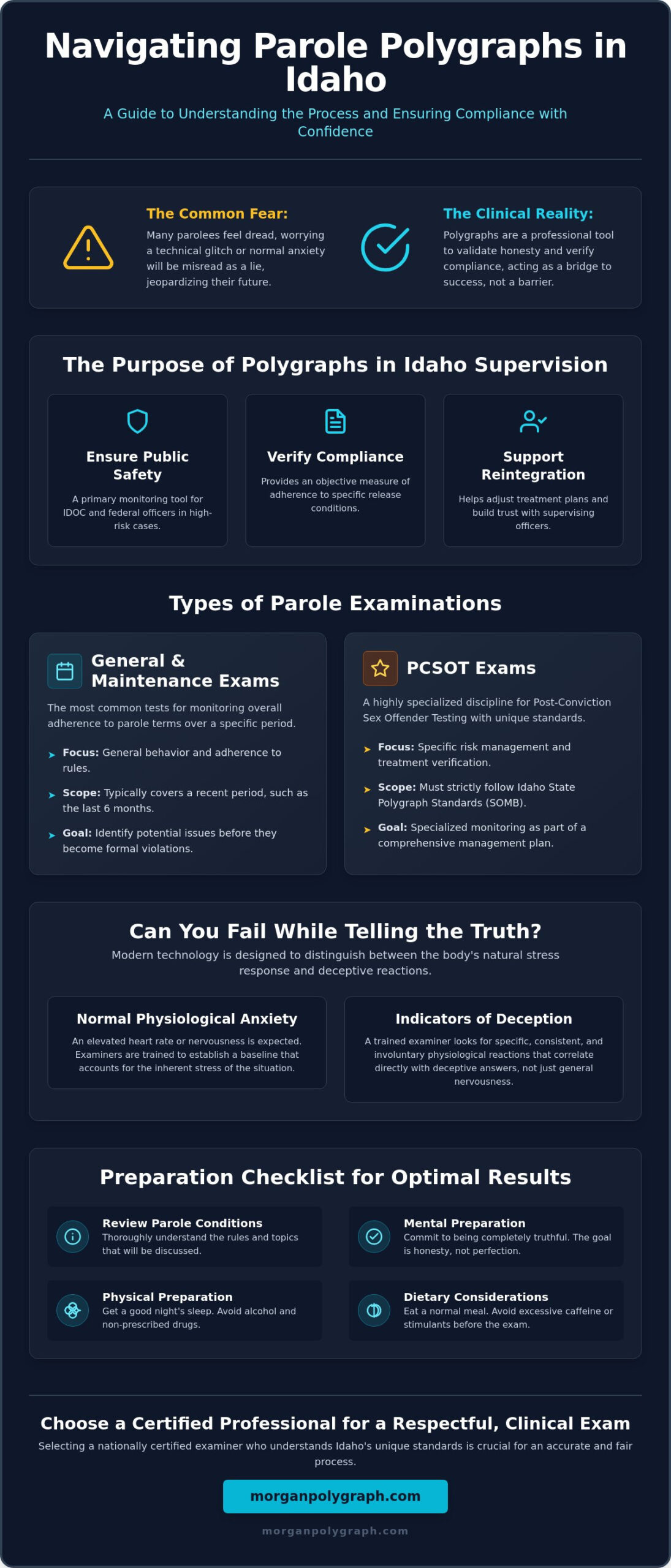
Maintenance examinations are the most common tool for checking general adherence to parole terms. These tests look at your behavior over a specific period, usually the last six months, to verify you haven’t engaged in prohibited activities. Monitoring examinations are more focused. They might address a specific allegation or a suspicious contact reported by a parole officer. In both cases, the goal is to identify potential issues before they escalate into a formal violation of your release conditions. Establishing a baseline of honesty through these tests often leads to a more stable relationship with your supervising officer.
The PCSOT Framework in Boise
Post-Conviction Sex Offender Testing (PCSOT) is a highly specialized discipline that differs significantly from standard criminal defense testing. In Idaho, these examinations must strictly follow the Idaho State Polygraph Standards, which were most recently updated by the Idaho Sexual Offender Management Board (SOMB) in February 2025. PCSOT includes sexual history disclosure exams, which help treatment providers understand a client’s full history to create effective management plans. This data-driven approach is essential for anyone listed on the registry. For more details on local requirements, you can consult our Idaho sex offender registry guide. These tests aren’t designed to find new crimes; they’re designed to support the “containment team” of officers, therapists, and examiners.
Maintenance and Monitoring Tests
For many Boise residents, maintenance tests focus on lifestyle stability. This includes verifying your employment status, residence, and travel history. Parole officers often use these tests to confirm you haven’t used alcohol or controlled substances, especially if those were factors in your original case. By providing objective verification of your sobriety and stability, you demonstrate that you’re a low-risk member of the community. These tests act as a preventive measure. They encourage transparency and help you stay on track with your long-term goals. If you’re facing a mandatory check-in, engaging with professional polygraph services ensures your test is conducted in a clinical, unbiased environment that respects your privacy and your progress.
Accuracy and Anxiety: Can a Parolee Fail While Telling the Truth?
The most common question we hear from individuals facing a Boise polygraph for parole violations is simple: “What if I am just nervous?” This fear is understandable. Your future depends on the outcome of a session where sensors monitor your every heartbeat. However, modern polygraph science is specifically designed to distinguish between general situational anxiety and the physiological shifts associated with deception. Professional examiners understand that every person sitting in the chair is under stress. We don’t look for the absence of nerves; we look for specific, significant deviations from your established baseline in response to relevant questions.
The examination relies on monitoring three primary physiological systems: respiration, heart rate, and Galvanic Skin Response (GSR). Respiration sensors track your breathing patterns, while a blood pressure cuff monitors cardiovascular activity. GSR sensors measure minute changes in sweat gland activity on the fingertips. These are involuntary responses controlled by the autonomic nervous system. While you might feel your heart racing because you are in a clinical environment, that elevated state becomes your “baseline” for the session. Deception is identified only when there is a distinct, repeatable change from that baseline when a specific question is asked. If you’re wondering about the data behind this, you can read more about are polygraphs accurate and how reliability is maintained in modern testing.
The Myth of the False Positive
Modern technology and standardized scoring systems have made the “false positive” extremely rare in a professional setting. Today’s software uses complex algorithms to filter out general baseline anxiety, allowing the examiner to focus on legitimate physiological reactions. The role of the examiner is to act as a neutral data interpreter. We provide a calm, controlled environment to ensure that external factors don’t interfere with your physiological signals. By maintaining a professional and respectful atmosphere, we help you reach a state of “calm confidence” that allows for the most accurate data collection possible.
Why Honesty is the Only Path to Compliance
Some individuals attempt to use “countermeasures” to influence the results, such as controlled breathing or physical movements. This is a dangerous mistake. Professional Boise examiners are trained to detect these tactics easily, and attempting them is often viewed by parole officers as a deliberate act of non-compliance. If a test returns an “inconclusive” result, it usually leads to a retest rather than an immediate violation, but it can delay your progress in the supervision program. The pre-test interview is the most critical phase for accuracy because it allows the examiner to establish a psychological baseline and ensure the examinee fully understands every question before the sensors are activated. Approaching the session with total transparency is the only way to ensure your Boise polygraph for parole violations supports your continued freedom.
Preparing for Your Examination: IDOC and Federal Standards
Proper preparation is the foundation of a reliable result and continued community supervision. When you’re scheduled for a Boise polygraph for parole violations, your readiness directly impacts the quality of the physiological data collected. Preparation should begin several days before your appointment by reviewing your specific parole agreement and any recent allegations mentioned by your supervising officer. This mental review ensures that no question comes as a surprise, allowing you to remain calm and focused during the session. Understanding your requirements under the Idaho Department of Correction (IDOC) or federal standards helps strip away the mystery of the process.
Your body’s physical state is just as important as your mental clarity. It’s essential to get a full night of sleep before your appointment to ensure your nervous system is stable. Continue taking all physician-prescribed medications as usual. You should never discontinue medication in an attempt to “clear” your system, as this often causes physiological instability that interferes with the sensors. Regarding your diet, eat a normal meal but avoid excessive caffeine or energy drinks that could artificially spike your heart rate or respiration. A baseline of physical normalcy is required for the most accurate calibration.
When you arrive at our State St. facility, please bring a valid photo ID and any specific paperwork provided by your parole officer. Full disclosure during the pre-test phase is non-negotiable. If you’ve had a minor slip-up or a misunderstanding of your terms, discussing it openly with the examiner before the sensors are attached is the most effective way to maintain compliance. Transparency during this phase prevents the “surprise” reactions that lead to deceptive results on the charts. If you need to verify specific documentation requirements, contact our Boise office to speak with a certified professional before your arrival.
The Day of the Exam: What to Expect
A professional examination at Morgan Polygraph consists of four distinct phases: the pre-test interview, the data collection phase, the chart analysis, and the post-test discussion. You should plan to be at the facility for 2-3 hours. Most of this time is spent in the pre-test interview to ensure you understand every question perfectly. The actual testing occurs in a specialized “quiet room” designed to eliminate external noise and distractions, which is a critical requirement for collecting valid, clinical data that meets Idaho standards.
Communication with Your Legal Counsel
While examiners remain neutral data collectors, you may wish to involve your attorney in the process if you’re concerned about specific legal implications of your answers. We provide clear, objective reports that can be shared with both Boise parole officers and your legal counsel to ensure everyone has the same factual baseline. For a deeper look at the technical steps and what to expect in the chair, you can review our polygraph examination guide. This transparency helps all parties work toward the common goal of your successful reintegration.
Professional Parole Polygraph Services at Morgan Polygraph
Selecting a highly qualified examiner is a vital step in maintaining your freedom and demonstrating total compliance with your release terms. At Morgan Polygraph, we provide a professional Boise polygraph for parole violations with a focus on clinical accuracy and human respect. Our examiners are nationally certified and court-recognized, bringing over 40 years of combined experience to every session. We understand the high stakes involved in parole and probation testing. That’s why we maintain a methodical, organized environment where your privacy is handled with the utmost confidentiality. By choosing a seasoned expert, you ensure that your physiological data is interpreted fairly and accurately.
Our commitment to excellence is reflected in our adherence to the latest industry advancements. According to a March 2026 report from the American Polygraph Association, modern polygraph examinations can achieve a 92% reliability rate when conducted by certified professionals. We utilize this high-level, data-driven methodology to provide results that stand up to the scrutiny of both state and federal agencies. We bridge the gap between traditional experience and futuristic technology, ensuring our clients receive the most precise truth verification available in the Boise metropolitan area.
Expertise in Idaho Parole Standards
Our practitioners maintain specialized certifications required for Post-Conviction Sex Offender Testing (PCSOT) in Idaho. We strictly follow the standards and guidelines revised by the Idaho Sexual Offender Management Board (SOMB) in February 2025. This deep familiarity with the Idaho Department of Correction (IDOC) requirements is why Boise attorneys and treatment providers trust us with sensitive cases. We focus on the following core values during every examination:
- Professional Integrity: Adhering to the highest ethical standards of the American Polygraph Association.
- Clinical Environment: Providing a neutral, quiet space on State Street to ensure valid physiological readings.
- Compassionate Interaction: Treating every individual with the respect and patience necessary to reduce situational anxiety.
- Technical Precision: Using modern sensors to monitor respiration, heart rate, and GSR with academic gravitas.
Scheduling and Confidentiality
We understand that parole timelines are often strict and require prompt action. Our Boise facility, located conveniently on State Street, is designed to provide a discreet and professional experience from the moment you arrive. We prioritize fast reporting to ensure your results reach your supervising officer or legal counsel without delay. Our process is transparent and unhurried, guiding you through each step of the engagement to ensure you feel prepared and confident. If you’re ready to fulfill your supervision requirements with a team that respects your progress while providing the expertise required by the court, schedule your professional parole polygraph in Boise today.
Moving Forward with Confidence and Compliance
Navigating the complexities of community supervision requires transparency and a commitment to your release terms. By understanding the specific standards set by the Idaho Sexual Offender Management Board and the Idaho Department of Correction, you can transform a mandatory Boise polygraph for parole violations from a source of anxiety into a validation of your progress. We’ve explored how modern physiological monitoring distinguishes between situational stress and actual deception, emphasizing that your honesty is your strongest asset during the testing process.
A successful examination depends on choosing a partner who combines traditional experience with the latest technical advancements. At Morgan Polygraph, we provide a clinical, respectful environment where your privacy is the priority. Our team utilizes state-of-the-art polygraph technology and provides court-recognized expert testimony to support your compliance journey. With nationally certified examiners guiding you through every phase, you can satisfy your legal requirements with calm, collected confidence.
Secure Your Professional Boise Polygraph Appointment
You’ve worked hard to reach this stage of your reintegration. Let our expertise help you maintain your momentum and secure your future in the Boise community.
Frequently Asked Questions
Can I be sent back to prison for failing a polygraph in Boise?
A deceptive result on a polygraph examination is typically used as a clinical monitoring tool rather than the sole basis for immediate parole revocation in Idaho. While a failed test may trigger an investigation or lead to increased supervision levels, the Idaho Department of Correction generally views these results as one part of a broader containment strategy. However, persistent deception or a refusal to comply with mandatory testing is often interpreted as a violation of your supervision terms. It’s vital to maintain transparency to avoid formal disciplinary action.
How much does a parole polygraph test cost in Idaho?
The cost for a professional examination varies based on the complexity of the case and the specific certification required for the examiner. Factors such as whether the test is a standard compliance check or a specialized PCSOT examination will influence the final fee. Because these tests require high levels of precision and adhere to strict state standards, we recommend contacting a certified examiner directly. They can provide a professional quote tailored to your specific Boise polygraph for parole violations and supervision requirements.
Will my Boise parole officer be present during the polygraph exam?
Your parole officer will not be present in the examination room during the actual testing phase. To ensure the highest level of physiological accuracy, the session must take place in a controlled, “quiet room” environment with only the examiner and the examinee present. This privacy helps minimize external distractions and situational anxiety, which allows for the collection of clean, reliable data. A comprehensive report of the findings is shared with your supervising officer once the analysis is complete.
What happens if my polygraph result is “inconclusive”?
An “inconclusive” result means the physiological data collected did not show a clear, repeatable pattern of either deception or truthfulness. This is not the same as a failure; it simply indicates that the charts were not scoreable at that time. In these instances, the examiner usually schedules a follow-up session to re-examine the specific questions. Boise parole officers understand that various factors can cause inconclusive results and typically allow for a retest to achieve a definitive, clinical outcome.
Can I take a polygraph if I have a heart condition or am on medication?
You can successfully undergo testing if you have a heart condition or are taking prescribed medications. It’s critical that you continue following your physician’s instructions and do not skip any doses before your appointment. You should inform your examiner about your medical history and specific medications during the pre-test interview. This allows the practitioner to accurately calibrate the sensors and interpret your physiological baseline while considering your unique health profile, ensuring the most accurate results possible.
Is a Boise parole polygraph different from a pre-employment test?
Yes, a Boise polygraph for parole violations is fundamentally different from a pre-employment screening in both its legal scope and methodology. While pre-employment tests look for general integrity, parole examinations focus on specific compliance with release conditions or past behaviors. Specialized tests like PCSOT follow rigorous Idaho SOMB standards that are much more detailed and focused on risk management than the general inquiries used for job applications or private sector screenings.
What specific questions will be asked during a parole violation polygraph?
The questions asked will focus strictly on your compliance with parole terms, such as unauthorized contacts, travel, or substance use. Every question is reviewed with you in detail during the pre-test interview to ensure there is no confusion or ambiguity. There are no “surprise” questions during the data collection phase of the examination. The primary goal is to verify your adherence to the specific conditions outlined in your Idaho Department of Correction or federal supervision plan.
Can I bring my attorney to the polygraph examination in Boise?
Your attorney is welcome to accompany you to our facility and consult with you before and after the session. However, legal counsel cannot be present in the room during the actual data collection phase to maintain a controlled, clinical environment. Many Boise residents find that involving their attorney in the preparation process provides an additional layer of confidence and clarity. We are happy to provide your legal representative with a detailed report of the findings upon the completion of the analysis.