

A polygraph report is far more than a simple “pass” or “fail” grade; it is a clinical data set that requires professional context to be truly actionable. It’s natural to feel a sense of overwhelming anxiety when you’re handed a document filled with technical jargon like “NDI,” “DI,” or “Inconclusive.” You want clarity. Yet the physiological charts and numerical scoring often feel like a foreign language that stands between you and the peace of mind you deserve. This polygraph results interpretation guide is designed to bridge that gap by offering expert insight from Boise’s court-recognized examiners to help you decode every aspect of your professional findings.
We provide the measured, authoritative guidance our seasoned experts bring to every case. You’ll learn how to decode professional findings, from the nuances of numerical scoring to the complex data captured in physiological charts. We will also explore the critical differences between automated scoring and manual interpretation by a specialized practitioner.
You’ll find practical advice on how to present your report to an attorney and what your next steps should be if your results are non-definitive. By the end of this guide, you will have the knowledge needed to move forward with the calm, collected confidence that comes from truly understanding the data behind the verdict.
Key Takeaways
- Understand the clinical distinction between NDI (No Deception Indicated) and DI (Deception Indicated) to clearly grasp the final verdict of your examination.
- Use this polygraph results interpretation guide to learn how examiners translate physiological data into the precise numerical scores that define your report’s validity.
- Discover why an “inconclusive” result is not a failure or a sign of cheating, but rather a reflection of specific biological or environmental variables.
- Gain insights into how professional reports are utilized in legal defense strategies, including leveraging NDI results during plea negotiations or investigations.
- Identify the critical role of peer review and examiner credentials in ensuring that your findings are both scientifically sound and court-recognized.
The Three Primary Outcomes of a Polygraph Examination
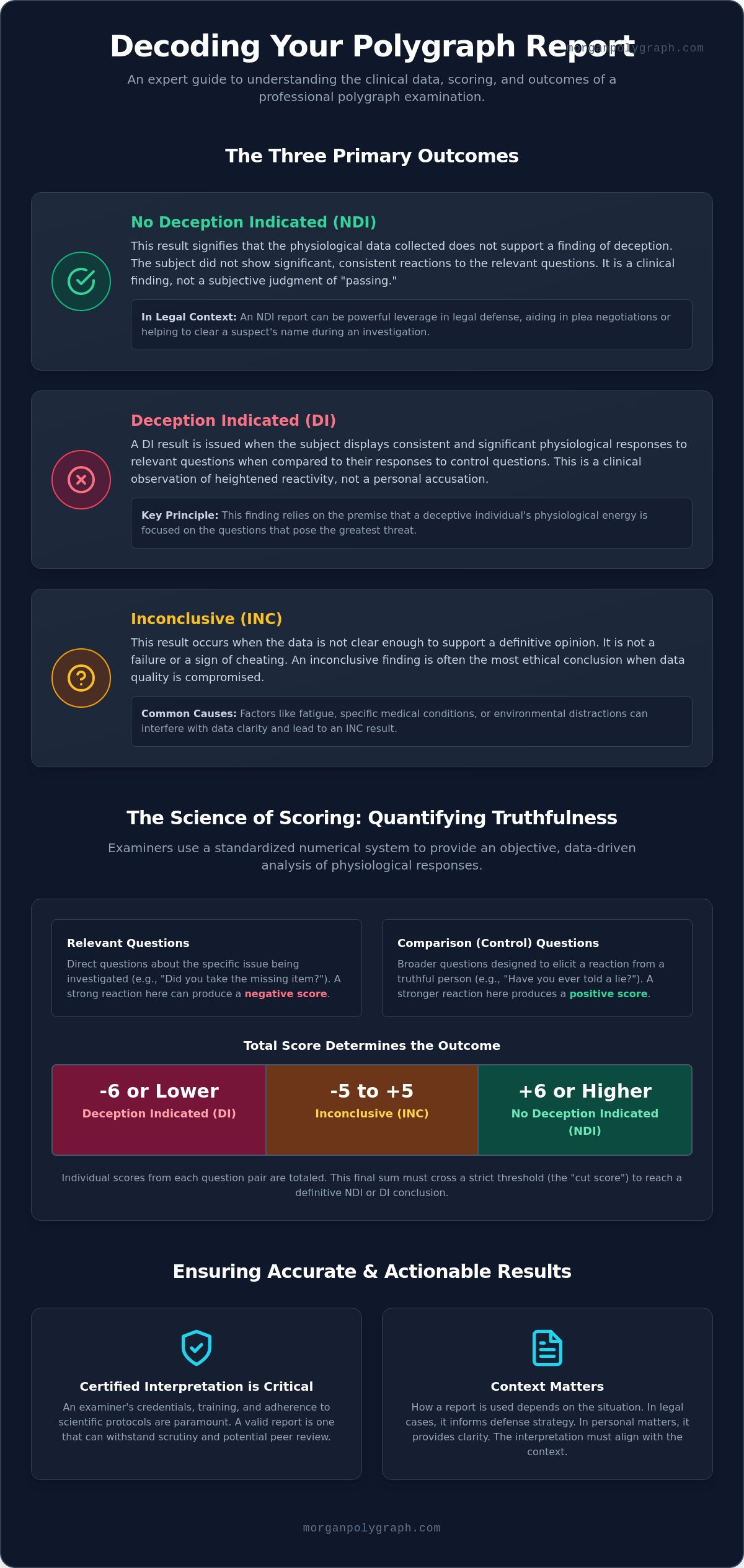
Understanding the conclusion of a polygraph report requires moving beyond binary ideas of “lying” or “truth-telling.” A professional examiner provides a clinical opinion based on physiological data. The Three Primary Outcomes of a Polygraph Examination typically fall into three categories: No Deception Indicated (NDI), Deception Indicated (DI), or Inconclusive (INC). These findings are the result of a rigorous numerical scoring process that compares responses to different types of questions. This polygraph results interpretation guide helps you understand that these labels aren’t arbitrary; they’re rooted in established scientific protocols and behavioral data.
Non-Deceptive Indicated (NDI) Explained
An NDI result means the subject didn’t show significant physiological reactions to the relevant questions. In the industry, we don’t say someone “passed” because that implies a subjective judgment. Instead, NDI signifies that the data collected doesn’t support a finding of deception. For those involved in legal matters, these results are vital for criminal defense polygraph strategies. An NDI report can serve as powerful leverage during negotiations with prosecutors or in clearing a suspect’s name during an investigation. It provides a data-driven basis for a client’s claims of innocence.
Deceptive Indicated (DI) and Significant Reactions
A DI result is issued when the subject displays consistent, significant physiological responses to the relevant questions compared to the control or comparison questions. This framework relies on the principle that a person who is being deceptive will focus their physiological energy on the questions that pose the greatest threat to them. If a report shows “Deception Indicated” in an infidelity test, it suggests the subject’s body reacted more strongly to questions about the affair than to the comparison questions. It’s a clinical observation of reactivity, not a personal accusation.
Sometimes, the data is simply not clear enough to support a definitive opinion. This leads to an Inconclusive (INC) finding. An INC result isn’t a failure of the test or the examiner. It’s often the most ethical finding when biological or environmental factors interfere with the data’s clarity. Perhaps the subject was overly fatigued, or they have a specific medical condition that masked their responses. A seasoned examiner will prioritize accuracy over a forced conclusion; they won’t guess if the data doesn’t meet strict scoring thresholds.
Professional polygraphy distinguishes between clinical findings and “truth” in a legal sense. While a court or a spouse might use these findings to inform a decision, the polygraph itself is an objective measurement of how a body reacts under specific conditions. Using a professional polygraph results interpretation guide ensures you don’t misinterpret clinical data as a moral judgment. It’s about what the sensors recorded during the session, provided in a measured, authoritative format that respects the gravity of the situation.
The Science of Scoring: How Examiners Quantify Truthfulness
A polygraph report isn’t a subjective narrative. It’s a structured mathematical analysis of your body’s involuntary responses. Modern examiners use a standardized numerical scoring system to ensure that every conclusion is rooted in data rather than intuition. This polygraph results interpretation guide clarifies how those numbers are derived and what they signify for your specific case.
Numerical Scoring Systems (The +/- Scale)
Numerical scoring is the objective assignment of values to physiological deviations recorded during the examination. Examiners use a +/- scale to compare reactions between relevant questions and comparison questions. If a subject reacts more strongly to a comparison question, they receive a positive score; a stronger reaction to a relevant question results in a negative score. These individual scores are totaled to reach “cut scores.” For instance, a total score of +6 or higher typically results in an NDI finding, while -6 or lower leads to a DI finding. Scores falling between these thresholds are classified as inconclusive. Ensuring Accuracy: The Importance of Certified Interpretation requires adhering to these strict protocols to minimize human bias.
Physiological Data Channels
The reliability of the score depends on the quality of the data captured across three primary channels:
- Pneumograph: Two tubes placed around the chest and abdomen track respiratory suppression, changes in rate, or baseline shifts that occur when a subject is under stress.
- Galvanometer: Small sensors on the fingertips measure sweat gland activity, known as electrodermal response. This is often the most sensitive indicator of immediate physiological arousal.
- Cardiosphygmograph: A blood pressure cuff monitors heart rate and fluctuations in blood volume.
While we’ve transitioned from analog ink-and-paper charts to advanced computerized algorithms, the technology hasn’t replaced the human expert. Modern software provides automated scoring as a secondary check, but the examiner’s manual review remains the gold standard. An experienced professional can identify “noise” in the data, such as a cough or a sudden movement, that an algorithm might misinterpret as deception. If you have questions about a specific report, consulting with a qualified polygraph examiner can provide the clarity you need. This blend of traditional expertise and innovative technology ensures the highest level of precision in every finding.
Why Results Aren’t Always Black and White: Handling Inconclusives
Receiving an “Inconclusive” result can be one of the most frustrating aspects of the polygraph process. It feels like a non-answer, but in the professional community, it’s often the most ethical finding an examiner can provide. An inconclusive result simply means that the physiological data collected did not meet the strict numerical thresholds required to issue a definitive NDI or DI opinion. This polygraph results interpretation guide emphasizes that a “No Opinion” verdict is a safeguard for accuracy, ensuring that conclusions are never based on guesswork or ambiguous charts.
The most common misconception regarding inconclusive findings is the belief that the subject “cheated” or successfully manipulated the sensors. While counter-measures can occasionally lead to messy data, an inconclusive result is usually the product of biological or environmental variables that are outside the subject’s intentional control. If the physiological responses to relevant and comparison questions are too similar in magnitude, the scoring system cannot mathematically distinguish between them. Professionals prioritize the integrity of the data over the desire for a quick answer.
Common Causes of Inconclusive Findings
Several factors can prevent a stable physiological baseline, which is the foundation of any reliable test. If a subject arrives at the examination after a night of poor sleep or having consumed excessive caffeine, their autonomic nervous system may be in a state of hyper-arousal or exhaustion. This instability makes it difficult to isolate specific reactions to relevant questions. Environmental noise or subtle sensor movements, such as a subject shifting in their chair, can also introduce “artifacts” into the data. We must ask, are polygraphs accurate when these external factors are present? The answer is only when the examiner can clearly differentiate between a true physiological reaction and a random spike in data caused by discomfort or fatigue.
Next Steps After an Inconclusive Result
An inconclusive finding isn’t the end of the road. It’s a signal that a different approach or a more controlled environment is necessary to achieve clarity. In many cases, the best course of action is to schedule a re-test after the subject has had time to rest and follow specific pre-test instructions more closely. During a re-examination, the practitioner might adjust the question set to better isolate the physiological triggers or spend more time in the pre-test interview to lower the subject’s general anxiety levels.
At Morgan Polygraph, we handle these situations with the same discretion and professionalism we bring to every case in Boise. We understand that your time and peace of mind are valuable. If your initial report is inconclusive, we work with you to identify the likely cause and determine if a follow-up session can provide the definitive answer you need. Using a clear polygraph results interpretation guide helps manage expectations and ensures that every client understands the clinical necessity of a “no opinion” finding when the data demands it.
Context Matters: Interpreting Results for Legal vs. Personal Cases
A polygraph report isn’t a static document; its weight is determined by the environment in which it’s presented. Whether you’re facing a criminal investigation or trying to rebuild trust at home, this polygraph results interpretation guide explains how the same data serves different strategic purposes. In a legal setting, a report is a tool for negotiation and evidence. In a personal or therapeutic setting, it’s a catalyst for healing or a requirement for compliance. Understanding these distinctions ensures you approach your findings with the correct expectations.
Polygraphs in the Idaho Legal System
Defense attorneys in Boise frequently utilize a professional polygraph test as a pre-trial strategy. An NDI (No Deception Indicated) result provides powerful leverage during plea negotiations or when urging a prosecutor to dismiss a case based on a lack of credible evidence. In Idaho courts, the admissibility of results often hinges on whether the test was “stipulated.” A stipulated result means both the prosecution and defense agreed to the test’s admission before it was administered. Even when non-stipulated, a court-recognized examiner can sometimes serve as an expert witness, providing testimony on the methodology and the clinical validity of the findings to support a defendant’s credibility.
Post-Conviction and Therapeutic Interpretation
In the specialized field of Post-Conviction Sex Offender Testing (PCSOT), the goal shifts from proving innocence to monitoring compliance. These examinations are a standard part of the “containment model” used by probation officers and treatment providers across Idaho. Results are shared directly with a professional supervision team to verify that an individual is adhering to the terms of their release and treatment plan. For those navigating these requirements, understanding how their data aligns with the Idaho sex offender registry guidelines is essential. The interpretation here is clinical and focused on long-term behavioral patterns rather than a single event.
For couples dealing with infidelity, the interpretation of a report is deeply personal. A DI (Deception Indicated) result isn’t just a data point; it’s a moment of profound emotional impact. Our examiners approach these cases with a measured, compassionate tone, recognizing that the “truth” revealed by the sensors is the first step toward a path forward. We provide the clarity needed to end the cycle of suspicion, allowing both parties to make informed decisions about their future based on verified facts rather than assumptions.
Regardless of your situation, having an expert who understands the nuances of Idaho’s legal and therapeutic standards is vital. If you need a professional interpretation of your findings, contact Morgan Polygraph to discuss your report with a court-recognized examiner. We bring decades of traditional experience and modern methodology to every case, ensuring your results are handled with the utmost discretion and expertise.
Ensuring Accuracy: The Importance of Certified Interpretation
The ultimate reliability of a polygraph examination depends on the person behind the sensors. While sensors capture raw data, the examiner translates that data into a clinical opinion. A report is only as valid as the expertise of the individual who produced it. This polygraph results interpretation guide concludes by emphasizing that in high-stakes legal or personal matters, the credentials of your polygraph near me provider are the most critical factor in ensuring the results stand up to scrutiny.
The Morgan Polygraph Standard in Boise
Our practice is built on a foundation of professional integrity and rigorous adherence to the American Polygraph Association (APA) standards. In Boise and throughout Idaho, the distinction of being a court-recognized expert is vital for criminal and civil cases. This recognition means the examiner’s methodology has been vetted by the legal community for its scientific rigor. Every Morgan Polygraph report undergoes rigorous internal validation before delivery. This quality control process ensures that every numerical score and physiological chart is reviewed for accuracy, minimizing the risk of human error and providing you with a document that is authoritative and discreet.
How to Challenge a Disputed Report
If you’ve received a report from a third-party provider that seems inconsistent or biased, you have the right to seek a professional review. Examiner bias or procedural errors, such as improper question phrasing or failing to establish a stable baseline, can skew results. Identifying these flaws requires a second opinion from a certified examiner who understands Idaho’s specific legal and ethical requirements. A professional review can determine if the original test met industry standards or if a re-examination is necessary to achieve a fair outcome.
When reviewing your final report, use this checklist to ensure it meets professional standards:
- Credentials: Is the examiner certified by a recognized body like the APA or AAPP?
- Scoring: Does the report include a clear numerical scoring breakdown for each relevant question?
- Methodology: Is the specific testing protocol (e.g., Utah ZCT or Federal ZCT) clearly identified?
- Clarity: Are the final outcomes (NDI, DI, or INC) stated without ambiguous or non-technical language?
Accuracy in polygraphy is about more than just technology; it’s about the methodical application of science by a seasoned expert. Whether you’re a defense attorney preparing for a case or an individual seeking the truth in a personal matter, you deserve results that are beyond reproach. If you need a professional review of existing results or a new, court-recognized examination, Contact Morgan Polygraph today. We provide the measured expertise and innovative methodology required to give you total confidence in your report.
Moving Forward with Clarity and Confidence
Navigating the technical details of a polygraph report doesn’t have to be a source of stress. This polygraph results interpretation guide has provided the framework needed to understand that outcomes like NDI or DI are rooted in precise mathematical scoring rather than subjective opinion. You now know that an inconclusive result is a safeguard for accuracy, ensuring that your final verdict is based on stable, reliable data. Whether you’re managing a legal defense or addressing a personal matter, having this knowledge empowers you to make informed decisions about your next steps.
At Morgan Polygraph, we combine decades of experience in criminal, civil, and fidelity cases with state-of-the-art polygraph technology. Our nationally certified and court-recognized examiners are dedicated to providing the measured, authoritative guidance you need during sensitive times. We ensure that every client receives a methodical, organized, and innovative approach to truth detection.
If you’re ready to gain the peace of mind that comes from professional, data-driven results, Schedule a Professional Polygraph Consultation in Boise. We’re here to help you find the answers you need with the respect and expertise you deserve.
Frequently Asked Questions
Can I fail a polygraph just because I am nervous?
You cannot fail a polygraph examination simply because you are nervous. Examiners establish a physiological baseline during the pre-test phase to account for your general anxiety levels. The numerical scoring system focuses on specific physiological deviations from this baseline that occur only when relevant questions are asked compared to comparison questions. This distinction ensures that a subject’s general state of tension does not result in a false finding of deception.
What does “No Opinion Rendered” mean on my report?
A “No Opinion Rendered” finding is a formal designation indicating that the physiological data collected was insufficient to support a definitive conclusion of NDI or DI. This is functionally the same as an inconclusive result. It signifies that the examiner has prioritized clinical accuracy over speculation because the data did not meet the strict numerical thresholds required by professional standards. It is a safeguard against issuing an unreliable verdict when the charts are ambiguous.
Are polygraph results admissible in Idaho courts in 2026?
Polygraph results are generally not admissible in Idaho courts in 2026 unless both the prosecution and defense agree to their admission through a prior stipulation. While they are powerful tools for investigations, civil litigation, and plea negotiations, their use as direct evidence remains restricted by current Idaho legal standards. However, a court-recognized examiner can often provide expert testimony regarding the methodology and clinical validity of the findings to support a client’s credibility.
How long does it take to receive the official polygraph results interpretation?
You will typically receive the official written report within 24 to 48 hours following the conclusion of the examination. This timeframe allows the practitioner to conduct a thorough numerical analysis and perform necessary quality control reviews. A comprehensive polygraph results interpretation guide is often included or explained during the delivery to ensure you understand every data point and conclusion reached by the examiner.
Can medication like anti-anxiety pills affect my polygraph scores?
Certain medications, including anti-anxiety pills or beta-blockers, can potentially suppress the autonomic nervous system and affect your scores. These substances may dampen physiological responses to a degree that makes it difficult to distinguish between relevant and comparison questions. This suppression often leads to an inconclusive finding rather than a “pass” or “fail.” It is essential to disclose all medications to your examiner during the pre-test interview for accurate context.
What is the difference between a “Significant Reaction” and a “Lie”?
A “Significant Reaction” refers to a measurable physiological spike recorded by the sensors, whereas a “Lie” is a behavioral intent. The polygraph measures the body’s involuntary arousal in response to specific stimuli. An examiner uses a professional polygraph results interpretation guide to determine if these physiological reactions are consistent with deceptive patterns. The sensors record the body’s reaction, and the examiner interprets whether that reaction indicates a lack of candor.
Is an inconclusive result the same as failing the test?
An inconclusive result is not the same as failing the test. Failing, or Deception Indicated (DI), means the data showed a clear, repeatable pattern of deceptive reactivity. An inconclusive finding simply means the data was not clear enough to make a definitive call. This can happen due to physical fatigue, environmental noise, or physiological instability. It is a “no opinion” finding rather than a negative judgment on the subject’s truthfulness.
How do I explain my polygraph results to my attorney or spouse?
When explaining results to an attorney or spouse, lead with the clinical finding (NDI, DI, or INC) and provide the full written report. Focus on the fact that the results were produced by a nationally certified examiner using standardized numerical scoring. This approach helps shift the conversation from personal emotional bias to objective, data-driven findings. Providing the full report ensures that all parties can see the professional standards and quality control measures applied to the case.