

What if the path back to intimacy isn’t found in more conversations, but in a single, objective “line in the sand”? You’ve likely spent months replaying every interaction in your head, searching for the tiny inconsistencies that keep you awake at 3:00 AM. This exhausting detective work doesn’t just damage the relationship; it erodes your own sense of reality and self-identity. Many couples find that using a polygraph to rebuild trust in a relationship provides the clinical data needed to finally stop the cycle of doubt and anxiety.
We understand that you’re looking for a way to return to emotional stability and end the constant mental loops. This article offers a methodical, expert-backed framework to move past the ambiguity and establish a foundation of verified transparency. We’ll examine how a professional examination can serve as a reset for your nervous system, allowing you to stop being an investigator and start feeling like yourself again. By the end, you’ll have a clear roadmap for using data-driven detection to regain confidence in your own judgment and your partner’s words.
Key Takeaways
- Understand why trust is a predictive model and how active transparency differs from simply avoiding further lies.
- Identify the physiological impact of betrayal trauma on the brain and why hyper-vigilance isn’t something you can just “think” your way out of.
- Learn the specific steps for using a polygraph to rebuild trust in a relationship as a permanent alternative to the cycle of phone-checking and monitoring.
- Implement a structured roadmap that transitions your dynamic from subjective “detective work” to a foundation of verified, objective facts.
- Discover how a clinical testing environment provides the necessary “reset” to stop the mental replaying of past events and regain confidence in your judgment.
The Anatomy of Betrayal: Why ‘Just Not Lying’ Isn’t Enough to Rebuild Trust
Trust operates as a sophisticated predictive model. We rely on past patterns of behavior to forecast future actions and safety within a partnership. Once a significant deception is uncovered, the reliability of that model drops to zero. The partner who was misled no longer has a baseline for what is real. This creates the “Truth Gap,” which is the agonizing distance between the version of events provided by a partner and the objective reality of what actually occurred. In 2026, we recognize that simply stopping the lies isn’t enough to bridge this gap.
There is a profound difference between “abstinence from lying” and “active transparency.” While the former is a passive state, the latter is a rigorous, ongoing commitment to verifiable truth. Living in the “middle space” of doubt is the most exhausting phase for any relationship. It’s a state of constant hyper-vigilance where every silence feels like a hidden secret. This is why many individuals begin researching What is a Polygraph? as they look for a way to move toward objective data rather than relying on subjective promises that have failed them in the past.
The Difference Between Honesty and Transparency
Honesty is often reactive. It involves answering questions truthfully only when they are specifically asked. Transparency, however, is proactive. It means offering information before it is requested. Many people mistakenly believe that if they aren’t asked about a specific detail, they aren’t lying. In the context of betrayal, waiting to be asked is almost always perceived as a “lie of omission.” Rebuilding requires moving from a “need to know” basis to an “open book” policy. This shift is a critical component when using a polygraph to rebuild trust in a relationship, as it sets the stage for a full, uncoerced disclosure that can be verified through clinical methodology.
Why Time Alone Does Not Heal Deception
The common myth that “time heals all wounds” is dangerously misleading in cases of serious deception. Time only heals if the underlying infection of doubt has been thoroughly removed. Without a definitive “line in the sand,” unresolved lies become skeletons that haunt every future interaction, regardless of how many years pass. Trust Erosion is a cumulative biological response to inconsistent data. It isn’t just a lack of faith; it’s a physiological state of alarm that persists until transparency is achieved. By using a polygraph to rebuild trust in a relationship, couples can provide the objective verification needed to finally stop this erosion and begin a genuine healing process based on facts rather than hope.
The Psychology of Doubt: How Your Brain Responds to Deception
The psychological aftermath of deception is often categorized as a state of “Betrayal Trauma.” When you discover a lie, your brain’s amygdala, the center for processing threats, enters a state of chronic hyper-vigilance. This isn’t a choice; it’s an involuntary physiological response. Your nervous system is trying to protect you from being blindsided again. This is why you might find yourself replaying old conversations, searching for the “clues” you missed. Your brain is desperately trying to update its predictive model to ensure future safety.
This neurological shift often leads to the “Detective Phase.” You feel a compulsive need to monitor devices, check emails, or verify locations. It’s important to understand that this behavior is a survival mechanism, not a personality flaw. It’s a protective response rather than a punitive one. However, this phase is unsustainable and leads to high levels of cortisol and stress. Many couples find that scheduling a professional evaluation is the only way to move past this exhausting surveillance cycle and find a path toward genuine transparency.
The Threat Response: Why You Can’t ‘Just Move On’
Betrayal triggers the same regions of the brain associated with physical pain. When your partner reaches out, you may experience a “flinch response” or a spike in anxiety. This is your nervous system’s way of signaling a potential threat. You can’t “just move on” because your biology won’t allow it until it feels safe. Scanning for inconsistencies is your brain’s attempt to regulate itself. While critics sometimes debate the scientific evidence on polygraph tests, the clinical application of these tools in a relationship context provides the “line in the sand” that the nervous system requires to finally de-escalate.
The Cognitive Load of Lying
Maintaining a lie requires significant “mental bandwidth.” This is known as cognitive load. A person who is being deceptive must simultaneously remember the truth, the false narrative, and the details they’ve shared with different people. This leads to “liar’s fatigue,” which often manifests as defensiveness or anger when questioned. When this is coupled with gaslighting, the betrayed partner’s sense of reality is further eroded. Using a polygraph to rebuild trust in a relationship removes this cognitive burden from the dynamic. It forces a transition from a state of mental exhaustion to one of factual clarity, allowing both partners to stop the “detective work” and begin the actual work of reconciliation based on verified data.
Moving from Monitoring to Objective Verification
Checking a partner’s phone or tracking their location often feels like a necessary precaution. In reality, these actions act as short-term sedatives. They provide a fleeting moment of relief but carry significant long-term side effects, such as increased paranoia and a deeper erosion of self-respect. Transitioning from subjective detective work to objective verification is the only way to exit this cycle. By using a polygraph to rebuild trust in a relationship, couples move the burden of proof away from the betrayed partner and onto a neutral, clinical process.
Third-party experts play a vital role by providing a neutral baseline of truth. When you rely on your own monitoring, you are constantly interpreting data through a lens of suspicion. A professional examiner removes this bias. Establishing verification milestones in a recovery plan creates a structured path forward. These milestones might include an initial full disclosure followed by periodic check-ins to ensure continued transparency. This methodical approach replaces chaos with organization.
The Failure of the ‘Honor System’ Post-Betrayal
The “honor system” is structurally incapable of functioning immediately after a breach of trust. A person who has been deceptive cannot be the one to police their own recovery; their word is the very thing under question. There is immense psychological relief in having an outside authority validate the facts. We view a “Full Disclosure” document as a prerequisite for healing. This document must contain every relevant detail, written down once and for all, so it can be verified. This removes the possibility of “trickle-truth,” which often destroys any remaining goodwill.
Monitoring vs. Professional Verification
It’s essential to distinguish between daily monitoring and professional verification. Monitoring breeds resentment and keeps both partners trapped in the roles of “guard” and “prisoner.” In contrast, verification breeds closure. Objective data effectively ends the “he-said/she-said” cycle that keeps relationships stagnant. While some may look for a scientific view on polygraph validity to understand the technical limitations, many find the process itself provides the psychological breakthrough needed. For those in the middle of a crisis, an infidelity test provides a new baseline. This allows the couple to stop looking backward at what was missed and start looking forward at what can be rebuilt. Using a polygraph to rebuild trust in a relationship ensures that the foundation is made of verified facts rather than fragile promises.
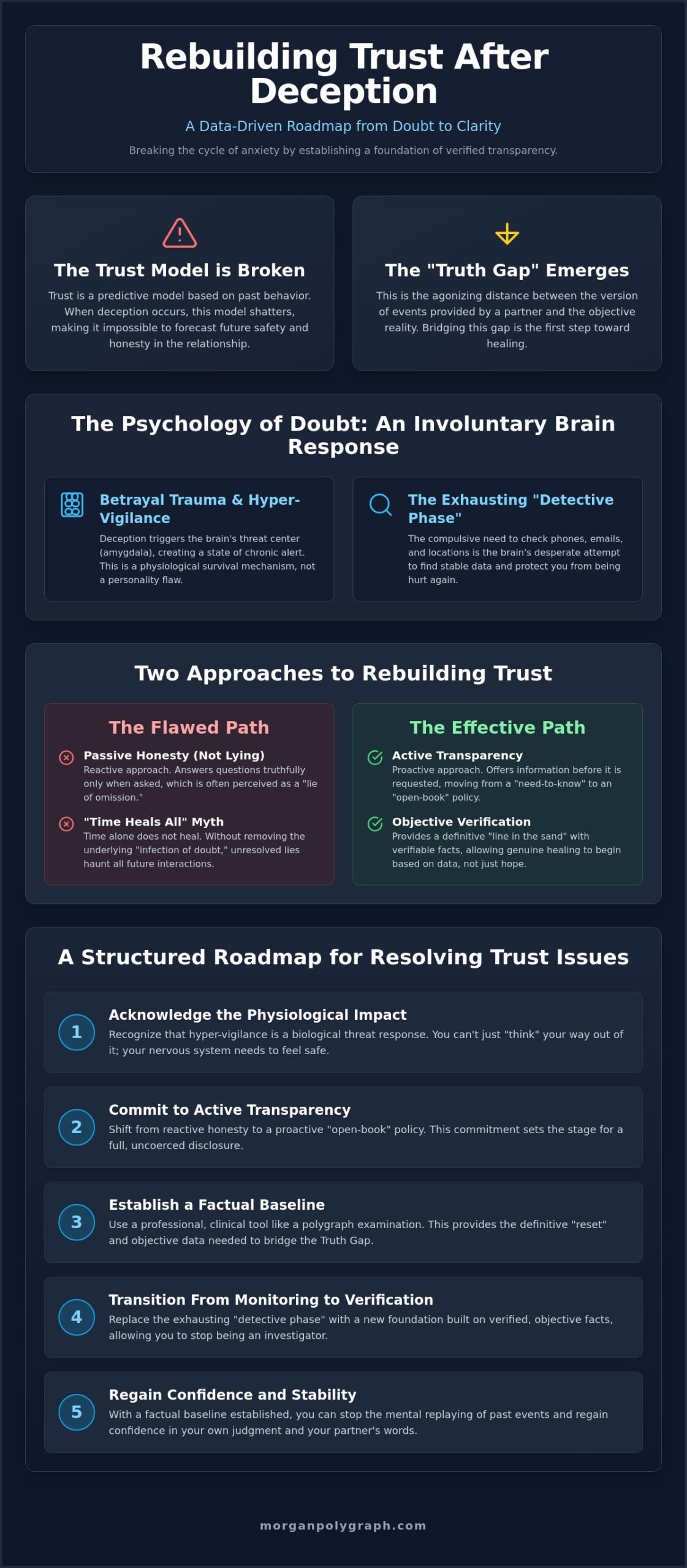
A Structured Roadmap for Resolving Trust Issues in 2026
Moving from theory to practice requires a disciplined, five-step framework. This roadmap is designed to transition a relationship from a state of crisis to a state of stability through measurable milestones. By following a methodical sequence, couples can replace the chaos of suspicion with a structured path toward reconciliation. This process is not about “blind faith” but about building a new history of verified honesty.
- Step 1: The ‘Full Disclosure’ Document. The partner who was deceptive must prepare a comprehensive, written account of all relevant events. This is a one-time opportunity to provide the complete truth without omissions.
- Step 2: Objective Verification. This phase involves using a polygraph to rebuild trust in a relationship by confirming the accuracy of the written disclosure. It provides the “line in the sand” needed to stop looking backward.
- Step 3: Radical Transparency. For a designated, temporary period, the partner provides open access to schedules and digital devices. This eliminates the opportunity for secret behavior while the new foundation is being set.
- Step 4: Consistent Re-engagement. Both partners focus on creating new, positive interactions. These serve as healthy data points that slowly replace the memories of deception.
- Step 5: The ‘Amends’ Phase. The focus shifts from merely apologizing to active restitution. The partner demonstrates through long-term effort and “proactive transparency” that they are committed to the relationship’s integrity.
The Power of the ‘Full Disclosure’ Session
“Trickle-truthing,” or the habit of revealing information in small increments over weeks or months, is often more damaging than the original betrayal. Every time a new detail emerges, the betrayed partner’s healing clock resets to zero. To minimize trauma, a disclosure session should be clinical, exhaustive, and final. Verifying this disclosure is essential to ensure that no “hidden” lies remain to sabotage the recovery process later. It creates a definitive end to the investigative phase of the relationship.
Setting Boundaries and Consequences
Clear boundaries are necessary for long-term accountability. Partners must define exactly what constitutes a relapse in transparency and what the specific consequences will be for future deceptions. In high-stakes cases, many couples choose to follow court-recognized standards for evidence and behavior to ensure total clarity. Utilizing a polygraph examination for periodic “check-ins” can provide ongoing peace of mind. These scheduled verifications act as a safety net, ensuring that the new foundation of honesty remains intact and that both parties stay aligned with their commitment to truth. If you are ready to establish this level of clarity in your partnership, you can consult with our lead practitioner to begin the process.
Professional Polygraph Testing: The Definitive Reset for Relationship Clarity
Deciding to undergo a formal examination is often the final step in moving from a state of perpetual crisis to one of informed decision-making. When traditional conversations have reached an impasse and suspicion has become a permanent resident in the home, a clinical intervention becomes necessary. Using a polygraph to rebuild trust in a relationship provides a “scientific reset” that words alone cannot achieve. It shifts the dynamic from a battle of wills to an objective review of physiological data, allowing both partners to stand on the same side of the truth.
The psychological closure that comes from a professional report is a powerful tool for reconciliation. Rather than wondering if there is “one more thing” left to be discovered, the betrayed partner receives a verified baseline. This clarity is essential for the nervous system to finally exit its state of high alert. For the partner who was deceptive, the test offers a way to prove that the “trickle-truth” phase has ended and that their commitment to transparency is genuine. Positioning the results as a foundation for future growth is the most effective way to utilize this professional service.
The Role of the Certified Examiner
National certification and adherence to American Polygraph Association (APA) standards are non-negotiable when dealing with sensitive relationship issues. A certified examiner provides a safe, clinical environment that removes the emotional volatility from the truth-telling process. We use state-of-the-art technology to capture respiratory, galvanic, and cardiovascular data, which effectively removes human bias from the analysis. For families in Boise, Idaho, our approach is always discreet and compassionate. We understand the human stress involved in these cases and ensure that every individual is treated with the utmost respect throughout the specialized methodology.
Case Study: From Suspicion to Stability
Many clients find that a simple search for a polygraph near me becomes the turning point in a multi-year argument. In the “Post-Test” phase, the professional report serves as a concrete piece of evidence that can be brought into therapy or counseling sessions. It removes the need for the therapist to act as a “lie detector” and allows them to focus on the emotional healing process instead. By providing a clear “line in the sand,” the test results empower couples to stop looking backward at past inconsistencies and start building a future based on verified facts. If you’re ready to end the cycle of doubt and regain confidence in your judgment, you can contact Morgan Polygraph for a confidential and professional consultation.
Establishing a Foundation for Future Stability
The path toward reconciliation doesn’t require you to rely on blind faith or exhausted detective work. By transitioning from subjective monitoring to objective verification, you can finally de-escalate the nervous system’s threat response. We’ve explored how a structured roadmap, combined with a clinical baseline, replaces the Truth Gap with a foundation of factual clarity. Using a polygraph to rebuild trust in a relationship is a decisive step for couples who are ready to stop looking backward and start constructing a new, transparent future together.
If you’re seeking a definitive reset, our team in Boise provides the expertise needed to handle these sensitive matters with precision. We employ nationally certified and court-recognized examiners who utilize state-of-the-art polygraph technology to ensure the highest levels of accuracy. Our service is designed to be discreet, compassionate, and professional, giving you the tools to move past the cycle of doubt and regain confidence in your own judgment.
Schedule a Confidential Infidelity Polygraph in Boise today to begin your journey toward emotional stability. You don’t have to navigate this uncertainty alone; a factual foundation is within reach.
Frequently Asked Questions
How long does it take to rebuild trust after a major lie?
Rebuilding trust typically requires a period of 18 to 24 months of consistent transparency. This timeline is heavily influenced by the elimination of “trickle-truth” and the establishment of a factual baseline. Using a polygraph to rebuild trust in a relationship helps accelerate this process by providing the objective certainty needed to end the cycle of doubt and begin genuine emotional repair.
Is it possible to ever 100% trust someone who has lied?
Trust can be fully restored, but it often evolves into a “verified trust” model rather than the “blind trust” that existed before. This new version is often more resilient because it’s based on active transparency rather than assumptions. The goal is to reach a point where doubt no longer interferes with your daily emotional stability or sense of reality.
Can a polygraph test really save a relationship?
A polygraph test acts as a diagnostic tool rather than a cure. It can’t “save” a relationship on its own, but it provides the objective data required for reconciliation to begin. By establishing a verified baseline of truth, it allows couples to stop the cycle of investigation and start the actual work of emotional repair in a safe, clinical environment.
What is ‘trickle-truthing’ and why is it so dangerous?
Trickle-truthing is the damaging practice of revealing a betrayal in small, incomplete segments over time. It’s dangerous because each new piece of information acts as a fresh trauma, resetting the recovery timeline and destroying any emerging credibility. A single, exhaustive disclosure document verified by a professional is the most effective way to prevent this cumulative destruction of the partnership.
How do I stop being a ‘detective’ in my own relationship?
Transitioning out of the “detective” phase requires a shift from constant monitoring to objective verification. Once a professional examiner validates a partner’s disclosure, the compulsive need to check devices or track locations can finally subside. This allows your nervous system to de-escalate from chronic hyper-vigilance, helping you regain your own sense of identity and emotional stability without the burden of surveillance.
What should I do if my partner refuses objective verification?
If a partner refuses objective verification, it often indicates they aren’t ready for radical transparency. You should evaluate whether the relationship can survive in a state of perpetual doubt and inconsistent data. While we don’t provide counseling, we’ve observed that successful recovery usually requires both parties to be fully committed to a verifiable truth and a methodical path forward.
Are relationship polygraphs accurate for infidelity?
Relationship polygraphs are highly accurate when conducted by a certified examiner using validated protocols. A 2011 meta-analysis by the American Polygraph Association found that single-issue diagnostic tests, which are standard for relationship verification, have an average accuracy of 89%. This precision makes the process a reliable method for establishing a “line in the sand” when subjective accounts are no longer sufficient to rebuild trust.
How do I find a certified polygraph examiner in Boise, Idaho?
To find a certified examiner in Boise, Idaho, prioritize practitioners with recognized credentials and extensive industry experience. Morgan Polygraph offers discreet and professional services in the local area, led by a highly decorated principal expert. Our methodology combines traditional expertise with modern technological advancements to ensure your sensitive issues are handled with the highest levels of precision, empathy, and confidentiality.