

In a legal landscape where verbal disputes often lead to expensive stalemates, the most powerful tool in your 2026 litigation strategy isn’t found in a law book; it’s found in the science of physiological data. You’ve likely felt the exhaustion of a case stuck in discovery, where escalating costs and conflicting testimonies make a favorable settlement feel out of reach. It’s frustrating when the truth remains obscured by a verbal deadlock that neither side seems able to break through traditional means.
This guide explores how a professional polygraph test for civil litigation in Idaho serves as a catalyst for resolution. By leveraging these examinations, you can secure the leverage needed to move past mediation obstacles and validate your client’s position before a critical deposition. We’ll examine the strategic benefits of mutual stipulation, the importance of American Polygraph Association accreditation in the absence of state licensing, and how modern detection technology transforms subjective claims into objective data. Discover how to use these innovative methodologies to protect your client’s interests and bring a methodical, organized approach to even the most sensitive civil disputes.
Key Takeaways
- Learn how a polygraph test for civil litigation in Idaho serves as a forensic tool to resolve complex verbal disputes and “he-said-she-said” stalemates.
- Understand the specific legal path to admissibility in Idaho courts through Mutual Stipulation Agreements and the application of Idaho Rule of Evidence 702.
- Discover how to utilize examination results as strategic settlement leverage to “smoke out” inconsistencies and accelerate favorable mediation outcomes.
- Explore the integration of modern biometrics, including heart rate variability and skin conductance, to ensure the highest levels of forensic accuracy in 2026.
- Identify the importance of selecting court-recognized examiners who strictly adhere to American Polygraph Association (APA) standards for civil cases.
The Role of Polygraph Testing in Idaho Civil Litigation
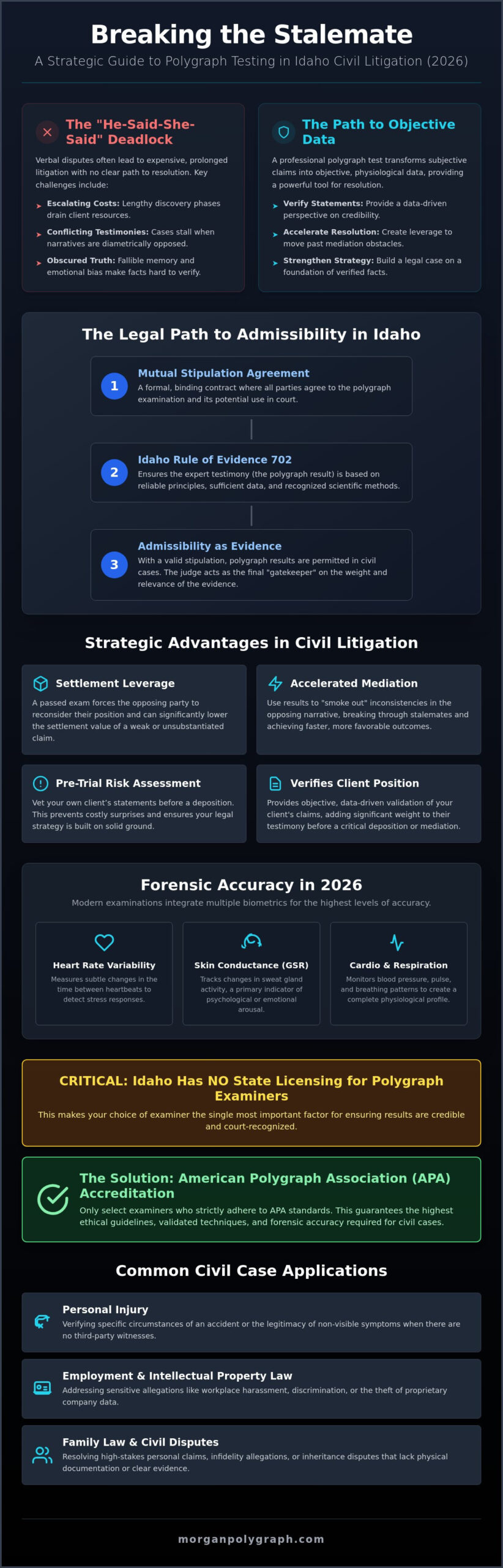
In the structured environment of Idaho’s civil courts, truth isn’t always self-evident. A polygraph test for civil litigation in Idaho acts as a specialized forensic tool designed to verify statements in non-criminal disputes. While often associated with criminal investigations, its application in the civil sector focuses on providing clarity where physical evidence is absent. By measuring physiological indicators, examiners offer a data-driven perspective on a person’s credibility. It’s a methodical way to move beyond simple assertions and toward verified information.
This shift toward objective verification is critical in 2026. Legal teams are moving away from relying solely on witness memory, which is notoriously fallible. Instead, they’re looking at the evolution of polygraph technology and validity to support their claims. In Boise, this methodical approach helps bridge the gap between conflicting testimonies, turning a subjective narrative into a measurable set of biological responses. It’s about providing a clear path forward when the facts are obscured by emotion or bias.
The “he-said-she-said” dilemma is the most common reason for litigation deadlocks. When two parties provide diametrically opposed accounts of an event, discovery can stretch for years without resolution. Boise attorneys are increasingly utilizing polygraph examinations as pre-trial risk assessments. It’s a pragmatic move. Vetting a client’s statement before a deposition prevents costly surprises and ensures the legal strategy is built on a foundation of verified facts. It allows counsel to proceed with calm, collected confidence.
Common Civil Case Applications in Boise
- Personal Injury: Verifying the specific circumstances of an accident or the legitimacy of non-visible symptoms when there were no third-party witnesses.
- Employment Law: Addressing sensitive allegations like workplace harassment, discrimination, or the theft of proprietary intellectual property.
- Family Law & Civil Disputes: Resolving high-stakes personal claims or inheritance disputes that lack physical documentation or clear evidence.
The Strategic Shift: From Courtroom to Mediation
The most effective use of a polygraph isn’t always in front of a jury. It’s in the mediation room. Since admissibility in Idaho often requires a mutual stipulation, using the test during the settlement phase provides immediate leverage. A passed exam can force the opposing party to reconsider the strength of their position. For example, if a defendant passes a polygraph, it can significantly lower the “settlement value” of a plaintiff’s weak or unsubstantiated claim. This innovative use of technology allows for faster resolutions that save clients both money and the stress of prolonged litigation.
Admissibility and the Idaho Legal Framework for 2026
The legal landscape for a polygraph test for civil litigation in Idaho is governed by specific rules that prioritize the reliability of expert testimony. Idaho Rule of Evidence 702 requires that any expert testimony be based on sufficient facts or data; it must be the product of reliable principles. While Idaho courts generally view polygraph results as inadmissible in criminal proceedings, a critical exception exists in the civil sector. Under the Idaho Administrative Code, results are permitted when all parties involved enter into a formal stipulation. This creates a strategic opening for litigators who need to move past a factual impasse. It works. By formalizing the process early, you ensure that the truth is documented in a way that the court can recognize.
A judge still maintains the role of gatekeeper, determining the weight and relevance of the evidence even after a stipulation is signed. Civil standards often allow for more collaborative use of forensic tools than criminal cases. In a civil dispute, the focus is on the preponderance of evidence, making a stipulated polygraph a significant piece of the puzzle. This distinction is vital for Boise attorneys aiming to resolve high-stakes disputes without the uncertainty of a trial. In 2026, the reliance on data-driven evidence has become the standard. Attorneys who understand these rules can use them to protect their clients from the high costs of prolonged discovery.
The Power of the Stipulation Agreement
A Mutual Stipulation Agreement is a binding contract that outlines how the examination will proceed. To be recognized by Boise courts, this document must specify the examiner, the exact questions, and the conditions for admission. Standardized polygraph testing techniques ensure the process is scientifically sound. Once results are obtained under a stipulation, they are difficult to challenge; this finality requires both parties to agree on every detail beforehand.
Expert Testimony and Credibility
Since Idaho lacks state-specific licensing, courts rely on APA accreditation to establish expertise. Examiners testify as expert witnesses, explaining the are polygraphs accurate data. This testimony addresses the Daubert Standard, evaluating whether the methodology is peer-reviewed and has a known error rate. Attorneys can consult with a court-recognized expert to ensure all technical requirements for Rule 702 are met.
Strategic Advantages: Settlement Leverage and Mediation
Utilizing a polygraph test for civil litigation in Idaho offers more than just truth verification. It serves as a high-stakes tactical maneuver designed to break through the inertia of a stalled case. In 2026, the most effective litigators aren’t just waiting for trial; they’re using forensic data as a “smoke out” tactic during the discovery phase. When one party offers to undergo a stipulated exam, it forces the opposing counsel to make a critical choice. Refusal can signal a lack of confidence in their own narrative, while acceptance sets the stage for a definitive resolution. This strategic pressure often accelerates the timeline for settlement discussions, saving clients from the grueling costs of multi-year discovery.
The psychological impact of a passed examination on the opposing side shouldn’t be underestimated. It shifts the perceived “settlement value” of a case instantly. When an attorney presents a verified report, it challenges the opposing party’s assumptions about witness credibility. This often leads to a re-evaluation of the risks involved in proceeding to trial. By following the Idaho Administrative Code on Polygraph Admissibility through mutual stipulation, you transform a subjective dispute into a data-backed position that is difficult to ignore at the negotiating table.
Leveraging Credibility in Mediation
In the mediation room, a neutral third party is looking for a reason to move both sides toward a middle ground. Presenting a formal polygraph examination report as an exhibit in a settlement brochure provides the mediator with objective leverage. It’s a tool that helps break factual deadlocks. Even if a result is “Inconclusive,” a methodical examiner can often identify the specific physiological stressors, allowing attorneys to narrow the scope of their questioning and focus on the core issues that are truly in dispute.
Pre-Trial Risk Assessment
Prudent Boise attorneys often use “blind” polygraphs as a private vetting tool before filing a claim or heading into high-stakes depositions. This isn’t just about winning; it’s about due diligence. Identifying weaknesses in a client’s veracity early prevents the waste of thousands of dollars on expert witnesses and court fees. It’s a discreet way to verify a claim’s foundation, ensuring that the legal strategy is built on a bedrock of truth. This methodical approach fulfills the ethical duty of counsel to ensure they’re presenting a case that can withstand the rigors of forensic scrutiny.
The Civil Polygraph Process: Forensic Accuracy in 2026
The precision of a polygraph test for civil litigation in Idaho relies on a rigorous, multi-layered forensic protocol. Modern instruments in 2026 have moved beyond basic pulse monitoring; they now integrate advanced biometrics to ensure the highest levels of data integrity. By measuring heart rate variability and skin conductance, examiners can distinguish between the chronic stress of litigation and the specific physiological spikes associated with deception. This technological advancement addresses the common concern regarding “nervousness” errors. It provides a stable, data-driven foundation that is essential for cases involving high-value settlements or complex liability claims.
The environment where the test occurs is just as critical as the technology. A climate-controlled, neutral testing environment in Boise ensures that external variables don’t interfere with the physiological readings. This methodical approach creates a “clinical” atmosphere that helps the examinee remain focused on the questions rather than their surroundings. Question design for a complex lawsuit differs significantly from the emotional framework of an infidelity test. Civil cases require a focus on objective actions and sensory observations rather than emotional motivations or abstract concepts. This clarity is what allows the results to stand up under the scrutiny of opposing counsel.
Step-by-Step Examination Workflow
The process begins with a comprehensive case review and consultation with legal counsel to define the “issue at hand.” This is followed by a pre-test interview where the examiner ensures the examinee understands the process and the specific questions being asked. During the data collection phase, state-of-the-art 2026 technology captures physiological responses across multiple charts. Finally, a post-test analysis is conducted, resulting in a professional legal report that details the findings with clinical precision.
Drafting Effective Civil Case Questions
Effective civil questioning usually follows a “single-issue” structure to maximize accuracy. It’s vital to avoid “legal conclusions” in the phrasing. For instance, an examiner won’t ask, “Did you commit negligence?” because negligence is a legal determination. Instead, they focus on specific actions, such as, “Did you see the red light before entering the intersection?” By focusing on objective facts, the test provides clear data that attorneys can use to build or defend a case. Attorneys seeking to implement this level of precision can schedule a forensic consultation to discuss specific case requirements.
Why Morgan Polygraph is the Trusted Choice for Boise Civil Cases
Selecting the right examiner for a polygraph test for civil litigation in Idaho is a decision that directly affects the credibility of your evidence. It’s not just about the equipment; it’s about the expertise of the individual interpreting the data. At Morgan Polygraph, we provide a blend of professional terminology and reassuring, client-focused language. We understand the human stress involved in these proceedings. Our operation is highly organized and systematic, ensuring that every detail of the examination is handled with precision. This methodical approach is why Boise’s leading legal professionals trust us with their most sensitive cases.
Our business projects a personality that is authoritative yet approachable. We bridge the gap between tradition and innovation, offering futuristic technology backed by decades of proven experience. By choosing a local expert, you ensure that your legal team has immediate access to the support they need throughout the discovery and mediation phases. Our commitment to accuracy and professionalism makes us the definitive choice for those who need to transform a legal stalemate into a clear resolution.
Credentials That Command Respect
Our practitioners are recognized within their professional community for their deep expertise and long-term industry experience. We maintain strict adherence to American Polygraph Association (APA) standards, which serves as the benchmark for forensic reliability in 2026. This commitment ensures our results are defensible under rigorous scrutiny. We’ve built a reputation for excellence through our work on complex civil disputes, making us a trusted name in the Idaho court system. The prominence of our lead practitioners, their credentials, and their published works are central to our brand, providing a personalized level of service that other providers can’t match.
Confidentiality and Professionalism
Discretion is the cornerstone of our practice. We ensure all civil case data is protected with the highest level of confidentiality. Our role is to maintain a neutral, non-accusatory environment where the human element is respected. This calm, collected atmosphere is vital for reducing false physiological spikes and ensuring the data is pure. Finding a polygraph near me means finding a partner who is accessible and understands the local legal landscape in Boise. We guide you through the logistics with unhurried, deliberate rhythm, ensuring you feel confident at every step of the process.
Secure a strategic advantage for your case—Contact Morgan Polygraph today.
Advancing Your Litigation Strategy with Forensic Precision
Breaking a litigation deadlock requires more than just persistence; it requires a shift toward objective, data-driven verification. By utilizing a polygraph test for civil litigation in Idaho, you move beyond the limitations of verbal disputes and toward a resolution based on physiological facts. We’ve explored how mutual stipulation provides a clear legal pathway and how modern biometrics ensure forensic accuracy in 2026. These tools don’t just validate statements; they create the necessary leverage to secure favorable settlements and protect your client’s interests during mediation.
Morgan Polygraph offers the expertise of nationally certified examiners who strictly adhere to APA accredited standards from our Boise-based professional office. We provide a methodical, discreet environment designed to handle the complexities of high-stakes civil cases with calm confidence. Don’t let a case remain stagnant when a scientific solution is available. Our team is ready to provide the clarity needed to move forward.
Schedule a Strategic Consultation for Your Civil Case
The path to a successful resolution is built on a foundation of truth. We’re here to help you uncover it with the professionalism and precision your case deserves.
Frequently Asked Questions
Are polygraph results admissible in Idaho civil courts?
Polygraph results are generally inadmissible in Idaho civil courts unless all parties involved enter into a formal Mutual Stipulation Agreement. This legal requirement is codified in the Idaho Administrative Code. By agreeing to the examiner and the specific questions beforehand, both sides acknowledge the validity of the findings for the purpose of settlement or trial proceedings.
How much does a polygraph test for civil litigation cost in Boise?
The cost of a polygraph test for civil litigation in Idaho varies depending on the complexity of the specific issues and the reporting requirements of the case. Forensic examinations for legal matters typically involve extensive preparation and a detailed legal report. It’s best to contact a professional examiner directly to discuss your case details and receive a quote tailored to your needs.
Can a polygraph test be used in a personal injury lawsuit?
Yes, a polygraph examination is a powerful tool in personal injury lawsuits to verify conflicting accounts of an accident. It’s especially useful when there are no third party witnesses or when the extent of non visible symptoms is in dispute. Providing objective physiological data can help break a factual deadlock during the mediation phase of the lawsuit.
What happens if a litigant is too nervous during the exam?
Modern polygraph technology is specifically designed to distinguish between general situational anxiety and the physiological markers of deception. Examiners establish a baseline of the person’s natural stress levels during a pre test interview. This methodical approach ensures that being nervous about the process itself doesn’t interfere with the accuracy of the data driven results.
How long does a civil polygraph examination take to complete?
A comprehensive civil polygraph examination usually takes between two and three hours to complete from start to finish. This duration allows for a thorough pre test interview, multiple rounds of data collection, and a preliminary analysis of the charts. We maintain a deliberate and unhurried rhythm to ensure the highest level of forensic precision for every client.
Can the opposing party force my client to take a polygraph in Idaho?
No, an opposing party cannot force a litigant to undergo a polygraph examination in the state of Idaho. The process is entirely voluntary and is typically conducted as a strategic maneuver through a mutual agreement between both legal teams. It’s a tool used for settlement leverage rather than a mandatory requirement of the discovery process.
What is the difference between a criminal and a civil polygraph test?
A criminal polygraph focuses on specific illegal acts, whereas a polygraph test for civil litigation in Idaho addresses factual disputes like liability, negligence, or contract violations. The question design for civil cases is tailored to resolve the “he said, she said” stalemates common in lawsuits. The primary goal is often to provide objective data that facilitates a faster settlement.
Does Morgan Polygraph provide expert witness testimony for the results?
Yes, Morgan Polygraph provides professional expert witness testimony to explain the methodology and the findings of the examination. Our examiners are court recognized experts who can address technical questions regarding data integrity and the Daubert Standard. This authoritative support ensures that the results are presented with the necessary academic and forensic gravitas in a legal setting.