

When an allegation of misconduct surfaces within a law enforcement agency, the true cost isn’t just the investigation itself; it’s the potential collapse of public trust. You already know that maintaining professional standards requires more than just internal hearsay. It demands objective, scientific verification that respects both the law and the individual. Utilizing a professional polygraph for internal affairs investigation Boise ensures that every inquiry is handled with the precision and confidentiality your department requires.
In this guide, you’ll learn how Boise agencies utilize certified polygraph examinations to navigate the legal complexities of employee rights while securing results that are both accurate and legally defensible. We’ll examine the integration of AI-powered behavioral speech analysis, the necessity of working with nationally certified experts, and the specific steps needed to resolve internal disputes efficiently. By the end, you’ll have a clear path toward maintaining agency integrity through 2026 and beyond.
Key Takeaways
- Understand how polygraphs serve as a vital administrative tool to clear the innocent and uphold professional standards within Boise agencies.
- Clarify why law enforcement and government entities remain exempt from private-sector polygraph bans under the 2026 EPPA guidelines.
- Learn the essential criteria for selecting a court-recognized examiner so you don’t compromise the legal defensibility of your investigation results.
- Discover the detailed stages of a polygraph for internal affairs investigation Boise, from the structured pre-test interview to the analysis of complex physiological data.
- Explore how modern investigations integrate AI-powered behavioral analysis with traditional methodology to ensure the highest levels of accuracy.
The Role of Polygraphy in Boise Internal Affairs Investigations
Internal affairs (IA) investigations in Boise represent the highest stakes for law enforcement leadership. When an allegation of misconduct arises, the goal is absolute clarity. A polygraph for internal affairs investigation Boise serves as a specialized administrative credibility assessment. It isn’t a replacement for a criminal trial; rather, it’s a precision instrument used to evaluate the truthfulness of statements when physical evidence is scarce. By 2026, the evolution of polygraph technology has integrated traditional physiological monitoring with AI-driven behavioral analysis to provide a more comprehensive view of subject integrity.
One of the most significant benefits of this process is its ability to “clear the innocent.” In professional standards cases, false accusations can derail a dedicated officer’s career. A methodical examination provides the objective data necessary to exonerate those wrongly accused. This ensures that agency resources remain focused on legitimate issues while protecting the reputations of those who uphold their oaths. In an era where every agency action is scrutinized, having a court-recognized expert provide an unbiased assessment is indispensable.
Maintaining Agency Integrity and Public Trust
Public confidence in Boise’s municipal and county agencies depends on transparency. When high-profile internal investigations occur, using an objective, third-party examiner removes the perception of bias or internal favoritism. This objectivity is crucial for supporting administrative disciplinary actions that must withstand legal scrutiny. A secure, professional environment outside the agency’s headquarters helps maintain the confidentiality required for these sensitive matters. It creates a neutral space where facts take precedence over departmental politics.
IA Exams vs. Standard Pre-Employment Screening
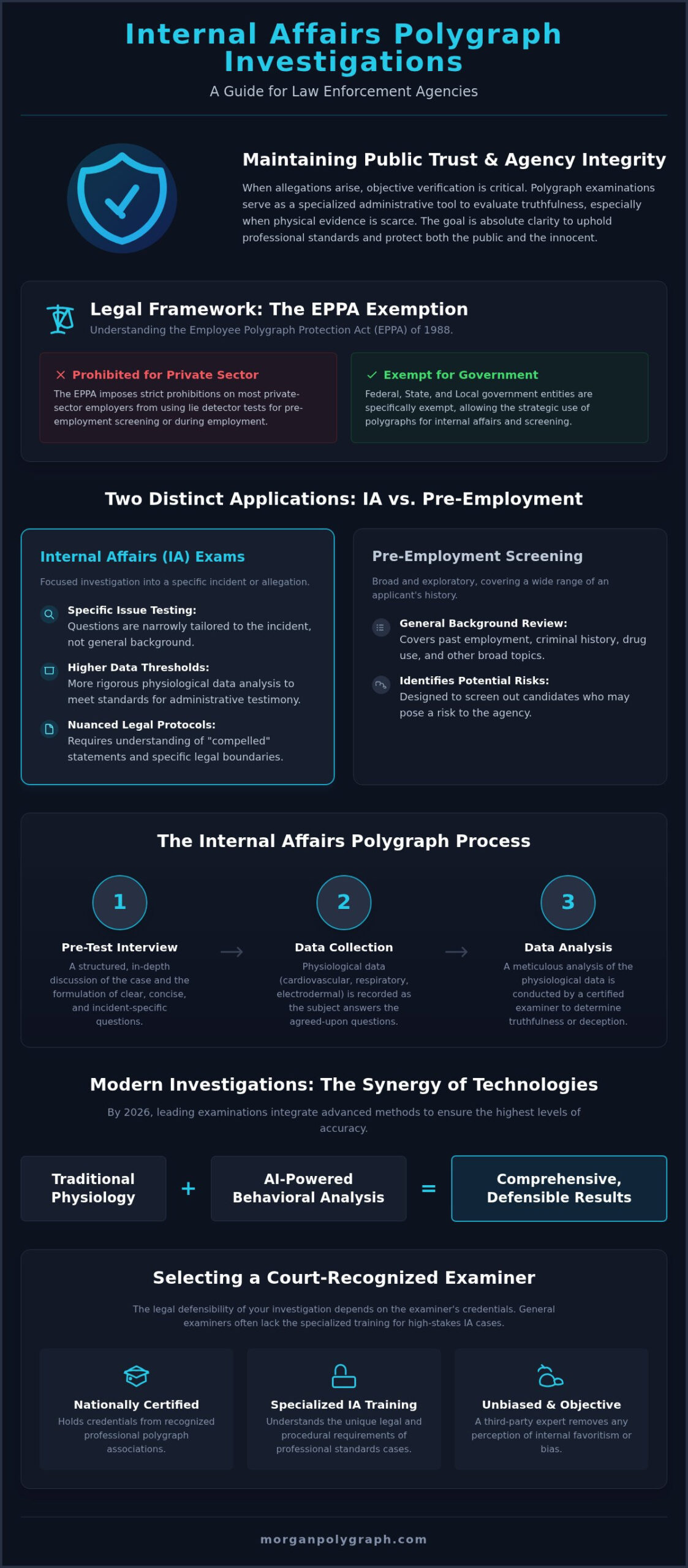
While many are familiar with pre-employment polygraphs, internal affairs examinations require a different level of nuance. Pre-employment screens are broad and exploratory. In contrast, an IA exam focuses on a specific incident or allegation. This requires a specialized approach to question formulation and data interpretation. Key differences include:
- Specific Issue Testing: Questions are narrowly tailored to the incident under investigation rather than general background history.
- Higher Data Thresholds: Examiners apply more rigorous physiological data analysis to ensure results meet professional standards for administrative testimony.
- Nuanced Protocols: IA cases often involve “compelled” statements, requiring the examiner to understand the specific legal boundaries of the investigation.
General examiners often lack the specialized training in professional standards required to handle these high-pressure scenarios correctly. Agencies need a practitioner who understands the weight of these decisions and the impact they have on both the individual and the organization.
Legal Framework: EPPA Exemptions and Idaho Regulations
Legal compliance is the bedrock of any professional standards unit. While the Employee Polygraph Protection Act (EPPA) of 1988 imposes strict prohibitions on most private-sector employers, the landscape for Boise’s public safety agencies is entirely different. Federal, state, and local government entities are specifically exempt from these federal restrictions. This allows for the strategic use of a polygraph for internal affairs investigation Boise to resolve allegations of misconduct or policy violations that threaten the integrity of the department.
In 2026, these exemptions remain a critical tool for maintaining agency transparency. The law recognizes that positions involving public trust require a higher level of accountability. When an agency initiates an IA polygraph, it must still adhere to specific documentation requirements. This includes providing the employee with sufficient notice and a clear statement of the allegations being investigated. Ensuring these procedural steps are followed protects the agency from future legal challenges regarding employee rights and administrative due process.
Understanding Federal EPPA Guidelines for Government
The “public sector” exemption isn’t a loophole; it’s a deliberate recognition of the sensitive nature of law enforcement work. The EPPA allows agencies to use polygraphs for both pre-employment screening and internal investigations. This legal framework protects the investigative process by allowing for the objective verification of statements in cases where traditional evidence may be inconclusive. Clear documentation and adherence to federal standards ensure that the results can be used effectively within an administrative framework.
Idaho State Standards for Investigative Credibility
Beyond federal law, Idaho-specific statutes play a vital role. The Idaho Polygraph Licensing Act, found in Title 54, Chapter 14 of the Idaho Code, mandates that all examiners be licensed by the Idaho Bureau of Occupational Licenses. This ensures that the professional you hire has completed accredited training and passed a rigorous background check. It’s essential to find a polygraph near me who understands these local regulations and the Peace Officer Standards and Training (POST) requirements.
While results are generally not admissible in Idaho courts without a prior stipulation from both parties, their value in administrative proceedings is significant. They provide the necessary data to support internal disciplinary actions or, conversely, to clear an officer’s name when facing unfounded complaints. If you are navigating a complex IA case, consulting with a court-recognized expert can ensure your process remains legally defensible and adheres to the highest professional standards.
Evaluating Examiners for Sensitive Professional Standards Cases
Selecting an examiner for an internal affairs case requires a different set of criteria than standard private testing. While many practitioners offer polygraph services, the technical and legal requirements of an agency investigation demand a specialist. A polygraph for internal affairs investigation Boise must be conducted by someone who understands the administrative weight of the results. The wrong choice can lead to procedural errors that compromise the entire investigation, potentially exposing the agency to litigation or grievances.
In 2026, the standard for excellence involves a marriage of seasoned experience and modern methodology. You should prioritize examiners who utilize advanced digital systems and AI-driven behavioral speech analysis. These tools provide a secondary layer of data that strengthens the traditional physiological findings. By choosing an expert who stays at the forefront of technology, your agency ensures that its professional standards remain beyond reproach.
The Importance of National APA Certification
National certification through the American Polygraph Association (APA) is the primary benchmark for credibility in Boise. APA standards dictate the ethics, methodology, and validated testing formats that are recognized by legal and administrative bodies. In 2026, certified examiners must meet rigorous continuing education requirements to maintain their standing. This commitment to ongoing training protects your agency from “junk science” challenges during arbitration or court proceedings. It ensures the methodology used is scientifically sound and peer-reviewed.
Experience with Law Enforcement and Agency Protocols
An examiner’s familiarity with law enforcement culture is vital. This includes a deep understanding of the chain of custody for reports and the ability to interface professionally with union representatives or legal counsel. High-stakes IA cases often involve complex dynamics where the examiner must remain a neutral, objective party. This is where 50 years of combined experience becomes a tangible asset. Seasoned experts understand the nuances of agency protocols and the specific pressures involved in professional standards investigations.
When evaluating potential partners, consider their history of court-recognized expert testimony in Idaho. An examiner who has successfully defended their findings in a legal setting brings a level of defensibility that a generalist cannot match. They should be well-versed in the Idaho Polygraph Licensing Act and the specific requirements of Title 54, Chapter 14 of the Idaho Code. This local expertise ensures that every aspect of the examination, from question formulation to final reporting, aligns with the highest professional and legal standards.
The Internal Affairs Polygraph Process: What to Expect
The procedural integrity of a polygraph for internal affairs investigation Boise depends on a rigid, step-by-step methodology. It’s not just about the time spent attached to sensors; it’s about the strategic preparation that occurs before the examinee even enters the suite. For IA officers, understanding this workflow is essential for ensuring that the results are both accurate and administrative-ready. A methodical approach minimizes the risk of procedural errors that could otherwise jeopardize a professional standards case.
Pre-Test Interview and Question Formulation
The first phase is a collaborative effort between the examiner and the internal affairs unit. We work closely with investigators to identify the “issue at hand,” ensuring the scope remains narrow and focused. Unlike general screenings, IA questions must be direct, unambiguous, and legally sound to avoid “gray areas” that could be exploited during a grievance process. During this stage, we also establish a physiological baseline. This allows us to calibrate the equipment to the subject’s unique resting state, ensuring that subsequent data reflects actual reactions to the target questions rather than general anxiety.
Once the interview is complete, the physiological data collection begins. We monitor three primary systems: cardiovascular activity, respiratory patterns, and electrodermal activity. In our Boise office, we use the latest medical-grade sensors to capture these subtle shifts in the autonomic nervous system. This phase is conducted with the utmost respect and patience. We provide a calm, professional environment that minimizes outside stressors which could otherwise skew the data. This focus on the human element is what allows for the high levels of precision required in agency matters.
Post-Test Analysis and Reporting for Agency Use
In 2026, the interpretation of a polygraph examination has become more precise through evidence-based scoring systems. We utilize modern algorithmic software alongside human expert analysis to ensure every chart is scored with mathematical rigor. This dual-layered approach is particularly valuable when distinguishing between “No Deception Indicated” (NDI) and “Inconclusive” results. While NDI provides a clear path forward, an inconclusive result often signals the need for further investigative work or a re-test under different parameters.
The final output is a clear, actionable summary designed for agency leadership. We understand that time is of the essence in professional standards cases. Most Boise agencies can expect a comprehensive report within a standard professional window, detailing the methodology, the specific questions asked, and the final expert opinion. If your department needs to resolve a pending matter with absolute certainty, scheduling a professional IA consultation ensures your investigation follows the highest industry protocols and remains legally defensible.
Morgan Polygraph: Expert IA Investigative Support in Boise
Morgan Polygraph has spent decades supporting law enforcement agencies and government entities throughout Idaho. Our Boise office, located at 6126 W. State Street, Suite 208, provides a secure and professional environment specifically designed for sensitive agency matters. When a department requires a polygraph for internal affairs investigation Boise, they aren’t just looking for a technician; they’re looking for a partner in professional standards. Our team brings over 50 years of combined experience to every case, ensuring that investigations are handled with the discretion and authority your agency deserves.
We understand that internal affairs investigations carry immense weight for both the individual and the organization. Because of this, we maintain a methodical and organized operation that prioritizes precision at every stage. From the initial consultation to the delivery of the final report, our process is designed to be transparent, ethical, and legally defensible. We bridge the gap between traditional investigative experience and the future of truth verification technology.
Integrating AI-Enhanced Deception Detection
We position Boise agencies at the forefront of truth verification by integrating traditional methodology with modern technology. Our current process includes AI-powered behavioral speech analysis and microexpression tools to augment traditional polygraphy. This dual-layer verification provides an additional level of data that helps resolve complex IA cases with greater certainty. This innovative approach doesn’t replace the human expert; it provides our court-recognized examiners with a more comprehensive data set to ensure the highest levels of accuracy in 2026.
Proven Reliability in Professional Standards
Reliability is the cornerstone of our practice. We adhere strictly to the highest ethical standards and American Polygraph Association (APA) guidelines to ensure every result is defensible. Many agency leaders ask, are polygraphs accurate enough for administrative action? Our record of court-recognized expert testimony proves they are, provided the examiner follows validated protocols and utilizes evidence-based scoring systems. We understand the impact these findings have on an officer’s career and the agency’s standing in the community.
Our commitment to the Boise community goes beyond just providing a service. We act as a specialized resource for professional standards units, offering expertise that is both authoritative and approachable. If your agency is facing a sensitive internal matter or needs to verify the integrity of a high-profile investigation, contact Morgan Polygraph today. We’re ready to provide the professional support needed to protect your department’s integrity and maintain public trust.
Advancing Agency Accountability and Public Trust
Maintaining high professional standards requires a commitment to objective truth. Utilizing a polygraph for internal affairs investigation Boise provides the scientific data necessary to resolve sensitive allegations while protecting the rights of dedicated officers. By combining Idaho-specific legal expertise with technological advancements like AI-driven behavioral analysis, your department can navigate complex administrative disputes with absolute confidence. These tools don’t just identify misconduct; they serve as a vital mechanism for clearing the innocent and preserving an officer’s hard-earned reputation.
Schedule a Professional Standards Polygraph in Boise to ensure your internal affairs process remains a gold standard for accountability. We look forward to supporting your agency’s mission and helping you uphold the public trust through methodical, expert-led investigations.
Frequently Asked Questions
Can an IA officer require a Boise police officer to take a polygraph?
Yes, law enforcement agencies in Boise can compel an officer to submit to an examination during an internal inquiry. Refusal to comply with a direct order for a polygraph can lead to disciplinary action, including termination, as public safety positions carry a unique mandate for transparency. IA officers typically issue a formal directive to ensure the officer understands their rights and the administrative nature of the test.
Are polygraph results admissible in Boise administrative hearings?
Results are frequently utilized in administrative hearings to assess credibility and support personnel decisions. While Idaho criminal courts generally exclude this data without a prior agreement between parties, administrative and civil proceedings operate under different evidentiary rules. A professional polygraph for internal affairs investigation Boise provides objective data that helps boards or hearing officers make more informed decisions regarding policy violations or misconduct allegations.
How does the EPPA affect internal affairs investigations in Idaho?
The federal Employee Polygraph Protection Act (EPPA) does not restrict government or law enforcement agencies in Idaho. Federal law specifically exempts the public sector from the prohibitions placed on private businesses. This allows Boise agencies to maintain rigorous professional standards by using polygraphs for both pre-employment screening and internal investigations without violating federal labor regulations.
What is the accuracy rate of polygraphs in professional standards cases?
The American Polygraph Association reports that single-issue examinations conducted by certified experts maintain high accuracy rates, often exceeding 85% to 90%. In professional standards cases, the narrow specificity of the questions contributes to these reliable outcomes. Accuracy depends heavily on the examiner’s adherence to validated protocols and the use of modern, calibrated equipment to monitor physiological responses with precision.
How long does an internal affairs polygraph examination take?
A standard examination typically requires two to three hours to complete. This duration allows for a comprehensive pre-test interview, the actual data collection phase, and a preliminary analysis of the results. Rushing the process can compromise the integrity of the data. We ensure every subject is given the necessary time to understand the questions and provide calm, consistent physiological responses in a professional environment.
Can an employee bring a lawyer to a polygraph exam in Boise?
An employee generally cannot have a lawyer or union representative inside the examination room during the actual testing phase. However, they are typically allowed to consult with legal counsel before the pre-test interview begins. Most agencies have specific protocols or collective bargaining agreements that outline these boundaries. The goal is to maintain a controlled, neutral environment free from outside distractions or influence.
What happens if a polygraph result is inconclusive in an IA case?
An inconclusive result means the physiological data did not meet the required threshold for a definitive opinion of truthfulness or deception. It isn’t a “pass” or a “fail,” but rather a lack of clear data. In these instances, the agency must rely on other investigative evidence to reach a conclusion. Occasionally, a re-test is scheduled after a period of rest to see if clearer data can be obtained.
Are AI-enhanced polygraphs more reliable for internal investigations?
AI-enhanced tools provide a secondary layer of objective verification that strengthens the overall findings. By using a polygraph for internal affairs investigation Boise that integrates behavioral speech analysis, examiners can look for patterns that traditional sensors might miss. This dual-layered approach increases the defensibility of the investigation and provides leadership with a more comprehensive view of the subject’s credibility during sensitive inquiries.