
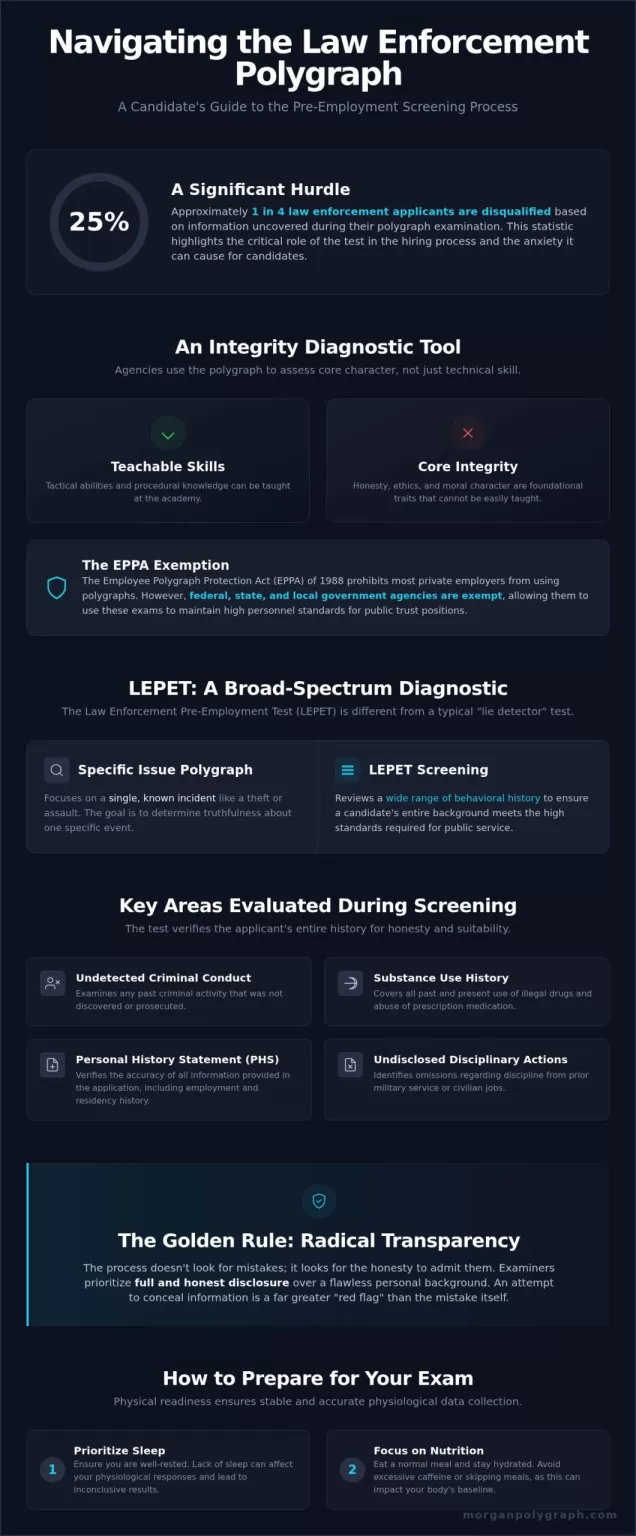
Approximately 25% of law enforcement applicants are disqualified based on information uncovered during their polygraph examination, a statistic that often fuels intense anxiety for those entering the recruitment process. This high-pressure environment makes the polygraph for law enforcement pre-employment screening one of the most misunderstood steps in a candidate’s journey. It’s common to feel a sense of dread about failing simply because you’re nervous or unsure about your legal rights under the Employee Polygraph Protection Act, which exempts government agencies from standard private-sector restrictions.
We understand that your career aspirations are on the line, and the clinical nature of these tests can feel overwhelming. This guide provides a clear roadmap to help you approach the Law Enforcement Pre-Employment Test (LEPET) with radical transparency and calm confidence. You’ll discover how agencies use these examinations as an integrity diagnostic tool rather than a search for perfection. We’ll also clarify the specific questions you can expect and how to find a nationally certified examiner in Boise to ensure your screening is conducted with the highest professional standards of accuracy and discretion.
Key Takeaways
- Learn why public sector agencies are exempt from the Employee Polygraph Protection Act and how the LEPET framework serves as a vital integrity diagnostic tool.
- Discover the specific behavioral categories evaluated during a polygraph for law enforcement pre-employment screening, including undetected criminal conduct and substance use history.
- Understand the critical role of radical transparency, as examiners prioritize honesty and full disclosure over a flawless personal background.
- Prepare effectively for your examination by following specific physical protocols regarding sleep and nutrition to ensure stable physiological data collection.
- Gain insights into the benefits of utilizing a Boise based, court recognized expert who understands local Idaho standards and modern polygraph technology.
The Role of Polygraph in Law Enforcement Hiring
Agencies today realize that technical skills are teachable, but core integrity is not. During the initial hiring phase, departments prioritize a candidate’s history of honesty over their tactical abilities. A polygraph for law enforcement pre-employment screening provides a unique psychological and physiological audit that a background investigator simply cannot perform through records alone. While the Employee Polygraph Protection Act of 1988 generally prohibits private sector testing, government and law enforcement entities rely on this exemption to maintain high personnel standards. This exam creates a “baseline of truth” for each officer. If internal affairs issues arise years later, the department has a verified record of the individual’s history upon entry. For Boise law enforcement roles, this filter is vital for maintaining the high-stress reliability and public confidence expected by the local community.
Validating Applicant Credentials and History
The Personal History Statement (PHS) is a dense document. It’s common for candidates to gloss over uncomfortable facts or omit minor details they feel are irrelevant. Using a polygraph for law enforcement pre-employment screening ensures that every listed employment history and the specific reasons for leaving previous departments are entirely accurate. It identifies “red flag” omissions that a standard background check often misses, such as:
- Undisclosed disciplinary actions from prior military or civilian service.
- Inconsistencies in residency history or financial obligations.
- Omitted details regarding previous drug experimentation or associations.
By verifying these details at our Boise facility, agencies focus their resources on candidates who demonstrate total transparency. This process doesn’t just look for mistakes; it looks for the honesty to admit them.
Assessing Moral Character and Public Trust
Police work requires a commitment to ethical policing that goes beyond simply following orders. Agencies must screen for biases or extremist affiliations that could compromise public safety or lead to civil rights violations. This is a sensitive area where modern technology meets behavioral observation to ensure the candidate’s values align with the department’s mission. Under Idaho POST standards, moral character is defined as the collection of personal traits, including honesty and law-abiding behavior, that prove a candidate’s fitness to hold a position of public trust. This assessment ensures that every officer patrolling Boise’s streets is dedicated to the community’s well-being and remains resilient under the pressures of the job.
Understanding LEPET: The Legal Framework and Process
The Law Enforcement Pre-Employment Test, or LEPET, is a specialized application of the DOJ Polygraph Technique designed specifically for applicant screening. Unlike a specific issue polygraph, which investigates a single known incident like a theft or assault, a polygraph for law enforcement pre-employment screening is a broad spectrum diagnostic. It reviews a wide range of behavioral history to ensure a candidate meets the high standards required for public service. This distinction is critical. The goal isn’t to “catch” a criminal, but to verify the integrity of a potential officer’s entire background. Agencies use this as a holistic tool to confirm that the person who applied is the same person who will wear the badge.
The EPPA Exemption for Government Agencies
The legal basis for these exams resides in the Employee Polygraph Protection Act (EPPA). While the EPPA generally prohibits private employers from using lie detectors, federal, state, and local government agencies are explicitly exempt. This allows law enforcement departments to require these examinations as a condition of employment. For private organizations that cannot use polygraphs, partnering with human resources experts like Sullivan Group HR is a common way to maintain high standards for employee vetting and compliance. Even within this exemption, candidates maintain specific rights. The exam must be conducted by a qualified professional; the results cannot be the sole basis for a hiring disqualification without additional corroborating evidence. This ensures the process remains a fair component of the overall background investigation.
A methodical, three phase structure defines the LEPET process, ensuring both accuracy and fairness. It begins with the pre-test interview. During this stage, the examiner reviews the candidate’s Personal History Statement and clarifies every question that will be asked during the actual test. There are no surprise questions. This phase is designed to reduce situational anxiety and ensure the candidate fully understands the scope of the inquiry. It’s a time for the applicant to amend any previous mistakes in their paperwork or provide context for past behaviors.
Physiological data collection occurs during the second phase, known as chart collection. This is where measurements are recorded using state of the art sensors. These instruments track respiratory activity through chest and abdominal bands, galvanic skin response via finger electrodes, and cardiovascular changes with a blood pressure cuff. The examiner remains a neutral observer, ensuring the environment is controlled and the data is clean. Finally, the post-test discussion allows the candidate to address any physiological reactions detected during the session. This collaborative approach helps distinguish between simple nerves and actual deception during a polygraph for law enforcement pre-employment screening. If you’re preparing for this process, choosing an experienced provider for pre-employment screening can help you navigate these phases with clarity.
Key Areas Evaluated During a Law Enforcement Polygraph
During a polygraph for law enforcement pre-employment screening, the examiner isn’t looking for a perfect life. They’re looking for a life of integrity. The exam covers four primary pillars: illegal drug involvement, criminal conduct, financial integrity, and personal conduct. Each area is explored through specific questions designed to uncover behaviors that could compromise an officer’s ability to serve the Boise community effectively. Radical transparency is your best asset during this phase.
Drug Use and Illegal Activities
Agencies recognize that people make mistakes, especially in their youth. They differentiate between experimental use from years ago and habitual patterns that suggest a dependency. “Recent use” standards vary by agency, but most Boise area departments look for a clear period of abstinence, often between one and three years, before an applicant is considered viable. Total disclosure regarding the sale or distribution of controlled substances is mandatory. Omissions here are viewed more severely than the use itself. If you’ve experimented in the past, being upfront about the frequency and timing is essential for maintaining credibility.
Theft and Financial Integrity
This phase evaluates honesty in the workplace and general financial responsibility. Examiners look for “theft of time,” such as falsifying records or timecards, alongside the theft of physical property from past employers. Financial stability is also a key indicator of moral character. Candidates with significant, unaddressed debt or a history of financial irresponsibility may be flagged as higher risks for potential corruption. Because these questions are deeply personal, many applicants ask, Are Polygraphs Accurate? regarding such sensitive topics. The reliability of the recorded data is maximized when the candidate provides full context during the pre-test discussion, allowing the examiner to adjust the inquiry to your specific history.
Criminal Conduct and Professionalism
Examiners also screen for undetected criminal acts and professional conduct issues that might not appear on a standard background check. This includes:
- Undetected felonies or serious misdemeanors that never resulted in an arrest.
- Serious traffic violations, including DUIs or a pattern of reckless driving.
- Incidents of domestic violence or significant civil disputes.
Under the Lautenberg Amendment, a domestic violence conviction is an automatic disqualifier for carrying a firearm, making this a critical area of inquiry. The polygraph ensures that no such history is hidden. By addressing these areas with honesty, you prove you possess the character required for public trust. This methodical approach filters for high stress reliability, ensuring that only those truly fit for the rigors of law enforcement move forward in the Boise recruitment process.
How Candidates Can Prepare for a Pre-Employment Exam
Preparation for a polygraph for law enforcement pre-employment screening is often counterintuitive. It isn’t about memorizing answers or practicing tactical breathing. Instead, successful preparation centers on fostering a mindset of total transparency. Most candidates who struggle with the exam don’t fail because of a past indiscretion; they fail because they attempted to hide it. Approaching the session with a commitment to radical honesty is the most effective way to ensure a smooth process.
The Power of Full Disclosure
In the world of law enforcement hiring, the lie is always worse than the past mistake. Agencies are looking for individuals who take responsibility for their actions. If you have ambiguous memories or minor details you’re unsure about, the pre-test interview is your opportunity to clarify them. This phase allows you to refine your answers and provide context before the sensors are ever attached. Polygraphs measure deception, not perfection. Departments expect you to have a history; they just need to know you have the integrity to admit to it.
Day-of Logistics and Physical Readiness
Physical stability is vital for producing a clean, interpretable chart. You should maintain your normal daily routine to ensure a stable physiological baseline. This means prioritizing a full night’s sleep and eating a balanced meal before your appointment. If you typically drink a cup of coffee in the morning, you shouldn’t skip it on the day of the exam. Drastic changes to your caffeine or nicotine intake can create irregular data that complicates the results. For a more detailed walkthrough of what to expect on your test day, read our Polygraph Examination: A Complete Guide to the Process.
It’s equally important to communicate any current health issues or medications to your examiner at the start of the session. Certain medical conditions or prescriptions can influence physiological responses. Providing this information upfront allows the examiner to account for these variables when reviewing your data. This level of communication builds trust and ensures the highest level of accuracy.
Finally, avoid “how to beat the test” websites. These platforms often suggest physical or mental maneuvers known as countermeasures. Modern, state-of-the-art technology used in our Boise facility easily detects these attempts. Attempting to manipulate the sensors is the fastest way to be permanently disqualified from the recruitment process. It signals a fundamental lack of character that no law enforcement agency will overlook. If you’re ready to schedule your pre-employment screening, contact our Boise office to work with a court-recognized expert.
Professional Law Enforcement Screening in Boise, Idaho
Choosing a local provider for a polygraph for law enforcement pre-employment screening offers significant advantages for both the hiring agency and the candidate. Morgan Polygraph operates as a specialized partner for departments across the Treasure Valley, providing the authoritative and discreet environment necessary for sensitive background evaluations. Our facility at 6126 W. State Street in Boise is designed to be a neutral space where candidates can feel respected while undergoing a rigorous diagnostic process. We use state-of-the-art technology that integrates modern, data-driven detection with behavioral observation, positioning our office as a leader in technical advancements within Idaho.
Serving Boise and Southern Idaho Agencies
We recognize that background investigators (BIs) often work under intense deadlines to fill academy slots or patrol vacancies. To support these efforts, we provide streamlined scheduling and prioritized reporting for local government entities. Our examiners produce detailed, professional reports that are specifically tailored to law enforcement standards, ensuring that every finding is clearly documented and defensible. The State Street location serves as a convenient, central hub for agencies in Boise, Meridian, Nampa, and Caldwell. This local accessibility reduces travel burdens for applicants and allows for closer collaboration between our experts and agency investigators. We maintain a methodical and organized operation to ensure that every screening is conducted with the precision required by the Idaho POST standards discussed earlier in this guide.
Why Certification Matters for LE Screening
The reliability of a polygraph for law enforcement pre-employment screening depends entirely on the expertise of the individual conducting it. Our practitioners are nationally certified and recognized as experts within the professional community. We strictly adhere to the American Polygraph Association (APA) standards, which set the global benchmark for ethical and effective testing. This commitment to high-level certification reduces agency liability by ensuring that every examination is legally sound and scientifically grounded. The path to becoming an expert in this field is demanding and requires a deep understanding of psychology and physiology. You can learn more about the intensive training our team undergoes by reviewing our career guide for examiners.
By bridging tradition with innovation, Morgan Polygraph provides Boise law enforcement with a reliable tool for assessing integrity. Our use of court-recognized experts and futuristic technology ensures that the screening process remains a powerful filter for identifying the most qualified candidates for public service. We take pride in our role in helping Southern Idaho agencies build teams characterized by resilience, honesty, and unwavering professionalism.
Securing Your Future Through Radical Transparency
The path to a career in public service is built on a foundation of trust and accountability. A polygraph for law enforcement pre-employment screening isn’t an obstacle to be feared but a specialized tool designed to validate your integrity. By prioritizing radical transparency and following the physical preparation protocols discussed, you’ll be ready to approach the LEPET process with calm, collected confidence. Agencies value the honesty to admit past mistakes far more than an impossible standard of perfection.
Morgan Polygraph provides the authoritative expertise necessary to navigate this sensitive phase of your recruitment. Our Boise based office utilizes state of the art technology and is led by a court recognized expert with decades of industry experience. Our nationally certified examiners ensure that every screening is conducted with the utmost discretion and professionalism. Contact Morgan Polygraph for Professional Law Enforcement Screening to ensure your background is evaluated with the highest standards of accuracy. Your commitment to the badge begins with your commitment to the truth. We look forward to helping you move forward in your career with confidence.
Frequently Asked Questions
Is the law enforcement polygraph required for all agencies in Idaho?
While not every single rural department may mandate it, the vast majority of law enforcement agencies in Idaho utilize a polygraph for law enforcement pre-employment screening as a core component of their hiring process. Idaho POST standards in 2026 continue to recognize the validity of these exams for applicant screening. Most Boise area departments require it to verify the integrity of the applicant’s history before final selection into the academy or patrol.
Can I fail a law enforcement polygraph because of nerves?
You cannot fail simply because you are nervous; examiners are trained to identify the difference between general situational anxiety and physiological responses related to deception. Every candidate experiences some level of stress during a polygraph for law enforcement pre-employment screening. The process includes a pre-test phase specifically designed to establish your baseline and lower your anxiety levels before the actual chart collection begins for the agency.
What happens if I admit to a past mistake during the pre-test interview?
Admitting to a past mistake allows the examiner to clarify the details and potentially adjust the test questions to reflect your current honesty. Agencies prioritize radical transparency over a perfect past. Many candidates successfully move forward after disclosing minor drug experimentation or traffic violations. The critical issue is the admission itself; discovering a hidden fact later in the background investigation is far more likely to result in your disqualification.
Does the Employee Polygraph Protection Act (EPPA) apply to police applicants?
The EPPA provides a specific exemption for federal, state, and local government agencies, meaning it does not prohibit law enforcement departments from requiring a polygraph. While private employers are restricted from using lie detectors for screening, the public sector utilizes these tools to ensure the high moral character of those in positions of public trust. You still maintain specific rights regarding how the exam is conducted and documented.
How long does a law enforcement pre-employment polygraph take?
A typical session lasts between two and four hours, depending on the complexity of your background and the specific agency requirements. This duration includes the comprehensive pre-test interview, the actual physiological data collection, and a post-test discussion. We never rush this process. Our Boise office ensures there is ample time for you to ask questions and clarify any points of concern to ensure the highest data accuracy.
Can I retake the polygraph if I am disqualified based on the results?
The ability to retake an exam is determined by the specific hiring agency’s policies rather than the polygraph examiner. Some departments allow for a retest if the initial results were inconclusive or if there were documented external factors that influenced the data. However, if a disqualification is based on an admission of a serious crime or a clear pattern of deception, a retake is rarely offered to candidates.
What kind of questions are considered “off-limits” during a screening?
Examiners are prohibited from asking questions regarding your religious beliefs, political affiliations, sexual orientation, or lawful union activities. The inquiry is strictly limited to behaviors that impact your fitness for duty and moral character. This includes criminal conduct, drug involvement, and employment integrity. Our Boise practitioners follow strict American Polygraph Association standards to ensure every question remains professional, relevant, and respectful of your privacy throughout the entire process.
How far back into my past will the examiner look?
The scope of the inquiry typically focuses on your adult life, but serious criminal acts or significant drug involvement are evaluated regardless of when they occurred. While agencies are less concerned with minor teenage indiscretions, they look for a consistent pattern of law-abiding behavior in your recent history. The primary goal is to ensure that your current character aligns with the high standards expected for law enforcement roles in Boise.