

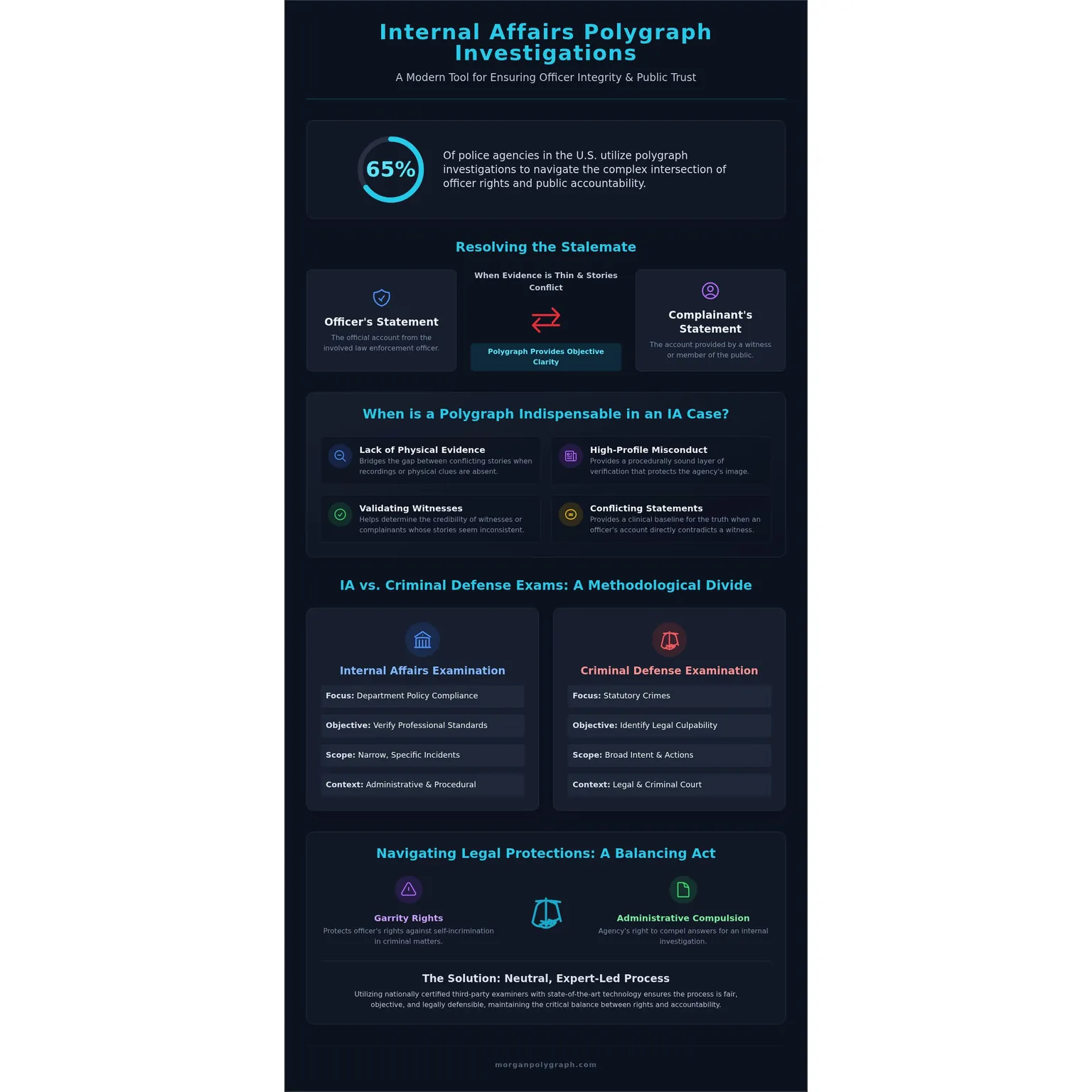
Approximately 65% of police agencies across the United States now utilize an internal affairs polygraph investigation to navigate the complex intersection of officer rights and public accountability. You know that maintaining the delicate balance between protecting an officer’s Garrity Rights and ensuring absolute transparency with the community is one of the most difficult challenges in modern law enforcement. When witness statements conflict and physical evidence is thin, the pressure to reach a fair, definitive resolution can strain department morale and public trust alike.
This guide explores how specialized polygraph examinations provide the objective clarity needed to resolve these high-stakes administrative disputes. By utilizing nationally certified examiners and state-of-the-art technology, your department can secure evidence that stands up to rigorous scrutiny. We’ll examine the role of neutral third-party experts in upholding procedural integrity, the logistical requirements for a successful exam, and how these modern tools help maintain the professional standards your agency and the public expect.
Key Takeaways
- Learn how polygraph examinations serve as a decisive tool for resolving conflicting statements between officers and complainants.
- Understand the procedural requirements for an internal affairs polygraph investigation, specifically how to maintain the balance between administrative compulsion and Garrity Rights.
- Discover the specialized methodology used in administrative testing to ensure results are procedurally sound and withstand internal scrutiny.
- Identify best practices for establishing clear department policies that communicate the process effectively to all parties involved.
- See how state-of-the-art technology and nationally certified examiners provide the neutral evidence necessary for confident administrative decisions.
The Critical Role of Polygraphy in Internal Affairs Investigations
An internal affairs polygraph investigation serves as a specialized administrative tool designed to protect the integrity of law enforcement agencies. Unlike pre-employment screenings that assess a candidate’s broad history, an IA examination focuses on specific allegations of misconduct or policy violations. These investigations are essential when traditional evidence is absent. By providing a data-driven analysis of truthfulness, the process helps command staff make informed decisions regarding an officer’s fitness for duty. This isn’t a routine check; it’s a reactive measure used to address specific, high-stakes incidents that threaten the agency’s standing.
Departments often face situations where the only evidence is the word of a complainant against the word of an officer. In these scenarios, Polygraph technology and its validity provide a path forward that subjective interviews cannot offer. Utilizing a third-party examiner in Boise ensures that the results are neutral and free from internal department politics. This objectivity is vital for maintaining public trust. When the community sees that an agency is willing to use rigorous, scientific methods to investigate its own, transparency increases and the department’s reputation is shielded from claims of favoritism.
Maintaining Professional Standards in Law Enforcement
Professional standards are the bedrock of any reputable agency. The presence of a formal internal affairs polygraph investigation process acts as a powerful deterrent against misconduct. Officers who know that their statements will be verified through specialized technology are more likely to adhere strictly to the Law Enforcement Code of Ethics. It’s about more than catching lies; it’s about fostering an environment where truth is the expected standard.
The examiner’s role is to provide a measured, objective report based on physiological data. This removes the personal element from the investigation. It ensures that the final administrative decision rests on facts rather than internal biases or workplace relationships. By integrating modern, innovative methodologies, departments in Idaho demonstrate a commitment to being forward-thinking leaders in professional accountability.
When to Utilize a Polygraph in an IA Case
While not every minor policy infraction requires a polygraph, certain situations make it indispensable. These exams are most effective when the investigation has reached a stalemate or involves serious breaches of protocol.
- Lack of Physical Evidence: When there are no body-worn camera recordings or physical clues, the polygraph bridges the gap between conflicting stories.
- High-Profile Misconduct: In cases that draw significant media attention, a formal exam provides a procedurally sound layer of verification that protects the agency’s image.
- Validating Witnesses: It’s not just for officers; polygraphs can help determine the credibility of witnesses or complainants whose stories seem inconsistent or motivated by malice.
- Resolution of Conflicting Statements: When an officer’s account directly contradicts a witness, the polygraph provides a clinical baseline for the truth.
Using these exams as a final step in complex administrative reviews provides the resolution necessary to close a case with confidence. It ensures that the investigation withstands the scrutiny of internal boards, unions, and potential civil litigation.
Methodology: How IA Polygraph Exams Differ from Criminal Defense
The methodology used in an internal affairs polygraph investigation is distinct from criminal defense testing because the objective shifts from identifying statutory crimes to verifying compliance with department policy. While a criminal exam might focus on broad intent or legal culpability, an administrative exam is narrow and focused on specific breaches of professional standards. The polygraph examination process follows a rigid, documented structure to ensure every result is defensible during a grievance hearing or civil court proceeding. Many agencies look to established models, such as the Little Rock Police Department polygraph procedures, to frame their own protocols and ensure they meet modern standards of accountability.
Utilizing a neutral, third-party examiner is essential for maintaining the credibility of the findings. When an investigation remains entirely in-house, there is a risk of perceived bias or conflict of interest. An external expert provides a clinical, detached analysis of the data, which protects both the officer and the department from accusations of favoritism or targeted discipline. If your agency needs to resolve a complex internal matter, professional standards testing provides the objective evidence required for a fair resolution.
Question Formulation for Administrative Policy
Effective question formulation is the foundation of a successful administrative exam. The examiner focuses on specific policy breaches, such as unauthorized use of force or failure to report an incident, rather than broad character traits. During the pre-test interview, the examiner reviews every question with the officer to ensure there is no confusion regarding the terminology or the scope of the inquiry. This phase is critical for setting the stage for accurate physiological data collection. Questions are kept clear, direct, and limited in scope to prevent the officer’s general stress from interfering with the specific responses related to the allegation.
Data-Driven Detection and Behavioral Observation
Modern polygraph sensors track subtle respiratory, galvanic, and cardiovascular changes that occur when an individual is untruthful. These state-of-the-art tools provide a high-resolution look at the body’s autonomic nervous system responses. The examiner’s role involves interpreting these complex charts without personal bias, relying on validated scoring systems to reach a conclusion. Regarding the question of are polygraphs accurate in a controlled IA environment, research indicates that when used with validated techniques, they provide a highly reliable baseline for truth verification. This data-driven approach ensures that the final report is based on science rather than subjective behavioral observation alone.
Navigating Legal Protections: Garrity Rights and Procedural Integrity
Conducting an internal affairs polygraph investigation requires a deep understanding of the unique legal landscape surrounding public sector employment. The most critical element is the ‘Garrity Warning,’ which originates from the 1967 Supreme Court case Garrity v. New Jersey. This rule allows an agency to compel an officer to answer questions, including those during a polygraph, under the threat of administrative discipline or termination. However, because the statement is compelled, the Fifth Amendment protects the officer by ensuring those specific statements cannot be used against them in a criminal prosecution. This distinction is the bedrock of professional standards investigations.
Maintaining this boundary is vital for procedural integrity. If an agency fails to properly administer these warnings or conflates administrative compulsion with voluntary criminal statements, the entire investigation can be jeopardized. Morgan Polygraph focuses on ensuring every internal affairs polygraph investigation is conducted within these strict legal boundaries, adhering to the Peace Officer Bill of Rights (POBR) where applicable. This methodical approach ensures that findings remain defensible during administrative appeals or union grievances, providing command staff with a reliable foundation for their decisions.
Compelled Statements vs. Admissibility
Polygraph results in an IA context are primarily administrative tools. They aren’t typically intended for criminal courtrooms but for internal decision-making regarding policy violations. The U.S. Department of Justice on Polygraph Use provides extensive context on how these tools are viewed at the federal level, emphasizing their role as investigative aids rather than standalone legal proof. For local agencies, using polygraph data to support termination or suspension helps mitigate the risk of ‘wrongful termination’ lawsuits. When a department can point to a procedurally sound, expert-led examination, they demonstrate that their disciplinary actions weren’t arbitrary or capricious.
Privacy and Confidentiality in High-Stakes Testing
Sensitivity is paramount when investigating one’s own staff. Our Boise facility is designed to be a clinical and discreet environment, ensuring that officers aren’t subjected to unnecessary public or peer scrutiny during the process. We handle all reports and physiological data with high-level security to prevent unauthorized access. This level of professionalism is why it’s crucial to work with examiners who understand the rigors of the field, as outlined in our guide on how to become a polygraph examiner. Certification isn’t just a credential; it’s a commitment to the procedural standards that protect both the individual and the institution.
Best Practices for Implementing Polygraph Testing in Agencies
The success of an internal affairs polygraph investigation depends on the quality of the administrative framework surrounding it. Agencies shouldn’t view the polygraph as a standalone solution but as a critical component of a comprehensive investigative process. This requires clear communication with the involved officer and their legal or union representative. When everyone understands the scope of the exam and the procedural protections in place, the process moves forward with less friction and higher credibility.
Integrating polygraph findings into the final investigative report requires precision. The results shouldn’t be presented as the sole basis for a disciplinary decision. Instead, they should corroborate or challenge existing evidence, such as witness statements or digital logs. This holistic approach ensures that the final administrative action is robust enough to withstand internal grievances or external litigation.
Developing a Standard Operating Procedure (SOP)
A well-defined Standard Operating Procedure (SOP) is the agency’s best defense against claims of bias or unfair treatment. Your policy should clearly define the threshold for requiring a polygraph, ensuring it’s reserved for cases where conflicting statements cannot be resolved through other means. Consistency is vital; the policy must apply equally across all ranks to maintain department morale. Before finalizing an SOP, agencies should review the document with legal counsel to ensure strict compliance with local Idaho laws and administrative codes. A transparent policy protects the department’s integrity and provides officers with a predictable process during high-stress investigations.
Selecting the Right Examiner for Law Enforcement
Choosing an examiner is a decision that directly impacts the agency’s professional standing. It’s essential to select a professional who is nationally certified and has a proven track record of court-recognized expertise. Examiners with law enforcement or governmental backgrounds are particularly valuable because they understand the nuances of police culture and the specific pressures of an internal investigation. When searching for a finding a certified polygraph near me, verify their professional affiliations and their experience with administrative policy violations.
Working with a Boise-based expert who utilizes state-of-the-art technology ensures that your agency receives the most accurate, data-driven results possible. If your department is ready to enhance its investigative protocols, schedule a professional standards consultation to discuss your agency’s specific needs and ensure your process is procedurally sound.
Why Law Enforcement Agencies Trust Morgan Polygraph for IA Investigations
Trust in an internal affairs polygraph investigation is built on the foundation of specialized expertise and procedural transparency. Law enforcement agencies across the Boise, Idaho area rely on Morgan Polygraph because our examiners understand that these cases require more than just technical proficiency. We recognize that an IA investigation carries significant weight for the officer’s career and the department’s public standing. By maintaining a focus on nationally certified standards and court-recognized methodology, we provide the objective clarity necessary to resolve sensitive internal disputes with total confidence.
Our approach balances authoritative expertise with a deep respect for the human element involved in these high-stress environments. We don’t just provide a service; we act as a neutral, third-party partner dedicated to protecting the integrity of your agency. This commitment to professional standards ensures that every exam is conducted with the compassion and discretion that law enforcement professionals deserve. When results are data-driven and the process is beyond reproach, departments can make administrative decisions that are fair, firm, and final.
Expertise in Professional Standards Investigations
This emphasis on procedural rigor and specialized expertise is a hallmark of high-stakes operations worldwide. For organizations requiring reliable support in complex environments, Tactical Troop provides international security and risk management services that prioritize the same level of integrity and professional accountability.
IA cases involve unique pressures that differ significantly from criminal or civil matters. Our examiners possess a deep understanding of these requirements, ensuring that every internal affairs polygraph investigation is tailored to the specific administrative policy at hand. We provide comprehensive, professional reports that are meticulously organized and ready for immediate administrative review. If a case proceeds to a formal hearing, our practitioners are available to provide expert testimony. This level of support ensures that the scientific data we collect is clearly explained and defended within the context of law enforcement professional standards.
State-of-the-Art Facilities and Technology
Precision requires a controlled environment. Our professional facility in Boise is designed to ensure both accuracy and privacy, providing a clinical setting where physiological responses can be monitored without external interference. We continuously integrate the latest polygraph methodologies and data-driven detection tools to maintain our position as a leader in the field. Morgan Polygraph bridges the gap between decades of traditional investigative experience and the integration of futuristic, data-driven technology. This focus on innovation doesn’t replace the human element; instead, it provides our seasoned experts with the high-resolution data needed to reach the most accurate conclusions possible. By combining methodical organization with modern technical descriptors, we offer a service that is both scientifically rigorous and procedurally sound.
Upholding Agency Integrity Through Objective Evidence
Maintaining professional standards requires more than just policy; it demands tools that provide clarity when truth is contested. An internal affairs polygraph investigation serves as a critical bridge between conflicting accounts, ensuring that administrative decisions rest on objective, data-driven results rather than subjective observation. By navigating the complexities of Garrity Rights and procedural integrity, your agency can resolve high-stakes misconduct allegations while protecting the rights of all personnel involved. This methodical approach fosters a culture of accountability and helps preserve the public trust that is essential for effective policing.
Morgan Polygraph provides the specialized support needed to uphold these standards with confidence. Our Boise-based professional facility is equipped with state-of-the-art technology to ensure every examination is precise, discreet, and procedurally sound. As nationally certified examiners and court-recognized experts, we offer the authority and reliability your department requires to navigate sensitive internal matters effectively. Schedule a Professional Standards Consultation with Morgan Polygraph today to strengthen your agency’s investigative framework. We’re here to help your department move forward with absolute certainty and professional excellence.
Frequently Asked Questions
Can an officer be forced to take a polygraph in an internal affairs investigation?
An agency can order an officer to undergo an internal affairs polygraph investigation as part of an administrative inquiry. While the Fifth Amendment protects against self-incrimination, the “Garrity Rule” allows departments to compel statements for internal purposes. An officer who refuses to comply with a direct order to take the examination may face disciplinary action, including termination for insubordination. However, the results of this compelled exam cannot be used against the officer in a criminal trial.
Are internal affairs polygraph results admissible in court?
Polygraph results from administrative investigations are typically not admissible in criminal trials due to their compelled nature. However, they are frequently used in administrative hearings, civil litigation, and labor arbitrations. These results provide a data-driven baseline for department leaders to make decisions regarding policy violations or fitness for duty. Because Morgan Polygraph utilizes nationally certified examiners, our reports are structured to withstand the rigorous scrutiny often found in internal grievance processes and administrative appeals.
What happens if an officer fails a polygraph during an administrative investigation?
A failed examination usually triggers a deeper review of the available evidence within the broader investigation. Department policy dictates the specific outcome, which may range from additional interviews to suspension or termination. It’s rare for a polygraph result to be the sole basis for discipline; instead, it serves to corroborate or contradict other evidence. The goal is to ensure professional standards are upheld while providing the agency with a procedurally sound path toward a final resolution.
How do Garrity Rights protect an officer during a polygraph exam?
Garrity Rights ensure that any statement an officer is compelled to make during an internal affairs polygraph investigation cannot be used as evidence in a criminal prosecution. This legal protection balances the agency’s need for internal accountability with the individual’s constitutional right against self-incrimination. Before the exam begins, the officer is typically issued a formal warning clarifying that their answers are for administrative purposes only. This allows the investigator to gather facts without violating the officer’s legal rights.
Can a polygraph be used for pre-employment screening in law enforcement?
Law enforcement agencies are legally permitted to use polygraph examinations as a standard part of their pre-employment screening process. Federal law specifically exempts governmental employers from the restrictions that prevent private businesses from using lie detector tests. Morgan Polygraph specializes in these screenings, helping agencies in Boise and throughout Idaho identify candidates who meet the high ethical standards required for public service. This proactive approach helps build a department founded on integrity and transparency from the start.
How long does a typical internal affairs polygraph investigation take?
A standard examination typically requires a minimum of 90 minutes to complete according to American Polygraph Association standards. This timeframe includes the pre-test interview, the actual physiological data collection, and a post-test review of the results. Complex internal affairs cases may take longer if there are multiple policy violations to address. We ensure that every session is unhurried and methodical, providing a professional environment that allows for the most accurate and reliable data collection possible.
What is the difference between a criminal polygraph and an IA polygraph?
The primary difference lies in the legal framework and the ultimate goal of the test. A criminal polygraph is usually voluntary and focused on gathering evidence for a potential prosecution. In contrast, an IA polygraph is often an administrative requirement focused on policy compliance and professional ethics. While criminal tests seek to prove a statutory crime, internal affairs examinations are designed to maintain agency standards and resolve conflicting statements between officers, witnesses, or complainants.
Is the Employee Polygraph Protection Act (EPPA) applicable to law enforcement agencies?
The Employee Polygraph Protection Act (EPPA) of 1988 does not apply to federal, state, or local government agencies. Law enforcement departments are specifically exempt from the federal regulations that prohibit private employers from using polygraph testing for screening or investigations. This exemption allows agencies to utilize truth verification technology to maintain the high levels of integrity required for public safety roles. The current OMB form related to this act is scheduled to remain in effect through October 31, 2026.