

In a contested adoption, the truth often gets buried under a mountain of conflicting testimonies and unverified allegations. You likely feel the immense pressure of defending your reputation against false claims or trying to prove years of hard-won sobriety. It’s a high-stakes environment where a “he-said-she-said” stalemate can stall your family’s future for months. Utilizing a professional lie detector test for contested adoption cases in Meridian can be the decisive factor that breaks through these legal deadlocks.
We understand that adoption litigation is emotionally and financially draining, especially with the 2026 updates to the Idaho Rules of Family Law Procedure creating new procedural hurdles. This article will show you how a polygraph examination provides the objective clarity needed to resolve credibility disputes and validate parental fitness. You’ll learn about the critical role of legal stipulations in Idaho courts and how a detailed, expert report can serve as a powerful tool during mediation. Discover how modern technology and experienced examiners help you move past accusations to reach a resolution that prioritizes the best interests of the child.
Key Takeaways
- Learn why objective data is often the only way to resolve “he-said-she-said” stalemates in complex Ada County adoption disputes.
- Understand the critical role of legal stipulations and how they impact the use of a lie detector test for contested adoption cases in Meridian.
- Gain insight into the three-phase examination process and the physiological metrics used to provide a clear, data-driven picture of truthfulness.
- Discover how to properly prepare for your Boise-based appointment to ensure professional results that meet the standards of Idaho family courts.
- Find out how expert polygraph reports can be strategically used during mediation to validate parental fitness and resolve neglect or abuse allegations.
Contested Adoption in Meridian: When Credibility Becomes the Deciding Factor
Adoption is meant to be a beginning, yet for many families in Ada County, it feels like an exhausting legal marathon. When a birth parent or a relative contests an adoption, the courtroom often transforms into a space of high-tension conflict. Traditional evidence like witness statements, character references, or home study reports are essential, but they frequently leave gaps that a judge cannot easily fill. These documents can be curated to show only the best side of a person, often failing to address the underlying question of character and honesty. When credibility becomes the central issue, a lie detector test for contested adoption cases in Meridian serves as a vital tool for bringing objective clarity to the proceedings.
The emotional weight of these cases cannot be overstated. Families are fighting for their future, and the stress of “he-said-she-said” arguments can be paralyzing. Using a professional examination provides a way to cut through the noise. It offers a structured, scientific method to evaluate the truthfulness of specific claims that might otherwise remain unproven. This level of verification is especially helpful when the court must decide between two diametrically opposed versions of the truth.
Common Allegations in Adoption Disputes
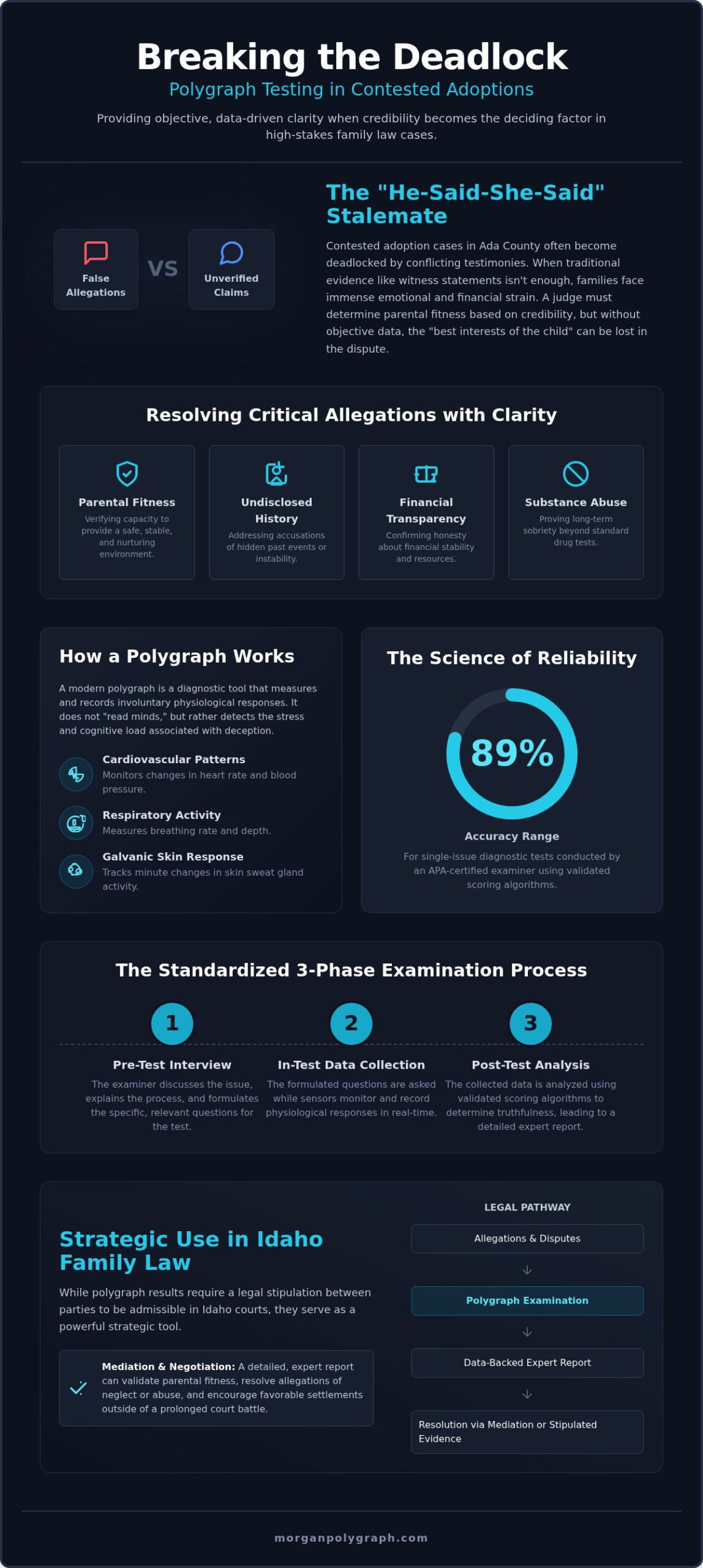
In many contested cases, allegations are designed to cast doubt on a party’s suitability. We often see disputes regarding past substance abuse where one party claims the other hasn’t maintained their recovery despite clean drug tests. There are also frequent accusations of domestic instability or undisclosed histories that didn’t surface during initial background screenings. Beyond these, verifying a party’s “intent to parent” and their financial transparency is crucial. Understanding How a Polygraph Works helps parties see how physiological monitoring can verify claims when verbal promises aren’t enough. It provides a data-driven foundation for trust in a highly skeptical environment.
The Burden of Proof in Ada County Courts
Idaho courts operate under the “best interests of the child” standard, which places a heavy burden on the court to determine who is most capable of providing a permanent, loving home. Credibility is the currency of the courtroom. If a judge senses deception, it colors every other piece of evidence presented, from financial records to character witness testimony. In the context of Idaho adoption law, parental fitness is defined as a parent’s demonstrated capacity to provide a safe, stable, and nurturing environment that consistently meets a child’s physical, emotional, and developmental requirements. Because the stakes involve a child’s entire future, Meridian families often turn to professional examinations to resolve stalemates. By providing a clear, data-backed report, parties can demonstrate their fitness and move toward a resolution that protects the child from the trauma of prolonged litigation.
How Polygraph Testing Works in Family Law and Adoption
The modern polygraph is a sophisticated diagnostic instrument. It doesn’t “read minds” in a literal sense. Instead, it records subtle physiological changes that occur when a person experiences the cognitive load and autonomic stress associated with deception. During a lie detector test for contested adoption cases in Meridian, the examiner monitors three primary systems: respiratory activity, cardiovascular patterns, and galvanic skin response (GSR). GSR measures minute changes in the sweat gland activity of the skin, providing a window into the nervous system that the examinee cannot consciously control.
Securing a reliable outcome requires an American Polygraph Association (APA) certified examiner. These professionals follow strict, standardized protocols that ensure every test is administered fairly and consistently. In high-stakes family law matters, we prioritize “single-issue” examinations. Unlike general screenings, a single-issue test focuses on one specific allegation or factual event. This focus significantly increases the precision of the result, providing the clear evidence needed for sensitive legal determinations where a child’s welfare is at stake.
The Science of Reliability
Modern polygraphy has evolved into a high-precision field. When a certified expert uses validated scoring algorithms, the accuracy range for single-issue diagnostic tests typically falls between 89% and 95%. This high level of reliability is why many parties look to the Idaho Rules on Polygraph Admissibility to understand how stipulated results can be introduced. State-of-the-art technology helps eliminate examiner bias by using computerized scoring systems that analyze data objectively. We distinguish between “screening” tests, which are broad and general, and “diagnostic” tests, which provide the deep verification required for court-related adoption disputes.
Adapting the Test for Adoption Cases
Adoption cases require a nuanced approach to question formulation. We don’t ask broad, subjective questions about “being a good parent.” Instead, we craft narrow, fact-based questions that address specific behaviors or past events. We avoid “intent” questions, such as “Do you intend to provide a safe home?” because intent is internal and often subjective. We focus on “action” questions, like “Since your last home study, have you consumed any illegal narcotics?” This shift ensures the data is grounded in verifiable reality rather than future promises.
The pre-test interview is perhaps the most critical phase for adoption-related exams. During this time, the examiner and the examinee review every question to ensure there is no confusion or ambiguity. This transparency builds the necessary rapport and ensures the physiological responses recorded during the test are a direct result of the specific questions asked. If you are preparing for a legal proceeding, you can consult with a certified expert to understand how these questions are structured for your specific case.
Admissibility and Strategy: Using Results in Idaho Proceedings
In Idaho, the legal weight of a polygraph depends entirely on the agreement between the parties involved. Many families assume that results are automatically barred from the courtroom, but that isn’t the case in the Treasure Valley. When navigating a lie detector test for contested adoption cases in Meridian, the primary hurdle is understanding the “stipulation.” Without a formal agreement signed by all legal parties, the judge won’t typically review the findings. However, even without a courtroom appearance, these results exert significant influence over the third-party professionals who shape the case outcome.
Guardians ad Litem and custody evaluators are tasked with digging into the truth of a family’s history. These professionals are often overwhelmed by conflicting stories and lack the time for exhaustive investigative deep dives. Providing them with a professional report simplifies their task. It offers a clear data point that supports your credibility, making it much easier for an evaluator to recommend you as a fit parent in a complex adoption dispute. When a neutral third party sees verified evidence, it often shifts the momentum of the entire case.
The Power of Stipulation
A stipulation is a legally binding agreement where both sides consent to the admissibility of the results before the test begins. This is the standard established by the Idaho rule on polygraph admissibility. Your legal counsel plays a vital role here, drafting a document that outlines which specific questions will be asked and how the results will be presented to the court. When a test is stipulated, it carries far more weight than a private examination. It shows both parties are committed to the truth, regardless of the outcome. This transparency often forces a contesting party to reconsider their position if they know their allegations won’t hold up under scientific scrutiny.
Negotiation and Out-of-Court Settlements
The ultimate goal in most adoption cases is to reach a resolution that provides stability for the child as quickly as possible. Litigation is expensive and emotionally taxing. Successfully passing a polygraph examination serves as powerful leverage during mediation. If you can prove that allegations of neglect or instability are false, the opposing party may choose to drop their contest rather than face a trial they are likely to lose.
Utilizing a lie detector test for contested adoption cases in Meridian during the early stages of mediation can prevent the case from dragging on for years. This early truth-verification provides adoptive agencies with the “peace of mind” they need to move forward with the placement. By resolving these disputes outside of the courtroom, you save thousands of dollars in legal fees. More importantly, you shield the child from a prolonged, contentious battle that could impact their long-term well-being.
What to Expect: The Polygraph Process in the Meridian Area
Entering a polygraph suite can feel intimidating, especially when your family’s future is on the line. Our facility provides a calm, clinical, and entirely private environment. We handle these sensitive family matters with the highest level of discretion to ensure you feel respected throughout the appointment. Understanding the steps involved in a lie detector test for contested adoption cases in Meridian can significantly reduce anxiety and help you arrive mentally prepared for the examination.
Physical and mental readiness are key to a successful session. We recommend that examinees get a full night’s sleep and avoid excessive caffeine on the day of the test. Our examiners use a measured, professional approach to put you at ease, focusing on the human element of the process. This collected confidence helps ensure that the data collected is a true reflection of your physiological state rather than a result of situational stress.
Step-by-Step Walkthrough
The process begins with a formal intake where you’ll sign confidentiality agreements. These documents ensure that your sensitive information is protected and only shared with the parties you authorize. Following intake, you’ll move into the pre-test interview. This is a collaborative phase where the examiner explains the technology and reviews every single question that will be asked. There are no surprise questions during a polygraph test. This transparency is vital for ensuring that your physiological responses are not triggered by confusion or shock.
During the in-test phase, the examiner attaches non-invasive sensors to monitor your respiratory patterns, cardiovascular activity, and sweat gland response. You’ll be asked to sit still and answer with a simple “yes” or “no.” The examiner repeats the questions multiple times to ensure the data is consistent and reliable. Finally, the post-test phase involves a methodical analysis of the recorded charts. You’ll receive a detailed report that translates these physiological metrics into a clear statement of truthfulness or deception, providing the objective evidence required for your case.
Meridian-Specific Logistics
For families living in Meridian, our Boise office on State Street is the primary choice for professional testing. The drive from central Meridian is typically less than 20 minutes, allowing you to attend your appointment with minimal disruption to your daily routine. We understand that working parents and legal teams have busy schedules, so we offer flexible timing to accommodate your needs. Every report we generate is formatted to meet the high standards of Ada County court filings, ensuring your evidence is ready for immediate use in your adoption proceedings.
If you are ready to move forward with a professional evaluation, reach out to our expert examiners to discuss the specific requirements of your contested adoption case.
Why Meridian Families Choose Morgan Polygraph for Adoption Cases
Choosing a provider for a sensitive legal matter requires more than just searching for a service online. It involves finding a partner who understands the specific legal landscape of Ada County and the unique pressures of family law. For those needing a lie detector test for contested adoption cases in Meridian, Morgan Polygraph offers a blend of clinical precision and deep local expertise. We’ve spent decades building a reputation within the Idaho legal community as a trusted resource for truth verification, ensuring that our results carry the weight necessary for serious proceedings.
Our Boise-based office serves as a primary hub for Meridian residents, providing a level of accessibility that national providers simply cannot match. While many directories offer generic options, finding a polygraph near me that is specifically recognized by local family law attorneys is essential for a successful outcome. Our proximity to the Meridian area means you aren’t just a case number; you’re a neighbor receiving care from examiners who are invested in the integrity of our local court system and the well-being of the families within it.
Expertise You Can Trust
Our lead examiner brings a high level of academic and professional gravitas to every session. With credentials that are recognized nationally and a long history of serving the Idaho legal system, we provide reports that stand up to intense scrutiny from judges and opposing counsel. We adhere strictly to the ethical standards and rigorous protocols set by the American Polygraph Association (APA). This commitment ensures that every lie detector test for contested adoption cases in Meridian is conducted with state-of-the-art technology and validated scoring methods. We regularly collaborate with legal teams in the Treasure Valley to ensure our procedures align with the latest judicial expectations, providing you with a seamless integration into your existing legal strategy.
Discretion and Compassion
We understand that parents involved in contested adoptions are often in a state of high emotional stress. You might feel vulnerable or defensive, especially if you’re facing unfounded accusations that threaten your family’s future. Our role is to provide a neutral, non-judgmental environment where the focus remains entirely on the data and the truth. We treat every client with the utmost respect and patience, recognizing the human element behind the clinical process. This calm, collected confidence helps settle nerves and ensures that the examination remains a professional diagnostic tool rather than an adversarial encounter.
Privacy is a central pillar of our operation. From the moment you contact us to the delivery of your final report, we maintain total discretion. This methodical and organized approach ensures that your sensitive family matters remain confidential and handled with the specialized skill they deserve. We bridge the gap between traditional experience and innovative methodology to give you the best possible chance at a clear resolution. If you’re ready to move past the uncertainty of a credibility stalemate, Schedule a confidential consultation for your adoption case.
Moving Toward a Resolution for Your Family
Resolving contested adoption disputes requires more than just verbal promises; it demands verifiable evidence. We’ve explored how a professional examination provides the objective clarity needed to break through “he-said-she-said” stalemates. By utilizing a lie detector test for contested adoption cases in Meridian, you can address false allegations and validate your parental fitness with confidence. This methodical approach ensures your reputation is protected while prioritizing the child’s long-term stability.
Morgan Polygraph is a leader in this sensitive field. We provide nationally certified and court-recognized expertise using state-of-the-art technology. Our team has served Meridian and the greater Boise area for decades with the utmost discretion. You don’t have to navigate these high-stakes legal challenges alone. Our professional reports are designed to meet the rigorous standards of Idaho’s family courts and provide the leverage needed during mediation.
Secure the truth for your adoption case with Morgan Polygraph. We’re here to help you find the clarity and peace of mind your family deserves.
Frequently Asked Questions
Can a judge force me to take a lie detector test for an adoption case in Meridian?
In Idaho civil matters, including adoption, a judge generally cannot compel a party to undergo a polygraph examination. The process is typically voluntary and initiated by the parties involved to resolve credibility gaps. However, if you refuse a test that was previously agreed upon in a legal stipulation, there may be procedural consequences. Most parents choose to take the test voluntarily to provide objective proof of their fitness and honesty.
Are polygraph results admissible in Idaho family courts?
Polygraph results are only admissible in Idaho family courts if all parties involved have signed a formal stipulation agreeing to their inclusion. This requirement follows specific state administrative codes regarding truth verification evidence. Even without a stipulation, a lie detector test for contested adoption cases in Meridian is a powerful strategic tool. It’s frequently used to influence custody evaluators or to reach a settlement during the mediation process before a trial begins.
How much does a lie detector test for adoption cases cost in Meridian?
Costs for professional examinations vary depending on the complexity of the allegations and the time required for question formulation. Factors such as the number of issues being tested and the necessity of a detailed written report for court filings will influence the final amount. Because these are specialized legal services, you should contact a certified examiner directly to discuss your case and receive a quote tailored to your specific legal requirements.
What kind of questions will be asked during an adoption-related polygraph?
The examiner focuses on narrow, fact-based questions that address specific behaviors or past events. You won’t be asked subjective questions about your feelings or general character. Instead, questions will target specific allegations, such as “Have you used any illegal narcotics in the last six months?” or “Did you disclose all previous arrests in your home study?” This approach ensures the data remains objective and directly relevant to the legal disputes at hand.
How accurate are polygraph tests for proving parental fitness?
When conducted by a certified expert using standardized single-issue protocols, modern polygraph examinations typically achieve an accuracy rate between 89% and 95%. While no diagnostic tool is 100% infallible, this high degree of precision provides a reliable foundation for evaluating truthfulness. It’s far more objective than “he-said-she-said” testimonies, making it a preferred method for resolving deep-seated credibility disputes regarding a parent’s history or current lifestyle choices.
Will my results be kept confidential from the adoption agency?
Confidentiality is governed by the specific agreement you sign before the test begins. In most instances, a lie detector test for contested adoption cases in Meridian is performed with the intent to share results with authorized parties, such as your attorney or the adoption agency. We maintain strict professional standards to ensure your sensitive data is only disclosed to those you’ve explicitly permitted, protecting your privacy throughout the entire legal process.
How long does it take to get the results of the polygraph test?
You’ll usually receive a verbal summary of the findings immediately after the examination is completed. A formal, written report that details the physiological metrics and the examiner’s expert opinion is typically prepared within 24 to 48 hours. This quick turnaround allows your legal team to move forward with mediation or court filings without unnecessary delays, helping to resolve your adoption case as efficiently as possible.
Can I bring my attorney to the polygraph examination?
Your attorney can certainly be present for the pre-test interview to review and approve the final list of questions. However, to maintain a controlled environment and ensure the most accurate physiological readings, only the examinee and the examiner are allowed in the room during the actual testing phase. This protocol prevents outside distractions or psychological influences from affecting your heart rate, respiration, or skin response during the data collection process.