

In a high-stakes courtroom where it’s simply your word against theirs, the legal process often feels like an unpredictable gamble with your reputation on the line. You’re likely feeling the pressure of uncertainty, wondering if using a polygraph in a civil lawsuit in Idaho is a viable way to bring objective truth to a complex business dispute or personal injury claim. It’s frustrating to face the possibility that vital facts might be dismissed simply because of the “he-said-she-said” nature of your case.
We understand the human stress and professional stakes involved in these sensitive legal battles. This 2026 guide will show you how to strategically leverage polygraph examinations to build credibility and accelerate settlements. You’ll learn the specific path to admissibility under Idaho Administrative Code Rule 62.01.01.484 and how to use expert-led stipulations to break legal stalemates. We’ll preview the essential steps for verifying the truth in complex disputes while maintaining the professional discretion and methodical precision your case demands.
Key Takeaways
- Resolve “word-against-word” stalemates by using objective data to build credibility in complex personal or business disputes.
- Discover the specific legal requirements for using a polygraph in a civil lawsuit in Idaho, including the necessity of a mutual stipulation under current state rules.
- Identify high-leverage opportunities in personal injury and family law where verified testimony can accelerate settlement negotiations.
- Learn the step-by-step process for drafting a joint stipulation that defines the examiner’s qualifications and the scope of the inquiry.
- Understand why selecting a nationally certified, Boise-based examiner is critical for meeting Idaho evidentiary standards and court expectations.
The Role of Polygraph Examinations in Idaho Civil Litigation
In the context of Idaho’s legal system, civil litigation often hinges on the credibility of the parties involved rather than physical evidence or forensic data. While many associate Polygraph examinations primarily with criminal investigations, their role in civil disputes is increasingly recognized as a methodical way to resolve factual stalemates. Unlike criminal cases where the government seeks to prove guilt, civil cases focus on private disputes between individuals or businesses. Using a polygraph in a civil lawsuit in Idaho serves as a bridge between raw data and legal strategy, offering a technical layer of verification when testimony is the primary evidence available.
The core of many civil lawsuits is the “he-said, she-said” dilemma. When two parties present diametrically opposed versions of events, judges and juries must decide who is more believable. A professionally conducted polygraph examination provides an objective baseline for this credibility. It isn’t just about the final report; it’s about the clarity it brings to the discovery process. Boise attorneys frequently use these examinations to encourage early settlements by demonstrating the strength of their client’s position before the case even reaches a courtroom.
Civil vs. Criminal: The Burden of Proof
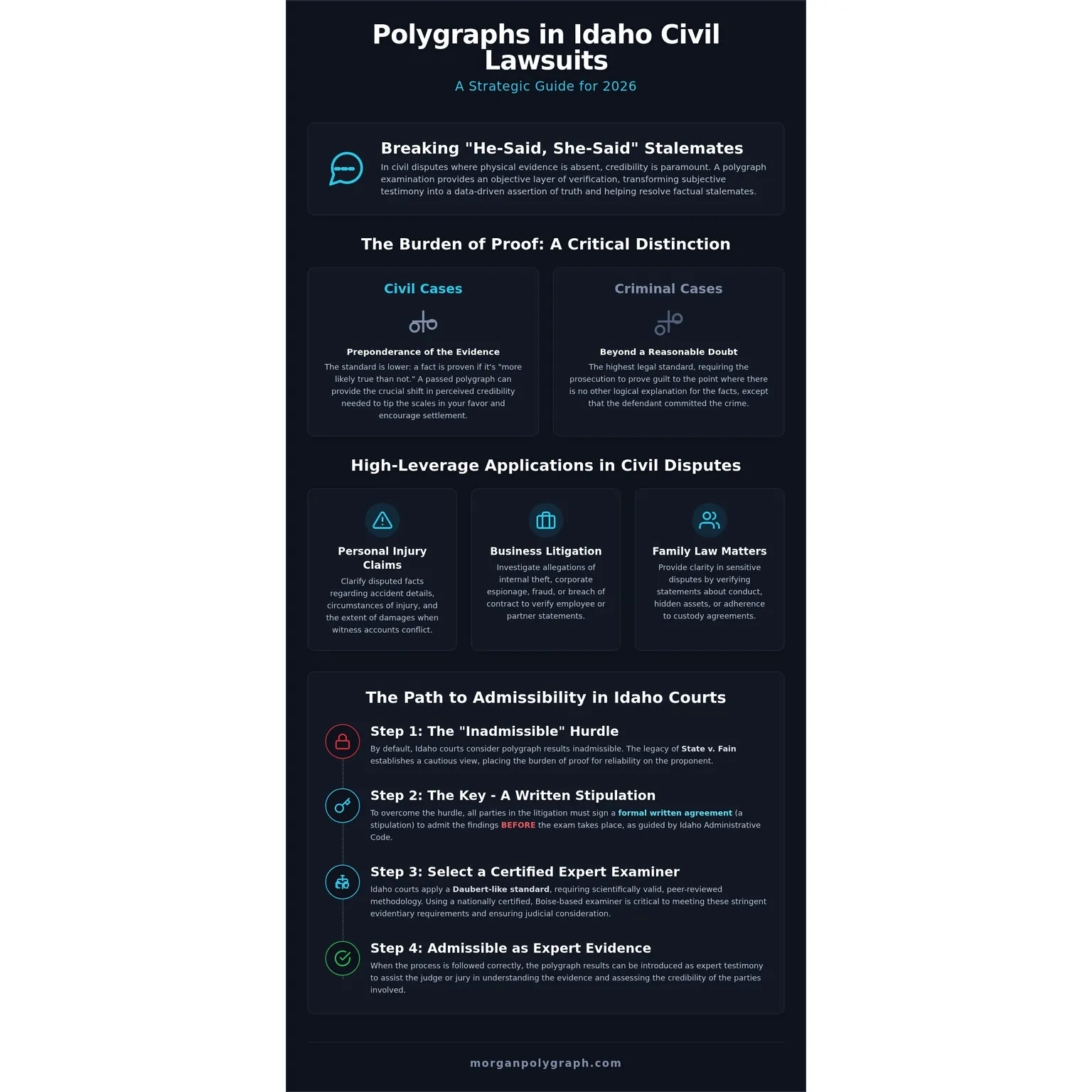
The primary difference lies in the burden of proof. In Idaho civil cases, the standard is a “preponderance of the evidence,” meaning a fact is more likely true than not. This is a lower threshold than the criminal standard of “beyond a reasonable doubt.” Because the margin for victory is narrower, even a slight shift in perceived credibility can tip the scales. A passed test can have a significant psychological impact on opposing counsel, often leading them to reassess the risks of proceeding to trial. It transforms a subjective argument into a data-driven assertion of truth.
When to Consider a Polygraph in Your Lawsuit
Litigants should consider using a polygraph in a civil lawsuit in Idaho when physical evidence is absent but the stakes are high. Common scenarios include:
- Personal injury claims where accident details or injury circumstances are disputed.
- Business litigation involving allegations of internal theft, fraud, or breach of contract.
- Family law matters requiring verification of conduct or hidden assets.
Testing also serves as a vital internal tool for attorneys to vet their own clients. By confirming a client’s story early, legal teams can commit to a strategy with greater confidence. Beyond the courtroom, these examinations are highly effective in private arbitration and mediation, providing the neutral ground needed to reach a resolution without the public exposure of a trial.
Admissibility Standards: Idaho Rules of Evidence and Polygraphy
Under Idaho Rule of Evidence 702, judges serve as the primary gatekeepers for expert testimony. This role is especially critical when litigants consider using a polygraph in a civil lawsuit in Idaho. The court’s objective is to ensure that any technical or specialized knowledge will actually assist the trier of fact in understanding the evidence. Historically, the legacy of State v. Fain established a cautious view of polygraph reliability within the state’s judicial system. However, this precedent doesn’t create an absolute ban. Instead, it places the burden on the proponent to demonstrate that the methodology is both relevant and reliable for the specific civil matter at hand.
In 2026, the Idaho standard dictates that polygraph results are inadmissible as evidence unless every party involved in the litigation signs a formal written agreement to admit the findings before the test occurs.
The Daubert Standard in Idaho Courts
Idaho courts apply a standard similar to the federal Daubert test to evaluate the scientific validity of a polygraph test. Judges look for peer-reviewed methodologies and standardized scoring systems that minimize examiner bias. It’s no longer enough to rely on older, subjective techniques. Modern courts demand data-driven detection and state-of-the-art technology to meet the threshold of judicial consideration. This methodical approach ensures that the results provided to the court are grounded in established scientific principles and recognized professional standards.
Overcoming the “Inadmissible” Hurdle
The primary legal objection to polygraphs is the fear that they “invade the province of the jury” by essentially deciding which witness is telling the truth. To navigate this, attorneys often distinguish between substantive evidence and impeachment evidence. While the results might not be allowed to prove an entire case, they can be powerful tools for challenging or bolstering witness credibility during the discovery phase. Many litigants wonder are polygraphs accurate enough to survive a motion to exclude? According to the Idaho Rules of Administrative Procedure, specifically Rule 62.01.01.484, the focus remains on mutual consent through stipulation. Even when a judge is hesitant to admit results at trial, a professionally conducted exam remains a potent strategic asset during settlement negotiations. If you’re unsure how these rules apply to your specific case, consulting with a court-recognized examiner can provide the necessary technical guidance to support your legal strategy.
Strategic Applications: When to Use a Polygraph in Civil Disputes
Strategic litigation requires more than just legal arguments; it requires leverage. While polygraph results are generally not admissible as evidence in the absence of a prior agreement, they serve as a powerful catalyst for resolution. Using a polygraph in a civil lawsuit in Idaho allows parties to verify claims long before they reach a jury. This proactive approach is particularly effective in personal injury cases where the circumstances of an accident are disputed or in contract litigation involving verbal agreements. When physical evidence is scarce, a methodical examination provides the clarity needed to move a case forward. Truth is the ultimate leverage.
Family Law and Credibility
Family law disputes are often the most emotionally charged civil cases. Credibility is paramount when a judge must decide on custody or the division of assets based on conflicting testimonies. In many instances, a psychosexual evaluation may be paired with polygraphy to provide a comprehensive view of a party’s history and risk level. Similarly, an infidelity test can resolve allegations that might otherwise stall a civil settlement. Beyond the data, the testing process often helps in rebuilding a baseline of trust, or at least a baseline of facts, which is essential for any mediation to succeed. It’s about finding a path through the emotional noise toward a factual resolution.
Business and Tort Litigation
In the corporate world, allegations of internal theft, harassment, or whistleblower claims can paralyze an organization. Using a polygraph in a civil lawsuit in Idaho can clear a defendant’s name early in the discovery phase, saving thousands in legal fees. It’s a discreet way to handle sensitive internal matters without the public fallout of a trial. Employment law cases frequently involve claims of hostile work environments where there is no paper trail. A polygraph provides a structured environment to test the veracity of these claims. Data doesn’t take sides.
For plaintiffs, a passed exam adds a layer of professional verification to their claims, which can be invaluable during high-stakes commercial mediation. Professional reports from a court-recognized examiner turn “he-said, she-said” into a documented technical analysis. This forces opposing parties to take the claims seriously and often leads to a more favorable settlement. Whether you’re dealing with a breach of contract or a complex tort claim, integrating modern technology into your legal strategy shows a commitment to the truth that is difficult to ignore.
How to Introduce Polygraph Results: The Stipulation Process
The process of using a polygraph in a civil lawsuit in Idaho begins with a formal agreement known as a Joint Stipulation. This document serves as the legal foundation that allows a court to consider the findings. Without a signed agreement, even the most technologically advanced examination remains inadmissible under Idaho’s current evidentiary standards. The stipulation must be drafted with precision, outlining exactly how the results will be used and which specific factual disputes the examiner will address. It’s a methodical approach that transforms raw physiological data into a tactical legal instrument.
Agreeing on the professional conducting the test is the next critical step. Both parties must consent to the examiner’s qualifications to ensure the results are viewed as objective and reliable. Once the scope and usage are defined, the final step is scheduling the examination with a certified polygraph near me in Boise. This ensures the process adheres to local legal standards and professional protocols while maintaining the highest level of discretion.
Key Components of a Legal Stipulation
A valid stipulation must be signed by all parties before the examination takes place. Retroactive agreements are rarely honored by Idaho judges, as the “blind” nature of the test is essential for credibility. The document should clearly define the consequences of “Deceptive” or “Non-Deceptive” results. For instance, parties may agree that a passed test leads to a dismissal of specific claims or that the results will be admissible regardless of the outcome. Specifying the examiner’s credentials, such as national certification and court-recognized expert status, prevents later challenges to the methodology during the discovery phase.
Pitfalls to Avoid in Civil Admissibility
One of the most common errors is the “unilateral” polygraph. Taking a test without notifying the opposing party is often a wasted effort for trial purposes. These exams are almost never admitted because the other side didn’t have input on the questions or the selection of the examiner. Additionally, the questions must relate directly to the “ultimate issue” of the case. Vague or irrelevant inquiries only serve to undermine the credibility of the entire report.
Finally, the stipulation must address the possibility of an “inconclusive” result. While modern data-driven detection significantly reduces this risk, it can still occur due to physiological factors. A well-drafted agreement will state whether a re-test is permitted or if the result will simply be set aside. If you’re ready to integrate this technical layer into your legal strategy, contact Morgan Polygraph to facilitate a court-recognized examination that meets these rigorous standards.
Morgan Polygraph: Expert Civil Examinations in Boise, Idaho
Morgan Polygraph serves as a specialized resource for litigants and legal professionals throughout the Treasure Valley. While the legal framework for admissibility relies on mutual consent, the actual execution of the test requires an examiner who understands the nuances of Idaho’s judicial expectations. Our practitioners are nationally certified and maintain court-recognized expert status, ensuring that every examination is conducted with the highest degree of technical precision. Using a polygraph in a civil lawsuit in Idaho demands a methodical approach that balances scientific rigor with the sensitive nature of private litigation.
Our firm bridges the gap between raw physiological data and legal strategy. We understand that civil cases often involve high stakes and significant emotional stress. Because of this, we prioritize a professional, authoritative, and discreet environment where clients feel they’re in capable hands. We have extensive experience working directly with Idaho defense and civil attorneys to ensure that the results we provide are formatted to withstand the rigors of legal scrutiny.
The Morgan Polygraph Advantage
We utilize state-of-the-art instrumentation that adheres strictly to the American Polygraph Association (APA) standards. This commitment to modern technology ensures the highest possible accuracy for every test, whether it involves a personal injury claim or a complex business dispute. Our process is designed to be organized and systematic, which naturally helps reduce client stress during a vulnerable time. By focusing on data-driven detection and behavioral observation, we provide a level of academic gravitas that simpler methods cannot match.
- Technical Precision: Use of the latest computerized polygraph systems for reliable data collection.
- Specialized Reporting: Professional reports designed for legal scrutiny and expert witness testimony.
- Confidential Environment: A discreet Boise location that ensures privacy for all parties involved.
- Professional Recognition: Examiners who are active, decorated members of the professional polygraph community.
Next Steps for Your Civil Case
Integrating a polygraph into your legal strategy begins with a professional consultation. We work with you to understand the specific needs of your litigation and help determine the most effective questions for the examination. Preparing your client or witness is equally important; we provide clear, step-by-step instructions to ensure they understand the process and feel respected throughout the interaction. This clarity avoids ambiguity in a process that requires high levels of precision.
If you’re considering using a polygraph in a civil lawsuit in Idaho, the first move is to establish a dialogue with a qualified expert. Our Boise office provides a calm, collected environment where sensitive issues are handled with absolute confidentiality. We provide the technical clarity you need to move toward a resolution or gain leverage in a settlement negotiation. Contact our team today for a discreet professional consultation to discuss how our court-recognized expertise can support your civil matter.
Securing Factual Clarity in Your Idaho Civil Matter
Navigating a complex legal dispute requires more than just persuasive arguments; it requires a foundation of verifiable truth. Using a polygraph in a civil lawsuit in Idaho is a methodical way to resolve credibility stalemates and gain leverage during settlement negotiations. Success in this area hinges on a properly drafted joint stipulation and the selection of an examiner who understands the specific evidentiary standards of Idaho courts. By integrating objective data into your legal strategy, you transform subjective testimony into a technical asset that can accelerate a resolution.
Morgan Polygraph provides the specialized expertise necessary to support your litigation. With Nationally Certified Examiners and State-of-the-Art Detection Technology, we offer the precision your case demands. Our Court-Recognized Expert Testimony ensures that your findings are presented with the professional authority required for judicial consideration. We invite you to Contact Morgan Polygraph for a Professional Civil Case Consultation to discuss your specific needs. Taking this step brings you closer to the clarity and peace of mind you deserve during a difficult legal process. Your pursuit of the truth is in capable hands.
Frequently Asked Questions
Is a polygraph test admissible in an Idaho civil trial?
Polygraph results are generally inadmissible in Idaho courts unless every party involved formally stipulates to their admission before the examination occurs. This standard is governed by Idaho Administrative Code Rule 62.01.01.484, which became effective July 1, 2024. Without a signed, written agreement from both the plaintiff and the defendant, a judge will typically exclude the findings from trial. However, many litigants still find value in using these tests as a strategic tool for discovery.
Can I be forced to take a polygraph in a civil lawsuit?
No, you cannot be legally compelled to undergo a polygraph examination in a civil matter. Participation is entirely voluntary and requires the explicit consent of the individual being tested. In the context of using a polygraph in a civil lawsuit in Idaho, any attempt to force an examination would likely be viewed as a violation of procedural standards. Most examinations are the result of a mutual agreement between legal counsel to resolve a factual stalemate.
What is a “stipulated polygraph” in Idaho?
A stipulated polygraph is a formal, written agreement signed by all parties in a lawsuit before the testing takes place. This document outlines the examiner’s qualifications, the specific questions to be asked, and how the results will be used as evidence. In Idaho, this is the primary legal path to making polygraph findings admissible in court. It ensures that both sides have agreed to the methodology and the technical standards used during the exam.
How much weight do Idaho judges give to polygraph results?
The weight given to results depends heavily on the specific terms of the stipulation and the examiner’s professional standing. Idaho judges act as gatekeepers under Rule 702, evaluating the scientific validity and relevance of the testimony. When a court-recognized examiner uses modern, data-driven detection methods, the findings carry more weight. While not always definitive on their own, they often provide the technical clarity needed to influence a judge’s perception of witness credibility.
Can polygraph results be used in Idaho divorce or custody cases?
Yes, polygraphs are frequently utilized in family law to address allegations of misconduct or disputes over hidden assets. While the results must still meet stipulation requirements for courtroom use, they are exceptionally effective in mediation. Parents often use these examinations to verify claims during psychosexual evaluations or to rebuild a baseline of trust. This technical verification helps move high-stakes custody disputes toward a resolution without further traumatic and costly litigation. For those managing similar legal transitions in other states, Nevada State Forms & Filing Services offers expert document preparation for Nevada-based divorce and name change cases.
An inconclusive result means the physiological data did not meet the statistical threshold for a definitive “deceptive” or “non-deceptive” finding. Your joint stipulation should explicitly state the protocol for this outcome. Common options include setting the result aside entirely or allowing for a second examination after a cooling-off period. Professional examiners in Boise use state-of-the-art technology to minimize these occurrences, ensuring the highest possible accuracy for civil litigants and their legal teams.
How do I find a court-recognized polygraph examiner in Boise?
Identifying a court-recognized examiner requires looking for individuals with national certification from the American Polygraph Association and a history of providing expert testimony. Using a polygraph in a civil lawsuit in Idaho requires an examiner who follows rigorous, peer-reviewed methodologies. It’s essential to select a practitioner who maintains a professional Boise location and has an established reputation for technical precision and discretion within the local legal community.
Does a polygraph help in civil settlement negotiations?
Absolutely. Polygraph examinations are powerful strategic tools for breaking “he-said, she-said” stalemates during settlement negotiations. A passed test provides your legal team with significant leverage, often forcing the opposing side to re-evaluate the risks of proceeding to a jury trial. By providing an objective layer of credibility early in the discovery phase, these examinations frequently lead to faster settlements and reduced legal costs for both parties involved in complex civil disputes.