

Contrary to what Hollywood thrillers suggest, a professional polygraph exam is never designed to trap you with a surprise question. It’s completely normal to feel a sense of dread when facing a lie detector test, especially when personal trust is on the line. You’re likely worried about trick questions or having your entire life scrutinized under a microscope. When preparing for a session involving infidelity polygraph questions, that anxiety often stems from a fear of the unknown.
We understand that this is a vulnerable moment, and our goal is to replace that uncertainty with professional clarity. This guide will demystify the process by showing you the exact types of questions used in a certified exam and explaining why transparency is a requirement, not an option. You’ll learn about the strict yes/no format, the essential pre-test interview, and the professional standards that ensure you’re fully prepared before the sensors are even attached.
Key Takeaways
- Learn why all professional polygraph questions are structured in a binary yes/no format to ensure scientific accuracy and objective physiological scoring.
- Understand the critical role of the pre-test interview, where every question is reviewed in advance to eliminate the possibility of “trick” or surprise questions.
- Discover how specific infidelity polygraph questions are customized for your unique situation while maintaining strict, court-recognized standards.
- Identify the three pillars of validated questioning techniques used by certified examiners to distinguish between general anxiety and actual deception.
- Gain confidence in the process by knowing how state-of-the-art technology and local Boise expertise create a discreet, professional environment for sensitive testing.
The Anatomy of Lie Detector Questions: The Binary Format
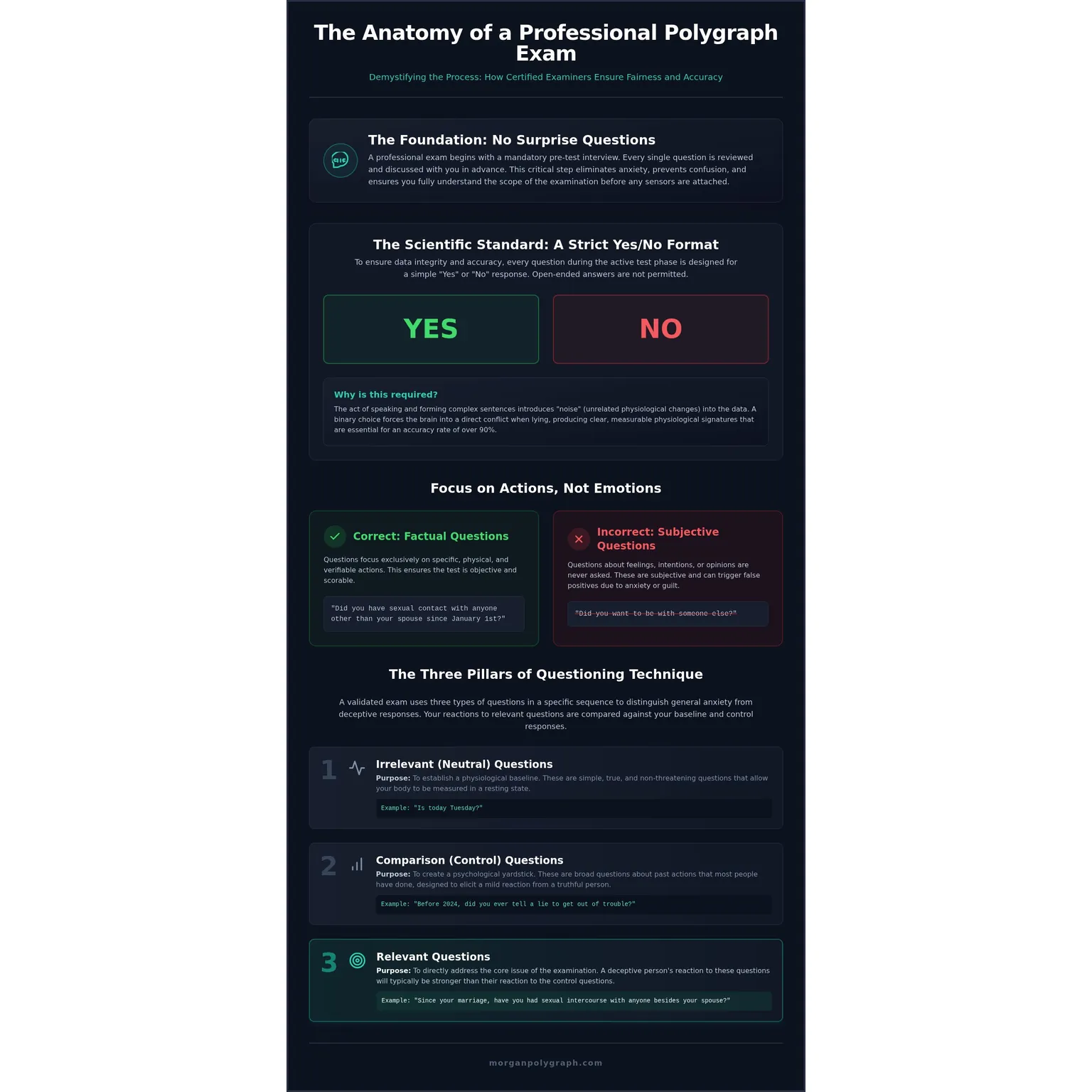
Professional polygraph examinations don’t look like the interrogation scenes in movies. There are no long, rambling explanations or emotional pleas. Instead, every valid exam relies on a strict binary format. This means that every question asked while the sensors are active requires a simple “Yes” or “No” answer. This isn’t a stylistic preference; it’s a scientific requirement for data integrity.
Physiological responses are delicate. When an examinee provides an open-ended answer, the act of speaking at length introduces “noise” into the data. Respiratory patterns change, and the physical effort of forming complex sentences can mask the subtle autonomic triggers that indicate deception. To maintain the 90% accuracy threshold required for evidentiary exams, the process must be controlled. This Polygraph overview explains how the instrument tracks specific physiological changes that occur when a person is forced to choose between a truthful or deceptive response.
The American Polygraph Association (APA) sets the global standard for these protocols. Every question must be factual, clear, and entirely non-ambiguous. When we develop infidelity polygraph questions, we strip away adjectives and subjective interpretations. The goal is to present a stimulus that is so direct it leaves the examinee with only one cognitive path: to tell the truth or to lie.
Why “Maybe” Is Not an Option
The human autonomic nervous system reacts most predictably when faced with a clear, direct choice. When a question is binary, the cognitive load on a deceptive person increases significantly. They must reconcile the truth they know with the “No” they’re providing. This internal friction creates the physiological signatures, such as changes in skin conductivity or blood pressure, that the sensors detect. Ambiguous questions that allow for “maybe” or “sometimes” dilute this reaction. If the question isn’t clear, the brain doesn’t have to work as hard to navigate the lie, which leads to messy, unscorable charts.
Factual vs. Subjective Questions
Accuracy depends on focusing on actions rather than emotions. We don’t ask about “feelings,” “intentions,” or “attractions” because these are subjective internal states. A person might feel guilty about a thought, which could trigger a false positive. To prevent this, infidelity polygraph questions focus exclusively on specific, physical acts. We don’t ask “Did you want to be with someone else?”; we ask “Did you have sexual contact with anyone else?” We also ensure that every word in the question is defined during the pre-test. If we use the term “dating,” we establish exactly what that means together so there’s no confusion when the test begins.
The Three Pillars of Polygraph Questioning Techniques
A polygraph exam is a structured psychological and physiological assessment, not a casual conversation. To achieve high levels of reliability, examiners follow specific, validated protocols that categorize questions into three distinct pillars. This methodology allows the examiner to distinguish between the natural stress of the environment and a specific deceptive response. Understanding are polygraphs accurate techniques involves looking at how these three question types interact to create a clear picture of a person’s truthfulness.
The process relies on establishing a unique physiological signature for each examinee. As outlined in the DOJ polygraph techniques documentation, the examiner must evaluate the subject’s ability to react to various stimuli before reaching a conclusion. By comparing reactions across these pillars, the examiner can filter out general anxiety and focus on the specific cognitive load associated with a lie.
Irrelevant (Neutral) Questions
The exam begins with irrelevant questions designed to establish a baseline. These are simple, non-threatening queries such as “Is today Tuesday?” or “Are you sitting in a chair?” Since the answers are undeniably true, they allow the autonomic nervous system to operate in a resting state. These questions don’t factor into the final score. Instead, they provide a “zero point” for the sensors and give the examinee a chance to settle into the rhythm of the test without the pressure of the core issues.
Comparison (Control) Questions
Comparison questions serve as a psychological yardstick. They address general past behaviors that most people have engaged in, such as “Before 2026, did you ever tell a lie to get out of trouble?” The examiner expects a person to feel some level of concern or minor guilt when answering these. By measuring your reaction to these “minor” lies, the examiner can see what your body looks like when you’re potentially being less than fully honest about a common human failing. This creates a standard for comparison against the more serious relevant questions.
Relevant Questions: The Core of the Exam
Relevant questions are the heart of the session. These are the direct, binary questions regarding the specific issue under investigation. When developing infidelity polygraph questions, we limit the scope to 2-3 core issues to ensure the physiological data remains sharp. For example, a relevant question might be: “Did you have sexual contact with [Name]?” Focusing on a few key points prevents cognitive fatigue and maintains the integrity of the data. If you have concerns about how your specific situation will be addressed, you can speak with our Boise team for a discreet consultation.
Common Questions by Category: Infidelity, Legal, and PCSOT
While the binary structure remains constant, the specific content of an exam varies significantly based on the client’s needs. At Morgan Polygraph, our Boise office adapts standardized protocols to ensure every question meets Idaho court-recognized standards. This is particularly important for legal cases where results might influence a defense strategy. We balance the need for a thorough investigation with a commitment to maintaining the examinee’s dignity. We don’t ask intrusive questions that aren’t directly relevant to the issue at hand. Instead, we focus on factual, observable behaviors that provide clear data for analysis.
Infidelity and Relationship Testing
When conducting an infidelity test, the examiner must distinguish between physical acts and subjective emotional states. We avoid asking about “feelings” or “intentions” because these can’t be scored accurately. Instead, infidelity polygraph questions focus on physical contact. A typical question might be: “Since your marriage, have you had any sexual contact with anyone other than your spouse?” If the concern involves digital behavior, we use specific timeframes. For example, we might ask: “In the last six months, have you used a dating app to arrange a secret meeting?” This specificity prevents “outside issue” anxiety from clouding the results.
Criminal Defense and Civil Litigation
In the context of legal strategy, a polygraph examination serves as a diagnostic tool to verify alibis or specific evidence. These questions are developed in coordination with legal counsel to ensure they address the core of the case. An examiner might ask: “Were you inside the building at 123 Main St. on October 5th?” By applying validated Polygraph Questioning Techniques, we provide attorneys with a reliable data point. These exams are usually “single-issue,” meaning they focus on one specific event to maintain the highest possible accuracy threshold.
PCSOT (Post-Conviction Sex Offender Testing)
Post-Conviction Sex Offender Testing (PCSOT) follows a different logic than standard diagnostic exams. These are often maintenance or monitoring exams used to ensure probation compliance. The questions check for unauthorized contact or violations of court-ordered restrictions. For instance, an examiner might ask: “Since your last exam, have you had any unauthorized contact with minors?” Unlike a diagnostic test that looks for a single past truth, PCSOT exams cover a range of behaviors over a specific period. This specialized instruction is a requirement for examiners in this field, ensuring that the process supports both community safety and the individual’s rehabilitation goals.
The Pre-Test Interview: Why There Are No Surprise Questions
Professional polygraphy relies on total transparency. The pre-test interview isn’t just a formality; it’s an ethical requirement that ensures the validity of the results. During this phase, your Boise examiner will walk you through the entire process to eliminate the fear of the unknown. This step is critical because anxiety about “trick” questions can create physiological noise that complicates the data analysis. When you know exactly what to expect during a session involving infidelity polygraph questions, your autonomic nervous system stays focused on the specific issues at hand.
The core philosophy of a certified exam is that there should be no surprises. An examiner will never ask a question while you’re attached to the sensors that you haven’t already reviewed and agreed upon. This collaborative process builds a foundation of trust and ensures that the physiological responses recorded are reactions to truth or deception, not to the shock of an unexpected query.
Step 1: Reviewing the Issue and Defining Terms
Before drafting the final list, you’ll discuss the background of your situation. This isn’t an interrogation; it’s a professional conversation that allows you to explain your perspective and help the examiner understand the context. A vital part of this step is defining terms. For instance, in relationship testing, we establish exactly what “sexual contact” or “dating” means for your specific exam. This ensures that when the test begins, both you and the examiner are operating with the same definitions, leaving no room for subjective interpretation.
Step 2: Drafting the Questions Together
The examiner will then draft the infidelity polygraph questions in your presence. Every question is read aloud to ensure it’s clear and can be answered with a direct “Yes” or “No.” We work together to adjust the wording so there’s no hidden meaning or ambiguity. If a question feels confusing or poorly phrased, it’s revised until you’re confident in your ability to answer it truthfully. This collaborative approach is a hallmark of professional testing and is designed to protect the integrity of the data.
Step 3: The Final Walkthrough and DIS
The final stage of the interview is a complete rehearsal. The examiner will read the sequence of questions exactly as they’ll be asked during the live recording. This walkthrough ensures you’re comfortable with the factual nature of the list. It also provides a final opportunity for disclosure (DIS). If a specific question triggers a memory of a minor detail you’ve forgotten to mention, you can discuss it then. This prevents the “startle response” that occurs when a person remembers a small, unrelated truth while the sensors are active, which could otherwise lead to an inconclusive result.
If you’re ready to proceed with a professional and transparent evaluation, you can schedule a consultation at our Boise office to discuss your specific needs.
Professional Polygraph Services in Boise: The Morgan Polygraph Approach
When seeking a polygraph near me, the quality and credentials of the examiner are the most critical factors to consider. In Idaho, choosing a professional who understands local legal standards and follows nationally recognized protocols is essential for results that hold weight. Morgan Polygraph operates with a commitment to scientific accuracy and personal discretion. We provide a structured, professional environment where truth is the priority. Our approach combines decades of traditional experience with the latest innovations in behavioral observation and data-driven detection.
Certified and Court-Recognized Experts
Idaho courts and legal professionals require a high standard of evidence. Our examiners are nationally certified and stay current with the latest advancements in the field. This includes completing the American Polygraph Association’s requirement of 30 hours of continuing education every two years to maintain the highest level of proficiency. We utilize state-of-the-art technology to ensure we meet the 90% accuracy threshold required for evidentiary exams. Choosing an uncertified or “cheap” service often results in inadmissible data and increased emotional stress. Our methodology is methodical and organized. We use modern sensors and validated scoring systems to provide a definitive answer. This innovation allows us to provide a service that is both traditional in its ethics and futuristic in its technical execution.
Discreet and Compassionate Testing
Our Boise office, located at 6126 W. State Street, is designed to be a private and professional space. We understand that discussing infidelity polygraph questions is a sensitive matter that requires empathy and patience. We treat every client with the respect they deserve. We ensure that the clinical nature of the test doesn’t overshadow the human element. Preparing for your session is straightforward. Once you schedule, we’ll guide you through the pre-test requirements in a clear, step-by-step manner. This preparation ensures that when you arrive for your pre-test interview, you feel informed and ready to find the clarity you need. We specialize in relationship testing, legal cases, and PCSOT exams, providing a comprehensive resource for the Idaho community. Polygraphy isn’t about traps; it’s a tool for rebuilding trust and moving forward with the truth. By choosing a seasoned expert, you ensure that your sensitive issues are handled with the utmost confidentiality and technical precision.
Seeking Clarity Through Professional Polygraphy
Professional polygraphy is a methodical process designed to replace uncertainty with objective data. You’ve learned that every exam relies on a binary format and a structured three-pillar technique to ensure scientific accuracy. Most importantly, the pre-test interview guarantees there are never any surprise questions. Whether you’re navigating sensitive relationship issues or legal matters, understanding how infidelity polygraph questions are developed can significantly reduce the anxiety of the unknown.
At Morgan Polygraph, we combine state-of-the-art technology with a compassionate, discreet approach at our Boise, Idaho location. Our nationally certified examiners provide court-recognized expert results that help you move forward with confidence. If you’re ready to find the answers you need in a respectful and professional environment, we’re here to help. Schedule Your Professional Polygraph in Boise Today and take the first step toward the truth.
Frequently Asked Questions
Can the examiner ask me about my political or religious beliefs?
No. Nationally certified examiners follow strict ethical guidelines that prohibit questions regarding your political or religious beliefs, sexual orientation, or social affiliations. These topics are irrelevant to the diagnostic process. Our Boise office focuses exclusively on the factual issues at hand, such as infidelity or criminal allegations. This approach ensures the exam remains professional, discreet, and respectful of your personal privacy throughout the entire session.
Will I see the questions before the test starts?
Yes, you will review every question in detail before the sensors are attached. Professional polygraphy relies on total transparency to ensure accurate results. Surprise questions are never used because an unexpected query can cause a startle response, which mimics the physiological signatures of deception. By reviewing the list beforehand, you can focus on providing a clear “Yes” or “No” without the stress of an unexpected surprise.
How many questions are usually asked in a lie detector test?
A standard professional exam usually includes between 10 and 12 questions. However, only 2 or 3 of these are relevant infidelity polygraph questions that address the core issue. The other questions are used for calibration. These include irrelevant questions to establish a baseline and comparison questions to measure your reaction to minor stressors. This structured approach allows the examiner to score your charts with scientific precision.
What happens if I do not understand a question?
You must inform the examiner immediately if any wording is unclear. During the pre-test interview, we work together to define every term so there is no confusion. If you don’t understand a question while the test is active, it can lead to an inconclusive result. We ensure that every word is simple and direct so you can answer with absolute confidence when the recording phase begins.
Can “trick” questions be used to catch me off guard?
No, “trick” questions are not used in certified examinations. The goal of a professional polygraph is to measure your physiological reaction to a known stimulus, not to confuse you. Using deceptive tactics or catching an examinee off guard would invalidate the data and violate the standards set by the American Polygraph Association. We prioritize a methodical and organized environment to ensure that every result is based on clear, scorable data.
Are the questions the same for everyone?
No, every exam is customized to the specific needs of the client. While the format follows validated scientific pillars, the infidelity polygraph questions are drafted based on the background of your specific situation. This customization allows the examiner to address the exact concerns you have, whether they involve physical contact or digital behavior. We ensure that the questions are relevant to your case while meeting Idaho court-recognized standards.
Can I refuse to answer a specific question during the exam?
You have the right to refuse to answer any question at any time. However, since all questions are reviewed and agreed upon during the pre-test interview, any concerns should be addressed before the sensors are active. Refusing to answer a question during the live portion of the exam will usually result in an incomplete test. This would prevent the examiner from providing a definitive report on the issues being investigated.
What is the most common reason people fail a specific question?
The most common reason for a deceptive result is an examinee holding back a minor detail. Even if the omission seems small, the brain perceives it as a lie, which triggers a physiological reaction. This is why our Boise examiners encourage full disclosure during the pre-test interview. By addressing “outside issues” or minor memories early, you can ensure that your nervous system remains calm and your answers stay truthful.