

How do you prove that something didn’t happen when the person you love most no longer believes your word? It’s an agonizing position to be in. You’re caught in a cycle where every explanation feels like an excuse and every silence feels like an admission. This dilemma often leaves you feeling unheard and deeply anxious that a simple misunderstanding might end your relationship forever. When you’re stuck in a loop of doubt, the emotional toll can be overwhelming for both parties.
We understand that trust is the foundation of any partnership, and once it’s fractured, words alone aren’t always enough to repair it. Utilizing a professional polygraph test to prove innocence in a relationship offers a methodical way out of this stalemate. By providing objective, physiological evidence, an examination can bridge the gap between suspicion and certainty. At Morgan Polygraph in Boise, our nationally certified examiners use state-of-the-art technology to help you clear your name with the discretion and respect you deserve.
In this guide, we’ll explain how a relationship polygraph works as a collaborative diagnostic tool rather than an interrogation. You’ll discover how to prepare for an exam, what to expect during the process, and how these results provide a concrete path forward for rebuilding trust and achieving peace of mind.
Key Takeaways
- Understand why a professional examination is the most effective tool to resolve the “he-said-she-said” dilemma and provide objective evidence where words are no longer enough.
- Learn how a polygraph test to prove innocence in a relationship utilizes the Comparison Question Technique to distinguish between normal nerves and specific deception.
- Discover the four primary physiological markers—including heart rate and skin conductivity—that provide a data-driven foundation for rebuilding trust.
- Identify the essential physical and behavioral steps you must take before your appointment to ensure the most accurate and reliable results.
- Find out why working with a court-recognized expert in Boise provides the professional level of discretion and precision required for sensitive personal matters.
The Role of a Polygraph Test to Prove Innocence in a Relationship
In a relationship, being accused of something you didn’t do is a unique kind of torture. Logic dictates that you cannot prove a negative. You can’t show a video of every second of your life to prove an event never occurred. This is where a polygraph test to prove innocence in a relationship becomes a vital asset. It shifts the burden from your words, which may no longer be trusted, to your physiological data, which doesn’t have an agenda. This voluntary tool provides a structured way to verify your statements when your partner’s doubt feels insurmountable.
People often use the term “lie detector” as if the machine has a mind of its own. In reality, it’s a sophisticated scientific instrument used by trained professionals. What is a polygraph? It is a device that records multiple physiological indicators such as blood pressure, pulse, and respiration while a person answers a series of questions. It doesn’t “detect” lies in a literal sense. Instead, it records data that a certified examiner interprets based on validated forensic protocols. This distinction is crucial. It moves the process from the realm of mythology into the realm of data-driven science.
The psychological relief that comes from having an external, neutral expert validate your word is profound. When you’re stuck in a cycle of disbelief, your partner may interpret your anxiety as guilt. A professional examiner understands these nuances. They provide a calm, clinical environment where the truth can surface without the emotional interference of a heated argument. This objective verification is often the only way to break through the “he-said-she-said” stalemate that keeps couples trapped in conflict.
When Should You Consider a Fidelity Polygraph?
Relationship testing is usually a voluntary choice made by couples who are committed to saving their partnership. You might consider this option if you’re facing persistent false accusations or “gaslighting” that makes you doubt your own reality. It’s also helpful when traditional counseling has reached a stalemate. If you can’t move past a specific event because one partner doesn’t believe the other, the data provides a “clean slate.” This allows you to stop looking backward at past suspicions and start focusing on your shared future.
The Psychology of Trust and Objective Verification
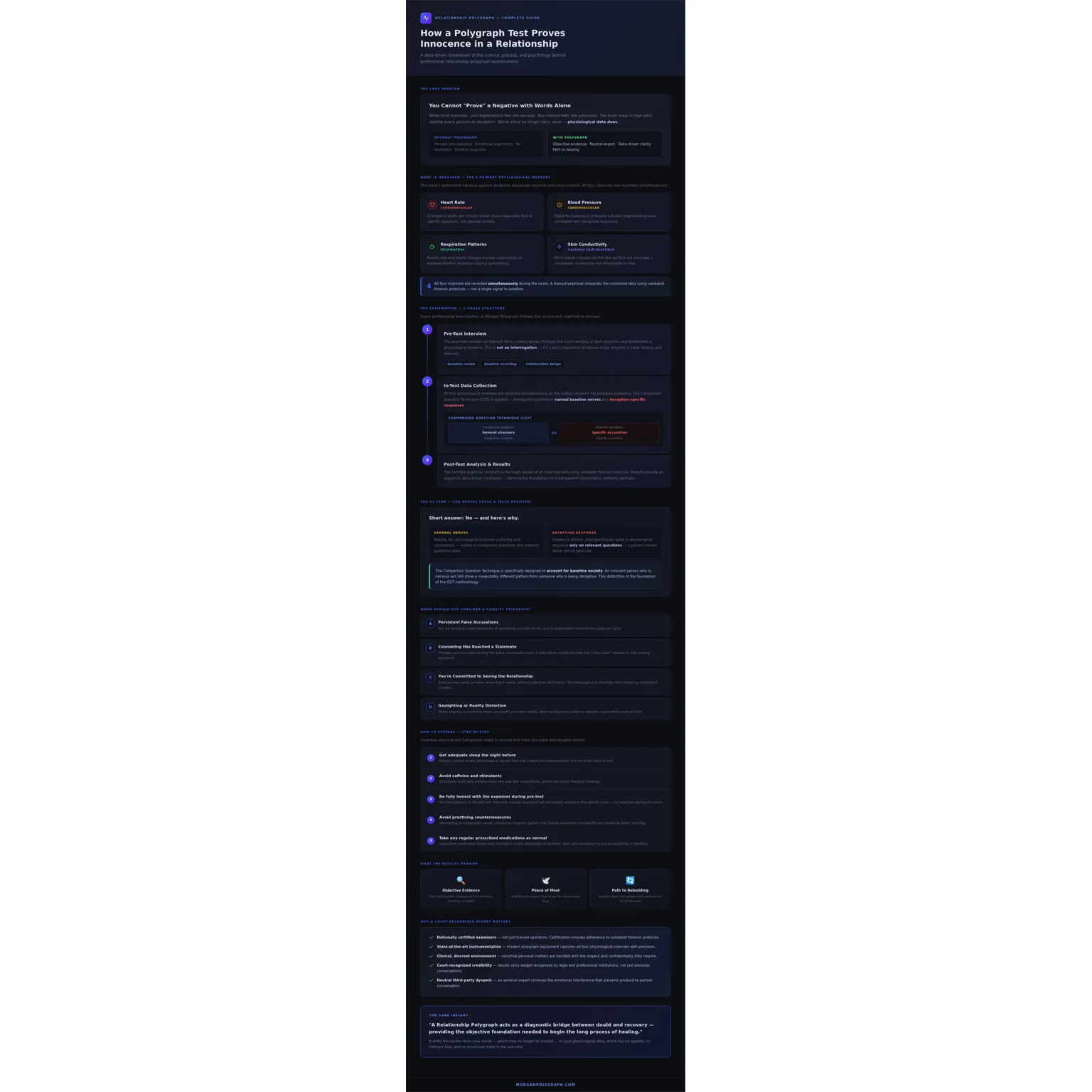
Understanding the mechanics of a polygraph examination helps strip away the mystery and anxiety often associated with the process. A polygraph test to prove innocence in a relationship relies on the body’s autonomic nervous system. When a person is asked a question, their body produces physiological responses that are beyond conscious control. Our examiners monitor four primary markers to provide an objective data set: heart rate, blood pressure, respiration patterns, and skin conductivity (galvanic skin response). By recording these involuntary reactions, the instrument provides a clear, data-driven map of a subject’s truthfulness.
The pre-test interview is arguably the most critical component for someone seeking to clear their name. During this phase, the examiner works closely with the subject to review all facts and ensure there is a complete understanding of the issues. This isn’t an interrogation. It’s a collaborative effort to ensure that the questions asked during the test are clear, binary, and relevant to the specific accusations. This preparation ensures that the final results are based on clarity rather than confusion or surprise.
The Three Phases of the Examination
A professional examination at Morgan Polygraph in Boise follows a methodical three-phase structure. The pre-test phase involves finalizing the questions and establishing a baseline for the subject’s physiological state. The in-test phase is the actual data collection period, where the sensors record responses to the agreed-upon questions. Finally, the post-test phase involves a detailed analysis of the charts. The examiner interprets the data to determine a result, often categorized as “No Deception Indicated” when the subject has been truthful.
Formulating Questions to Clear Your Name
Vague questions lead to vague results. Asking “Did you cheat?” is often too broad because “cheating” means different things to different people. Effective infidelity tests focus on observable, physical facts rather than subjective feelings. For example, a question might be narrowed down to: “Since January 2025, have you had any physical sexual contact with [Name]?” This specificity removes ambiguity and allows the technology to focus on concrete actions.
While some skeptics question the process, the psychological science on polygraphs shows that when administered by certified experts using validated techniques, accuracy rates are high. We utilize state-of-the-art computerized technology to ensure every client receives the most precise results possible. If you are ready to move past the cycle of suspicion, you can schedule a confidential consultation to discuss your specific situation.
Addressing the #1 Fear: Can Nerves Cause a False Positive?
It’s natural to feel anxious when your future depends on a single exam. Most people worry that their heart will race or their palms will sweat simply because they’re under pressure, leading to a false result. Nerves are a constant in this field. Experienced examiners expect every subject to be anxious, especially when the stakes involve a long-term partnership. Choosing to take a polygraph test to prove innocence in a relationship is a significant decision, and the process is designed to account for your emotional state from the moment you walk in.
The Comparison Question Technique (CQT) is the primary method used to distinguish between general anxiety and specific deception. During the test, the examiner asks neutral questions to establish how your body reacts when you’re telling the truth while under stress. The U.S. Department of Justice on polygraphs notes that these instruments are investigative tools that require expert interpretation rather than being “lie detectors” in a magical sense. By comparing your reactions to neutral questions against your reactions to relevant ones, the examiner filters out situational stress.
Environment plays a major role in managing these nerves. A professional, quiet office in Boise provides a vastly different experience than a police station or a high-pressure interrogation room. This is why a polygraph test to prove innocence in a relationship is conducted in a controlled, clinical setting. Working with a certified polygraph examiner ensures that these complexities are handled with forensic precision and compassion.
The Science of Baseline Responses
Before the actual testing begins, the examiner establishes your “normal” physiological state. This baseline accounts for your unique heart rate, breathing patterns, and skin conductivity while you’re simply sitting in the chair. The “fight or flight” response triggered by a lie is distinct from the general stress of a relationship conflict. Accuracy depends on the examiner’s ability to filter out situational stress and focus on specific physiological shifts that occur only when a subject is being deceptive about a relevant issue.
What if the Results Are Inconclusive?
Sometimes, the data doesn’t provide a clear “pass” or “fail” result. It’s important to understand that an “Inconclusive” result is not a failure; it simply means the physiological data was not distinct enough to make a definitive call. Common reasons for this include extreme fatigue, certain medications, or even poorly phrased questions that caused confusion. At Morgan Polygraph, we prioritize clarity. If a result is inconclusive, we discuss the potential causes and determine if a follow-up session or a re-test with refined questions is the best path forward for your peace of mind.
Relationship Polygraph: A Step-by-Step Prep Guide
Preparation for a polygraph test to prove innocence in a relationship begins long before you arrive at the office. Your goal is to arrive in a physiological state that is representative of your normal baseline. This means prioritizing basic physical needs in the 24 hours leading up to your appointment. Ensure you get a full night of restorative sleep and stay properly hydrated. You should maintain your normal routine, including taking any prescribed medications and eating regular meals. Drastic changes to your caffeine intake or skipping breakfast can create unnecessary physiological “noise” that complicates the data collection process.
How you frame the examination to your partner is equally important. It’s most effective to introduce the test as a “tool for us” rather than a “shield for me.” Presenting it as a proactive step to remove doubt and provide the clarity needed for the relationship to heal helps lower the temperature of the conflict. However, you must follow the “No Disclosure” rule. Don’t discuss specific test questions with your partner beforehand. If you pre-rehearse questions, you may become sensitized to them, which can lead to heightened reactions during the actual exam. Total honesty during the pre-test interview is mandatory. Disclosing even minor, unrelated details ensures there are no “surprises” that could trigger a reaction when the sensors are active.
The Day of the Examination
When you arrive at our discreet Boise office, you’ll find a professional and neutral environment designed to minimize stress. We recommend that subjects come alone or have their partner wait in a separate area or nearby location. Having a partner in the room can create a “pressure cooker” effect that makes it harder for you to remain calm. Manage your mindset by focusing on a simple fact: the truth is your best defense. If you have been honest, the physiological data will reflect that. If you’re ready to take this step, you can contact our Boise office to schedule your session.
Post-Test: How to Handle the Results Together
It’s important to manage expectations regarding the results. While some findings are clear immediately, instant results aren’t always possible because the examiner must carefully score the charts and verify the data. Once the formal report is issued, use it as a foundational starting point for rebuilding trust. The examiner’s role is to provide objective facts, and they can explain the findings to both parties if requested. Remember that the polygraph provides the evidence of innocence, but the work of emotional healing is a separate journey you’ll take together.
Why Choose Morgan Polygraph for Relationship Testing in Boise
Choosing a provider for a polygraph test to prove innocence in a relationship requires more than just finding a technician; it requires an expert who understands the delicate nature of personal disputes. At Morgan Polygraph, we provide a neutral, professional environment in our Boise office. We have specifically selected our Suite 208 location to ensure maximum discretion for our clients. This setting allows you to address sensitive matters in a space that feels both secure and private, far removed from the high-pressure atmosphere of a legal or law enforcement facility.
Our examiners are court-recognized experts. This means the results we produce meet the highest professional and forensic standards used in civil and criminal cases. While our process is clinical and data-driven, we integrate compassion and respect into every interaction. We understand the human stress involved in these situations. To support our findings, we utilize state-of-the-art computerized sensors to ensure the highest possible polygraph accuracy. This technology provides the objective evidence needed to bridge the gap between doubt and trust.
Expertise You Can Trust in Idaho
Working with a local expert provides a level of accountability and accessibility that national firms simply cannot match. Our team understands the Boise community and the unique needs of Idaho residents. Being nationally certified is a critical credential that ensures your peace of mind; it proves that your examiner follows the most rigorous training and ethical standards in the industry. This certification is your guarantee that your polygraph test to prove innocence in a relationship is conducted with total precision. Your privacy is our central theme, and we guarantee that your sensitive relationship issues stay strictly within our office walls.
Taking the Next Step Toward Resolution
The journey toward healing begins with a methodical approach to the facts. When you’re ready to proceed, the first step is to schedule a confidential consultation. During the initial phone call, we’ll discuss the specifics of your case and determine how to structure the exam for the most accurate results. We provide clear, step-by-step instructions so you know exactly what to expect. This unhurried rhythm ensures that both partners feel heard and respected throughout the process.
Contact Morgan Polygraph today to schedule your relationship testing session.
Restoring Trust Through Objective Verification
Rebuilding a relationship after a period of doubt requires more than just time; it requires clarity. We’ve explored how scientific methodology replaces the cycle of endless questioning with data-driven results. By understanding that anxiety is factored into every baseline and following a structured preparation guide, you can approach your examination with confidence. This process isn’t about interrogation; it’s about providing a diagnostic bridge that allows both partners to move past suspicion.
Choosing a polygraph test to prove innocence in a relationship is a courageous step toward transparency. At Morgan Polygraph, our nationally certified and court-recognized examiners use state-of-the-art detection technology to provide the answers you need. We operate from a discreet Boise location to ensure your privacy is protected throughout this sensitive process. Our commitment to precision and compassion ensures that you’re in capable hands during this pivotal moment.
Schedule a Confidential Relationship Polygraph in Boise to begin your journey toward resolution. You don’t have to stay stuck in a cycle of disbelief. Peace of mind is within reach, and we’re here to help you find the path forward together.
Frequently Asked Questions
Is a polygraph test for relationship innocence admissible in court?
Polygraph results are generally not admissible as primary evidence in Idaho courts for either civil or criminal proceedings. The only exception occurs if all parties involved agree, or stipulate, to its admissibility beforehand. While they lack the strict evidentiary standing for court, they remain highly effective investigative tools for resolving personal disputes and providing the clarity needed to move forward in a relationship when trust has been fractured.
How much does a polygraph test to prove innocence cost in Boise?
Professional polygraph fees in major metropolitan areas like Boise vary based on the complexity of the case and the examiner’s experience. While we don’t provide specific pricing here, industry rates typically reflect the specialized skill and advanced technology required for a forensic examination. It’s best to check with a licensed Idaho examiner to discuss your specific situation and receive a quote that covers the pre-test, examination, and formal report phases.
Can my partner be in the room while I take the lie detector test?
No, partners are not permitted in the examination room during the active testing phase. The presence of a loved one often creates additional emotional pressure or situational stress that can interfere with the physiological data collection. To ensure the most accurate results for a polygraph test to prove innocence in a relationship, the environment must be controlled and free from outside distractions. Your partner can wait in our discreet reception area.
How long does a relationship polygraph examination usually take?
A standard relationship polygraph examination typically lasts between two and three hours. This duration is necessary to conduct a thorough pre-test interview, establish a physiological baseline, and run multiple test charts for consistency. We don’t rush the process because precision is our top priority. Each session is methodical and unhurried, allowing the examiner to interpret the data with the academic gravitas and care your sensitive personal matter deserves.
What happens if I am on medication for anxiety or blood pressure?
You should continue taking all prescribed medications as directed by your physician. During the pre-test interview, you’ll disclose any medications to the examiner so they can account for them when interpreting your physiological markers. While certain substances can affect your baseline heart rate or blood pressure, certified examiners are trained to identify these patterns. Maintaining your normal medical routine is essential for ensuring that the data reflects your typical physiological state during the exam.
Will the polygraph show if I am just thinking about someone else?
A polygraph instrument does not read thoughts or intentions; it records physiological responses to specific, factual questions. The examination focuses on observable actions rather than subjective feelings or passing thoughts. If a question is phrased clearly, such as “Have you had physical contact with [Name]?”, the test will monitor your body’s reaction to that specific event. It cannot detect internal emotions or mental imagery that do not involve a deceptive response to a binary question.
What is the success rate of polygraphs in clearing the falsely accused?
Research from the American Polygraph Association indicates that professionally administered, single-issue exams have an accuracy rate of approximately 89%. This is significantly higher than unaided human judgment, which is only about 54% accurate. Utilizing a polygraph test to prove innocence in a relationship provides a data-driven foundation that far exceeds the reliability of a “he-said-she-said” argument. This high level of precision helps clear the names of those who have been wrongly accused.
Can I take a polygraph test online to prove my innocence?
No, a valid polygraph examination cannot be conducted online or through a mobile app. Professional testing requires physical sensors to be attached to the subject to monitor heart rate, respiration, and skin conductivity in real-time. These sensors must be operated by a licensed examiner in a controlled, clinical environment to ensure data integrity. Any service claiming to offer “remote” or “digital” lie detection lacks the scientific validity and specialized technology required for a credible result.